Nigeria Gas Sensors Market Size, Share & Growth Rate
The Nigeria Gas Sensors Market was estimated at USD 741 Million in 2025 and is projected to reach USD 1078 Million by 2032, growing at a CAGR of 5.5% from 2026 to 2032. This growth trajectory is primarily driven by increasing industrial activities, heightened awareness regarding air quality management, and the enforcement of stricter emission regulations. As industries evolve and urbanization accelerates, there is a pressing demand for advanced gas detection technologies to ensure safety and compliance.
Nigeria Gas Sensors Market Year-wise Growth Rate and Key Drivers
This graph highlights how the Nigeria Gas Sensors Market has steadily grown over the years, supported by major growth factors.
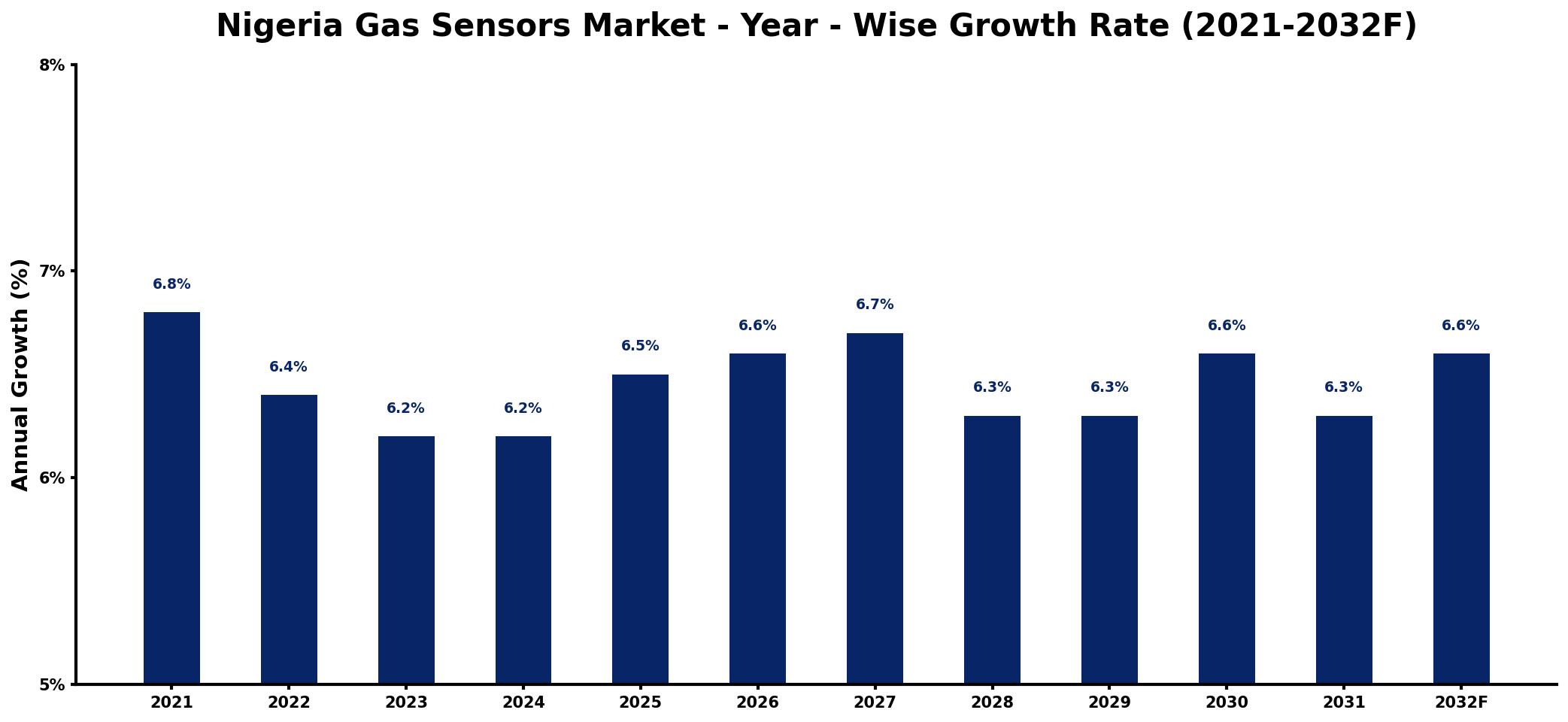
The table below presents the year‑wise growth rates along with the key drivers influencing the market
| Year | Growth Rate | Major Drivers |
| 2021 | 6.8% | Increased industrial safety regulations |
| 2022 | 6.4% | Growth in manufacturing sector demand |
| 2023 | 6.2% | Expansion of energy infrastructure projects |
| 2024 | 6.2% | Rising awareness of environmental concerns |
| 2025 | 6.5% | Investments in renewable energy solutions |
| 2026 | 6.6% | Technological advancements in monitoring |
| 2027 | 6.7% | stronger distribution network expansion |
| 2028 | 6.3% | Emerging markets driving new applications |
| 2029 | 6.3% | Increased urbanization and population growth |
| 2030 | 6.6% | Government incentives for safety upgrades |
| 2031 | 6.3% | Rising industrial automation trends |
| 2032 | 6.6% | Growing demand for smart technologies |
Note: Market size estimations and growth projections presented in this report are based on 6Wresearch's proprietary forecasting methodology, utilizing the latest available industry data, government publications, and primary research inputs.
Nigeria Gas Sensors Market Synopsis
The strongest force shaping the Nigeria Gas Sensors Market right now is the burgeoning industrialization across the country. This rapid development has necessitated the implementation of robust safety measures, including the deployment of gas sensors in workplaces to safeguard employee health and environmental integrity.
Furthermore, an increased emphasis on monitoring air quality has led to a wider adoption of gas sensors in diverse sectors such as automotive, healthcare, and environmental monitoring. As awareness about the dangers posed by toxic gases grows, so does the need for reliable sensing technologies.
Nigeria Gas Sensors Market Key Takeaways
- The market is driven by heightened safety regulations and air quality awareness across various sectors.
- Technological advancements, such as IoT-enabled sensors, are revolutionizing data monitoring capabilities.
- Investment opportunities are ripe in manufacturing, maintenance, and calibration services tailored for local needs.
- Government initiatives are actively promoting domestic gas sensor manufacturing and compliance with safety standards.
- Despite challenges, the market is on a steady growth trajectory, indicating robust future prospects.
Evaluation of Restraints in Nigeria Gas Sensors Market
Despite the promising growth, the Nigeria Gas Sensors Market is faced with several notable restraints. A significant barrier is the pervasive lack of awareness among potential end-users regarding the benefits of gas sensors. This is compounded by the presence of a large informal sector with limited access to advanced technologies. Moreover, challenges related to sensor quality and reliability further impede market expansion. Inconsistent governmental regulations, along with infrastructural limitations, create an environment that complicates the adoption of gas sensing technologies. Addressing these constraints will require strategic education initiatives and targeted technological advancements that resonate with local market needs.
Nigeria Gas Sensors Market Trends
A significant trend in the Nigeria Gas Sensors Market is the shift toward smart technologies, particularly IoT-enabled gas sensors that facilitate real-time monitoring and data analytics. This trend is enhancing operational efficiency and safety across industries. Additionally, the growing trend of sustainable practices is leading companies to seek solutions that not only ensure compliance with environmental regulations but also contribute to energy efficiency. The combination of these technological advancements with an increased focus on health and safety is driving the market towards more innovative and reliable sensing solutions.
Nigeria Gas Sensors Market Opportunities
Opportunities for growth in the Nigeria Gas Sensors Market are abundant, particularly as the industrial sector continues to expand. There is an increasing demand for sensors capable of detecting toxic and combustible gases across various applications, including oil and gas, manufacturing, and healthcare. Moreover, government initiatives that promote domestic production and compliance are paving the way for new investment avenues. Collaborating with local partners and government agencies can amplify the impact of these investments and help capture the increasing demand for efficient gas monitoring solutions.
Government Initiatives in the Nigeria Gas Sensors Market
The Nigerian government has implemented several initiatives to promote the gas sensors market, notably through the National Gas Policy, which aims to enhance domestic gas utilization. Compliance with local content requirements is emphasized by the Nigerian Content Development and Monitoring Board (NCDMB), fostering local production of gas sensors. Additionally, programs such as the Nigerian Gas Flare Commercialization Program work to minimize gas flaring and encourage investments in gas infrastructure. Such initiatives are designed to strengthen the market and boost the competitiveness of Nigeria's gas industry.
Future Insights of the Nigeria Gas Sensors Market
Looking forward to the period of 2026-2032, the Nigeria Gas Sensors Market is expected to continue on its growth path, propelled by ongoing industrialization and the enforcement of stringent environmental regulations. The demand for gas sensors will likely surge in key sectors such as oil & gas, manufacturing, and healthcare, with an increasing need for reliable detection of gas leaks. Moreover, advancements in sensor technology, including wireless connectivity and IoT integration, are set to enhance real-time monitoring capabilities. However, challenges regarding initial costs and the availability of skilled professionals for sensor maintenance could present hurdles. Overall, the market appears poised for significant development, presenting ample opportunities for innovation.
Nigeria Gas Sensors Market Latest Developments (2025 - 2026)
Recent developments in the Nigeria Gas Sensors Market indicate a strong push toward innovation and enhanced sensor capabilities. Companies are investing in research and development to create more effective gas detection solutions that align with the growing demands of industry standards. Partnerships between local manufacturers and international technology providers are becoming more common, facilitating knowledge transfer and technology enhancement. Additionally, there is an increasing focus on regulatory compliance, which is leading to the development of more tailored products that meet specific local requirements.
Nigeria Gas Sensors Market - Key Attractiveness of the Report
- 10 Years of Market Numbers
- Historical Data Starting from 2022 to 2025
- Base Year: 2025
- Forecast Data until 2032
- Key Performance Indicators Impacting the Market
- Major Upcoming Developments and Projects
Key Highlights of the Report:
- Nigeria Gas Sensors Market Outlook
- Market Size of Nigeria Gas Sensors Market, 2025
- Forecast of Nigeria Gas Sensors Market, 2032
- Historical Data and Forecast of Nigeria Gas Sensors Revenues & Volume for the Period 2022-2032F
- Nigeria Gas Sensors Market Trend Evolution
- Nigeria Gas Sensors Market Drivers and Challenges
- Nigeria Gas Sensors Price Trends
- Nigeria Gas Sensors Porter's Five Forces
- Nigeria Gas Sensors Industry Life Cycle
- Historical Data and Forecast of Nigeria Gas Sensors Market Revenues & Volume By Product for the Period 2022-2032F
- Historical Data and Forecast of Nigeria Gas Sensors Market Revenues & Volume By Hydrogen for the Period 2022-2032F
- Historical Data and Forecast of Nigeria Gas Sensors Market Revenues & Volume By Ammonia for the Period 2022-2032F
- Historical Data and Forecast of Nigeria Gas Sensors Market Revenues & Volume By Hydrogen Sulfide for the Period 2022-2032F
- Historical Data and Forecast of Nigeria Gas Sensors Market Revenues & Volume By Methyl Mercaptan Sensor for the Period 2022-2032F
- Historical Data and Forecast of Nigeria Gas Sensors Market Revenues & Volume By NOx Sensor for the Period 2022-2032F
- Historical Data and Forecast of Nigeria Gas Sensors Market Revenues & Volume By Carbon Monoxide Sensor for the Period 2022-2032F
- Historical Data and Forecast of Nigeria Gas Sensors Market Revenues & Volume By Carbon Dioxide Sensor for the Period 2022-2032F
- Historical Data and Forecast of Nigeria Hydrogen Gas Sensors Market Revenues & Volume By Oxygen/Lambda Sensor for the Period 2022-2032F
- Historical Data and Forecast of Nigeria Gas Sensors Market Revenues & Volume By Technology for the Period 2022-2032F
- Historical Data and Forecast of Nigeria Gas Sensors Market Revenues & Volume By Infrared for the Period 2022-2032F
- Historical Data and Forecast of Nigeria Gas Sensors Market Revenues & Volume By Catalytic for the Period 2022-2032F
- Historical Data and Forecast of Nigeria Gas Sensors Market Revenues & Volume By Photo-Ionization Detector for the Period 2022-2032F
- Historical Data and Forecast of Nigeria Gas Sensors Market Revenues & Volume By Solid State/MOS for the Period 2022-2032F
- Historical Data and Forecast of Nigeria Gas Sensors Market Revenues & Volume By Semiconductor for the Period 2022-2032F
- Historical Data and Forecast of Nigeria Gas Sensors Market Revenues & Volume By Electrochemical for the Period 2022-2032F
- Nigeria Gas Sensors Import Export Trade Statistics
- Market Opportunity Assessment By Product
- Market Opportunity Assessment By Technology
- Nigeria Gas Sensors Top Companies Market Share
- Nigeria Gas Sensors Competitive Benchmarking By Technical and Operational Parameters
- Nigeria Gas Sensors Company Profiles
- Nigeria Gas Sensors Key Strategic Recommendations






































