Nigeria Livestock Market Size, Share & Growth Rate
The Nigeria Livestock Market was estimated at USD 311 Million in 2025 and is projected to reach USD 417 Million by 2032, growing at a CAGR of 4.3% from 2026 to 2032. This growth trajectory is significantly fueled by the rising demand for protein-rich foods as the Nigerian population expands, coupled with increasing urbanization and changing dietary habits. Additionally, the government's initiatives aimed at modernizing the sector and enhancing productivity play a pivotal role in driving market expansion.
Nigeria Livestock Market Year-wise Growth Rate and Key Drivers
This graph highlights how the Nigeria Livestock Market has steadily grown over the years, supported by major growth factors.
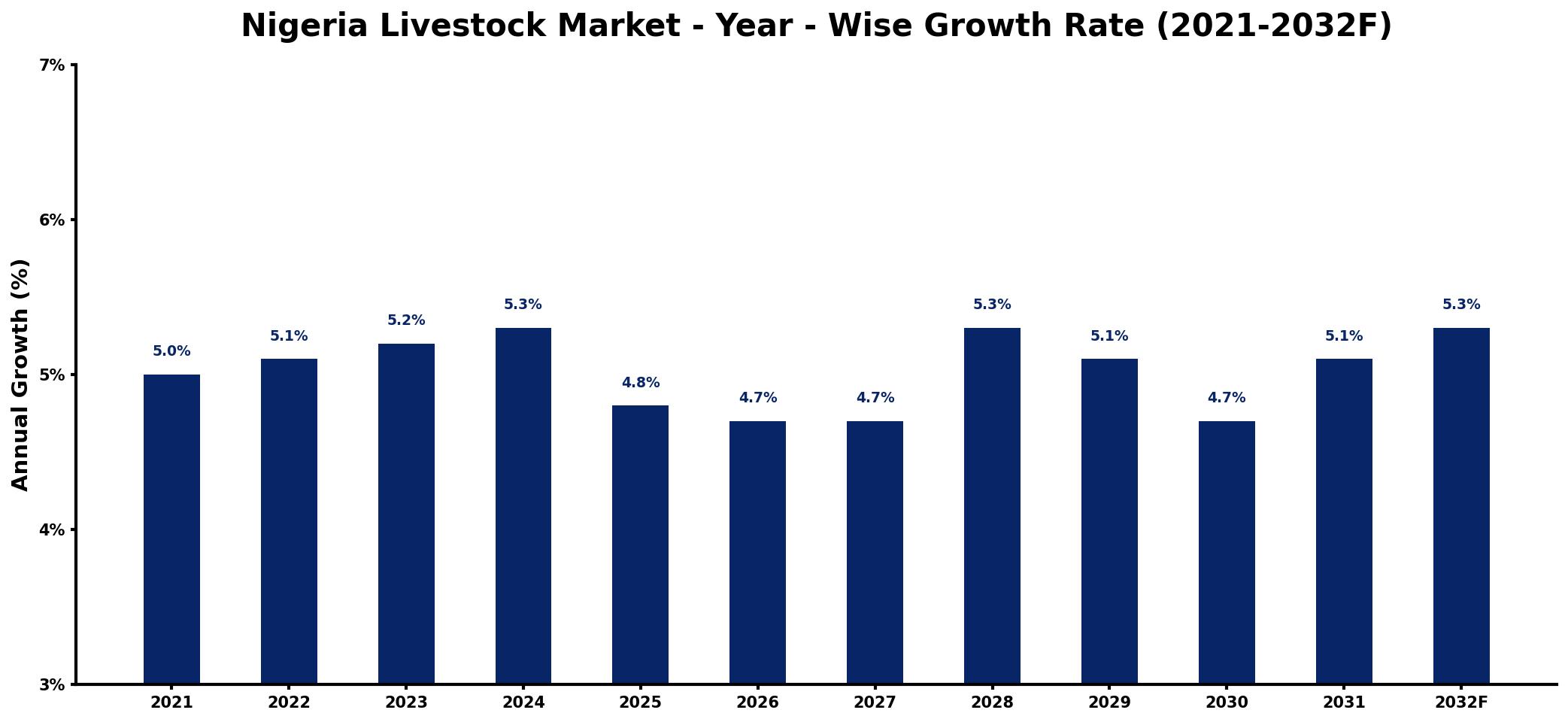
The table below presents the year‑wise growth rates along with the key drivers influencing the market
| Year | Growth Rate | Major Drivers |
| 2021 | 5.0% | Increase in consumer protein demand |
| 2022 | 5.1% | Rising investment in agriculture technology |
| 2023 | 5.2% | Expansion of rural farming initiatives |
| 2024 | 5.3% | Growing export opportunities for meat |
| 2025 | 4.8% | Shift towards sustainable farming practices |
| 2026 | 4.7% | Improved access to veterinary services |
| 2027 | 4.7% | Enhanced feed production capabilities |
| 2028 | 5.3% | Strengthened supply chain infrastructure |
| 2029 | 5.1% | Development of cooperative farming models |
| 2030 | 4.7% | Increased urbanization driving consumption |
| 2031 | 5.1% | Rising demand for organic products |
| 2032 | 5.3% | Boost in government agricultural funding |
Note: Market size estimations and growth projections presented in this report are based on 6Wresearch's proprietary forecasting methodology, utilizing the latest available industry data, government publications, and primary research inputs.
Nigeria Livestock Market Synopsis
The Nigeria Livestock Market is witnessing a transformative phase, where traditional farming practices are blending with modern techniques to boost productivity. This dynamic sector is not just about raising livestock; it encompasses the entire supply chain from production to processing and distribution, catering to an evolving consumer base.
Despite facing challenges, such as inadequate infrastructure and disease outbreaks, the market shows robust potential. A growing middle class is increasingly driving the demand for high-quality beef, poultry, and dairy products, encouraging investment and innovation within the industry.
Nigeria Livestock Market Key Takeaways
- The market is set for steady growth, influenced by population expansion and urbanization trends.
- Investment in modern farming techniques is gaining momentum, enhancing overall productivity.
- Consumer preferences are shifting towards organic and ethically sourced livestock products.
- Government initiatives aim to address infrastructure deficits and improve animal health services.
- Rising interest in value-added products provides new avenues for growth within the sector.
Evaluation of Restraints in Nigeria Livestock Market
Several constraints are currently limiting the full potential of the Nigeria Livestock Market. The lack of robust infrastructure, particularly in transportation and veterinary services, significantly hampers farmers' productivity. Many livestock producers face difficulties accessing timely healthcare for their animals, leading to higher mortality rates and reduced herd viability. Additionally, the variability in feed supply can impact livestock health and productivity. Such challenges, compounded by market inefficiencies and insufficient information systems, create a need for targeted interventions and investments to boost the industry's growth.
Nigeria Livestock Market Trends
A clear trend in the Nigeria Livestock Market is the increasing adoption of technology to optimize farming practices. Digital platforms for livestock management are becoming more prevalent, allowing farmers to better monitor animal health and streamline operations. Moreover, there is a rising consumer demand for organic and sustainably sourced products, pushing producers to adopt more ethical practices. The market is also witnessing growth in the processed meat and dairy segment, reflecting shifting consumer preferences for convenience and quality.
Nigeria Livestock Market Opportunities
Investment opportunities in the Nigeria Livestock Market are varied and promising. Investors can explore commercial livestock farming, focusing on raising cattle, poultry, goats, or pigs to meet the growing demand for protein sources. There's also significant potential in feed production and veterinary services, which are critical for enhancing livestock health. Furthermore, meat processing and packaging operations present lucrative opportunities to cater to the evolving tastes of consumers seeking processed food products.
Government Initiatives in the Nigeria Livestock Market
The Nigerian government is actively implementing policies to promote and regulate the livestock market. Initiatives such as the National Livestock Transformation Plan (NLTP) aim to modernize the industry through the establishment of production centers and improved grazing reserves. Furthermore, programs focusing on animal health and breed improvement are pivotal in enhancing productivity and ensuring food safety. By addressing various challenges, including herdsmen-farmers conflicts and food security concerns, the government aims to foster a sustainable livestock sector.
Future Insights of the Nigeria Livestock Market
Looking ahead to 2026-2032, the Nigeria Livestock Market is poised for significant growth, supported by factors such as population increase, urbanization, and rising disposable incomes. As dietary preferences continue to shift towards protein-rich options, the demand for livestock products is expected to surge. However, stakeholders must also remain vigilant regarding infrastructural improvements, disease management, and climate-related challenges to sustain this growth trajectory. By focusing on innovation and efficiency, the sector can adapt and thrive in a changing marketplace.
Nigeria Livestock Market Latest Developments (2025 - 2026)
Recent developments in the Nigeria Livestock Market indicate a robust shift towards modernization. Investments in veterinary health programs and feed supply chains have been prioritized to enhance livestock productivity. Additionally, several regions are witnessing the establishment of commercial farms that leverage new technologies in livestock management. These efforts reflect the market's response to growing consumer demands and the necessity for improved food security measures.
Nigeria Livestock Market - Key Attractiveness of the Report
- 10 Years of Market Numbers
- Historical Data Starting from 2022 to 2025
- Base Year: 2025
- Forecast Data until 2032
- Key Performance Indicators Impacting the Market
- Major Upcoming Developments and Projects
Key Highlights of the Report:
- Nigeria Livestock Market Outlook
- Market Size of Nigeria Livestock Market, 2025
- Forecast of Nigeria Livestock Market, 2032
- Historical Data and Forecast of Nigeria Livestock Revenues & Volume for the Period 2022-2032F
- Nigeria Livestock Market Trend Evolution
- Nigeria Livestock Market Drivers and Challenges
- Nigeria Livestock Price Trends
- Nigeria Livestock Porter's Five Forces
- Nigeria Livestock Industry Life Cycle
- Historical Data and Forecast of Nigeria Livestock Market Revenues & Volume By Animal Type for the Period 2022-2032F
- Historical Data and Forecast of Nigeria Livestock Market Revenues & Volume By Ruminants for the Period 2022-2032F
- Historical Data and Forecast of Nigeria Livestock Market Revenues & Volume By Poultry for the Period 2022-2032F
- Historical Data and Forecast of Nigeria Livestock Market Revenues & Volume By Swine for the Period 2022-2032F
- Historical Data and Forecast of Nigeria Livestock Market Revenues & Volume By Aquaculture for the Period 2022-2032F
- Nigeria Livestock Import Export Trade Statistics
- Market Opportunity Assessment By Animal Type
- Nigeria Livestock Top Companies Market Share
- Nigeria Livestock Competitive Benchmarking By Technical and Operational Parameters
- Nigeria Livestock Company Profiles
- Nigeria Livestock Key Strategic Recommendations






































