Nigeria Organic Cotton Market Size, Share & Growth Rate
The Nigeria Organic Cotton Market was estimated at USD 437 Million in 2025 and is projected to reach USD 615 Million by 2032, growing at a CAGR of 5.0% from 2026 to 2032. This growth trajectory is primarily fueled by an increasing consumer preference for sustainable textiles, as more people are becoming aware of the harmful effects of conventional cotton farming practices. Additionally, the engagement of smallholder farmers adopting organic practices plays a pivotal role, alongside supportive government initiatives aimed at fostering organic farming in Nigeria.
Nigeria Organic Cotton Market Year-wise Growth Rate and Key Drivers
This graph highlights how the Nigeria Organic Cotton Market has steadily grown over the years, supported by major growth factors.
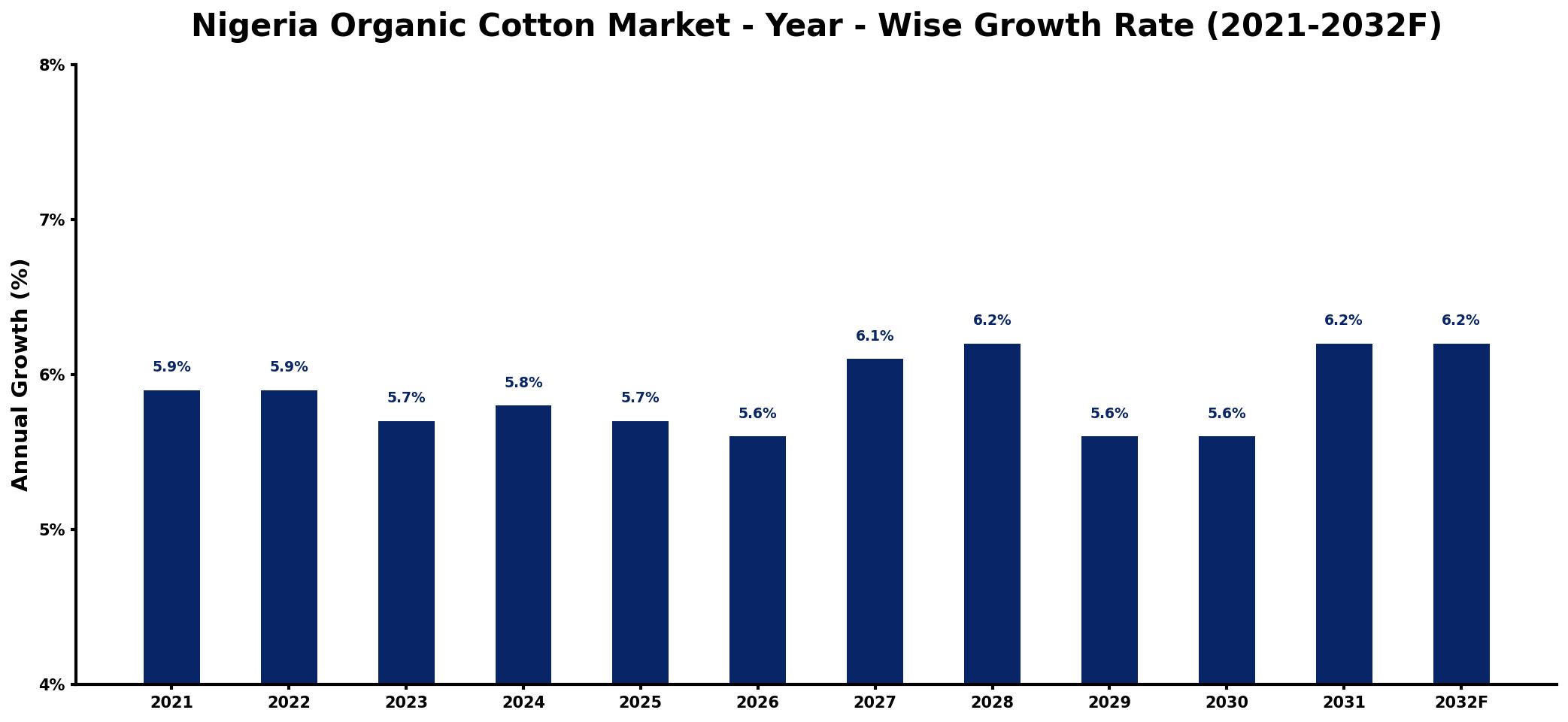
The table below presents the year‑wise growth rates along with the key drivers influencing the market
| Year | Growth Rate | Major Drivers |
| 2021 | 5.9% | Rising consumer sustainability awareness |
| 2022 | 5.9% | Increased investment in agriculture |
| 2023 | 5.7% | Growth in eco-friendly textiles market |
| 2024 | 5.8% | increased capital investment inflows |
| 2025 | 5.7% | Enhanced distribution network efficiency |
| 2026 | 5.6% | Government support for sustainable practices |
| 2027 | 6.1% | Surge in ethical fashion brands |
| 2028 | 6.2% | Higher demand for eco-conscious products |
| 2029 | 5.6% | Strengthening of local farming cooperatives |
| 2030 | 5.6% | Boost in international market access |
| 2031 | 6.2% | Emergence of innovative farming techniques |
| 2032 | 6.2% | Growing collaboration with NGOs |
Note: Market size estimations and growth projections presented in this report are based on 6Wresearch's proprietary forecasting methodology, utilizing the latest available industry data, government publications, and primary research inputs.
Nigeria Organic Cotton Market Synopsis
The Nigeria Organic Cotton Market has seen significant momentum in recent years, largely driven by heightened awareness among consumers about sustainability and ethical sourcing. Looking ahead, this momentum is poised to escalate as local farmers transition toward organic practices, aligning their output with both domestic and international sustainability targets.
As the market matures, it is becoming increasingly vital for stakeholders to address existing barriers such as limited consumer education and the complexities of organic certification. The trajectory appears favorable; however, it will require coordinated efforts from all sectors involved in the organic cotton value chain to ensure robust and sustainable growth.
Nigeria Organic Cotton Market Key Takeaways
- The market is experiencing a shift towards organic practices as awareness of sustainability grows among consumers.
- Smallholder farmers are at the forefront of organic cotton production, adapting practices to meet international standards.
- Government policies are increasingly supportive, facilitating the transition to organic farming through incentives and technical assistance.
- Challenges such as lack of infrastructure and market access must be navigated to fully capitalize on growth opportunities.
- The rise in certifications, like GOTS, is bolstering consumer confidence in organic cotton products.
Evaluation of Restraints in Nigeria Organic Cotton Market
Despite the potential for growth, several restraints hinder the full realization of the Nigeria Organic Cotton Market's capabilities. One significant barrier is the limited understanding of organic practices among both consumers and farmers, which creates a disconnect in market demand and supply. Additionally, the existing agricultural infrastructure is often inadequate for supporting organic farming, leading to challenges in production efficiency and market access. The complex and costly certification processes further dissuade farmers from transitioning, as these hurdles can deter investment and commitment in organic practices.
Nigeria Organic Cotton Market Trends
A noticeable trend in the Nigeria Organic Cotton Market is the increasing incorporation of organic cotton into the product lines of local textile manufacturers, reflecting a broader shift toward sustainability in the industry. Consumers are not just seeking eco-friendly products; they desire transparency within supply chains, pushing companies to adopt clearer practices. Moreover, the emphasis on certifications such as GOTS is expected to grow, providing consumers with assurance regarding the integrity of organic claims while fostering greater market confidence.
Nigeria Organic Cotton Market Opportunities
The opportunities for growth and investment within the Nigeria Organic Cotton Market are vast. With the global demand for sustainable textiles rising, there is a compelling case for investors to explore organic cotton farming, establish processing facilities, and develop value-added products such as organic clothing and home textiles. The market is well-positioned for expansion, and with a growing emphasis on ethical sourcing, producers can command premium pricing for their organic offerings. Additionally, supportive government initiatives surrounding organic farming are likely to bolster investment and growth within this sector.
Government Initiatives in the Nigeria Organic Cotton Market
The Nigerian government is actively supporting the organic cotton market through a range of policies aimed at promoting sustainable agricultural practices. The National Organic Agriculture Policy lays the groundwork for organic cotton cultivation and includes incentives such as subsidies and grants designed to encourage farmers to adopt organic methodologies. The Nigerian Export Promotion Council also plays a role by facilitating access for organic cotton producers to international markets, thereby enhancing their competitive edge. Collaborations with industry stakeholders are crucial for establishing quality standards, which further solidifies the market's framework for growth.
Future Insights of the Nigeria Organic Cotton Market
The outlook for the Nigeria Organic Cotton Market from 2026 to 2032 is optimistic, driven by the continuous rise in consumer demand for eco-friendly textiles. As awareness around the negative effects of conventional cotton farming intensifies, more consumers are gravitating towards organic alternatives. Nigerian farmers stand to gain significantly by expanding organic cotton production and embracing ethical practices that appeal to environmentally-conscious buyers. However, for the market to thrive fully, challenges such as the certification process and access to broader distribution channels will need to be strategically addressed to harness the full potential of this burgeoning sector.
Nigeria Organic Cotton Market Latest Developments (2025 - 2026)
Recent developments in the Nigeria Organic Cotton Market indicate a strengthening commitment from various stakeholders towards sustainable practices. Initiatives aimed at increasing farmer training programs and enhancing infrastructure to support organic production are underway. Additionally, there has been a rise in partnerships between local farmers and international brands focusing on sustainable sourcing, which is expected to further integrate organic cotton into the global supply chain. The positive engagement from government bodies also signals an ongoing dedication to nurturing the organic sector, paving the way for future advancements.
Nigeria Organic Cotton Market - Key Attractiveness of the Report
- 10 Years of Market Numbers
- Historical Data Starting from 2022 to 2025
- Base Year: 2025
- Forecast Data until 2032
- Key Performance Indicators Impacting the Market
- Major Upcoming Developments and Projects
Key Highlights of the Report:
- Nigeria Organic Cotton Market Outlook
- Market Size of Nigeria Organic Cotton Market, 2025
- Forecast of Nigeria Organic Cotton Market, 2032
- Historical Data and Forecast of Nigeria Organic Cotton Revenues & Volume for the Period 2022-2032F
- Nigeria Organic Cotton Market Trend Evolution
- Nigeria Organic Cotton Market Drivers and Challenges
- Nigeria Organic Cotton Price Trends
- Nigeria Organic Cotton Porter's Five Forces
- Nigeria Organic Cotton Industry Life Cycle
- Historical Data and Forecast of Nigeria Organic Cotton Market Revenues & Volume By Type for the Period 2022-2032F
- Historical Data and Forecast of Nigeria Organic Cotton Market Revenues & Volume By Long-Staple Cotton for the Period 2022-2032F
- Historical Data and Forecast of Nigeria Organic Cotton Market Revenues & Volume By Short-Staple Cotton for the Period 2022-2032F
- Historical Data and Forecast of Nigeria Organic Cotton Market Revenues & Volume By Middle Staple Cotton for the Period 2022-2032F
- Historical Data and Forecast of Nigeria Organic Cotton Market Revenues & Volume By Extra-long Staple Cotton for the Period 2022-2032F
- Historical Data and Forecast of Nigeria Organic Cotton Market Revenues & Volume By Others for the Period 2022-2032F
- Historical Data and Forecast of Nigeria Organic Cotton Market Revenues & Volume By Quality Type for the Period 2022-2032F
- Historical Data and Forecast of Nigeria Organic Cotton Market Revenues & Volume By Supima/Pima for the Period 2022-2032F
- Historical Data and Forecast of Nigeria Organic Cotton Market Revenues & Volume By Upland for the Period 2022-2032F
- Historical Data and Forecast of Nigeria Organic Cotton Market Revenues & Volume By Giza for the Period 2022-2032F
- Historical Data and Forecast of Nigeria Organic Cotton Market Revenues & Volume By Others for the Period 2022-2032F
- Historical Data and Forecast of Nigeria Organic Cotton Market Revenues & Volume By Application for the Period 2022-2032F
- Historical Data and Forecast of Nigeria Organic Cotton Market Revenues & Volume By Apparel for the Period 2022-2032F
- Historical Data and Forecast of Nigeria Organic Cotton Market Revenues & Volume By Packaging for the Period 2022-2032F
- Historical Data and Forecast of Nigeria Organic Cotton Market Revenues & Volume By Others for the Period 2022-2032F
- Nigeria Organic Cotton Import Export Trade Statistics
- Market Opportunity Assessment By Type
- Market Opportunity Assessment By Quality Type
- Market Opportunity Assessment By Application
- Nigeria Organic Cotton Top Companies Market Share
- Nigeria Organic Cotton Competitive Benchmarking By Technical and Operational Parameters
- Nigeria Organic Cotton Company Profiles
- Nigeria Organic Cotton Key Strategic Recommendations






































