Nigeria Paints & Varnishes Market Top 5 Importing Countries and Market Competition (HHI) Analysis
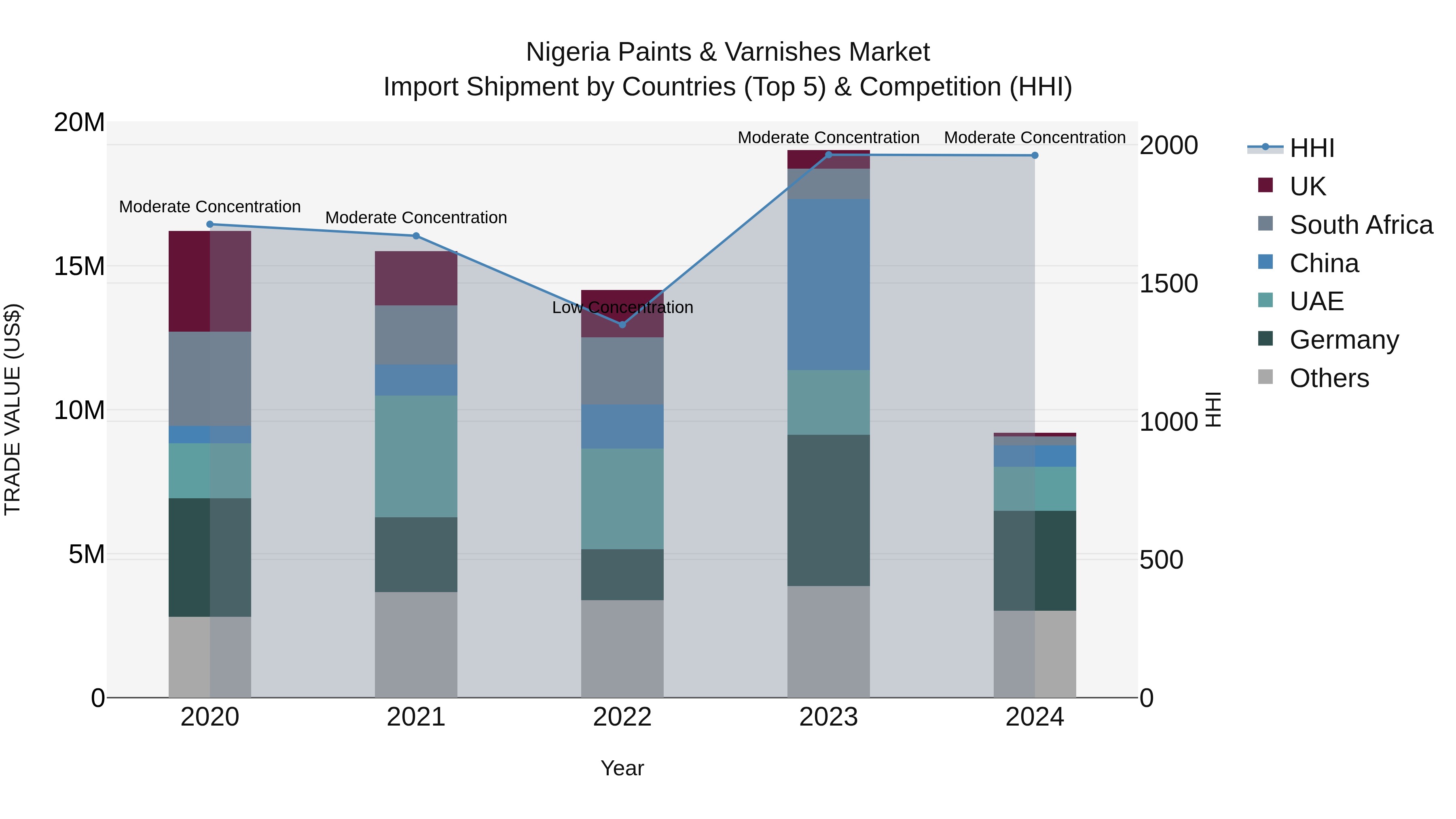
The Nigeria paints & varnishes import market saw a decline in 2024, with top exporting countries being Germany, UAE, Singapore, China, and India. Despite a moderate concentration level indicated by HHI, the industry experienced a negative Compound Annual Growth Rate (CAGR) of -13.19% from 2020 to 2024. The growth rate in 2024 further plummeted by -51.59% compared to the previous year, reflecting a challenging environment for importers in the sector. To navigate these challenges, stakeholders may need to reassess their strategies and adapt to changing market dynamics.
Nigeria Paints Varnishes Market Synopsis
The Nigeria paints and varnishes market is projected to be worth USD 1.3 billion by 2026, growing at a CAGR of 6.4% from 2020 to 2026. This growth can be attributed to the increasing population in Nigeria, rising levels of urbanization, an improved economy, and increased access to quality housing in the country. The need for decoration and protection against corrosion has also led to an increase in demand for paints and varnishes in Nigeria over the forecast period. Additionally, high disposable incomes among consumers have resulted in an inclination towards luxury products such as interior wall coatings with special effects like glittering pearl finishes or exotic textures that add value to living spaces. Furthermore, technological advancements are expected to continue driving product innovation across the industry verticals during the forecast period; thereby fostering growth opportunities within this sector over time.
Key Highlights of the Report:
- Nigeria Paints & varnishes Market Outlook
- Market Size of Nigeria Paints & varnishes Market, 2019
- Forecast of Nigeria Paints & varnishes Market, 2026
- Historical Data and Forecast of Nigeria Paints & varnishes Revenues & Volume for the Period 2016 - 2026
- Nigeria Paints & varnishes Market Trend Evolution
- Nigeria Paints & varnishes Market Drivers and Challenges
- Nigeria Paints & varnishes Price Trends
- Nigeria Paints & varnishes Porter's Five Forces
- Nigeria Paints & varnishes Industry Life Cycle
- Historical Data and Forecast of Nigeria Paints & varnishes Market Revenues & Volume By Type for the Period 2016 - 2026
- Historical Data and Forecast of Nigeria Paints & varnishes Market Revenues & Volume By Water-borne paints and varnishes for the Period 2016 - 2026
- Historical Data and Forecast of Nigeria Paints & varnishes Market Revenues & Volume By Solvent-borne paints and varnishes for the Period 2016 - 2026
- Historical Data and Forecast of Nigeria Paints & varnishes Market Revenues & Volume By Others for the Period 2016 - 2026
- Historical Data and Forecast of Nigeria Paints & varnishes Market Revenues & Volume By Applications for the Period 2016 - 2026
- Historical Data and Forecast of Nigeria Paints & varnishes Market Revenues & Volume By Transportations paints and varnishes for the Period 2016 - 2026
- Historical Data and Forecast of Nigeria Paints & varnishes Market Revenues & Volume By Industrial paints and varnishes for the Period 2016 - 2026
- Historical Data and Forecast of Nigeria Paints & varnishes Market Revenues & Volume By Construction paints and varnishes for the Period 2016 - 2026
- Nigeria Paints & varnishes Import Export Trade Statistics
- Market Opportunity Assessment By Type
- Market Opportunity Assessment By Applications
- Nigeria Paints & varnishes Top Companies Market Share
- Nigeria Paints & varnishes Competitive Benchmarking By Technical and Operational Parameters
- Nigeria Paints & varnishes Company Profiles
- Nigeria Paints & varnishes Key Strategic Recommendations






































