Nigeria Pharmaceutical Packaging Market Summary
The nigeria pharmaceutical packaging market was estimated at USD 349 Million in 2025 and is projected to reach USD 463 Million by 2032, growing at a CAGR of 5.0% from 2026 to 2032.
Nigeria Pharmaceutical Packaging Market Year-wise Growth Rate and Key Drivers
This graph highlights how the Nigeria Pharmaceutical Packaging Market has steadily grown over the past five years, supported by major growth factors.
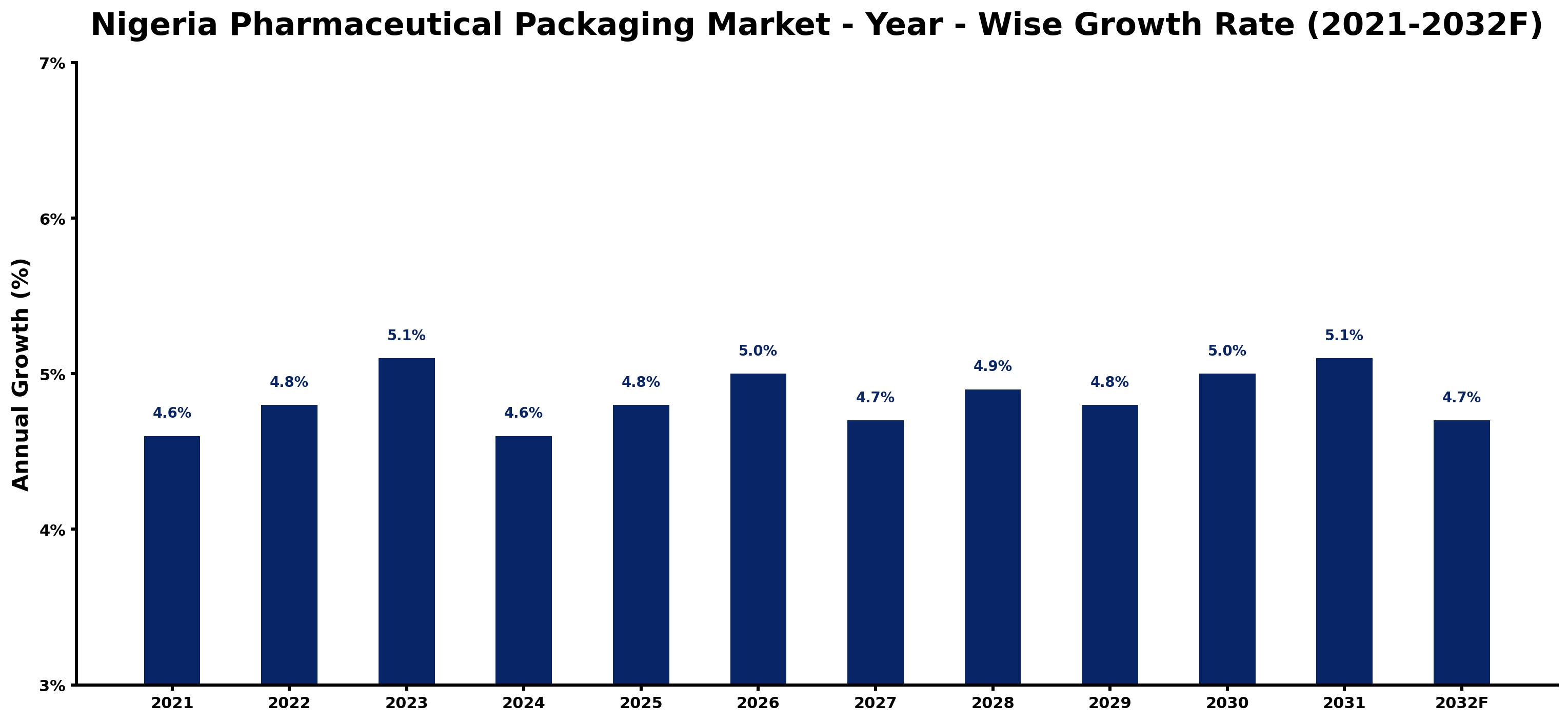
The table below presents the year wise growth rates along with the key drivers influencing the market
| Year | Growth Rate | Major Drivers |
| 2021 | 4.6% | Pharmaceutical manufacturers are increasingly focusing on sustainable packaging solutions for compliance. |
| 2022 | 4.8% | A surge in domestic production capabilities is enhancing local pharmaceutical packaging options. |
| 2023 | 5.1% | Emerging startups are innovating packaging technologies tailored specifically for Nigeria's unique needs. |
| 2024 | 4.6% | Partnerships between local firms and global players are boosting packaging technology knowledge transfer. |
| 2025 | 4.8% | Consumer awareness surrounding drug safety is pushing demand for advanced packaging solutions. |
| 2026 | 5.0% | Increased competition among pharmaceutical companies is driving innovation in packaging aesthetics. |
| 2027 | 4.7% | The expansion of e-commerce is creating a demand for durable and efficient packaging solutions. |
| 2028 | 4.9% | Technological advancements in smart packaging are becoming a key focus in market offerings. |
| 2029 | 4.8% | Rising urbanization is leading to changes in packaging requirements for urban-centric drug distribution. |
| 2030 | 5.0% | Investment in healthcare infrastructure is improving distribution channels for pharmaceutical packaging. |
| 2031 | 5.1% | Growing export opportunities for Nigerian pharmaceuticals are necessitating high-quality packaging standards. |
| 2032 | 4.7% | Focus on reducing environmental impact is shaping the future of pharmaceutical packaging design. |
Note - Market size estimations and growth projections presented in this report are based on 6Wresearch's advanced forecasting approach, validated with industry datasets as of June 2026.
Nigeria Pharmaceutical Packaging Market Synopsis
The Nigeria Pharmaceutical Packaging Market is projected to reach 5.0% and witness significant growth during the forecast period (2026-2032). This growth trajectory is primarily attributed to increased healthcare expenditure, a surging demand for pharmaceutical products, and a pronounced emphasis on enhancing packaging standards. The landscape of packaging materials is diverse, with glass, plastic, and metal being predominant, while a notable trend is emerging towards innovative and sustainable packaging solutions.
Nigeria Pharmaceutical Packaging Market Growth Drivers
Several factors are propelling the growth of the Nigeria Pharmaceutical Packaging Market. The following elements are particularly influential:
- The escalating healthcare costs have led to increased investments in the pharmaceutical sector, thereby boosting demand for advanced packaging solutions.
- There is a rising consumer awareness regarding product safety, resulting in heightened demands for tamper-evident and child-resistant packaging.
- Ongoing globalization is pushing local pharmaceutical companies to adhere to international packaging standards, further stimulating innovation in the packaging domain.
- A significant inclination towards environmentally friendly and recyclable materials is shaping consumer preferences and influencing market trends.
- Technological advances such as smart packaging options are gaining traction, ensuring product integrity and facilitating tracking to combat counterfeiting.
Nigeria Pharmaceutical Packaging Market Trends and Opportunities
The Nigeria Pharmaceutical Packaging Market is witnessing a slew of trends that illustrate both challenges and opportunities:
- There is a pronounced shift towards sustainable packaging solutions, as companies seek to minimize their environmental footprints while adhering to global sustainability initiatives.
- The demand for personalized packaging is on the rise, as pharmaceutical companies look to cater to the unique requirements of various products and consumer preferences.
- Smart packaging technologies, such as RFID tracking and temperature-sensitive materials, are being increasingly integrated to enhance product safety and consumer engagement.
- Packaging designs are evolving, focusing on aesthetics and functionality to improve user experience and compliance among patients.
- Collaborations and partnerships within the industry are fostering innovation, providing companies with a competitive edge and access to cutting-edge technologies.
Nigeria Pharmaceutical Packaging Market Challenges and Restraints
Despite its growth potential, the Nigeria Pharmaceutical Packaging Market is not devoid of challenges that could hinder progress:
- Counterfeit drugs remain a significant threat, leading to concerns over patient safety and eroding trust in the healthcare system.
- The absence of a rigorous regulatory framework creates inconsistencies, often resulting in varying quality standards across the packaging landscape.
- Infrastructure weaknesses, including inadequate power supply and inefficient transportation networks, complicate logistical operations for pharmaceutical companies.
- Lack of investment in technology hampers the ability to implement advanced traceability solutions that could enhance security and product authenticity.
- Market players face pressure to comply with evolving regulations, necessitating continuous adaptation to maintain compliance and market relevance.
Nigeria Pharmaceutical Packaging Market Investment Opportunities
The current landscape of the Nigeria Pharmaceutical Packaging Market is ripe for investment, with several lucrative opportunities emerging:
- Investors can tap into the increasing demand for high-quality packaging materials that meet both local and international standards.
- There exists significant potential for companies focusing on sustainable packaging solutions, aligning with global sustainability trends and consumer expectations.
- The need for innovation in packaging formats such as blister packs, bottles, and labels presents opportunities for new market entrants and existing players.
- Investment in smart packaging technologies can offer a competitive advantage by enhancing product integrity and ensuring adherence to regulatory requirements.
- As the pharmaceutical industry continues to expand, so does the opportunity for ventures that emphasize compliance and safety in packaging.
Nigeria Pharmaceutical Packaging Market Government Investment and Initiatives
The Nigerian government has taken proactive steps to fortify the pharmaceutical packaging market through various initiatives and regulatory frameworks:
- The National Agency for Food and Drug Administration and Control (NAFDAC) plays a crucial role in regulating packaging materials, ensuring safety and efficacy in pharmaceutical products.
- Guidelines for Good Manufacturing Practice (GMP) have been introduced to uphold quality standards for packaging materials, safeguarding against tampering.
- The government has implemented strict regulations aimed at curbing counterfeit drugs, thereby protecting public health and promoting confidence in the health sector.
- Public spending on healthcare infrastructure upgrades is essential for enhancing distribution networks, which directly impacts the pharmaceutical packaging sector.
- Incentives for companies that demonstrate adherence to regulatory standards are fostering a culture of compliance and innovation within the industry.
Nigeria Pharmaceutical Packaging Market Latest Developments (May 2025 - June 2026)
Recent developments in the Nigeria Pharmaceutical Packaging Market indicate a dynamic shift towards modernization and compliance:
- There has been a notable increase in the adoption of eco-friendly packaging materials, reflecting a growing commitment to sustainability among pharmaceutical firms.
- Technological advancements in packaging processes have enhanced operational efficiencies, leading to reduced production costs and enhanced product safety.
- Efforts to combat counterfeit drugs have intensified, with enhanced collaboration between government agencies and industry stakeholders to implement effective tracking systems.
- The market has seen an uptick in educational initiatives aimed at improving awareness around packaging regulations and the importance of compliance.
- New collaborations between local and international manufacturers are underway, aimed at leveraging global best practices in packaging innovations.
Nigeria Pharmaceutical Packaging Market - Key Attractiveness of the Report
- 10 Years of Market Numbers
- Historical Data Starting from 2022 to 2025
- Base Year: 2025
- Forecast Data until 2032
- Key Performance Indicators Impacting the Market
- Major Upcoming Developments and Projects
Key Highlights of the Report:
- Nigeria Pharmaceutical Packaging Market Outlook
- Market Size of Nigeria Pharmaceutical Packaging Market, 2025
- Forecast of Nigeria Pharmaceutical Packaging Market, 2032F
- Historical Data and Forecast of Nigeria Pharmaceutical Packaging Revenues & Volume for the Period 2022-2032F
- Nigeria Pharmaceutical Packaging Market Trend Evolution
- Nigeria Pharmaceutical Packaging Market Drivers and Challenges
- Nigeria Pharmaceutical Packaging Price Trends
- Nigeria Pharmaceutical Packaging Porter's Five Forces
- Nigeria Pharmaceutical Packaging Industry Life Cycle
- Historical Data and Forecast of Nigeria Pharmaceutical Packaging Market Revenues & Volume By Material Types for the Period 2022-2032F
- Historical Data and Forecast of Nigeria Pharmaceutical Packaging Market Revenues & Volume By Plastics & Polymers for the Period 2022-2032F
- Historical Data and Forecast of Nigeria Pharmaceutical Packaging Market Revenues & Volume By Paper & Paperboard for the Period 2022-2032F
- Historical Data and Forecast of Nigeria Pharmaceutical Packaging Market Revenues & Volume By Glass for the Period 2022-2032F
- Historical Data and Forecast of Nigeria Pharmaceutical Packaging Market Revenues & Volume By Aluminum Foil for the Period 2022-2032F
- Historical Data and Forecast of Nigeria Pharmaceutical Packaging Market Revenues & Volume By Others for the Period 2022-2032F
- Historical Data and Forecast of Nigeria Pharmaceutical Packaging Market Revenues & Volume By Product Types for the Period 2022-2032F
- Historical Data and Forecast of Nigeria Pharmaceutical Packaging Market Revenues & Volume By Primary Pharmaceutical Packaging for the Period 2022-2032F
- Historical Data and Forecast of Nigeria Pharmaceutical Packaging Market Revenues & Volume By Secondary Pharmaceutical Packaging for the Period 2022-2032F
- Historical Data and Forecast of Nigeria Pharmaceutical Packaging Market Revenues & Volume By Tertiary Pharmaceutical Packaging for the Period 2022-2032F
- Historical Data and Forecast of Nigeria Pharmaceutical Packaging Market Revenues & Volume By End-users for the Period 2022-2032F
- Historical Data and Forecast of Nigeria Pharmaceutical Packaging Market Revenues & Volume By Pharmaceutical Manufacturing for the Period 2022-2032F
- Historical Data and Forecast of Nigeria Pharmaceutical Packaging Market Revenues & Volume By Retail Pharmacy for the Period 2022-2032F
- Historical Data and Forecast of Nigeria Pharmaceutical Packaging Market Revenues & Volume By Contract Packaging for the Period 2022-2032F
- Historical Data and Forecast of Nigeria Pharmaceutical Packaging Market Revenues & Volume By Institutional Pharmacy for the Period 2022-2032F
- Historical Data and Forecast of Nigeria Pharmaceutical Packaging Market Revenues & Volume By Others for the Period 2022-2032F
- Nigeria Pharmaceutical Packaging Import Export Trade Statistics
- Market Opportunity Assessment By Material Types
- Market Opportunity Assessment By Product Types
- Market Opportunity Assessment By End-users
- Nigeria Pharmaceutical Packaging Top Companies Market Share
- Nigeria Pharmaceutical Packaging Competitive Benchmarking By Technical and Operational Parameters
- Nigeria Pharmaceutical Packaging Company Profiles
- Nigeria Pharmaceutical Packaging Key Strategic Recommendations






































