Nigeria Planting Equipment Market Size, Share & Growth Rate
The Nigeria Planting Equipment Market was estimated at USD 691 Million in 2025 and is projected to reach USD 991 Million by 2032, growing at a CAGR of 5.3% from 2026 to 2032. This growth is largely driven by the increasing shift towards mechanized farming practices, particularly among smallholder farmers. Government incentives and support initiatives are further enhancing the adoption of modern planting technologies, as farmers recognize the significant benefits of improved efficiency and higher crop yields.
Nigeria Planting Equipment Market Year-wise Growth Rate and Key Drivers
This graph highlights how the Nigeria Planting Equipment Market has steadily grown over the years, supported by major growth factors.
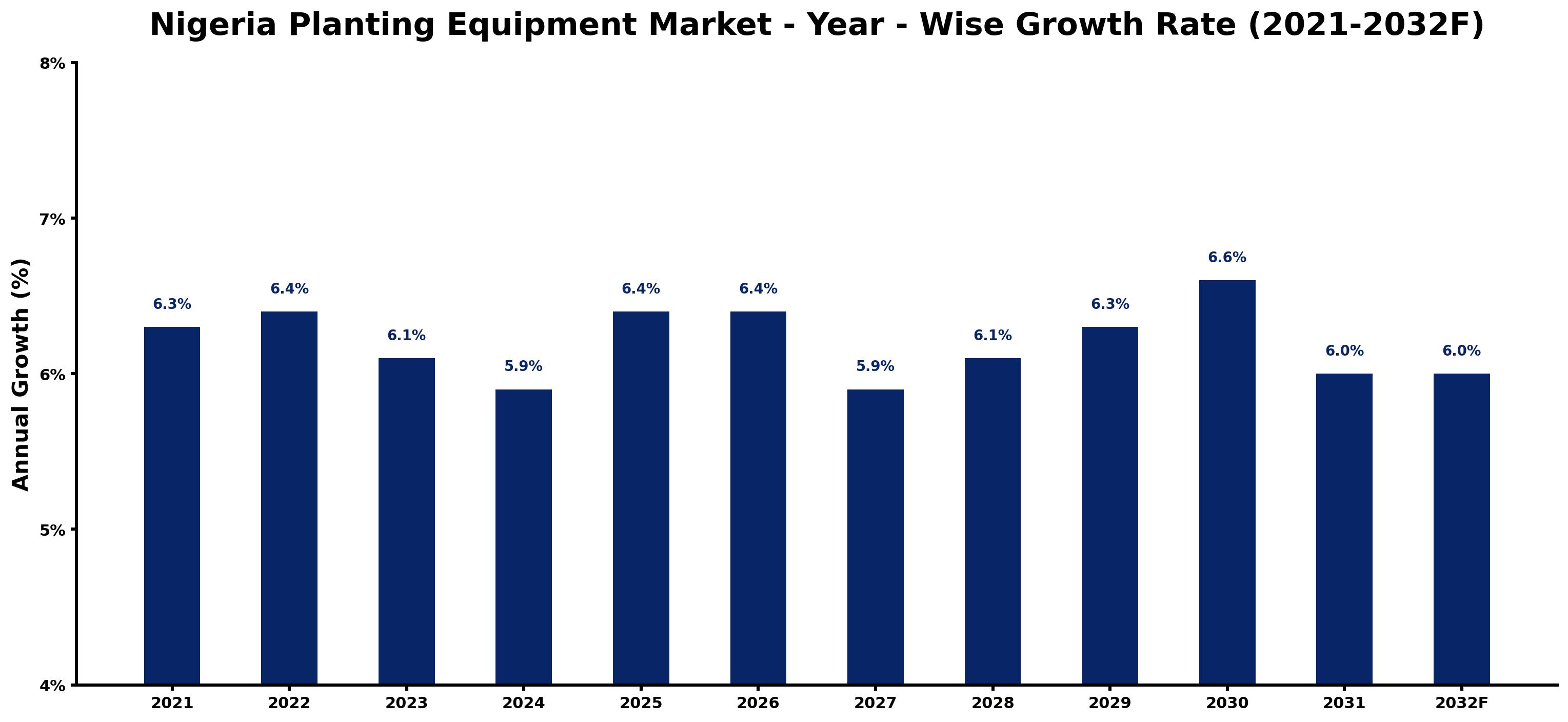
The table below presents the year‑wise growth rates along with the key drivers influencing the market
| Year | Growth Rate | Major Drivers |
| 2021 | 6.3% | Growing urbanization and commercial development |
| 2022 | 6.4% | Expansion of transportation and logistics networks |
| 2023 | 6.1% | Growing renewable energy integration projects |
| 2024 | 5.9% | Increasing industrial infrastructure investments |
| 2025 | 6.4% | Rapid growth in telecom and data center sectors |
| 2026 | 6.4% | Rapid growth in telecom and data center sectors |
| 2027 | 5.9% | Expansion of manufacturing activities |
| 2028 | 6.1% | Increasing industrial infrastructure investments |
| 2029 | 6.3% | Expansion of transportation and logistics networks |
| 2030 | 6.6% | Expansion of commercial construction activities |
| 2031 | 6.0% | Growing urbanization and commercial development |
| 2032 | 6.0% | Growing urbanization and commercial development |
Note - Market size estimations and growth projections presented in this report are based on 6Wresearch’s advanced forecasting approach, validated with industry datasets as of June 2026.
Nigeria Planting Equipment Market Synopsis
The demand for tractor-mounted planters and seed drills is surging in Nigeria, as farmers increasingly seek to enhance planting efficiency amidst rising labor costs. This transition to mechanization is motivated by the urgent need for higher productivity and better resource management in agriculture.
On the supply side, both local and international manufacturers are expanding their offerings to cater to diverse farming requirements. This includes a focus on innovative solutions tailored to varying scales of operations, addressing the unique challenges faced by farmers in Nigeria.
Nigeria Planting Equipment Market Key Takeaways
- Growing adoption of precision planting equipment is driving market demand.
- Government policies are facilitating access to modern planting machinery for farmers.
- Increasing availability of financing options is encouraging investment in planting technologies.
- Domestic and international manufacturers are diversifying product portfolios to meet local needs.
- The market is evolving to prioritize sustainability and efficiency in agricultural practices.
Evaluation of Restraints in Nigeria Planting Equipment Market
Despite the promising growth trajectory, the Nigeria Planting Equipment Market faces significant challenges. Access to affordable, high-quality planting equipment remains a critical issue for smallholder farmers, often limiting their productivity. Coupled with inadequate maintenance and repair services, these factors lead to equipment breakdowns that can severely impact farming operations. Furthermore, the lack of accessible financing options constrains farmers' ability to invest in advanced technologies, while a shortage of skilled technicians hampers effective use and maintenance of the machinery.
Nigeria Planting Equipment Market Trends
A notable trend in the Nigeria Planting Equipment Market is the increasing integration of technology into agricultural practices. Farmers are now gravitating towards advanced planting machinery, including seed drills and fertilizer spreaders designed for precision agriculture. This shift not only addresses labor shortages but also optimizes seed placement and reduces input costs, enhancing overall farm management. Additionally, as awareness of these benefits grows, there is a marked increase in demand for equipment that supports sustainable farming practices.
Nigeria Planting Equipment Market Opportunities
The Nigeria Planting Equipment Market is rich with investment opportunities, particularly in the distribution of advanced planting technologies. As smallholder farmers seek to mechanize their operations, there is a clear demand for high-quality, efficient planting equipment. Collaborations between local manufacturers and international brands can further enhance product offerings, driving innovation tailored specifically to the Nigerian agricultural landscape. Moreover, financing solutions that enable farmers to invest in these technologies will further catalyze market growth.
Government Initiatives in the Nigeria Planting Equipment Market
The Nigerian government has enacted several policies to bolster the planting equipment market, emphasizing agricultural mechanization. Programs like the Agricultural Transformation Agenda (ATA) are designed to provide farmers with subsidies and incentives to access modern planting equipment. Additionally, the Growth Enhancement Support Scheme (GESS) is focused on improving access to agricultural inputs for smallholder farmers, demonstrating the government's commitment to enhancing productivity and food security through mechanization.
Future Insights of the Nigeria Planting Equipment Market
Looking ahead to 2026-2032, the Nigeria Planting Equipment Market is poised for steady expansion, driven by a growing emphasis on mechanization and governmental initiatives aimed at improving agricultural productivity. The expected increase in demand for advanced planting technologies, coupled with technological innovations in precision agriculture, suggests a robust growth environment. However, challenges such as initial investment costs and financing accessibility may temper growth rates, underscoring the need for ongoing intervention and support in the sector.
Nigeria Planting Equipment Market Latest Developments (May 2025 - June 2026)
In recent months, the Nigeria Planting Equipment Market has seen a notable uptick in the introduction of innovative technologies aimed at enhancing agricultural efficiency. Many manufacturers are focusing on integrating smart technology into planting equipment, offering solutions that provide real-time data on planting conditions. Concurrently, various initiatives aimed at increasing the availability of financing options for farmers are being launched, thereby facilitating greater adoption of mechanized farming practices across the country.
Nigeria Planting Equipment Market - Key Attractiveness of the Report
- 10 Years of Market Numbers
- Historical Data Starting from 2022 to 2025
- Base Year: 2025
- Forecast Data until 2032
- Key Performance Indicators Impacting the Market
- Major Upcoming Developments and Projects
Key Highlights of the Report:
- Nigeria Planting Equipment Market Outlook
- Market Size of Nigeria Planting Equipment Market, 2025
- Forecast of Nigeria Planting Equipment Market, 2032
- Historical Data and Forecast of Nigeria Planting Equipment Revenues & Volume for the Period 2022-2032F
- Nigeria Planting Equipment Market Trend Evolution
- Nigeria Planting Equipment Market Drivers and Challenges
- Nigeria Planting Equipment Price Trends
- Nigeria Planting Equipment Porter's Five Forces
- Nigeria Planting Equipment Industry Life Cycle
- Historical Data and Forecast of Nigeria Planting Equipment Market Revenues & Volume By Type for the Period 2022-2032F
- Historical Data and Forecast of Nigeria Planting Equipment Market Revenues & Volume By Air seeders for the Period 2022-2032F
- Historical Data and Forecast of Nigeria Planting Equipment Market Revenues & Volume By Seed drills for the Period 2022-2032F
- Historical Data and Forecast of Nigeria Planting Equipment Market Revenues & Volume By Planters for the Period 2022-2032F
- Historical Data and Forecast of Nigeria Planting Equipment Market Revenues & Volume By Others for the Period 2022-2032F
- Historical Data and Forecast of Nigeria Planting Equipment Market Revenues & Volume By Design for the Period 2022-2032F
- Historical Data and Forecast of Nigeria Planting Equipment Market Revenues & Volume By Mechanical for the Period 2022-2032F
- Historical Data and Forecast of Nigeria Planting Equipment Market Revenues & Volume By Automatic for the Period 2022-2032F
- Historical Data and Forecast of Nigeria Planting Equipment Market Revenues & Volume By Crop Type for the Period 2022-2032F
- Historical Data and Forecast of Nigeria Planting Equipment Market Revenues & Volume By Cereals & grains for the Period 2022-2032F
- Historical Data and Forecast of Nigeria Planting Equipment Market Revenues & Volume By Oilseeds & pulses for the Period 2022-2032F
- Historical Data and Forecast of Nigeria Planting Equipment Market Revenues & Volume By Fruits & vegetables for the Period 2022-2032F
- Historical Data and Forecast of Nigeria Planting Equipment Market Revenues & Volume By Others for the Period 2022-2032F
- Nigeria Planting Equipment Import Export Trade Statistics
- Market Opportunity Assessment By Type
- Market Opportunity Assessment By Design
- Market Opportunity Assessment By Crop Type
- Nigeria Planting Equipment Top Companies Market Share
- Nigeria Planting Equipment Competitive Benchmarking By Technical and Operational Parameters
- Nigeria Planting Equipment Company Profiles
- Nigeria Planting Equipment Key Strategic Recommendations






































