Nigeria Ploughing and Cultivating Machinery Market Size, Share & Growth Rate
The Nigeria Ploughing and Cultivating Machinery Market was estimated at USD 1271 Million in 2025 and is projected to reach USD 1814 Million by 2032, growing at a CAGR of 5.2% from 2026 to 2032. This anticipated growth is primarily driven by the ongoing modernization of the agricultural sector, characterized by a rapid transition toward mechanized farming. Furthermore, increased government support and a rising awareness of sustainable farming practices are expected to further propel market demand.
Nigeria Ploughing and Cultivating Machinery Market Year-wise Growth Rate and Key Drivers
This graph highlights how the Nigeria Ploughing and Cultivating Machinery Market has steadily grown over the years, supported by major growth factors.
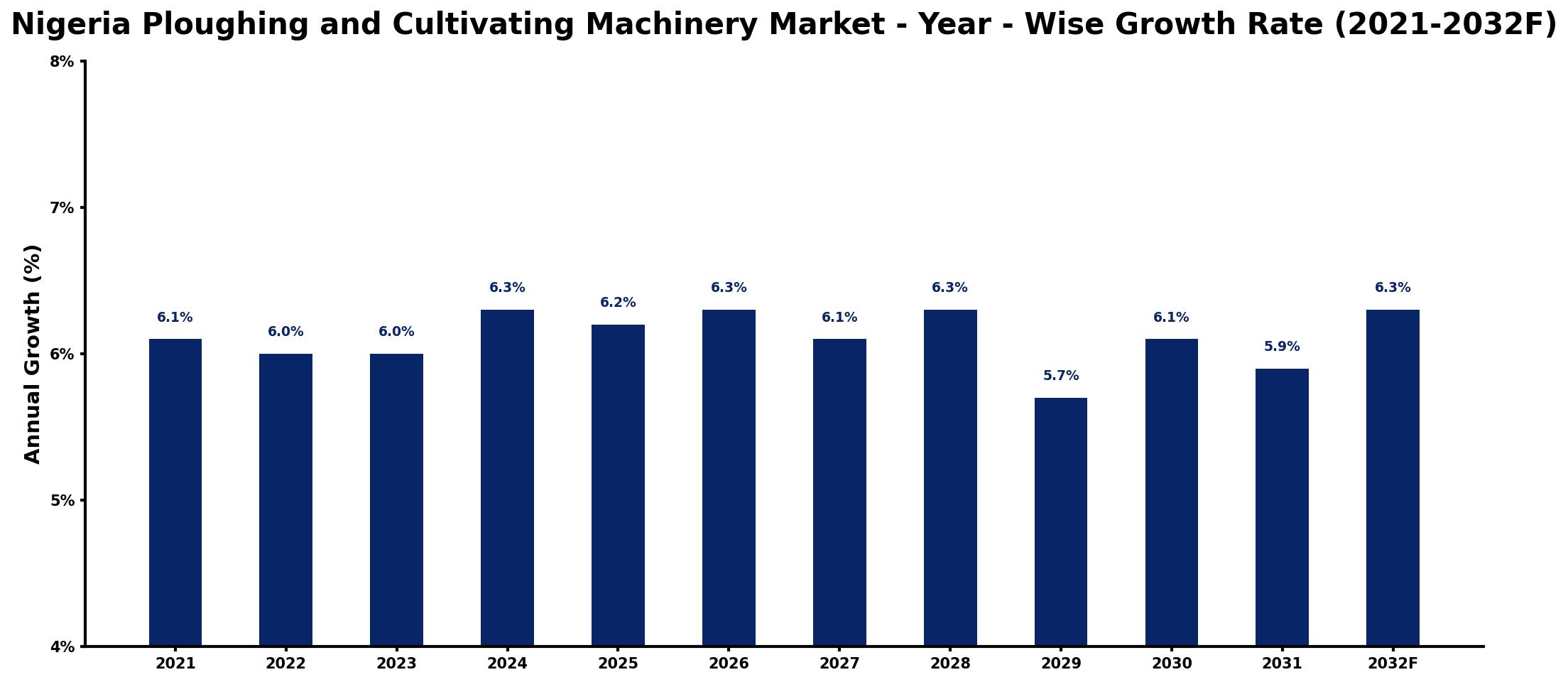
The table below presents the year‑wise growth rates along with the key drivers influencing the market
| Year | Growth Rate | Major Drivers |
| 2021 | 6.1% | Rising agricultural investment levels |
| 2022 | 6.0% | Increased demand for mechanization |
| 2023 | 6.0% | Expanding rural infrastructure projects |
| 2024 | 6.3% | Growth in export opportunities |
| 2025 | 6.2% | enhanced product quality standards |
| 2026 | 6.3% | Government support for modernization |
| 2027 | 6.1% | Surge in agribusiness initiatives |
| 2028 | 6.3% | Increased access to financing options |
| 2029 | 5.7% | Emerging market diversification trends |
| 2030 | 6.1% | Growing awareness of efficiency |
| 2031 | 5.9% | Rising population food demands |
| 2032 | 6.3% | Strengthening agricultural research partnerships |
Note: Market size estimations and growth projections presented in this report are based on 6Wresearch's proprietary forecasting methodology, utilizing the latest available industry data, government publications, and primary research inputs.
Nigeria Ploughing and Cultivating Machinery Market Synopsis
The market for ploughing and cultivating machinery in Nigeria has gained significant momentum in recent years, reflecting a strong commitment to enhancing agricultural productivity. As smallholder farmers increasingly adopt advanced machinery, the landscape of agriculture in Nigeria is evolving to meet both local and global food demands.
Looking ahead, the market is poised for transformative growth, spurred by technological advancements and a shift towards eco-friendly farming equipment. The emphasis on improving food security through mechanization is becoming crucial as Nigeria's population continues to grow, creating a clear pathway for the future development of this market.
Nigeria Ploughing and Cultivating Machinery Market Key Takeaways
- The market is driven by rising mechanization and government initiatives aimed at modernizing agriculture.
- Investments in sustainable machinery solutions are increasing as farmers recognize the importance of eco-friendly practices.
- Precision farming technologies are gaining traction, optimizing resource usage and enhancing crop yields.
- High costs and limited access to financing remain significant barriers for small-scale farmers.
- Future growth opportunities are promising, particularly for technology-based agricultural solutions.
Evaluation of Restraints in Nigeria Ploughing and Cultivating Machinery Market
While the Nigeria Ploughing and Cultivating Machinery Market shows robust growth potential, several restraints inhibit broader adoption. One of the primary challenges is the substantial upfront investment required for modern machinery, which many small-scale farmers cannot afford. Furthermore, the limited access to credit options constrains their ability to finance these essential upgrades. Logistical hurdles due to inadequate infrastructure, especially in rural areas, complicate transportation and maintenance, thereby discouraging investment in advanced agricultural equipment.
Nigeria Ploughing and Cultivating Machinery Market Trends
The prevailing trends in the Nigeria Ploughing and Cultivating Machinery Market revolve around increased mechanization and technological adoption. Farmers are progressively shifting towards modern farming techniques, recognizing the efficiency gains from machinery such as tractors and automated ploughing systems. Notably, there's a heightened focus on sustainable agricultural practices, with an increasing demand for equipment designed to minimize environmental impact. Additionally, the incorporation of precision farming techniques is helping farmers optimize inputs, making their operations both more efficient and productive.
Nigeria Ploughing and Cultivating Machinery Market Opportunities
The Nigeria Ploughing and Cultivating Machinery Market holds significant investment opportunities, especially as the country seeks to modernize its agricultural practices. Manufacturers and suppliers can capitalize on the demand for efficient ploughing and cultivating machinery. Furthermore, theres potential for growth in providing ancillary services such as maintenance and repair. Embracing innovative technology, particularly in precision farming and smart machinery, will enable investors to meet the evolving needs of farmers. Partnerships with local cooperatives and government initiatives will also facilitate market entry and expansion.
Government Initiatives in the Nigeria Ploughing and Cultivating Machinery Market
The Nigerian government has undertaken several initiatives to bolster the Ploughing and Cultivating Machinery Market. Policies designed to reduce import tariffs on agricultural machinery promote local production, thereby decreasing reliance on foreign imports. Subsidies have been introduced to enhance affordability for farmers, facilitating greater access to modern machinery. Additionally, government programs offer essential training and technical support, ensuring that farmers are equipped with the necessary skills to utilize and maintain their equipment effectively. These strategic policies aim to elevate agricultural productivity and contribute to national food security.
Future Insights of the Nigeria Ploughing and Cultivating Machinery Market
Looking forward to 2026-2032, the Nigeria Ploughing and Cultivating Machinery Market is set to experience continued growth driven by the ongoing mechanization of agriculture. The push for enhanced productivity in response to food security needs will likely drive demand for innovative ploughing and cultivating machinery. Government initiatives promoting mechanization will remain pivotal, alongside an increasing trend towards commercial farming. Technological innovations, particularly in precision agriculture and smart farming, will shape the future landscape of this market, ensuring that it remains relevant and responsive to the challenges faced by Nigerian farmers.
Nigeria Ploughing and Cultivating Machinery Market Latest Developments (2025 - 2026)
Recent developments within the Nigeria Ploughing and Cultivating Machinery Market indicate a robust focus on sustainability and technological integration. There has been a noticeable uptick in the introduction of eco-friendly machinery aimed at reducing the environmental impact of farming practices. Furthermore, various stakeholders are collaborating to enhance training programs for farmers, ensuring they are well-equipped to utilize modern technologies effectively. This commitment to education is essential for promoting widespread adoption of advanced agricultural machinery across the country.
Nigeria Ploughing and Cultivating Machinery Market - Key Attractiveness of the Report
- 10 Years of Market Numbers
- Historical Data Starting from 2022 to 2025
- Base Year: 2025
- Forecast Data until 2032
- Key Performance Indicators Impacting the Market
- Major Upcoming Developments and Projects
Key Highlights of the Report:
- Nigeria Ploughing and Cultivating Machinery Market Outlook
- Market Size of Nigeria Ploughing and Cultivating Machinery Market, 2025
- Forecast of Nigeria Ploughing and Cultivating Machinery Market, 2032
- Historical Data and Forecast of Nigeria Ploughing and Cultivating Machinery Revenues & Volume for the Period 2022-2032F
- Nigeria Ploughing and Cultivating Machinery Market Trend Evolution
- Nigeria Ploughing and Cultivating Machinery Market Drivers and Challenges
- Nigeria Ploughing and Cultivating Machinery Price Trends
- Nigeria Ploughing and Cultivating Machinery Porter's Five Forces
- Nigeria Ploughing and Cultivating Machinery Industry Life Cycle
- Historical Data and Forecast of Nigeria Ploughing and Cultivating Machinery Market Revenues & Volume By Type for the Period 2022-2032F
- Historical Data and Forecast of Nigeria Ploughing and Cultivating Machinery Market Revenues & Volume By Ploughs for the Period 2022-2032F
- Historical Data and Forecast of Nigeria Ploughing and Cultivating Machinery Market Revenues & Volume By Harrows for the Period 2022-2032F
- Historical Data and Forecast of Nigeria Ploughing and Cultivating Machinery Market Revenues & Volume By Others for the Period 2022-2032F
- Historical Data and Forecast of Nigeria Ploughing and Cultivating Machinery Market Revenues & Volume By Application for the Period 2022-2032F
- Historical Data and Forecast of Nigeria Ploughing and Cultivating Machinery Market Revenues & Volume By Soil Loosening for the Period 2022-2032F
- Historical Data and Forecast of Nigeria Ploughing and Cultivating Machinery Market Revenues & Volume By Clod Size Reduction for the Period 2022-2032F
- Historical Data and Forecast of Nigeria Ploughing and Cultivating Machinery Market Revenues & Volume By Clod Sorting for the Period 2022-2032F
- Historical Data and Forecast of Nigeria Ploughing and Cultivating Machinery Market Revenues & Volume By Others for the Period 2022-2032F
- Nigeria Ploughing and Cultivating Machinery Import Export Trade Statistics
- Market Opportunity Assessment By Type
- Market Opportunity Assessment By Application
- Nigeria Ploughing and Cultivating Machinery Top Companies Market Share
- Nigeria Ploughing and Cultivating Machinery Competitive Benchmarking By Technical and Operational Parameters
- Nigeria Ploughing and Cultivating Machinery Company Profiles
- Nigeria Ploughing and Cultivating Machinery Key Strategic Recommendations






































