Nigeria Real Estate Market Size, Share & Growth Rate
The Nigeria Real Estate Market was estimated at USD 332 Million in 2025 and is projected to reach USD 442 Million by 2032, growing at a CAGR of 4.2% from 2026 to 2032. This upward trajectory is fueled by rapid urbanization, an increasing population, and a burgeoning middle class eager for improved living conditions and commercial spaces. As Nigeria continues to develop its infrastructure and attract foreign investment, the demand for both residential and commercial properties remains robust, creating a vibrant market landscape.
Nigeria Real Estate Market Year-wise Growth Rate and Key Drivers
This graph highlights how the Nigeria Real Estate Market has steadily grown over the years, supported by major growth factors.
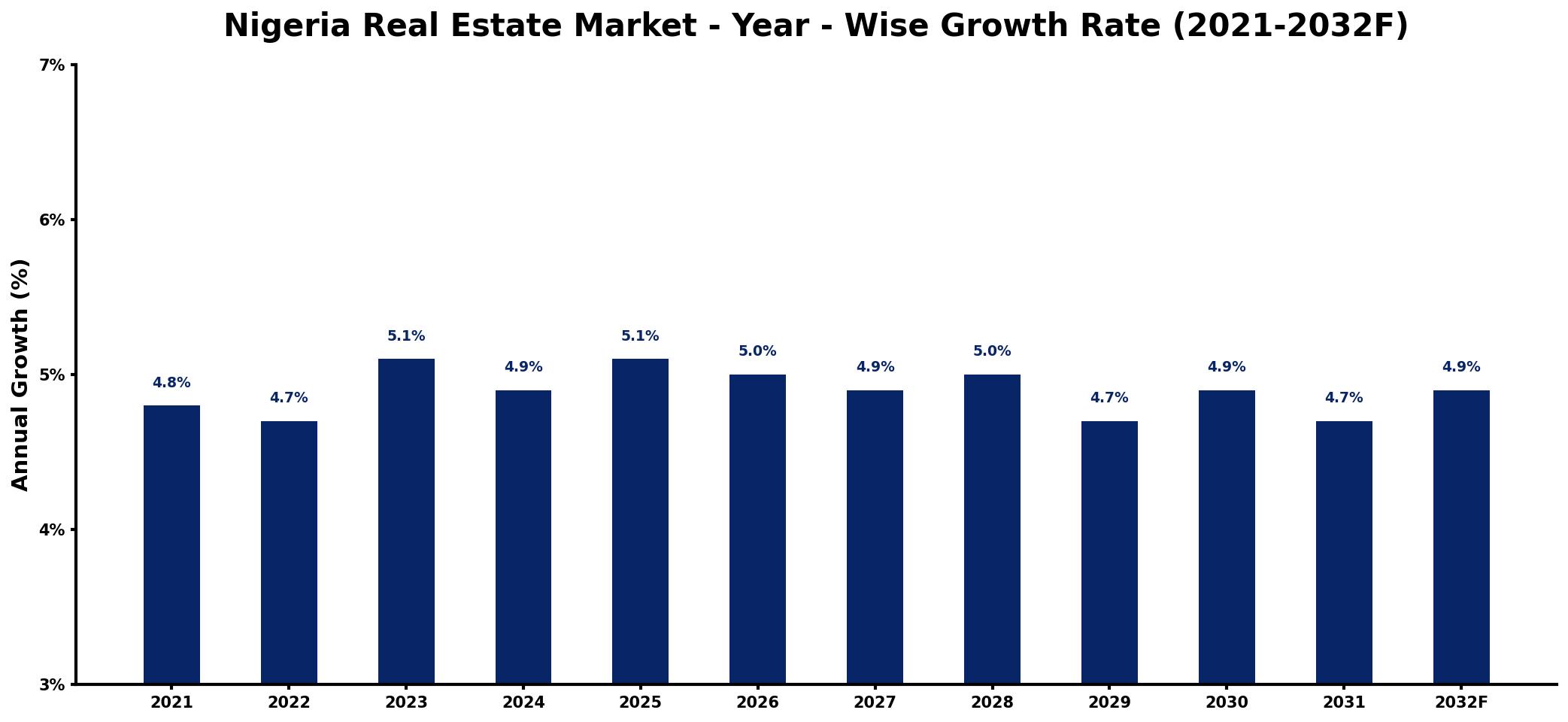
The table below presents the year‑wise growth rates along with the key drivers influencing the market
| Year | Growth Rate | Major Drivers |
| 2021 | 4.8% | Increased foreign investment interest |
| 2022 | 4.7% | Growing urban population demand |
| 2023 | 5.1% | Rising infrastructure development projects |
| 2024 | 4.9% | Expansion of mortgage financing options |
| 2025 | 5.1% | Boost in commercial property demand |
| 2026 | 5.0% | Surge in residential construction activities |
| 2027 | 4.9% | Increased rental market opportunities |
| 2028 | 5.0% | Growth in luxury housing segment |
| 2029 | 4.7% | Rising demand for affordable housing |
| 2030 | 4.9% | enhanced product quality standards |
| 2031 | 4.7% | Increase in property technology adoption |
| 2032 | 4.9% | growing automotive sector requirements |
Note: Market size estimations and growth projections presented in this report are based on 6Wresearch's proprietary forecasting methodology, utilizing the latest available industry data, government publications, and primary research inputs.
Nigeria Real Estate Market Synopsis
Urbanization stands as the most potent force shaping the Nigeria Real Estate Market today. With a substantial segment of the population migrating to urban centers like Lagos and Abuja, the demand for housing and commercial properties is surging, leading to significant price appreciation in prime locales.
Additionally, the rising middle class is redefining consumer preferences, pushing for affordable yet quality housing solutions. Concurrently, there is an increasing inclination towards sustainable construction practices, as developers and buyers alike prioritize eco-friendliness and energy efficiency.
Nigeria Real Estate Market Key Takeaways
- The Nigeria Real Estate Market is set for steady growth driven by urbanization and a growing middle class.
- There is a significant demand for affordable housing solutions, especially in urban areas.
- Developers are increasingly adopting sustainable and energy-efficient construction practices.
- The government is implementing reforms aimed at enhancing market transparency and attracting investments.
- Investment opportunities abound in residential, commercial, and development projects across the nation.
Evaluation of Restraints in Nigeria Real Estate Market
Despite its promising outlook, the Nigeria Real Estate Market is held back by several significant restraints. Inadequate infrastructure remains a primary concern, impacting the overall cost and feasibility of development projects. Furthermore, inconsistent government policies and bureaucratic procedures can complicate transactions and deter potential investors. Access to financing is another critical issue, with many developers and buyers facing challenges securing funding. These factors combine to create a complex operating environment that necessitates careful navigation and strategic planning.
Nigeria Real Estate Market Trends
A notable trend in the Nigeria Real Estate Market is the growing demand for affordable housing, particularly among the urban middle class. As the population expands and disposable incomes rise, there is an evident shift towards properties that are both economically accessible and of high quality. The commercial sector is also thriving, with increased demand for office and retail spaces in major cities. Moreover, the adoption of sustainable building practices is becoming more prevalent, reflecting a broader global emphasis on environmental responsibility.
Nigeria Real Estate Market Opportunities
Opportunities for growth within the Nigeria Real Estate Market are abundant. The ongoing urbanization and population growth create a continuous demand for both residential and commercial properties. Investors may find lucrative prospects in affordable housing developments, as well as high-quality retail spaces catering to an emerging consumer base. Furthermore, government initiatives focused on infrastructure development are expected to bolster the market's attractiveness, providing a fertile ground for innovative real estate projects and investments.
Government Initiatives in the Nigeria Real Estate Market
The Nigerian government has rolled out various initiatives to stimulate the real estate market. Key among these is the National Housing Fund Act, which promotes affordable housing through mandatory contributions from employers and employees. The Land Use Act governs land ownership and transactions, aiming to streamline property acquisition. The Mortgage Refinance Company (NMRC) facilitates liquidity for mortgage lenders, thereby improving access to financing for potential homeowners. Such policies reflect a commitment to addressing housing deficits and enhancing the overall investment climate in the real estate sector.
Future Insights of the Nigeria Real Estate Market
Looking ahead to 2026-2032, the future of the Nigeria Real Estate Market appears optimistic. Continued urbanization and population growth will likely maintain high demand for housing and commercial properties. Government efforts to improve infrastructure and streamline business operations are expected to foster a more conducive environment for investment. However, stakeholders must remain vigilant regarding potential economic volatility and funding challenges, which could influence the market's trajectory. Overall, strategic investments and innovative solutions will be key to tapping into this evolving market landscape.
Nigeria Real Estate Market Latest Developments (2025 - 2026)
In recent months, the Nigeria Real Estate Market has seen a renewed focus on infrastructure improvements, with several public-private partnerships announced to enhance urban development. Additionally, there is growing interest among foreign investors, particularly in the residential and commercial sectors. The trend towards sustainable building practices is also gaining momentum, with many new projects incorporating eco-friendly features and designs that cater to a more environmentally conscious consumer base.
Nigeria Real Estate Market - Key Attractiveness of the Report
- 10 Years of Market Numbers
- Historical Data Starting from 2022 to 2025
- Base Year: 2025
- Forecast Data until 2032
- Key Performance Indicators Impacting the Market
- Major Upcoming Developments and Projects
Key Highlights of the Report:
- Nigeria Real Estate Market Outlook
- Market Size of Nigeria Real Estate Market, 2025
- Forecast of Nigeria Real Estate Market, 2032
- Historical Data and Forecast of Nigeria Real Estate Revenues & Volume for the Period 2022-2032F
- Nigeria Real Estate Market Trend Evolution
- Nigeria Real Estate Market Drivers and Challenges
- Nigeria Real Estate Price Trends
- Nigeria Real Estate Porter's Five Forces
- Nigeria Real Estate Industry Life Cycle
- Historical Data and Forecast of Nigeria Real Estate Market Revenues & Volume By Property for the Period 2022-2032F
- Historical Data and Forecast of Nigeria Real Estate Market Revenues & Volume By Residential for the Period 2022-2032F
- Historical Data and Forecast of Nigeria Real Estate Market Revenues & Volume By Commercial for the Period 2022-2032F
- Historical Data and Forecast of Nigeria Real Estate Market Revenues & Volume By Industrial for the Period 2022-2032F
- Historical Data and Forecast of Nigeria Real Estate Market Revenues & Volume By Land for the Period 2022-2032F
- Historical Data and Forecast of Nigeria Real Estate Market Revenues & Volume By Others for the Period 2022-2032F
- Historical Data and Forecast of Nigeria Real Estate Market Revenues & Volume By Type for the Period 2022-2032F
- Historical Data and Forecast of Nigeria Real Estate Market Revenues & Volume By Sales for the Period 2022-2032F
- Historical Data and Forecast of Nigeria Real Estate Market Revenues & Volume By Rental for the Period 2022-2032F
- Historical Data and Forecast of Nigeria Real Estate Market Revenues & Volume By Lease for the Period 2022-2032F
- Nigeria Real Estate Import Export Trade Statistics
- Market Opportunity Assessment By Property
- Market Opportunity Assessment By Type
- Nigeria Real Estate Top Companies Market Share
- Nigeria Real Estate Competitive Benchmarking By Technical and Operational Parameters
- Nigeria Real Estate Company Profiles
- Nigeria Real Estate Key Strategic Recommendations






































