Nigeria Refined Petroleum Products Market Size, Share & Growth Rate
The Nigeria Refined Petroleum Products Market was estimated at USD 476 Million in 2025 and is projected to reach USD 666 Million by 2032, growing at a CAGR of 4.9% from 2026 to 2032. This growth trajectory is primarily driven by increasing demand for refined products like gasoline and diesel, which are essential for transportation and industrial operations. Additionally, ongoing investments in domestic refining capacity and infrastructure development are set to bolster local production capabilities, reducing the nations heavy reliance on imported fuels.
Nigeria Refined Petroleum Products Market Year-wise Growth Rate and Key Drivers
This graph highlights how the Nigeria Refined Petroleum Products Market has steadily grown over the years, supported by major growth factors.
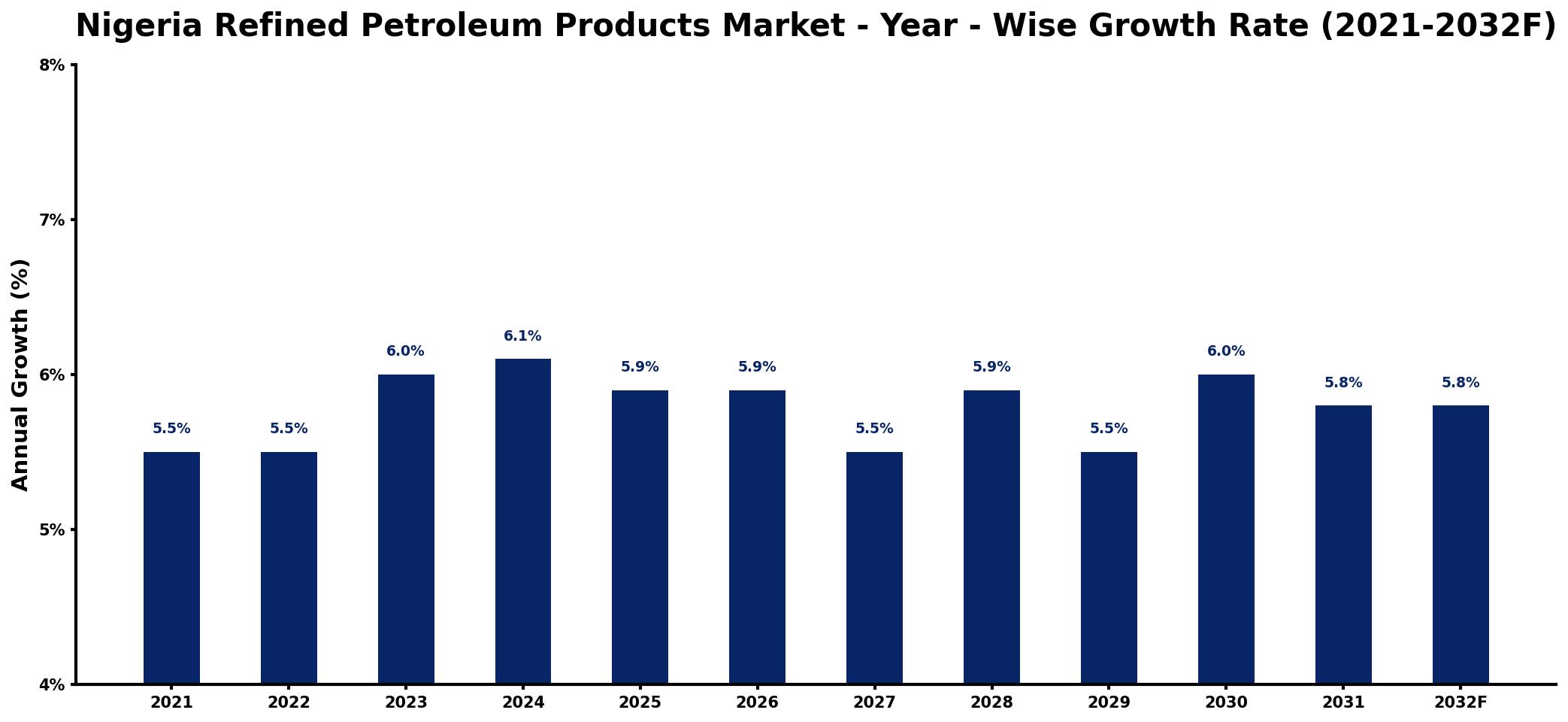
The table below presents the year‑wise growth rates along with the key drivers influencing the market
| Year | Growth Rate | Major Drivers |
| 2021 | 5.5% | Increased industrial energy demand |
| 2022 | 5.5% | Rising transportation sector growth |
| 2023 | 6.0% | Expansion of urban infrastructure projects |
| 2024 | 6.1% | Growing population and consumption patterns |
| 2025 | 5.9% | Enhanced foreign investment influx |
| 2026 | 5.9% | Development of new energy policies |
| 2027 | 5.5% | Strengthened regional trade agreements |
| 2028 | 5.9% | Advancements in logistics capabilities |
| 2029 | 5.5% | Emerging renewable energy initiatives |
| 2030 | 6.0% | Boost in export opportunities |
| 2031 | 5.8% | Innovations in energy efficiency technologies |
| 2032 | 5.8% | Increased demand from manufacturing sectors |
Note: Market size estimations and growth projections presented in this report are based on 6Wresearch's proprietary forecasting methodology, utilizing the latest available industry data, government publications, and primary research inputs.
Nigeria Refined Petroleum Products Market Synopsis
The Nigeria Refined Petroleum Products Market has witnessed recent momentum, underscored by a growing population and rising urbanization. However, this is juxtaposed with a long-standing issue of inadequate refining capacity, prompting significant imports of refined products. As the government seeks to deregulate the sector and encourage private investments, the landscape is poised for transformation.
Looking ahead, the market is expected to evolve significantly, driven by changing consumer preferences towards cleaner fuels and an increase in domestic production. While the journey is rife with challenges, including regulatory complexities and infrastructural deficits, the opportunities for sustained growth cannot be overlooked.
Nigeria Refined Petroleum Products Market Key Takeaways
- The market is estimated to grow from USD 476 Million in 2025 to USD 666 Million by 2032.
- Increasing urbanization and industrialization are driving demand for refined petroleum products.
- Government initiatives aim to improve domestic refining capacity and infrastructure.
- Emergence of cleaner fuels like LPG and CNG highlights a shift towards sustainability.
- Investment in technology and digitalization is enhancing operational efficiency within the sector.
Evaluation of Restraints in Nigeria Refined Petroleum Products Market
Despite its growth potential, the Nigeria Refined Petroleum Products Market is hindered by several real restraints. Inconsistent government policies and regulatory frameworks create an unpredictable business environment for stakeholders. The lack of sufficient infrastructure leads to supply chain disruptions, hampering the distribution of petroleum products. Furthermore, the pervasive issues of smuggling and corruption within the distribution network exacerbate product scarcity and increase operational costs. These factors collectively demand focused attention and strategic interventions to achieve sustainable growth.
Nigeria Refined Petroleum Products Market Trends
Several key trends are shaping the Nigeria Refined Petroleum Products Market. There is a marked shift towards the adoption of cleaner fuels, spurred by both consumer demand and government regulations aimed at environmental sustainability. The government's push for deregulation is fostering increased private sector participation, enhancing competition and efficiency in the market. Additionally, advances in technology are paving the way for better supply chain management and operational practices, while increased interest in biofuels reflects the market's diversification towards renewable energy sources.
Nigeria Refined Petroleum Products Market Opportunities
Opportunities abound in the Nigeria Refined Petroleum Products Market for both local and international investors. Establishing new refineries or upgrading existing facilities could significantly enhance local production and reduce dependency on imports. Investment in logistical infrastructure, such as storage and transportation networks, is crucial to meet the rising demand for petroleum products. Furthermore, technology investments that focus on refining efficiency present lucrative prospects, while exploring export opportunities for refined products could drive economic diversification.
Government Initiatives in the Nigeria Refined Petroleum Products Market
The Nigerian government is actively involved in regulating the Refined Petroleum Products Market through various initiatives and policies. The Petroleum Products Pricing Regulatory Agency (PPPRA) plays a pivotal role in establishing pricing mechanisms to stabilize the market and ensure affordability for consumers. Additionally, the government implements subsidies for certain products to alleviate the effects of global price fluctuations. Regulatory measures are also in place to oversee the importation and quality of refined products, ensuring compliance with safety and quality standards while promoting market efficiency.
Future Insights of the Nigeria Refined Petroleum Products Market
Looking towards 2026-2032, the Nigeria Refined Petroleum Products Market is set to experience steady growth fueled by urbanization, industrial expansion, and population increase. As investments in refining capacity and infrastructure gain momentum, the country's dependency on imported fuels is expected to diminish. However, market participants must remain vigilant of regulatory uncertainties and global market dynamics that could influence pricing and profitability. The evolving landscape presents a wealth of opportunities for investors who are adaptive and forward-thinking.
Nigeria Refined Petroleum Products Market Latest Developments (2025 - 2026)
Recent developments in the Nigeria Refined Petroleum Products Market indicate a growing commitment to enhancing domestic refining capabilities. Infrastructure projects aimed at modernizing storage facilities and distribution networks have been initiated to address supply chain inefficiencies. Additionally, there has been a marked increase in private sector engagement, with several stakeholders exploring partnerships to expand refining operations. The government's ongoing policy adjustments reflect an intent to create a more competitive and transparent market environment, aiming to alleviate the long-standing challenges of the sector.
Nigeria Refined Petroleum Products Market - Key Attractiveness of the Report
- 10 Years of Market Numbers
- Historical Data Starting from 2022 to 2025
- Base Year: 2025
- Forecast Data until 2032
- Key Performance Indicators Impacting the Market
- Major Upcoming Developments and Projects
Key Highlights of the Report:
- Nigeria Refined Petroleum Products Market Outlook
- Market Size of Nigeria Refined Petroleum Products Market, 2025
- Forecast of Nigeria Refined Petroleum Products Market, 2032
- Historical Data and Forecast of Nigeria Refined Petroleum Products Revenues & Volume for the Period 2022-2032F
- Nigeria Refined Petroleum Products Market Trend Evolution
- Nigeria Refined Petroleum Products Market Drivers and Challenges
- Nigeria Refined Petroleum Products Price Trends
- Nigeria Refined Petroleum Products Porter's Five Forces
- Nigeria Refined Petroleum Products Industry Life Cycle
- Historical Data and Forecast of Nigeria Refined Petroleum Products Market Revenues & Volume By Product Type for the Period 2022-2032F
- Historical Data and Forecast of Nigeria Refined Petroleum Products Market Revenues & Volume By Diesel for the Period 2022-2032F
- Historical Data and Forecast of Nigeria Refined Petroleum Products Market Revenues & Volume By Gasoline for the Period 2022-2032F
- Historical Data and Forecast of Nigeria Refined Petroleum Products Market Revenues & Volume By Fuel Oils for the Period 2022-2032F
- Historical Data and Forecast of Nigeria Refined Petroleum Products Market Revenues & Volume By Kerosene for the Period 2022-2032F
- Historical Data and Forecast of Nigeria Refined Petroleum Products Market Revenues & Volume By Others for the Period 2022-2032F
- Historical Data and Forecast of Nigeria Refined Petroleum Products Market Revenues & Volume By Application for the Period 2022-2032F
- Historical Data and Forecast of Nigeria Refined Petroleum Products Market Revenues & Volume By Fuel for the Period 2022-2032F
- Historical Data and Forecast of Nigeria Refined Petroleum Products Market Revenues & Volume By Chemical for the Period 2022-2032F
- Historical Data and Forecast of Nigeria Refined Petroleum Products Market Revenues & Volume By Others for the Period 2022-2032F
- Historical Data and Forecast of Nigeria Refined Petroleum Products Market Revenues & Volume By Fraction for the Period 2022-2032F
- Historical Data and Forecast of Nigeria Refined Petroleum Products Market Revenues & Volume By Light Distillates for the Period 2022-2032F
- Historical Data and Forecast of Nigeria Refined Petroleum Products Market Revenues & Volume By Middle Distillates for the Period 2022-2032F
- Historical Data and Forecast of Nigeria Refined Petroleum Products Market Revenues & Volume By Heavy Oils for the Period 2022-2032F
- Nigeria Refined Petroleum Products Import Export Trade Statistics
- Market Opportunity Assessment By Product Type
- Market Opportunity Assessment By Application
- Market Opportunity Assessment By Fraction
- Nigeria Refined Petroleum Products Top Companies Market Share
- Nigeria Refined Petroleum Products Competitive Benchmarking By Technical and Operational Parameters
- Nigeria Refined Petroleum Products Company Profiles
- Nigeria Refined Petroleum Products Key Strategic Recommendations






































