Nigeria Renewable Chemicals Market Size, Share & Growth Rate
The Nigeria Renewable Chemicals Market was estimated at USD 432 Million in 2025 and is projected to reach USD 570 Million by 2032, growing at a CAGR of 4.0% from 2026 to 2032. This growth trajectory reflects the country's increasing commitment to sustainability and the utilization of its abundant agricultural resources as feedstock for renewable chemical production. As consumer demand for eco-friendly products surges, coupled with advancements in biochemistry, the market is poised for significant expansion.
Nigeria Renewable Chemicals Market Year-wise Growth Rate and Key Drivers
This graph highlights how the Nigeria Renewable Chemicals Market has steadily grown over the years, supported by major growth factors.
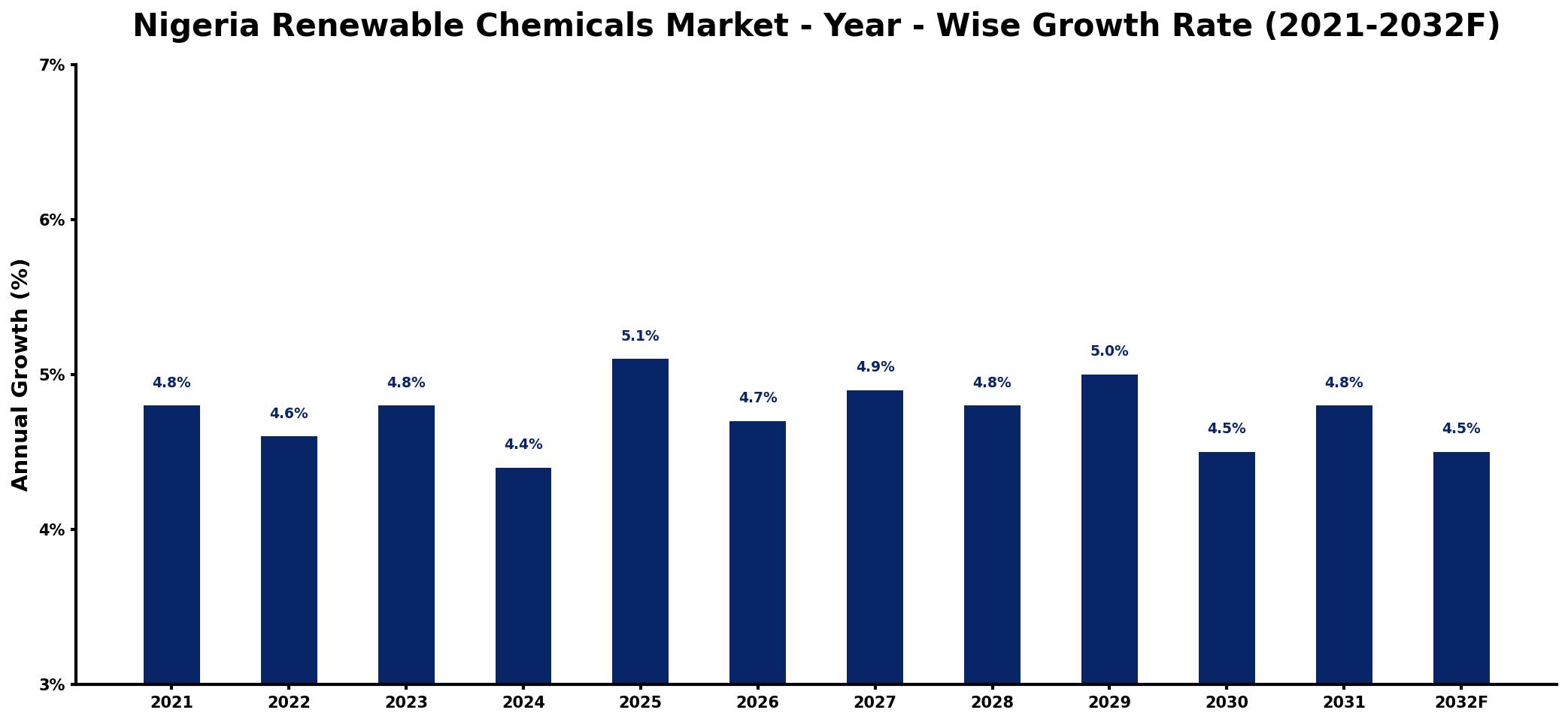
The table below presents the year‑wise growth rates along with the key drivers influencing the market
| Year | Growth Rate | Major Drivers |
| 2021 | 4.8% | Rising interest in sustainable solutions |
| 2022 | 4.6% | Increased investment in bio-based solutions |
| 2023 | 4.8% | Growing consumer preference for sustainability |
| 2024 | 4.4% | Expansion of green technology initiatives |
| 2025 | 5.1% | Emergence of new market opportunities |
| 2026 | 4.7% | Strengthening regulatory support for sustainability |
| 2027 | 4.9% | Development of innovative production techniques |
| 2028 | 4.8% | Growing collaboration among industry players |
| 2029 | 5.0% | improved raw material availability |
| 2030 | 4.5% | rising procurement volume requirements |
| 2031 | 4.8% | Rise in public-private partnerships |
| 2032 | 4.5% | Strengthened supply chain sustainability efforts |
Note: Market size estimations and growth projections presented in this report are based on 6Wresearch's proprietary forecasting methodology, utilizing the latest available industry data, government publications, and primary research inputs.
Nigeria Renewable Chemicals Market Synopsis
The reliance on Nigerias rich agricultural outputs, such as cassava and sugarcane, positions the country uniquely to produce renewable chemicals effectively. This feedstock availability not only supports local industries but also aligns with global trends favoring sustainable practices.
Furthermore, the Nigerian government's policies aimed at reducing oil dependency are fostering an environment conducive to the growth of renewable chemicals. With incentives for research and local sourcing of raw materials, the nation is establishing a robust foundation for a sustainable chemical sector.
Nigeria Renewable Chemicals Market Key Takeaways
- Significant growth driven by the transition toward eco-friendly products and sustainability.
- Rich agricultural resources provide a consistent and reliable feedstock base.
- Government initiatives are strategically designed to promote renewable chemical production.
- Technological advancements in biochemistry are enhancing production capabilities.
- International investments are strengthening the Nigerian chemical industry's market reach.
Evaluation of Restraints in Nigeria Renewable Chemicals Market
Despite the promising outlook, the Nigeria Renewable Chemicals Market faces notable restraints that could impede its growth. High production costs pose a significant challenge, limiting the competitiveness of renewable chemicals compared to conventional alternatives. Additionally, the limited infrastructure for agricultural waste management impacts the availability of feedstock, restricting production capabilities. Consumer awareness surrounding the benefits of renewable chemicals remains low, which further complicates market penetration and growth. These factors collectively underscore the need for concerted efforts in addressing both supply and demand barriers in this emerging market.
Nigeria Renewable Chemicals Market Trends
Current trends in the Nigeria Renewable Chemicals Market are heavily influenced by advancements in biotechnological processes, which enhance the efficiency of converting biomass into chemicals. There's a growing preference for biobased plastics and sustainable packaging solutions across various sectors, including agriculture and textiles. Moreover, as consumers become more environmentally conscious, brands are increasingly seeking to incorporate renewable chemicals into their products, further stimulating demand and innovation within the industry.
Nigeria Renewable Chemicals Market Opportunities
The Nigeria Renewable Chemicals Market holds immense opportunities for growth and investment. A key area of potential lies in developing partnerships to enhance production technologies and create more effective biomass conversion methods. Additionally, as the global market shifts towards sustainable solutions, Nigerian producers have the chance to position themselves as significant players in the international renewable chemicals landscape. Expanding awareness campaigns to educate consumers about eco-friendly products presents another avenue for boosting demand and fostering market acceptance.
Government Initiatives in the Nigeria Renewable Chemicals Market
The Nigerian government is actively pursuing policies that prioritize the development of renewable chemicals as part of a broader economic diversification strategy. Initiatives include financial support for research and development, tax incentives for manufacturers transitioning to renewable chemical production, and programs that encourage the use of locally sourced agricultural materials. These efforts are designed to foster a sustainable industrial ecosystem and align with national goals of reducing carbon emissions and environmental impact.
Future Insights of the Nigeria Renewable Chemicals Market
Looking ahead to 2026-2032, the Nigeria Renewable Chemicals Market is expected to evolve significantly. The anticipated tightening of environmental regulations globally will likely amplify demand for renewable chemicals, positioning Nigeria as a viable supplier to both local and international markets. Continued advancements in technology, combined with the government's supportive policies, will further facilitate the transition towards a greener chemical industry. If current trends hold, this market could not only enhance local economies but also contribute meaningfully to global sustainability efforts.
Nigeria Renewable Chemicals Market Latest Developments (2025 - 2026)
Recent developments in the Nigeria Renewable Chemicals Market have highlighted a renewed focus on enhancing production capacity through technological innovations. Collaborative efforts between local universities and industry stakeholders are fostering research initiatives aimed at optimizing biomass conversion processes. Additionally, several pilot projects are underway to explore new applications for renewable chemicals in sectors such as agriculture and packaging, indicating an upward trajectory in market activity.
Nigeria Renewable Chemicals Market - Key Attractiveness of the Report
- 10 Years of Market Numbers
- Historical Data Starting from 2022 to 2025
- Base Year: 2025
- Forecast Data until 2032
- Key Performance Indicators Impacting the Market
- Major Upcoming Developments and Projects
Key Highlights of the Report:
- Nigeria Renewable Chemicals Market Outlook
- Market Size of Nigeria Renewable Chemicals Market, 2025
- Forecast of Nigeria Renewable Chemicals Market, 2032
- Historical Data and Forecast of Nigeria Renewable Chemicals Revenues & Volume for the Period 2022-2032F
- Nigeria Renewable Chemicals Market Trend Evolution
- Nigeria Renewable Chemicals Market Drivers and Challenges
- Nigeria Renewable Chemicals Price Trends
- Nigeria Renewable Chemicals Porter's Five Forces
- Nigeria Renewable Chemicals Industry Life Cycle
- Historical Data and Forecast of Nigeria Renewable Chemicals Market Revenues & Volume By Product Type for the Period 2022-2032F
- Historical Data and Forecast of Nigeria Renewable Chemicals Market Revenues & Volume By Alcohols for the Period 2022-2032F
- Historical Data and Forecast of Nigeria Renewable Chemicals Market Revenues & Volume By Organic Acids for the Period 2022-2032F
- Historical Data and Forecast of Nigeria Renewable Chemicals Market Revenues & Volume By Ketones for the Period 2022-2032F
- Historical Data and Forecast of Nigeria Renewable Chemicals Market Revenues & Volume By Platform Chemicals for the Period 2022-2032F
- Historical Data and Forecast of Nigeria Renewable Chemicals Market Revenues & Volume By Biopolymers for the Period 2022-2032F
- Historical Data and Forecast of Nigeria Renewable Chemicals Market Revenues & Volume By Others for the Period 2022-2032F
- Historical Data and Forecast of Nigeria Renewable Chemicals Market Revenues & Volume By Applications for the Period 2022-2032F
- Historical Data and Forecast of Nigeria Renewable Chemicals Market Revenues & Volume By Transportation for the Period 2022-2032F
- Historical Data and Forecast of Nigeria Renewable Chemicals Market Revenues & Volume By Textiles for the Period 2022-2032F
- Historical Data and Forecast of Nigeria Renewable Chemicals Market Revenues & Volume By Food safety for the Period 2022-2032F
- Historical Data and Forecast of Nigeria Renewable Chemicals Market Revenues & Volume By Environment for the Period 2022-2032F
- Historical Data and Forecast of Nigeria Renewable Chemicals Market Revenues & Volume By Communication for the Period 2022-2032F
- Historical Data and Forecast of Nigeria Renewable Chemicals Market Revenues & Volume By Housing for the Period 2022-2032F
- Historical Data and Forecast of Nigeria Renewable Chemicals Market Revenues & Volume By Recreation for the Period 2022-2032F
- Historical Data and Forecast of Nigeria Renewable Chemicals Market Revenues & Volume By Other Applications for the Period 2022-2032F
- Nigeria Renewable Chemicals Import Export Trade Statistics
- Market Opportunity Assessment By Product Type
- Market Opportunity Assessment By Applications
- Nigeria Renewable Chemicals Top Companies Market Share
- Nigeria Renewable Chemicals Competitive Benchmarking By Technical and Operational Parameters
- Nigeria Renewable Chemicals Company Profiles
- Nigeria Renewable Chemicals Key Strategic Recommendations






































