Iraq Renewable Chemicals Market Size, Share & Growth Rate
The Iraq Renewable Chemicals Market was estimated at USD 197 Million in 2025 and is projected to reach USD 268 Million by 2032, growing at a CAGR of 4.5% from 2026 to 2032. This growth trajectory is underpinned by rising environmental awareness and governmental commitments towards sustainable development, which are driving the adoption of renewable chemicals across various industries. As Iraq looks to diversify its economy beyond fossil fuels, the shift towards bio-based feedstocks such as biomass and agricultural waste is increasingly seen as a viable solution.
Iraq Renewable Chemicals Market Year-wise Growth Rate and Key Drivers
This graph highlights how the Iraq Renewable Chemicals Market has steadily grown over the years, supported by major growth factors.
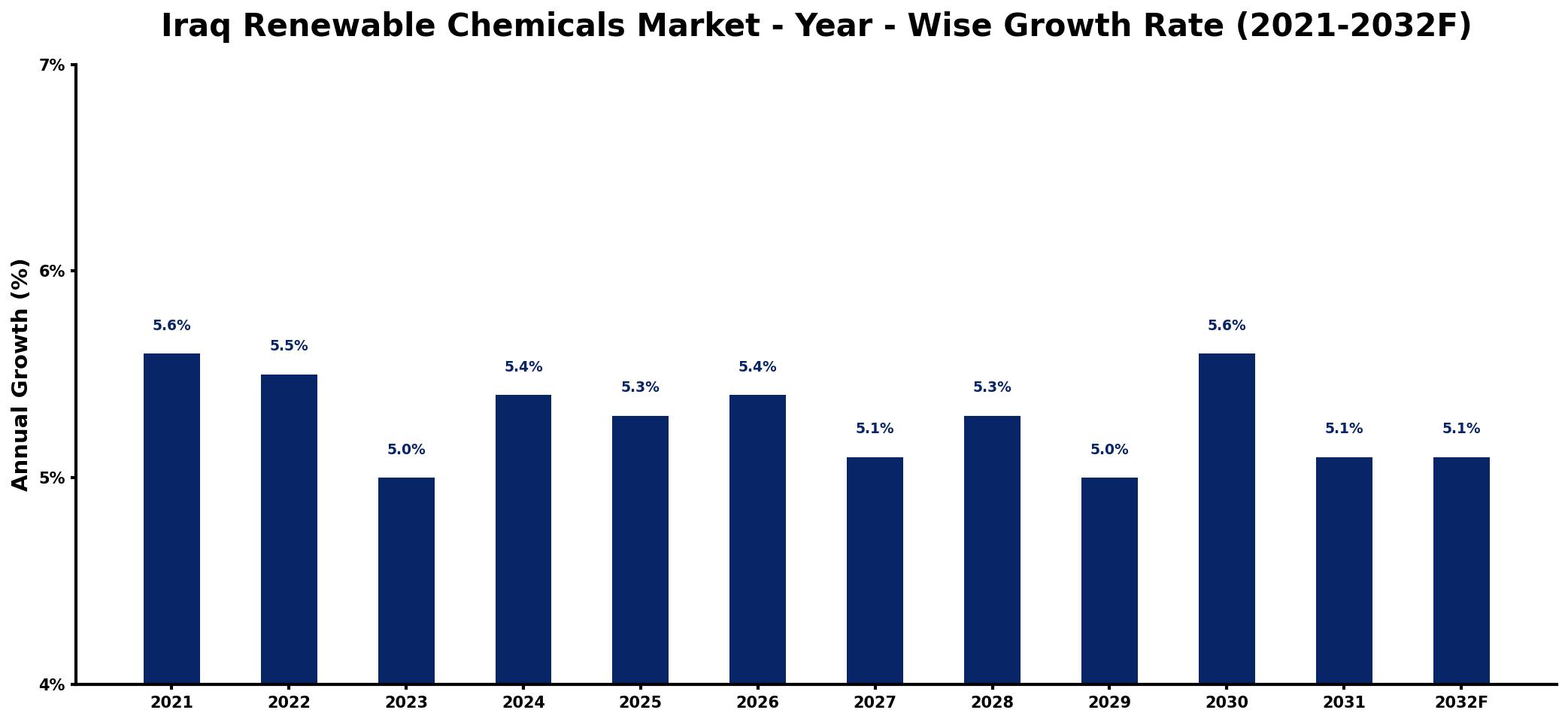
The table below presents the year‑wise growth rates along with the key drivers influencing the market
| Year | Growth Rate | Major Drivers |
| 2021 | 5.6% | Increased investments in sustainable technologies |
| 2022 | 5.5% | Growing demand for eco-friendly solutions |
| 2023 | 5.0% | Expansion of green manufacturing initiatives |
| 2024 | 5.4% | Rising consumer preference for sustainability |
| 2025 | 5.3% | Development of innovative production methods |
| 2026 | 5.4% | Strengthened regulatory support for sustainability |
| 2027 | 5.1% | improved raw material availability |
| 2028 | 5.3% | Emergence of new market players |
| 2029 | 5.0% | Enhanced collaboration with research institutions |
| 2030 | 5.6% | Boost in public awareness campaigns |
| 2031 | 5.1% | Increased funding for sustainable projects |
| 2032 | 5.1% | growing regional consumption patterns |
Note: Market size estimations and growth projections presented in this report are based on 6Wresearch's proprietary forecasting methodology, utilizing the latest available industry data, government publications, and primary research inputs.
Iraq Renewable Chemicals Market Synopsis
The most significant force shaping the Iraq Renewable Chemicals Market is the growing consumer demand for eco-friendly products. As industries and consumers alike become more conscious of their environmental impact, the demand for sustainable alternatives to traditional petrochemical products continues to rise. This shift not only aligns with global sustainability trends but also reflects a broader movement within Iraq to foster a greener economy.
Government initiatives play a crucial role in the market's development, with policies designed to support the transition towards renewable chemicals. By providing incentives for bio-based manufacturing and encouraging investments in green technologies, the government is fostering an environment conducive to growth in this sector, ultimately aiming to reduce the country's reliance on fossil fuels.
Iraq Renewable Chemicals Market Key Takeaways
- The market is anticipated to reach USD 268 Million by 2032, reflecting a growing commitment to sustainability.
- Government policies are actively promoting the adoption of renewable chemicals, creating a favorable investment climate.
- Consumer awareness regarding environmental issues is significantly influencing market demand for eco-friendly products.
- Renewable chemicals derived from biomass and agricultural waste are emerging as key growth areas in Iraq.
- Investment in technological advancements will be essential to overcome barriers and enhance competitiveness.
Evaluation of Restraints in Iraq Renewable Chemicals Market
Despite the encouraging market landscape, several restraints hinder the potential for rapid growth. A primary concern is the technological barriers, which limit access to efficient production methods for renewable chemicals. Furthermore, competition from established petrochemical products presents a significant challenge, given their existing market dominance and price advantages. Fluctuations in raw material prices can further complicate market dynamics, affecting profitability and investor confidence. In addition, regulatory constraints and policy uncertainties may deter new investments in this burgeoning sector, posing ongoing risks to market development.
Iraq Renewable Chemicals Market Trends
Key trends shaping the Iraq Renewable Chemicals Market include a marked shift towards circular economy principles, focusing on waste valorization and resource efficiency. Companies are increasingly looking to integrate sustainable practices throughout their supply chains, utilizing waste materials and by-products as feedstocks. Additionally, the rise of bio-based chemicals as a preferred alternative to traditional products is gaining traction, driven by innovations in production technology and increased consumer acceptance. The market is also witnessing collaborations between public and private sectors to advance research and development in renewable chemical technologies.
Iraq Renewable Chemicals Market Opportunities
Investment opportunities are abundant in the Iraq Renewable Chemicals Market, particularly in areas such as bio-feedstock cultivation and advanced processing technologies. Companies can explore partnerships with local farmers to source agricultural waste, thereby enhancing feedstock availability. Moreover, the establishment of research initiatives aimed at improving production efficiencies and developing new bio-based products presents significant growth prospects. With the right policies in place, Iraq could position itself as a regional leader in renewable chemicals, attracting foreign investments and fostering technological advancements.
Government Initiatives in the Iraq Renewable Chemicals Market
The Iraqi government is actively implementing policies that support the growth of the renewable chemicals sector. This includes various incentives aimed at promoting bio-based manufacturing, such as tax breaks and grants for companies investing in green technologies. Furthermore, the government is working to establish regulatory frameworks that facilitate the growth of sustainable industries while ensuring environmental protection. These initiatives reflect a broader commitment to diversifying Iraq's economy and reducing its dependence on fossil fuels.
Future Insights of the Iraq Renewable Chemicals Market
Looking ahead to the period between 2026 and 2032, the Iraq Renewable Chemicals Market is poised for significant transformation. As the government amplifies its focus on sustainability and eco-friendly practices, we can expect a more robust regulatory framework that encourages innovation and investment. The ongoing collaboration between various stakeholders will likely lead to breakthroughs in production technologies, enhancing the market's overall viability. With a growing emphasis on environmental stewardship, the market is set to become an essential component of Iraq's economic diversification strategy.
Iraq Renewable Chemicals Market Latest Developments (2025 - 2026)
Recent developments in the Iraq Renewable Chemicals Market indicate a strengthening collaboration between governmental bodies and private enterprises. There has been a noticeable increase in initiatives aimed at enhancing public awareness of sustainable practices and encouraging investment in renewable chemical projects. Furthermore, ongoing advancements in production technologies are expected to facilitate the growth of bio-based chemicals in various sectors, including agriculture and pharmaceuticals, thus broadening the market's application scope.
Iraq Renewable Chemicals Market - Key Attractiveness of the Report
- 10 Years of Market Numbers
- Historical Data Starting from 2022 to 2025
- Base Year: 2025
- Forecast Data until 2032
- Key Performance Indicators Impacting the Market
- Major Upcoming Developments and Projects
Key Highlights of the Report:
- Iraq Renewable Chemicals Market Outlook
- Market Size of Iraq Renewable Chemicals Market, 2025
- Forecast of Iraq Renewable Chemicals Market, 2032
- Historical Data and Forecast of Iraq Renewable Chemicals Revenues & Volume for the Period 2022-2032F
- Iraq Renewable Chemicals Market Trend Evolution
- Iraq Renewable Chemicals Market Drivers and Challenges
- Iraq Renewable Chemicals Price Trends
- Iraq Renewable Chemicals Porter's Five Forces
- Iraq Renewable Chemicals Industry Life Cycle
- Historical Data and Forecast of Iraq Renewable Chemicals Market Revenues & Volume By Product Type for the Period 2022-2032F
- Historical Data and Forecast of Iraq Renewable Chemicals Market Revenues & Volume By Alcohols for the Period 2022-2032F
- Historical Data and Forecast of Iraq Renewable Chemicals Market Revenues & Volume By Organic Acids for the Period 2022-2032F
- Historical Data and Forecast of Iraq Renewable Chemicals Market Revenues & Volume By Ketones for the Period 2022-2032F
- Historical Data and Forecast of Iraq Renewable Chemicals Market Revenues & Volume By Platform Chemicals for the Period 2022-2032F
- Historical Data and Forecast of Iraq Renewable Chemicals Market Revenues & Volume By Biopolymers for the Period 2022-2032F
- Historical Data and Forecast of Iraq Renewable Chemicals Market Revenues & Volume By Others for the Period 2022-2032F
- Historical Data and Forecast of Iraq Renewable Chemicals Market Revenues & Volume By Applications for the Period 2022-2032F
- Historical Data and Forecast of Iraq Renewable Chemicals Market Revenues & Volume By Transportation for the Period 2022-2032F
- Historical Data and Forecast of Iraq Renewable Chemicals Market Revenues & Volume By Textiles for the Period 2022-2032F
- Historical Data and Forecast of Iraq Renewable Chemicals Market Revenues & Volume By Food safety for the Period 2022-2032F
- Historical Data and Forecast of Iraq Renewable Chemicals Market Revenues & Volume By Environment for the Period 2022-2032F
- Historical Data and Forecast of Iraq Renewable Chemicals Market Revenues & Volume By Communication for the Period 2022-2032F
- Historical Data and Forecast of Iraq Renewable Chemicals Market Revenues & Volume By Housing for the Period 2022-2032F
- Historical Data and Forecast of Iraq Renewable Chemicals Market Revenues & Volume By Recreation for the Period 2022-2032F
- Historical Data and Forecast of Iraq Renewable Chemicals Market Revenues & Volume By Other Applications for the Period 2022-2032F
- Iraq Renewable Chemicals Import Export Trade Statistics
- Market Opportunity Assessment By Product Type
- Market Opportunity Assessment By Applications
- Iraq Renewable Chemicals Top Companies Market Share
- Iraq Renewable Chemicals Competitive Benchmarking By Technical and Operational Parameters
- Iraq Renewable Chemicals Company Profiles
- Iraq Renewable Chemicals Key Strategic Recommendations






































