Nigeria Retail Industry Market Size, Share & Growth Rate
The Nigeria Retail Industry Market was estimated at USD 207 Million in 2025 and is projected to reach USD 262 Million by 2032, growing at a CAGR of 3.4% from 2026 to 2032. This growth trajectory is largely fueled by rising disposable incomes and the ongoing urbanization trend, which is transforming the consumption patterns of a young and increasingly tech-savvy population. Furthermore, the influx of international retail brands and the proliferation of modern shopping outlets continue to reshape the retail landscape, catering to a diverse range of consumer needs.
Nigeria Retail Industry Market Year-wise Growth Rate and Key Drivers
This graph highlights how the Nigeria Retail Industry Market has steadily grown over the years, supported by major growth factors.
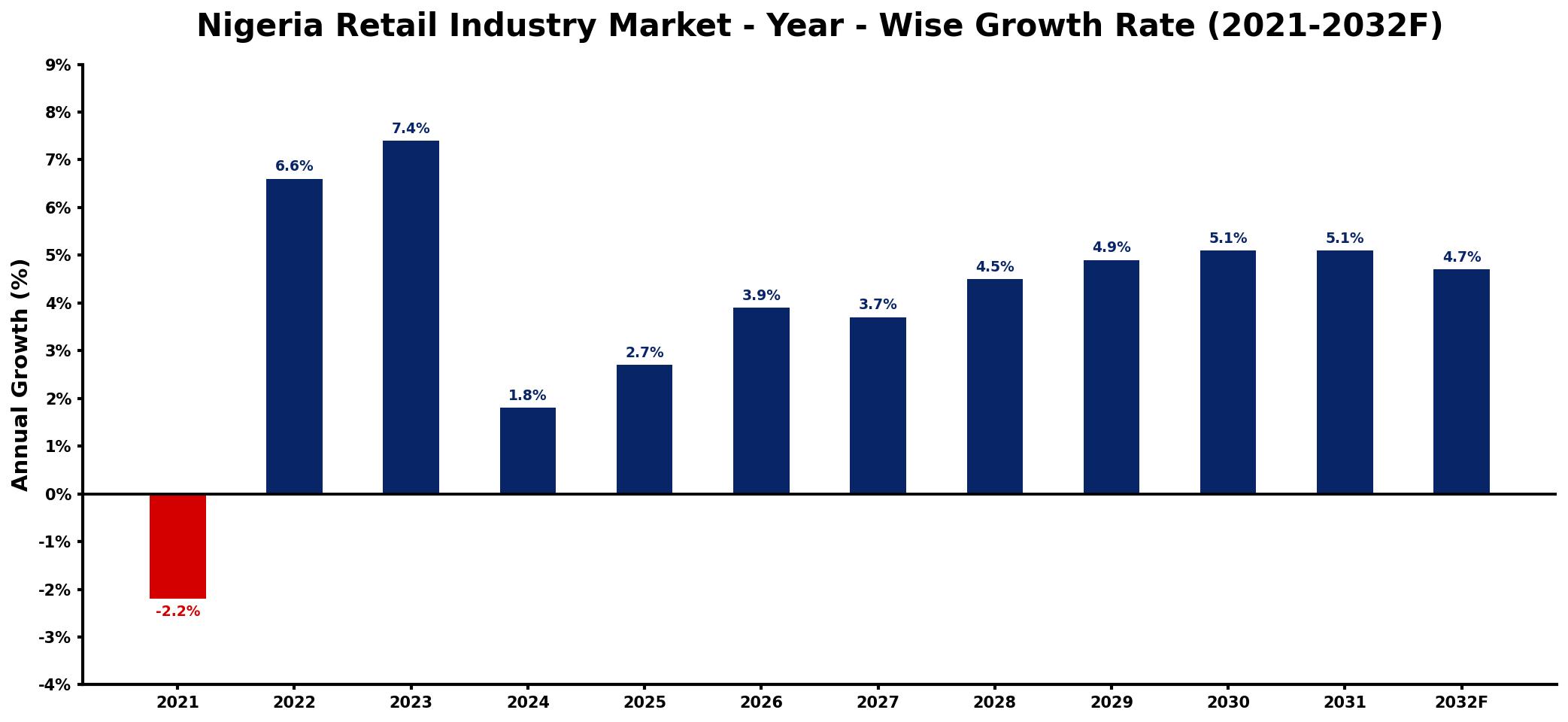
The table below presents the year‑wise growth rates along with the key drivers influencing the market
| Year | Growth Rate | Major Drivers |
| 2021 | -2.2% | Consumer spending shows noticeable decline |
| 2022 | 6.6% | E-commerce platforms gain traction |
| 2023 | 7.4% | Increased foreign investment inflows |
| 2024 | 1.8% | Infrastructure development enhances accessibility |
| 2025 | 2.7% | Rising disposable income boosts consumption |
| 2026 | 3.9% | Technological advancements streamline operations |
| 2027 | 3.7% | Urbanization drives market expansion opportunities |
| 2028 | 4.5% | Diverse product offerings attract consumers |
| 2029 | 4.9% | Increased focus on sustainable practices |
| 2030 | 5.1% | Growing middle class increases demand |
| 2031 | 5.1% | Enhanced logistics improve supply chain |
| 2032 | 4.7% | Strengthened local partnerships foster growth |
Note: Market size estimations and growth projections presented in this report are based on 6Wresearch's proprietary forecasting methodology, utilizing the latest available industry data, government publications, and primary research inputs.
Nigeria Retail Industry Market Synopsis
The Nigerian retail market is a vibrant blend of traditional and modern formats, including bustling open-air markets alongside sophisticated supermarket chains. This unique composition not only caters to varying consumer preferences but also illustrates the dynamic nature of retail in Nigeria, reflecting both cultural heritage and contemporary trends.
Increasing urbanization is leading to a surge in demand for retail goods, with consumers seeking convenience and quality. As shopping malls and e-commerce platforms become more prevalent, they are meeting this demand and further driving market growth across the nation.
Nigeria Retail Industry Market Key Takeaways
- The retail market is significantly influenced by a growing, urbanized population and increased consumer purchasing power.
- Modern retail formats are gaining traction, creating competitive pressure on traditional retail sectors.
- Government policies promoting e-commerce and local business support are enhancing the retail environment.
- Investment in infrastructure is critical for expanding retail reach and improving operational efficiency.
- Challenges such as currency fluctuations and informal retail sectors continue to impact profitability in the industry.
Evaluation of Restraints in Nigeria Retail Industry Market
Despite its growth potential, the Nigeria retail market faces substantial restraints. The prevalence of informal sectors, such as street vendors and open-air markets, often undermines formal retail operations, creating an uneven playing field. Additionally, economic instability—marked by fluctuating consumer purchasing power and currency volatility—poses significant challenges for retailers aiming to establish stable operations. Infrastructure inadequacies, particularly in transport and storage facilities, further hinder the efficiency and expansion of retail businesses, limiting their ability to meet increasing consumer demands.
Nigeria Retail Industry Market Trends
Several notable trends are currently shaping the Nigeria retail market. A marked shift towards e-commerce is becoming evident as internet penetration increases, allowing consumers to access a wider array of products online. Additionally, retail technology innovations, such as mobile payments and advanced inventory systems, are enhancing consumer experiences. Sustainability practices are also becoming a focal point, with brands increasingly prioritizing eco-friendly products to attract conscious consumers.
Nigeria Retail Industry Market Opportunities
Significant growth and investment opportunities abound within the Nigerian retail landscape. The ongoing urbanization trend offers retail players the chance to tap into new markets, particularly in underserved regions. Moreover, the rising popularity of online shopping and mobile commerce presents avenues for expanding market reach. Collaborations with local producers can help to strengthen supply chains while also appealing to the growing consumer preference for locally sourced products.
Government Initiatives in the Nigeria Retail Industry Market
The Nigerian government has implemented a range of initiatives aimed at fostering growth in the retail sector. This includes tax incentives for small and medium enterprises (SMEs), import restrictions to protect local manufacturers, and programs designed to enhance financial inclusion. Additionally, the government is actively promoting e-commerce growth, recognizing its potential to drive consumer spending and stimulate economic development.
Future Insights of the Nigeria Retail Industry Market
Looking ahead to the period from 2026 to 2032, the Nigeria retail industry is poised for transformative changes. As the economy stabilizes, increased consumer confidence is expected to drive spending growth. Retailers will likely continue to innovate through technology adoption and improved customer engagement strategies. Additionally, as government policies continue to evolve favorably towards the retail sector, the market is likely to become more attractive for investment, paving the way for sustainable growth.
Nigeria Retail Industry Market Latest Developments (2025 - 2026)
Recent developments in the Nigeria retail market indicate a strong push towards enhancing the digital shopping experience. Retailers are increasingly investing in online platforms to improve accessibility and customer engagement. Concurrently, there is a noticeable trend of established brands diversifying their product offerings to cater to shifting consumer preferences. This evolving landscape signals a robust commitment to adapting to changing market dynamics and consumer demands.
Nigeria Retail Industry Market - Key Attractiveness of the Report
- 10 Years of Market Numbers
- Historical Data Starting from 2022 to 2025
- Base Year: 2025
- Forecast Data until 2032
- Key Performance Indicators Impacting the Market
- Major Upcoming Developments and Projects
Key Highlights of the Report:
- Nigeria Retail Industry Market Outlook
- Market Size of Nigeria Retail Industry Market, 2025
- Forecast of Nigeria Retail Industry Market, 2032
- Historical Data and Forecast of Nigeria Retail Industry Revenues & Volume for the Period 2022-2032F
- Nigeria Retail Industry Market Trend Evolution
- Nigeria Retail Industry Market Drivers and Challenges
- Nigeria Retail Industry Price Trends
- Nigeria Retail Industry Porter's Five Forces
- Nigeria Retail Industry Industry Life Cycle
- Historical Data and Forecast of Nigeria Retail Industry Market Revenues & Volume By Product for the Period 2022-2032F
- Historical Data and Forecast of Nigeria Retail Industry Market Revenues & Volume By Food and Beverages for the Period 2022-2032F
- Historical Data and Forecast of Nigeria Retail Industry Market Revenues & Volume By Personal and Household Care for the Period 2022-2032F
- Historical Data and Forecast of Nigeria Retail Industry Market Revenues & Volume By Apparel, Footwear, and Accessories for the Period 2022-2032F
- Historical Data and Forecast of Nigeria Retail Industry Market Revenues & Volume By Furniture, Toys, and Hobby for the Period 2022-2032F
- Historical Data and Forecast of Nigeria Retail Industry Market Revenues & Volume By Electronic and Household Appliances for the Period 2022-2032F
- Historical Data and Forecast of Nigeria Retail Industry Market Revenues & Volume By Other Products for the Period 2022-2032F
- Historical Data and Forecast of Nigeria Retail Industry Market Revenues & Volume By Distribution Channel for the Period 2022-2032F
- Historical Data and Forecast of Nigeria Retail Industry Market Revenues & Volume By Supermarkets/Hypermarkets for the Period 2022-2032F
- Historical Data and Forecast of Nigeria Retail Industry Market Revenues & Volume By Convenience Stores for the Period 2022-2032F
- Historical Data and Forecast of Nigeria Retail Industry Market Revenues & Volume By Department Stores for the Period 2022-2032F
- Historical Data and Forecast of Nigeria Retail Industry Market Revenues & Volume By Specialty Stores for the Period 2022-2032F
- Historical Data and Forecast of Nigeria Retail Industry Market Revenues & Volume By Online for the Period 2022-2032F
- Historical Data and Forecast of Nigeria Retail Industry Market Revenues & Volume By Other Distribution Channels for the Period 2022-2032F
- Nigeria Retail Industry Import Export Trade Statistics
- Market Opportunity Assessment By Product
- Market Opportunity Assessment By Distribution Channel
- Nigeria Retail Industry Top Companies Market Share
- Nigeria Retail Industry Competitive Benchmarking By Technical and Operational Parameters
- Nigeria Retail Industry Company Profiles
- Nigeria Retail Industry Key Strategic Recommendations






































