Nigeria Rubber Vulcanization Market Top 5 Importing Countries and Market Competition (HHI) Analysis
The Nigeria rubber vulcanization import market saw a significant increase in concentration in 2024, with top exporters being Germany, India, Spain, Belgium, and Italy. The Herfindahl-Hirschman Index (HHI) reached a very high level, indicating a more consolidated market. However, the overall compound annual growth rate (CAGR) from 2020 to 2024 was notably negative at -42.85%, with a steep decline in growth rate from 2023 to 2024 at -61.17%. This suggests a challenging landscape for rubber vulcanization importers in Nigeria, possibly influenced by various market factors and trends.
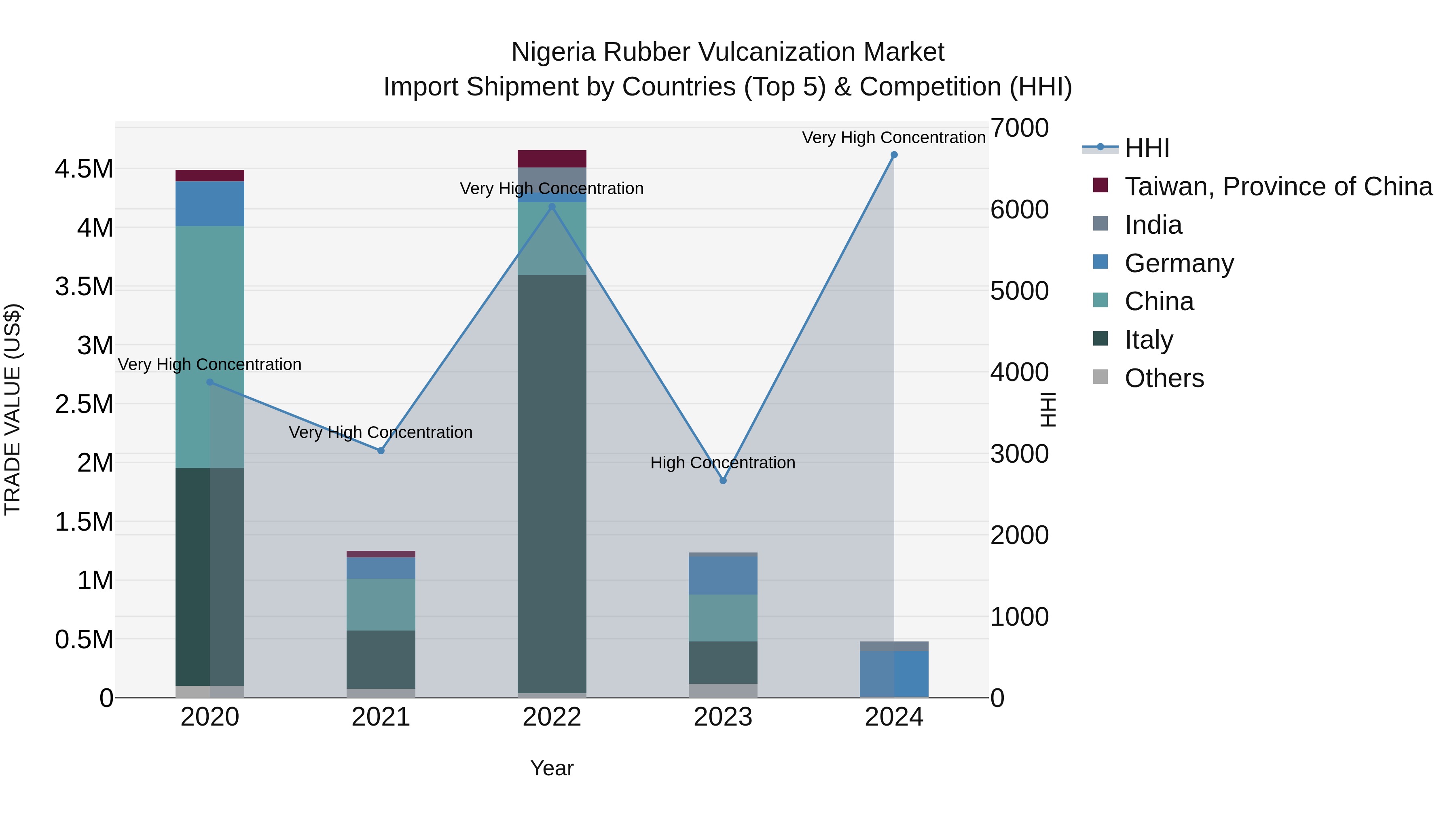
Nigeria Rubber Vulcanization Market Overview
The Nigeria Rubber Vulcanization market is experiencing steady growth driven by the expanding automotive, construction, and industrial sectors. The process of rubber vulcanization involves adding sulfur and heat to raw rubber to enhance its strength, durability, and elasticity. This treated rubber is widely used in manufacturing tires, conveyor belts, seals, hoses, and various automotive components. Key market players in Nigeria include rubber manufacturers, tire producers, and industrial rubber goods manufacturers. With increasing industrialization and infrastructure development in Nigeria, the demand for vulcanized rubber products is projected to rise further in the coming years, creating opportunities for market expansion and technological advancements in the sector.
Nigeria Rubber Vulcanization Market Trends
The Nigeria Rubber Vulcanization market is experiencing a growing demand for eco-friendly and sustainable vulcanization technologies as environmental concerns and regulations become more stringent. Additionally, there is a rising adoption of automation and advanced machinery in vulcanization processes to improve efficiency and reduce labor costs. The market is witnessing a shift towards the use of alternative vulcanization agents and methods to reduce reliance on traditional chemicals like sulfur. Furthermore, increasing investments in research and development to enhance product quality and durability are driving innovation in the industry. Overall, the Nigeria Rubber Vulcanization market is evolving towards more sustainable, efficient, and technologically advanced solutions to meet the changing needs of the market and comply with environmental standards.
Nigeria Rubber Vulcanization Market Challenges
In the Nigeria Rubber Vulcanization Market, key challenges include the high cost of raw materials and energy, inadequate infrastructure leading to supply chain disruptions, inconsistent government policies affecting the industry, lack of skilled labor and technical expertise, and competition from imported products. Additionally, issues related to environmental regulations and waste disposal practices pose challenges for rubber vulcanization companies in Nigeria. Overcoming these obstacles requires investment in technology and innovation, strategic partnerships to improve supply chain efficiency, and government support in the form of favorable policies and incentives to boost domestic production and competitiveness in the global market.
Nigeria Rubber Vulcanization Market Investment Opportunities
Investment opportunities in the Nigeria Rubber Vulcanization Market include setting up modern rubber vulcanization facilities to meet the growing demand for high-quality rubber products in industries such as automotive, construction, and footwear. Investing in research and development to improve vulcanization processes and develop innovative products can also provide a competitive edge. Additionally, there is potential for partnerships with local rubber plantations to ensure a stable supply of raw materials. With a rapidly expanding economy and increasing industrialization in Nigeria, the rubber vulcanization market offers promising prospects for investors looking to capitalize on the country`s growing manufacturing sector and the rising demand for rubber products both domestically and internationally.
Nigeria Rubber Vulcanization Market Government Policy
Government policies related to the Nigeria Rubber Vulcanization Market include regulations on environmental protection, quality standards, and import-export tariffs. The government has implemented measures to ensure that rubber vulcanization processes adhere to strict environmental guidelines to minimize pollution and protect the ecosystem. Quality standards are also enforced to maintain the integrity and safety of rubber products in the market. Additionally, import-export tariffs are in place to regulate the flow of rubber materials and products across borders, aiming to support local industries and safeguard against unfair competition. Overall, these policies aim to promote sustainable growth, ensure product quality, and protect domestic rubber industries in Nigeria.
Nigeria Rubber Vulcanization Market Future Outlook
The Nigeria Rubber Vulcanization Market is poised for moderate growth in the coming years, driven by increasing demand from the automotive, construction, and industrial sectors. The market is expected to benefit from rising investments in infrastructure development and the expanding automotive industry in the country. Additionally, the growing focus on sustainable and eco-friendly manufacturing processes is likely to drive the adoption of rubber vulcanization techniques. However, challenges such as fluctuating raw material prices and competition from alternative materials may hinder market growth. Overall, with the government`s initiatives to boost manufacturing and industrial sectors, coupled with technological advancements in the rubber industry, the Nigeria Rubber Vulcanization Market is expected to show steady growth in the foreseeable future.
Key Highlights of the Report:
- Nigeria Rubber Vulcanization Market Outlook
- Market Size of Nigeria Rubber Vulcanization Market, 2021
- Forecast of Nigeria Rubber Vulcanization Market, 2031
- Historical Data and Forecast of Nigeria Rubber Vulcanization Revenues & Volume for the Period 2021 - 2031
- Nigeria Rubber Vulcanization Market Trend Evolution
- Nigeria Rubber Vulcanization Market Drivers and Challenges
- Nigeria Rubber Vulcanization Price Trends
- Nigeria Rubber Vulcanization Porter's Five Forces
- Nigeria Rubber Vulcanization Industry Life Cycle
- Historical Data and Forecast of Nigeria Rubber Vulcanization Market Revenues & Volume By Type for the Period 2021 - 2031
- Historical Data and Forecast of Nigeria Rubber Vulcanization Market Revenues & Volume By Accelerator for the Period 2021 - 2031
- Historical Data and Forecast of Nigeria Rubber Vulcanization Market Revenues & Volume By Vulcanizing Agent for the Period 2021 - 2031
- Historical Data and Forecast of Nigeria Rubber Vulcanization Market Revenues & Volume By Activator for the Period 2021 - 2031
- Historical Data and Forecast of Nigeria Rubber Vulcanization Market Revenues & Volume By Other for the Period 2021 - 2031
- Historical Data and Forecast of Nigeria Rubber Vulcanization Market Revenues & Volume By Application for the Period 2021 - 2031
- Historical Data and Forecast of Nigeria Rubber Vulcanization Market Revenues & Volume By Automotive for the Period 2021 - 2031
- Historical Data and Forecast of Nigeria Rubber Vulcanization Market Revenues & Volume By Medical for the Period 2021 - 2031
- Historical Data and Forecast of Nigeria Rubber Vulcanization Market Revenues & Volume By Industrial for the Period 2021 - 2031
- Historical Data and Forecast of Nigeria Rubber Vulcanization Market Revenues & Volume By Consumer Goods for the Period 2021 - 2031
- Historical Data and Forecast of Nigeria Rubber Vulcanization Market Revenues & Volume By Other for the Period 2021 - 2031
- Nigeria Rubber Vulcanization Import Export Trade Statistics
- Market Opportunity Assessment By Type
- Market Opportunity Assessment By Application
- Nigeria Rubber Vulcanization Top Companies Market Share
- Nigeria Rubber Vulcanization Competitive Benchmarking By Technical and Operational Parameters
- Nigeria Rubber Vulcanization Company Profiles
- Nigeria Rubber Vulcanization Key Strategic Recommendations






































