Norway Carbonated Beverages Market Top 5 Importing Countries and Market Competition (HHI) Analysis
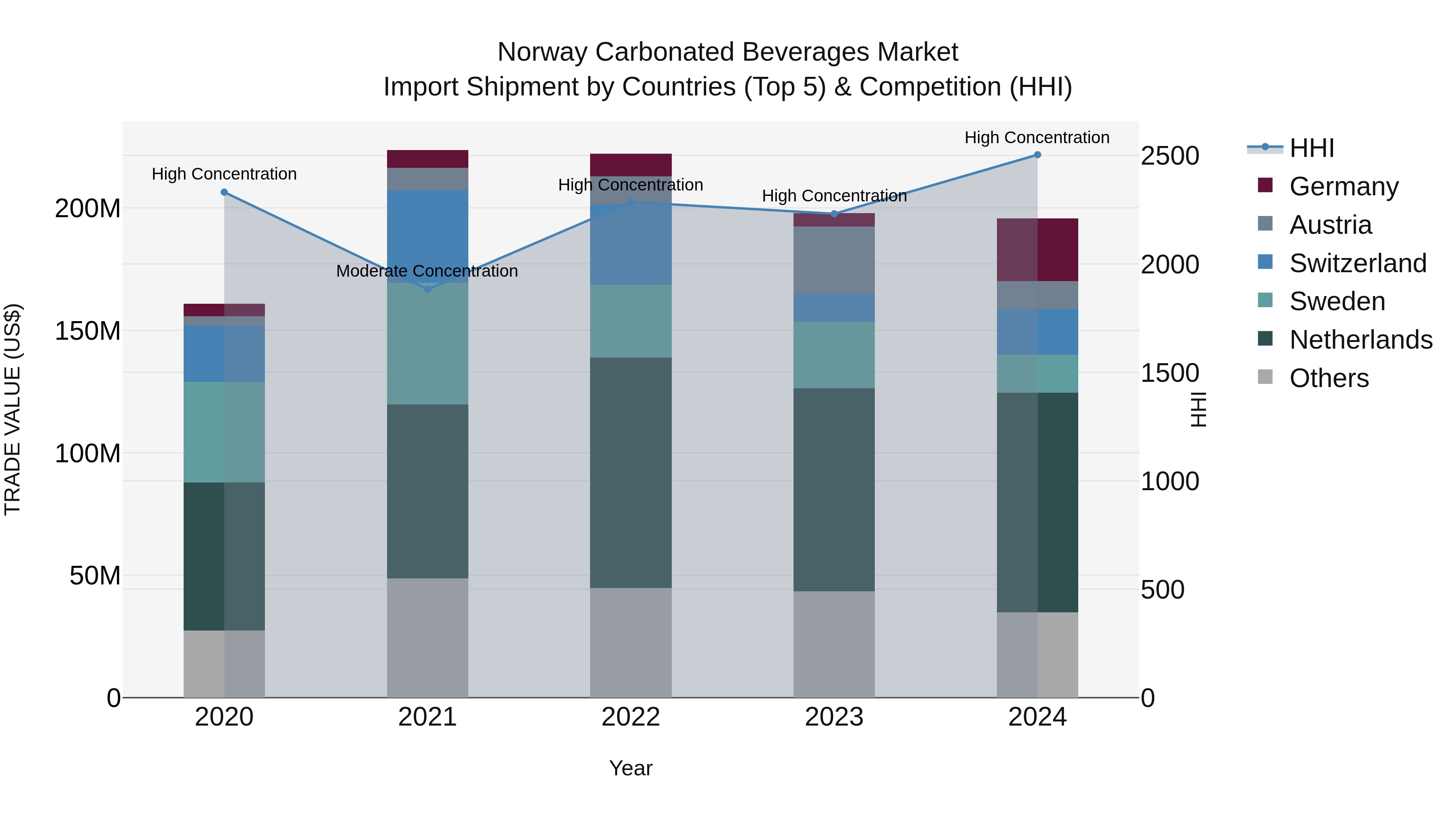
In 2024, Norway continued to see a high concentration of carbonated beverages imports, with top exporting countries being Netherlands, Germany, Switzerland, Sweden, and Austria. Despite a slight decline in growth rate from 2023 to 2024, the compound annual growth rate (CAGR) from 2020 to 2024 remained positive at 5.02%. This indicates a steady demand for carbonated beverages in Norway, with these key exporting countries playing a significant role in supplying the market. The consistent presence of these top exporters suggests a competitive market landscape and potential for further growth and development in the industry.
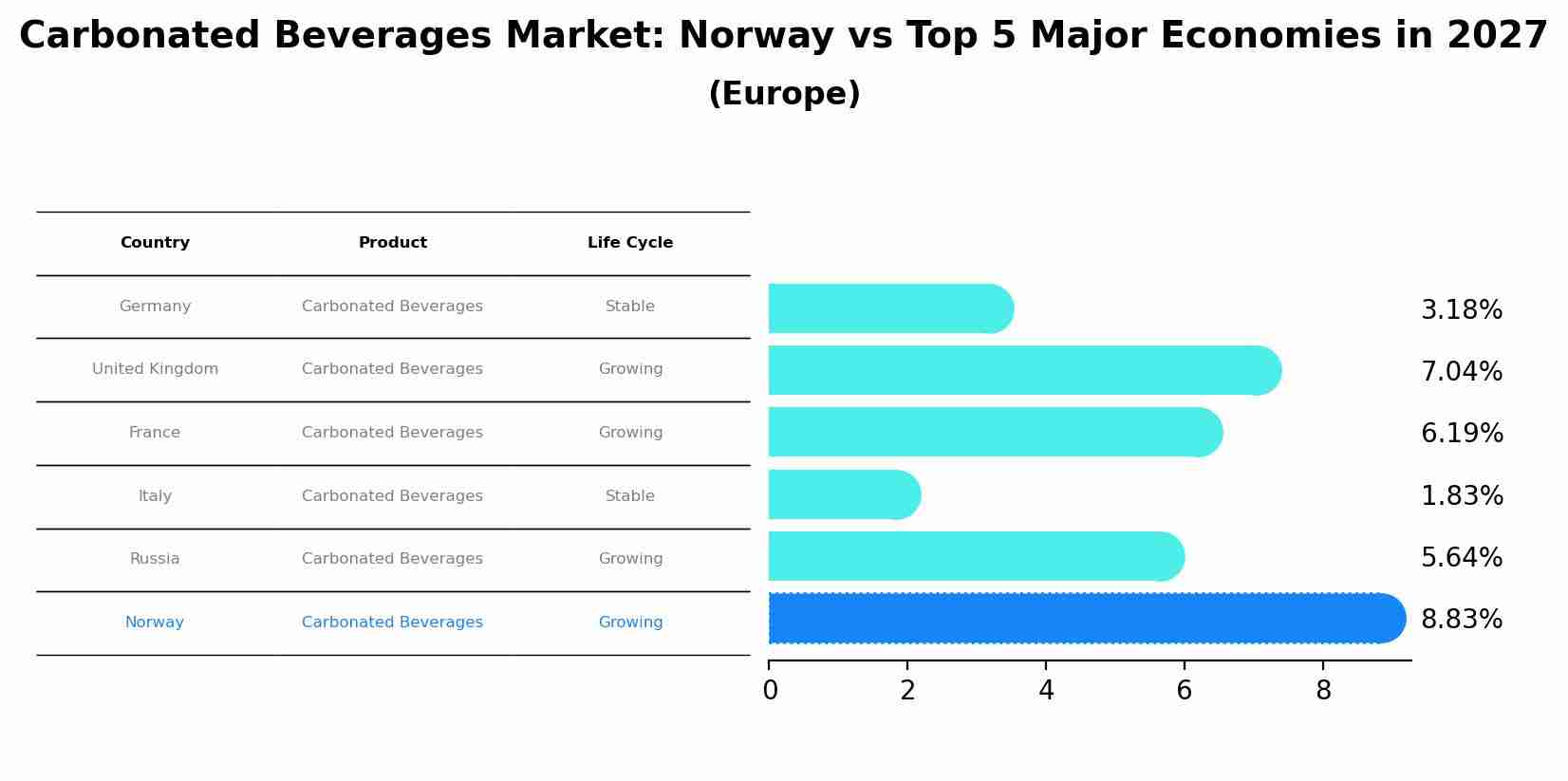
Carbonated Beverages Market: Norway vs Top 5 Major Economies in 2027 (Europe)
By 2027, Norway's Carbonated Beverages market is forecasted to achieve a growing growth rate of 8.83%, with Germany leading the Europe region, followed by United Kingdom, France, Italy and Russia.
Norway Carbonated Beverages Market Overview
The Carbonated Beverages market in Norway is experiencing growth as consumers continue to enjoy a variety of carbonated drinks, including sodas, sparkling waters, and flavored beverages. The market is influenced by changing consumer preferences, innovations in beverage flavors and formulations, and the expanding availability of carbonated beverages in retail and foodservice channels.
Drivers of the market
The Norway Carbonated Beverages Market is being driven by a rising consumer preference for fizzy drinks, especially among younger demographics. Innovations in flavors and product offerings are also contributing to the market`s expansion.
Challenges of the market
The Norway Carbonated Beverages Market faces challenges related to shifting consumer preferences toward healthier alternatives. Regulatory pressures regarding sugar content, along with competition from non-carbonated beverages, add complexity to the market.
Government Policy of the market
Norwegian government policies on public health and taxation on sugary drinks shape the carbonated beverages market. Initiatives to reduce sugar consumption and encourage healthier alternatives are key factors influencing the types of beverages available and their market demand.
Key Highlights of the Report:
- Norway Carbonated Beverages Market Outlook
- Market Size of Norway Carbonated Beverages Market, 2024
- Forecast of Norway Carbonated Beverages Market, 2031
- Historical Data and Forecast of Norway Carbonated Beverages Revenues & Volume for the Period 2021-2031
- Norway Carbonated Beverages Market Trend Evolution
- Norway Carbonated Beverages Market Drivers and Challenges
- Norway Carbonated Beverages Price Trends
- Norway Carbonated Beverages Porter`s Five Forces
- Norway Carbonated Beverages Industry Life Cycle
- Historical Data and Forecast of Norway Carbonated Beverages Market Revenues & Volume By Product Types for the Period 2021-2031
- Historical Data and Forecast of Norway Carbonated Beverages Market Revenues & Volume By Soft Drinks for the Period 2021-2031
- Historical Data and Forecast of Norway Carbonated Beverages Market Revenues & Volume By Carbonated Water for the Period 2021-2031
- Historical Data and Forecast of Norway Carbonated Beverages Market Revenues & Volume By Sports & Energy Drinks for the Period 2021-2031
- Historical Data and Forecast of Norway Carbonated Beverages Market Revenues & Volume By Others for the Period 2021-2031
- Historical Data and Forecast of Norway Carbonated Beverages Market Revenues & Volume By Flavour for the Period 2021-2031
- Historical Data and Forecast of Norway Carbonated Beverages Market Revenues & Volume By Cola for the Period 2021-2031
- Historical Data and Forecast of Norway Carbonated Beverages Market Revenues & Volume By Fruit Based for the Period 2021-2031
- Historical Data and Forecast of Norway Carbonated Beverages Market Revenues & Volume By Others for the Period 2021-2031
- Historical Data and Forecast of Norway Carbonated Beverages Market Revenues & Volume By Distribution Channel for the Period 2021-2031
- Historical Data and Forecast of Norway Carbonated Beverages Market Revenues & Volume By Hypermarkets & Supermarkets for the Period 2021-2031
- Historical Data and Forecast of Norway Carbonated Beverages Market Revenues & Volume By Convenience Stores for the Period 2021-2031
- Historical Data and Forecast of Norway Carbonated Beverages Market Revenues & Volume By Food Service Outlets for the Period 2021-2031
- Historical Data and Forecast of Norway Carbonated Beverages Market Revenues & Volume By Transport Terminals for the Period 2021-2031
- Historical Data and Forecast of Norway Carbonated Beverages Market Revenues & Volume By Online Stores & D2C for the Period 2021-2031
- Norway Carbonated Beverages Import Export Trade Statistics
- Market Opportunity Assessment By Product Types
- Market Opportunity Assessment By Flavour
- Market Opportunity Assessment By Distribution Channel
- Norway Carbonated Beverages Top Companies Market Share
- Norway Carbonated Beverages Competitive Benchmarking By Technical and Operational Parameters
- Norway Carbonated Beverages Company Profiles
- Norway Carbonated Beverages Key Strategic Recommendations






































