Norway Kegs Market Top 5 Importing Countries and Market Competition (HHI) Analysis
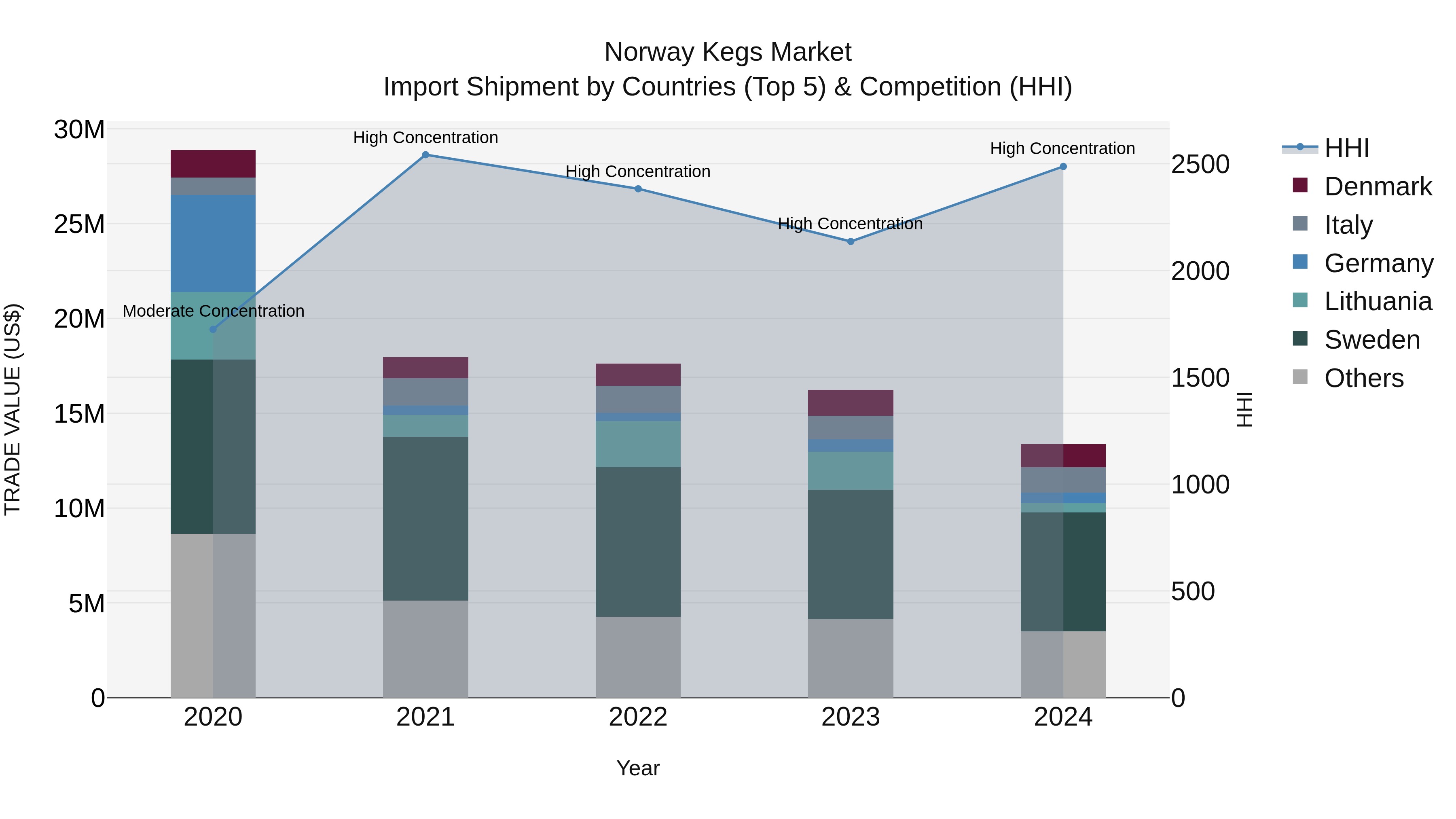
In 2024, Norway continued to see significant kegs import shipments, with top exporting countries being Sweden, Italy, Denmark, China, and Latvia. The market remained highly concentrated, as indicated by the high Herfindahl-Hirschman Index (HHI). However, the industry experienced a notable decline with a compound annual growth rate (CAGR) of -17.5% from 2020 to 2024. Furthermore, the growth rate in 2024 showed a continuation of this downward trend, with a decrease of -17.55% compared to the previous year. This data suggests a challenging environment for keg importers in Norway, requiring strategic adaptations to navigate market conditions.
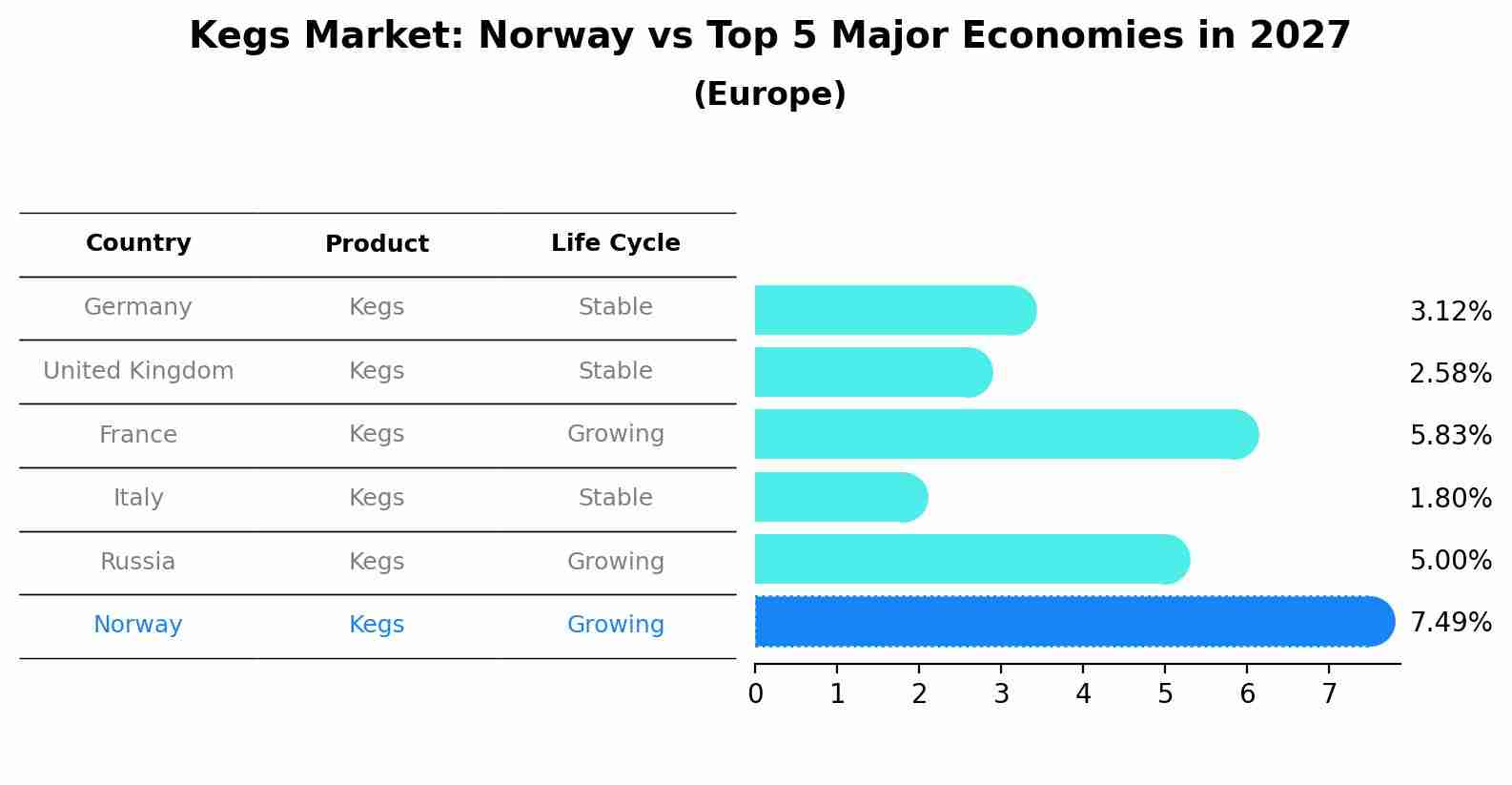
Kegs Market: Norway vs Top 5 Major Economies in 2027 (Europe)
The Kegs market in Norway is projected to grow at a growing growth rate of 7.49% by 2027, within the Europe region led by Germany, along with other countries like United Kingdom, France, Italy and Russia, collectively shaping a dynamic and evolving market environment driven by innovation and increasing adoption of emerging technologies.
Norway Kegs Market Overview
The kegs market in Norway is expanding due to the demand for kegs used in the storage and dispensing of beverages, particularly beer and soft drinks. Kegs offer convenience, quality preservation, and efficient distribution. The market benefits from advancements in keg technology, increasing demand in the beverage industry, and the need for reliable and durable keg solutions.
Drivers of the market
The kegs market in Norway is driven by the demand for efficient and cost-effective beverage storage and dispensing solutions. Kegs are widely used in the beverage industry, including for beer, wine, and soft drinks. The growth of the food and beverage industry, coupled with the increasing popularity of draft beverages and the need for sustainable packaging solutions, contributes to the market`s expansion. Innovations in keg design and the rise of craft breweries also drive the market.
Challenges of the market
The kegs market in Norway encounters challenges related to fluctuating raw material prices and the need to ensure the durability and quality of kegs. Managing production costs and complying with industry regulations are crucial for maintaining market competitiveness. Additionally, the market is competitive, with numerous global and local suppliers offering various keg solutions, which can impact pricing and market dynamics.
Government Policy of the market
Government policies in Norways kegs market focus on quality, safety, and regulatory compliance. Regulations ensure that kegs meet standards for durability and effectiveness in various applications. The government supports advancements in keg technologies that improve performance and safety.
Key Highlights of the Report:
- Norway Kegs Market Outlook
- Market Size of Norway Kegs Market, 2024
- Forecast of Norway Kegs Market, 2031
- Historical Data and Forecast of Norway Kegs Revenues & Volume for the Period 2021-2031
- Norway Kegs Market Trend Evolution
- Norway Kegs Market Drivers and Challenges
- Norway Kegs Price Trends
- Norway Kegs Porter`s Five Forces
- Norway Kegs Industry Life Cycle
- Historical Data and Forecast of Norway Kegs Market Revenues & Volume By Material for the Period 2021-2031
- Historical Data and Forecast of Norway Kegs Market Revenues & Volume By Plastic for the Period 2021-2031
- Historical Data and Forecast of Norway Kegs Market Revenues & Volume By Tin for the Period 2021-2031
- Historical Data and Forecast of Norway Kegs Market Revenues & Volume By Stainless Steel for the Period 2021-2031
- Historical Data and Forecast of Norway Kegs Market Revenues & Volume By Capacity for the Period 2021-2031
- Historical Data and Forecast of Norway Kegs Market Revenues & Volume By Up to 20 Liter for the Period 2021-2031
- Historical Data and Forecast of Norway Kegs Market Revenues & Volume By 20 Liter to 40 Liter for the Period 2021-2031
- Historical Data and Forecast of Norway Kegs Market Revenues & Volume By 40 Liter to 60 Liter for the Period 2021-2031
- Historical Data and Forecast of Norway Kegs Market Revenues & Volume By Above 60 Liter for the Period 2021-2031
- Historical Data and Forecast of Norway Kegs Market Revenues & Volume By End Use for the Period 2021-2031
- Historical Data and Forecast of Norway Kegs Market Revenues & Volume By Alcoholic Beverages for the Period 2021-2031
- Historical Data and Forecast of Norway Kegs Market Revenues & Volume By Non-Alcoholic Beverages for the Period 2021-2031
- Historical Data and Forecast of Norway Kegs Market Revenues & Volume By Cooking Oil for the Period 2021-2031
- Historical Data and Forecast of Norway Kegs Market Revenues & Volume By Chemicals for the Period 2021-2031
- Historical Data and Forecast of Norway Kegs Market Revenues & Volume By Others for the Period 2021-2031
- Historical Data and Forecast of Norway Kegs Market Revenues & Volume By Distribution Channel for the Period 2021-2031
- Historical Data and Forecast of Norway Kegs Market Revenues & Volume By Supermarket/Hypermarket for the Period 2021-2031
- Historical Data and Forecast of Norway Kegs Market Revenues & Volume By Commercial Liquor Store for the Period 2021-2031
- Historical Data and Forecast of Norway Kegs Market Revenues & Volume By Others for the Period 2021-2031
- Norway Kegs Import Export Trade Statistics
- Market Opportunity Assessment By Material
- Market Opportunity Assessment By Capacity
- Market Opportunity Assessment By End Use
- Market Opportunity Assessment By Distribution Channel
- Norway Kegs Top Companies Market Share
- Norway Kegs Competitive Benchmarking By Technical and Operational Parameters
- Norway Kegs Company Profiles
- Norway Kegs Key Strategic Recommendations






































