Oman Auto Parts And Accessories Market Size, Share & Growth Rate
The Oman Auto Parts And Accessories Market was estimated at USD 542 Million in 2025 and is projected to reach USD 779 Million by 2032, growing at a CAGR of 5.3% from 2026 to 2032. This growth trajectory is largely fueled by the rising vehicle ownership in Oman, coupled with an increasing focus on vehicle maintenance and upgrades. As the automotive industry expands, the demand for both replacement parts and innovative accessories will likely grow, underpinning a robust market outlook.
Oman Auto Parts And Accessories Market Year-wise Growth Rate and Key Drivers
This graph highlights how the Oman Auto Parts And Accessories Market has steadily grown over the years, supported by major growth factors.
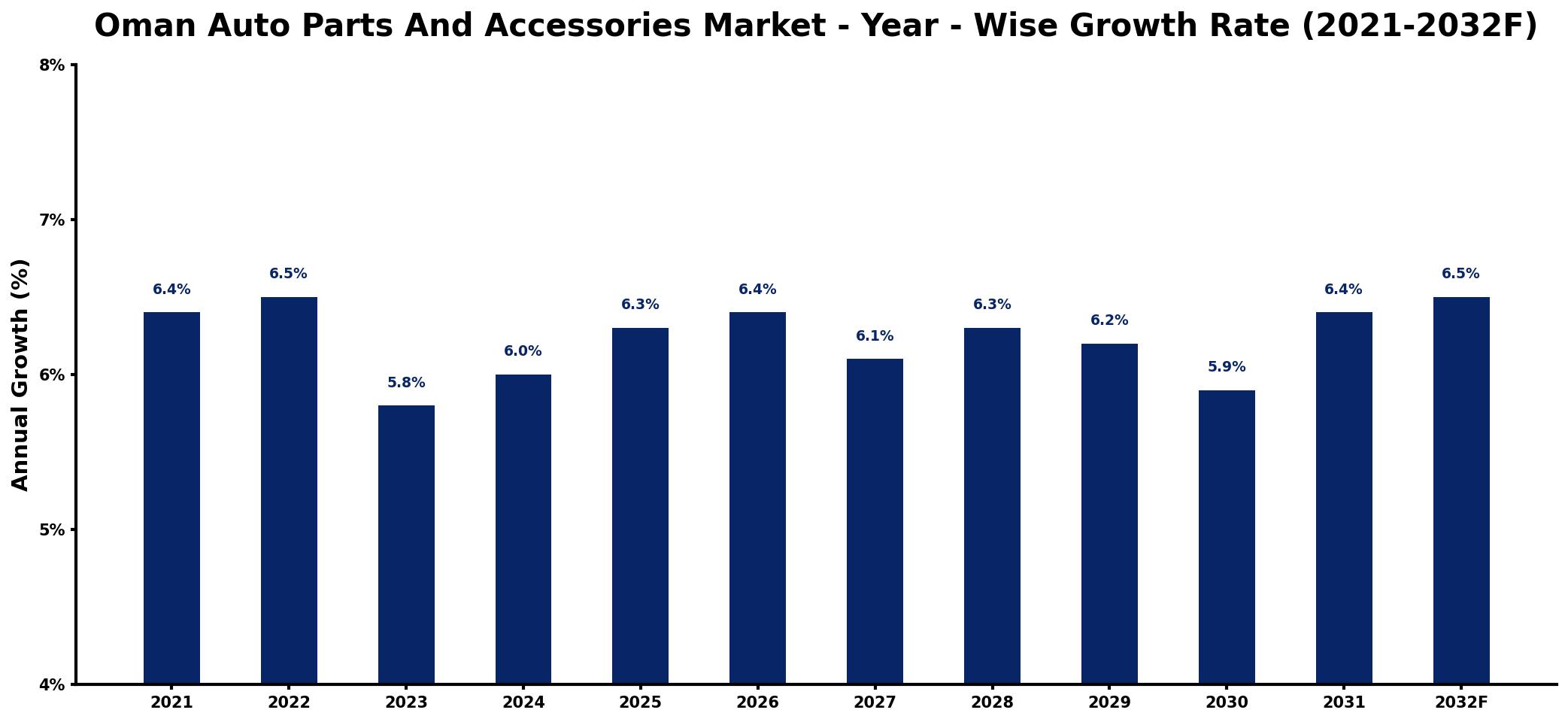
The table below presents the year‑wise growth rates along with the key drivers influencing the market
| Year | Growth Rate | Major Drivers |
| 2021 | 6.4% | Increased vehicle ownership rates |
| 2022 | 6.5% | Expansion of local manufacturing capacity |
| 2023 | 5.8% | Rising consumer spending trends |
| 2024 | 6.0% | Growth in transportation infrastructure projects |
| 2025 | 6.3% | Boost in online retail platforms |
| 2026 | 6.4% | Surge in vehicle maintenance services |
| 2027 | 6.1% | Higher demand for electric vehicles |
| 2028 | 6.3% | Investment in sustainable technologies |
| 2029 | 6.2% | increased pharmaceutical industry usage |
| 2030 | 5.9% | Increased focus on safety regulations |
| 2031 | 6.4% | rising demand from electronics |
| 2032 | 6.5% | Rising popularity of customization options |
Note: Market size estimations and growth projections presented in this report are based on 6Wresearch's proprietary forecasting methodology, utilizing the latest available industry data, government publications, and primary research inputs.
Oman Auto Parts And Accessories Market Synopsis
A significant force shaping the Oman Auto Parts and Accessories Market is the growing consumer demand for vehicle customization and performance enhancement. This trend is spurred by a demographic shift towards younger, tech-savvy consumers who prioritize vehicle personalization, driving the adoption of various aftermarket accessories.
Additionally, a pronounced shift toward online retail channels is reshaping how consumers interact with auto parts and accessories. By enhancing convenience and accessibility, these platforms are capturing consumer interest and driving sales growth, making it easier for customers to find the right products.
Oman Auto Parts And Accessories Market Key Takeaways
- The market is poised for significant growth, driven by increased vehicle ownership and a focus on maintenance.
- Consumers are increasingly turning to online channels for their auto parts and accessories purchases.
- There is a marked rise in demand for electric vehicle components as sustainable transportation gains traction.
- Quality and durability are key factors for consumers, leading to a preference for premium products.
- Technological advancements are creating new opportunities for smart and connected vehicle accessories.
Evaluation of Restraints in Oman Auto Parts And Accessories Market
The Oman Auto Parts and Accessories Market faces several restraints that can impact its growth trajectory. The prevalence of counterfeit products undermines the trust in genuine brands and poses safety risks for consumers, complicating the purchasing process. Furthermore, the limited availability of skilled labor for specialized automotive services leads to service delays and can affect customer satisfaction. Economic fluctuations, particularly in oil prices, also influence consumer spending power, further impacting demand for auto parts. Lastly, the absence of standardized regulations presents challenges for businesses in ensuring product quality and competing effectively.
Oman Auto Parts And Accessories Market Trends
Several current and emerging trends are shaping the Oman Auto Parts and Accessories Market. The increasing consumer inclination towards electric vehicles is prompting the demand for EV-specific components. Online retail continues to gain momentum, making shopping for auto parts more accessible. Theres also a heightened focus on quality, with consumers willing to invest in products that promise durability and performance. Additionally, the integration of advanced technologies, such as connected car devices, is becoming a priority for consumers, reflecting a shift towards smarter automotive solutions.
Oman Auto Parts And Accessories Market Opportunities
Investment opportunities abound in the Oman Auto Parts and Accessories Market due to the expanding automotive industry and increasing vehicle sales. As the number of vehicles on the road grows, there is heightened demand for high-quality components and accessories. Investors should consider diversifying their offerings to include a wide range of products, from engine components to aftermarket enhancements. Additionally, the integration of innovative technologies and digital solutions presents a promising avenue for growth, enhancing operational efficiencies and meeting evolving consumer demands.
Government Initiatives in the Oman Auto Parts And Accessories Market
The Omani government has enacted various policies aimed at regulating and supporting the auto parts and accessories market. These initiatives include stringent import regulations to ensure product quality and safety, alongside tariffs designed to foster local manufacturing capabilities. Furthermore, the government is actively encouraging innovation within the sector, seeking to enhance the competitiveness of domestic players while generating job opportunities, ultimately contributing to the broader economic growth of Oman.
Future Insights of the Oman Auto Parts And Accessories Market
Looking ahead, the Oman Auto Parts and Accessories Market is set for steady growth from 2026 to 2032. The increasing vehicle sales, coupled with rising consumer demand for customization, will further stimulate the aftermarket sector. Moreover, the ongoing shift towards electric vehicles is likely to create new avenues for manufacturers and suppliers, allowing them to cater to a more diverse customer base. As regulations strengthen and consumer focus on vehicle safety intensifies, the market is positioned for sustained expansion, attracting both domestic and international investments.
Oman Auto Parts And Accessories Market Latest Developments (2025 - 2026)
Recent developments in the Oman Auto Parts and Accessories Market indicate a growing trend towards technological advancements, particularly in smart accessory integration. Many retailers are enhancing their online platforms to provide a more streamlined shopping experience, catering to the increasing preference for digital solutions. Simultaneously, there is a noticeable uptick in investment towards electric vehicle parts, in line with government initiatives promoting sustainable transportation. These shifts reflect a market adapting to consumer demands and technological progress.
Oman Auto Parts And Accessories Market - Key Attractiveness of the Report
- 10 Years of Market Numbers
- Historical Data Starting from 2022 to 2025
- Base Year: 2025
- Forecast Data until 2032
- Key Performance Indicators Impacting the Market
- Major Upcoming Developments and Projects
Key Highlights of the Report:
- Oman Auto Parts And Accessories Market Outlook
- Market Size of Oman Auto Parts And Accessories Market, 2025
- Forecast of Oman Auto Parts And Accessories Market, 2032
- Historical Data and Forecast of Oman Auto Parts And Accessories Revenues & Volume for the Period 2022-2032F
- Oman Auto Parts And Accessories Market Trend Evolution
- Oman Auto Parts And Accessories Market Drivers and Challenges
- Oman Auto Parts And Accessories Price Trends
- Oman Auto Parts And Accessories Porter's Five Forces
- Oman Auto Parts And Accessories Industry Life Cycle
- Historical Data and Forecast of Oman Auto Parts And Accessories Market Revenues & Volume By Product for the Period 2022-2032F
- Historical Data and Forecast of Oman Auto Parts And Accessories Market Revenues & Volume By Driveline & Powertrain for the Period 2022-2032F
- Historical Data and Forecast of Oman Auto Parts And Accessories Market Revenues & Volume By Interiors & Exteriors for the Period 2022-2032F
- Historical Data and Forecast of Oman Auto Parts And Accessories Market Revenues & Volume By Electronics for the Period 2022-2032F
- Historical Data and Forecast of Oman Auto Parts And Accessories Market Revenues & Volume By Bodies & Chassis for the Period 2022-2032F
- Historical Data and Forecast of Oman Auto Parts And Accessories Market Revenues & Volume By Wheel & Tires for the Period 2022-2032F
- Historical Data and Forecast of Oman Auto Parts And Accessories Market Revenues & Volume By Others for the Period 2022-2032F
- Historical Data and Forecast of Oman Auto Parts And Accessories Market Revenues & Volume By Application for the Period 2022-2032F
- Historical Data and Forecast of Oman Auto Parts And Accessories Market Revenues & Volume By OEMs for the Period 2022-2032F
- Historical Data and Forecast of Oman Auto Parts And Accessories Market Revenues & Volume By Aftermarket for the Period 2022-2032F
- Oman Auto Parts And Accessories Import Export Trade Statistics
- Market Opportunity Assessment By Product
- Market Opportunity Assessment By Application
- Oman Auto Parts And Accessories Top Companies Market Share
- Oman Auto Parts And Accessories Competitive Benchmarking By Technical and Operational Parameters
- Oman Auto Parts And Accessories Company Profiles
- Oman Auto Parts And Accessories Key Strategic Recommendations






































