Italy Auto Parts And Accessories Market Size, Share & Growth Rate
The Italy Auto Parts And Accessories Market was estimated at USD 97 Million in 2025 and is projected to reach USD 107 Million by 2032, growing at a CAGR of 1.4% from 2026 to 2032. This growth trajectory is fueled by an expanding vehicle fleet and a rising trend towards vehicle personalization. As Italian consumers increasingly demand high-quality aftermarket products, coupled with technological advancements in the automotive sector, the market's landscape is poised for dynamic evolution.
Italy Auto Parts And Accessories Market Year-wise Growth Rate and Key Drivers
This graph highlights how the Italy Auto Parts And Accessories Market has steadily grown over the years, supported by major growth factors.
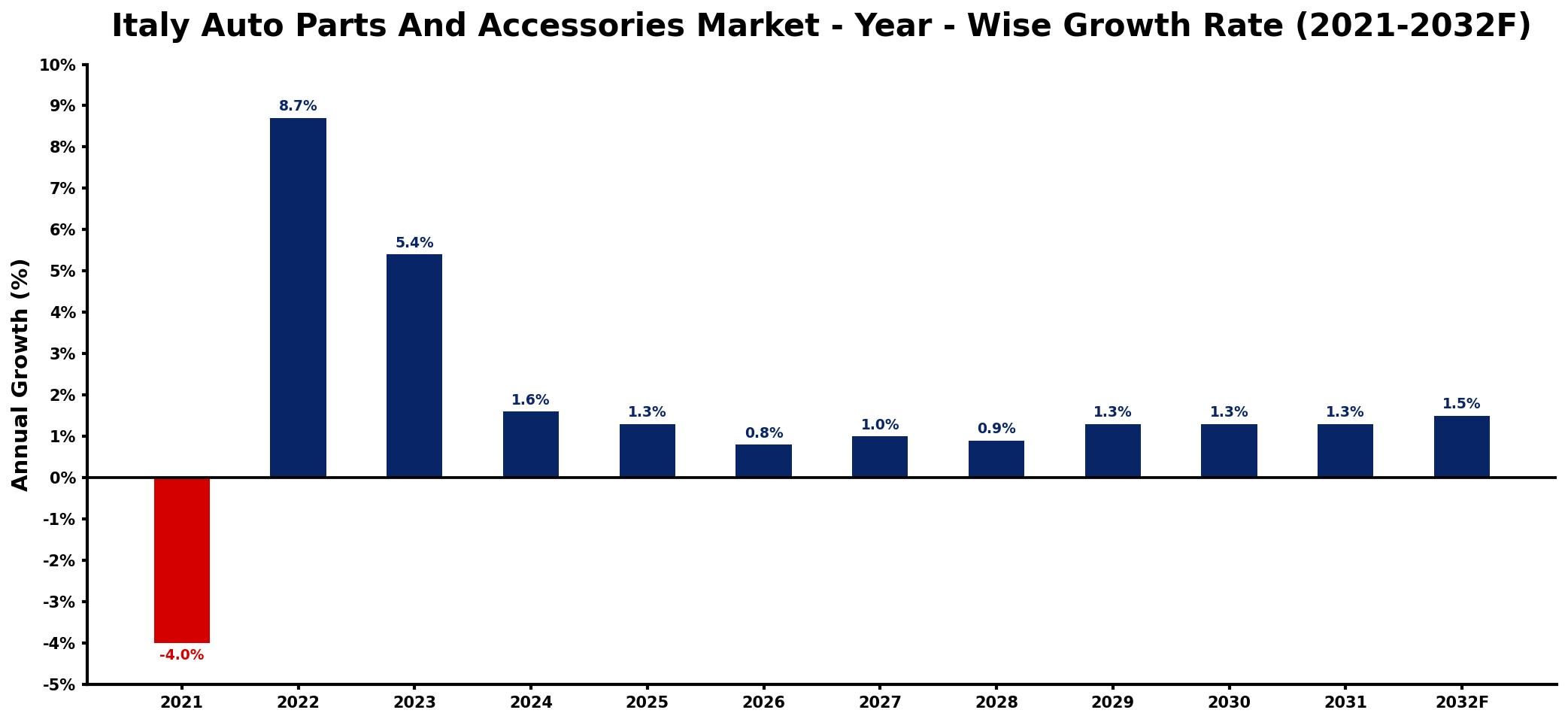
The table below presents the year‑wise growth rates along with the key drivers influencing the market
| Year | Growth Rate | Major Drivers |
| 2021 | -4.0% | decrease in consumer spending habits |
| 2022 | 8.7% | rising demand for sustainable solutions |
| 2023 | 5.4% | increased electric vehicle adoption |
| 2024 | 1.6% | growth in online sales channels |
| 2025 | 1.3% | expansion of manufacturing capabilities |
| 2026 | 0.8% | stronger distribution network expansion |
| 2027 | 1.0% | investment in technology advancements |
| 2028 | 0.9% | improved processing technologies adoption |
| 2029 | 1.3% | growing interest in customization options |
| 2030 | 1.3% | rising popularity of car leasing |
| 2031 | 1.3% | enhanced focus on safety features |
| 2032 | 1.5% | development of smart vehicle technologies |
Note: Market size estimations and growth projections presented in this report are based on 6Wresearch's proprietary forecasting methodology, utilizing the latest available industry data, government publications, and primary research inputs.
Italy Auto Parts And Accessories Market Synopsis
The Italian auto parts and accessories segment is marked by a robust demand for premium components, a reflection of consumer preferences for quality and performance. With a large vehicle population and the growing influence of electric vehicles, there is a notable demand for both traditional and advanced automotive parts.
The market caters to a diverse customer base, including professional mechanics and DIY enthusiasts. This broad appeal contributes to the dynamic landscape of the Italy Auto Parts And Accessories Market, which is continuously adapting to changing consumer expectations and technological innovations.
Italy Auto Parts And Accessories Market Key Takeaways
- The market is evolving towards more sustainable and eco-friendly products.
- Technological advancements are creating new opportunities for innovative auto parts.
- Online sales channels are increasingly preferred by consumers for purchasing auto parts.
- There is a growing demand for advanced safety features in vehicles.
- Investment in electric vehicle components is seen as a lucrative opportunity.
Evaluation of Restraints in Italy Auto Parts And Accessories Market
The Italian auto parts and accessories market faces several restraints that can hinder growth. Increasing competition from both domestic and international manufacturers intensifies the pressure on margins and requires constant innovation. Fluctuating raw material prices present additional challenges that impact manufacturing costs, pushing companies to optimize supply chains and production processes. Furthermore, stringent government regulations concerning emissions and safety standards complicate compliance, thereby affecting market operations.
Italy Auto Parts And Accessories Market Trends
Current trends highlight a significant shift toward sustainability, with consumers increasingly gravitating towards eco-friendly auto parts and accessories. The adoption of electric vehicles is reshaping product demand, with components tailored to hybrid technologies gaining traction. Moreover, the rise of e-commerce is transforming how consumers access auto parts, with online platforms offering greater convenience and variety. These trends underscore a broader movement towards technological integration in vehicle customization and safety.
Italy Auto Parts And Accessories Market Opportunities
As the Italian automotive market progresses, several investment opportunities emerge. The increasing focus on electric and hybrid vehicle components presents a lucrative avenue for manufacturers. Additionally, the demand for high-quality aftermarket accessories provides fertile ground for companies to innovate and capture niche segments. The growing interest in advanced safety technologies also opens doors for investments in research and development, paving the way for collaboration with original equipment manufacturers (OEMs) seeking to enhance vehicle safety features.
Government Initiatives in the Italy Auto Parts And Accessories Market
The Italian government has implemented a range of policies aimed at promoting environmental sustainability in the auto parts sector. Stringent regulations surrounding emissions and safety standards play a crucial role in shaping the market landscape. Furthermore, initiatives to encourage the production and adoption of electric vehicles support the demand for relevant parts and accessories. Public spending on infrastructure and technology further fuels innovation within the industry, as the government seeks to align with international standards.
Future Insights of the Italy Auto Parts And Accessories Market
Looking ahead to 2026-2032, the outlook for the Italy Auto Parts and Accessories Market is promising. Growth in vehicle sales and ongoing technological advancements are expected to drive demand for innovative products. Additionally, the continued emphasis on customization and the evolution of electric vehicles will create new opportunities for manufacturers and suppliers. Companies that invest in R&D and prioritize quality will be best positioned to thrive in this evolving market landscape.
Italy Auto Parts And Accessories Market Latest Developments (2025 - 2026)
In recent months, the Italy Auto Parts and Accessories Market has seen a surge in the introduction of advanced safety technologies, responding to consumer demand for increased vehicle safety. Companies are also pivoting towards sustainable practices in manufacturing, reflecting a broader industry commitment to eco-friendly initiatives. The trend towards online sales continues to grow, with many businesses enhancing their digital presence to cater to a shifting customer base that favors convenience and accessibility.
Italy Auto Parts And Accessories Market - Key Attractiveness of the Report
- 10 Years of Market Numbers
- Historical Data Starting from 2022 to 2025
- Base Year: 2025
- Forecast Data until 2032
- Key Performance Indicators Impacting the Market
- Major Upcoming Developments and Projects
Key Highlights of the Report:
- Italy Auto Parts And Accessories Market Outlook
- Market Size of Italy Auto Parts And Accessories Market, 2025
- Forecast of Italy Auto Parts And Accessories Market, 2032
- Historical Data and Forecast of Italy Auto Parts And Accessories Revenues & Volume for the Period 2022-2032F
- Italy Auto Parts And Accessories Market Trend Evolution
- Italy Auto Parts And Accessories Market Drivers and Challenges
- Italy Auto Parts And Accessories Price Trends
- Italy Auto Parts And Accessories Porter's Five Forces
- Italy Auto Parts And Accessories Industry Life Cycle
- Historical Data and Forecast of Italy Auto Parts And Accessories Market Revenues & Volume By Product for the Period 2022-2032F
- Historical Data and Forecast of Italy Auto Parts And Accessories Market Revenues & Volume By Driveline & Powertrain for the Period 2022-2032F
- Historical Data and Forecast of Italy Auto Parts And Accessories Market Revenues & Volume By Interiors & Exteriors for the Period 2022-2032F
- Historical Data and Forecast of Italy Auto Parts And Accessories Market Revenues & Volume By Electronics for the Period 2022-2032F
- Historical Data and Forecast of Italy Auto Parts And Accessories Market Revenues & Volume By Bodies & Chassis for the Period 2022-2032F
- Historical Data and Forecast of Italy Auto Parts And Accessories Market Revenues & Volume By Wheel & Tires for the Period 2022-2032F
- Historical Data and Forecast of Italy Auto Parts And Accessories Market Revenues & Volume By Others for the Period 2022-2032F
- Historical Data and Forecast of Italy Auto Parts And Accessories Market Revenues & Volume By Application for the Period 2022-2032F
- Historical Data and Forecast of Italy Auto Parts And Accessories Market Revenues & Volume By OEMs for the Period 2022-2032F
- Historical Data and Forecast of Italy Auto Parts And Accessories Market Revenues & Volume By Aftermarket for the Period 2022-2032F
- Italy Auto Parts And Accessories Import Export Trade Statistics
- Market Opportunity Assessment By Product
- Market Opportunity Assessment By Application
- Italy Auto Parts And Accessories Top Companies Market Share
- Italy Auto Parts And Accessories Competitive Benchmarking By Technical and Operational Parameters
- Italy Auto Parts And Accessories Company Profiles
- Italy Auto Parts And Accessories Key Strategic Recommendations






































