Tajikistan Auto Parts And Accessories Market Size, Share & Growth Rate
The Tajikistan Auto Parts And Accessories Market was estimated at USD 372 Million in 2025 and is projected to reach USD 518 Million by 2032, growing at a CAGR of 4.8% from 2026 to 2032. This growth trajectory is fueled by a burgeoning vehicle ownership rate, coupled with a marked increase in the demand for both routine maintenance and vehicle customization. As the economy continues to evolve, rising disposable incomes contribute to consumers' aspirations for higher quality and more reliable auto components.
Tajikistan Auto Parts And Accessories Market Year-wise Growth Rate and Key Drivers
This graph highlights how the Tajikistan Auto Parts And Accessories Market has steadily grown over the years, supported by major growth factors.
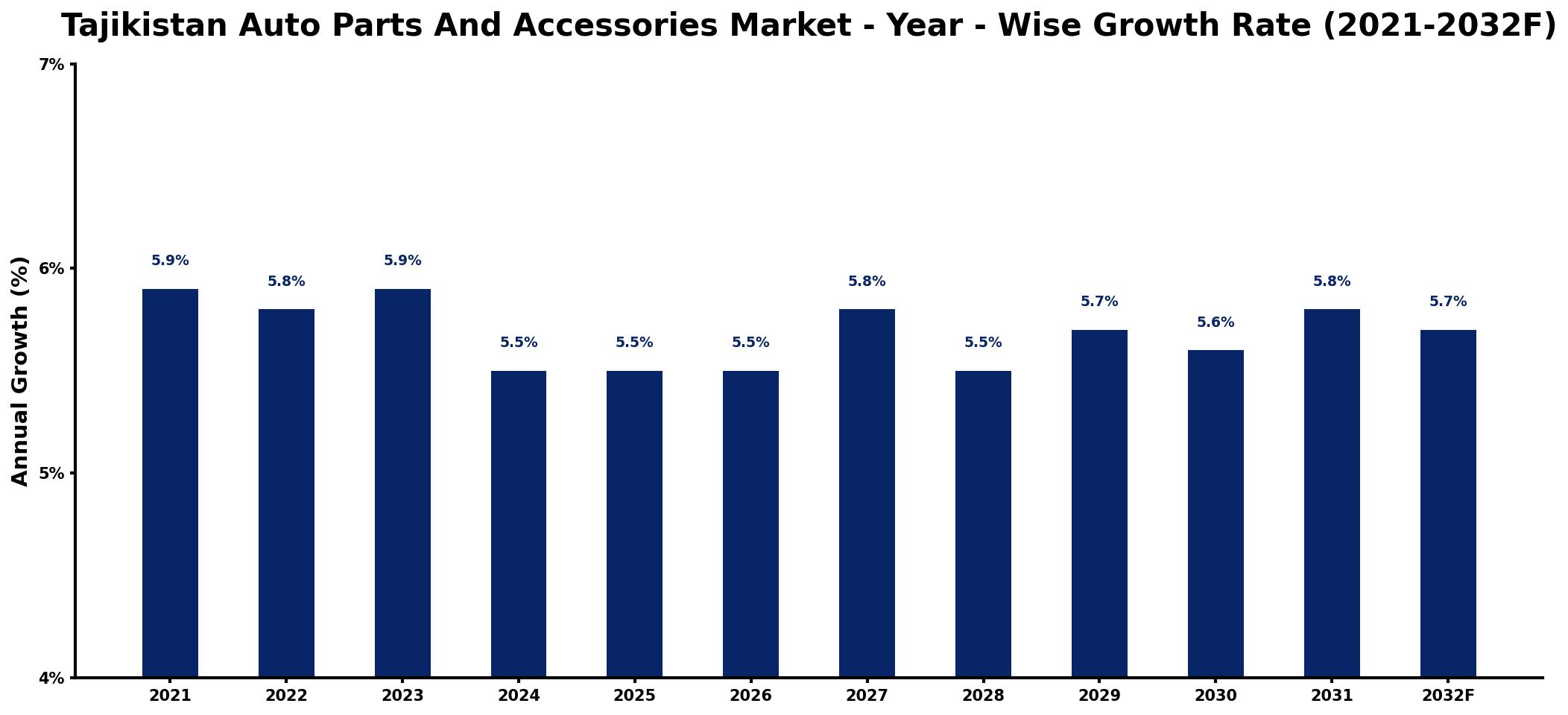
The table below presents the year‑wise growth rates along with the key drivers influencing the market
| Year | Growth Rate | Major Drivers |
| 2021 | 5.9% | Rising consumer purchasing power |
| 2022 | 5.8% | Increased vehicle registrations nationwide |
| 2023 | 5.9% | Growth in transportation infrastructure |
| 2024 | 5.5% | Expanding regional trade agreements |
| 2025 | 5.5% | Investments in local manufacturing |
| 2026 | 5.5% | Improved logistics and distribution networks |
| 2027 | 5.8% | Surge in online retail platforms |
| 2028 | 5.5% | Growing demand for vehicle maintenance |
| 2029 | 5.7% | Increase in fleet management services |
| 2030 | 5.6% | Development of eco-friendly technologies |
| 2031 | 5.8% | Enhanced government support initiatives |
| 2032 | 5.7% | Rising popularity of electric vehicles |
Note: Market size estimations and growth projections presented in this report are based on 6Wresearch's proprietary forecasting methodology, utilizing the latest available industry data, government publications, and primary research inputs.
Tajikistan Auto Parts And Accessories Market Synopsis
The current landscape of the Tajikistan auto parts and accessories market is characterized by a clear upward trend in consumer demand, primarily driven by a surge in vehicle ownership. As more citizens acquire vehicles, the necessity for quality maintenance products and accessories becomes increasingly apparent.
Due to limited domestic production capabilities, the market remains heavily reliant on imports from countries such as China, Russia, and Turkey. This reliance highlights both the challenges and opportunities present within the market, as local consumers seek dependable, high-quality products to enhance their vehicle experience.
Tajikistan Auto Parts And Accessories Market Key Takeaways
- The market is currently dominated by imported auto parts, with limited local manufacturing.
- Consumers show a growing preference for OEM parts, reflecting a desire for quality and reliability.
- The shift toward online purchasing channels is reshaping how consumers acquire auto parts and accessories.
- Investment opportunities are ripe, especially in establishing distribution networks and retail platforms.
- Government policies are focused on bolstering domestic production and enhancing market competitiveness.
Evaluation of Restraints in Tajikistan Auto Parts And Accessories Market
Despite its potential, the Tajikistan auto parts and accessories market faces several significant constraints. The predominant issue is the limited availability of high-quality products, as the markets heavy reliance on imports can lead to challenges like inconsistent product quality and delivery delays. Furthermore, a lack of a robust distribution network complicates access for both individual consumers and businesses. Additionally, the infiltration of counterfeit goods poses a serious threat, undermining consumer trust and affecting legitimate businesses striving for quality.
Tajikistan Auto Parts And Accessories Market Trends
A notable trend in the Tajikistan auto parts and accessories market is the growing consumer inclination toward high-quality, durable products that promise longevity and performance. This shift is complemented by the rising popularity of online shopping, where consumers appreciate the convenience and variety offered. Retailers are adapting to these demands by expanding product lines, enhancing customer service, and offering user-friendly online platforms.
Tajikistan Auto Parts And Accessories Market Opportunities
With increasing vehicle registrations and a rising middle class, numerous investment opportunities are emerging within the Tajikistan auto parts and accessories market. Ventures focused on creating efficient distribution channels, establishing retail stores, or developing e-commerce platforms can be particularly lucrative. Collaborating with local manufacturers is another promising avenue to ensure a consistent supply of quality products while aligning with governmental initiatives to enhance domestic production.
Government Initiatives in the Tajikistan Auto Parts And Accessories Market
The Tajikistan government has enacted policies aimed at fostering the local auto parts and accessories manufacturing sector. This includes providing tax incentives, subsidies, and loans to stimulate domestic production. Additionally, the government promotes partnerships between local and international firms to facilitate technology transfer and elevate the industrys standards. Such initiatives are strategically designed to reduce the countrys dependence on imports while enhancing the overall quality of products available in the market.
Future Insights of the Tajikistan Auto Parts And Accessories Market
Looking ahead, the outlook for the Tajikistan auto parts and accessories market is optimistic. Factors such as increasing vehicle ownership rates and a general rise in disposable income are likely to drive demand further. Moreover, improving road infrastructure will enhance vehicle usage, thus propelling the need for aftermarket products. The governments focus on bolstering the automotive industry and attracting foreign investments will create additional opportunities for growth, paving the way for both domestic and foreign suppliers to meet consumer demand.
Tajikistan Auto Parts And Accessories Market Latest Developments (2025 - 2026)
Recently, the auto parts and accessories market in Tajikistan has shown signs of dynamic movement, with an increasing number of players exploring e-commerce avenues to cater to tech-savvy consumers. Additionally, there has been a noteworthy push towards establishing partnerships between local businesses and international suppliers, aimed at enhancing product quality and availability. The government continues to emphasize initiatives that encourage local production, indicating a shift towards a more self-reliant market structure.
Tajikistan Auto Parts And Accessories Market - Key Attractiveness of the Report
- 10 Years of Market Numbers
- Historical Data Starting from 2022 to 2025
- Base Year: 2025
- Forecast Data until 2032
- Key Performance Indicators Impacting the Market
- Major Upcoming Developments and Projects
Key Highlights of the Report:
- Tajikistan Auto Parts And Accessories Market Outlook
- Market Size of Tajikistan Auto Parts And Accessories Market, 2025
- Forecast of Tajikistan Auto Parts And Accessories Market, 2032
- Historical Data and Forecast of Tajikistan Auto Parts And Accessories Revenues & Volume for the Period 2022-2032F
- Tajikistan Auto Parts And Accessories Market Trend Evolution
- Tajikistan Auto Parts And Accessories Market Drivers and Challenges
- Tajikistan Auto Parts And Accessories Price Trends
- Tajikistan Auto Parts And Accessories Porter's Five Forces
- Tajikistan Auto Parts And Accessories Industry Life Cycle
- Historical Data and Forecast of Tajikistan Auto Parts And Accessories Market Revenues & Volume By Product for the Period 2022-2032F
- Historical Data and Forecast of Tajikistan Auto Parts And Accessories Market Revenues & Volume By Driveline & Powertrain for the Period 2022-2032F
- Historical Data and Forecast of Tajikistan Auto Parts And Accessories Market Revenues & Volume By Interiors & Exteriors for the Period 2022-2032F
- Historical Data and Forecast of Tajikistan Auto Parts And Accessories Market Revenues & Volume By Electronics for the Period 2022-2032F
- Historical Data and Forecast of Tajikistan Auto Parts And Accessories Market Revenues & Volume By Bodies & Chassis for the Period 2022-2032F
- Historical Data and Forecast of Tajikistan Auto Parts And Accessories Market Revenues & Volume By Wheel & Tires for the Period 2022-2032F
- Historical Data and Forecast of Tajikistan Auto Parts And Accessories Market Revenues & Volume By Others for the Period 2022-2032F
- Historical Data and Forecast of Tajikistan Auto Parts And Accessories Market Revenues & Volume By Application for the Period 2022-2032F
- Historical Data and Forecast of Tajikistan Auto Parts And Accessories Market Revenues & Volume By OEMs for the Period 2022-2032F
- Historical Data and Forecast of Tajikistan Auto Parts And Accessories Market Revenues & Volume By Aftermarket for the Period 2022-2032F
- Tajikistan Auto Parts And Accessories Import Export Trade Statistics
- Market Opportunity Assessment By Product
- Market Opportunity Assessment By Application
- Tajikistan Auto Parts And Accessories Top Companies Market Share
- Tajikistan Auto Parts And Accessories Competitive Benchmarking By Technical and Operational Parameters
- Tajikistan Auto Parts And Accessories Company Profiles
- Tajikistan Auto Parts And Accessories Key Strategic Recommendations






































