Oman Food & Grocery Retail Market Size, Share & Growth Rate
The Oman Food & Grocery Retail Market was estimated at USD 666 Million in 2025 and is projected to reach USD 1160 Million by 2032, growing at a CAGR of 8.2% from 2026 to 2032. This impressive growth is primarily fueled by a young, urbanizing population with increasing disposable income and a burgeoning appetite for convenience, quality, and diverse food options. Additionally, the shift towards online shopping and the rising demand for health-conscious products further contribute to this positive trajectory.
Oman Food & Grocery Retail Market Year-wise Growth Rate and Key Drivers
This graph highlights how the Oman Food & Grocery Retail Market has steadily grown over the years, supported by major growth factors.
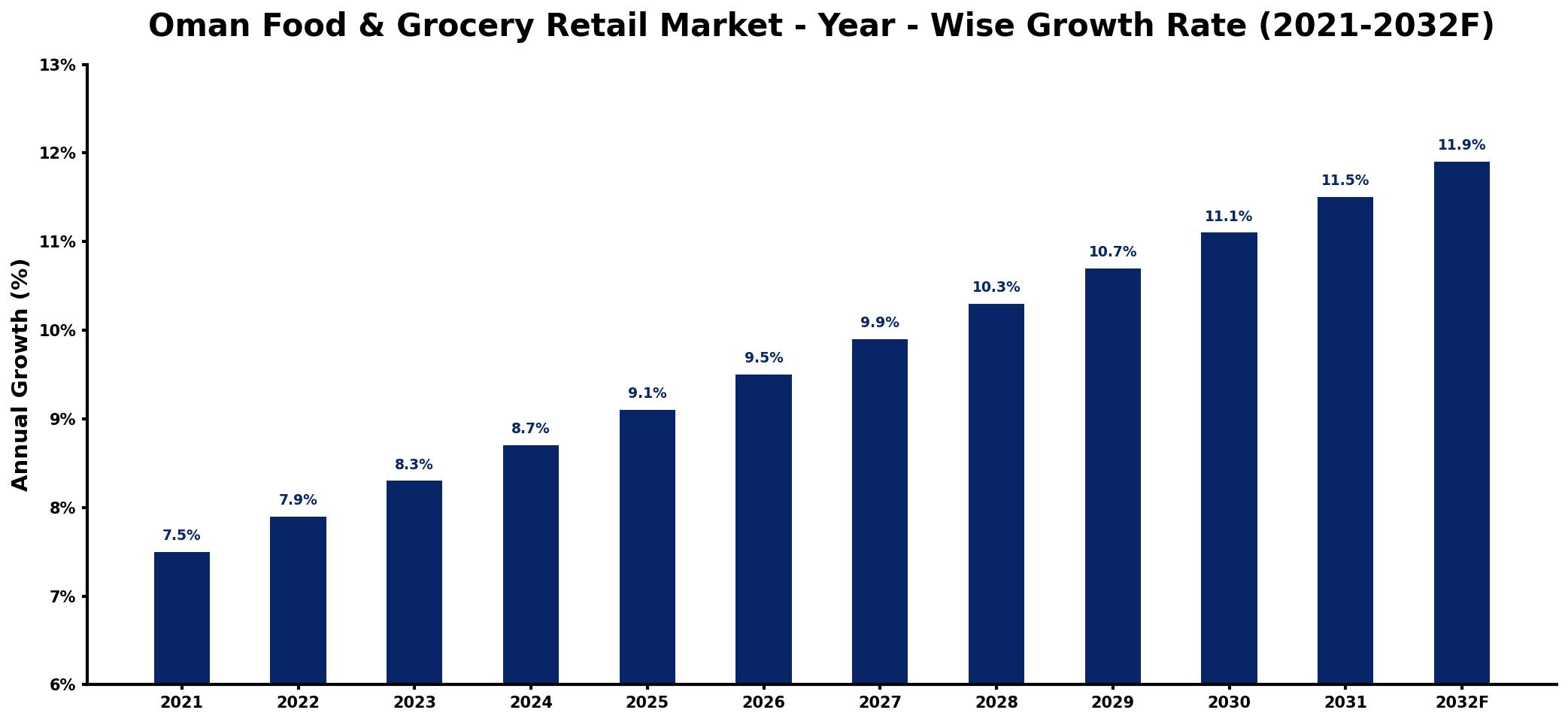
The table below presents the year‑wise growth rates along with the key drivers influencing the market
| Year | Growth Rate | Major Drivers |
| 2021 | 7.5% | Increased consumer spending habits |
| 2022 | 7.9% | Expansion of online shopping platforms |
| 2023 | 8.3% | Rising demand for convenience options |
| 2024 | 8.7% | Growth in health conscious consumers |
| 2025 | 9.1% | Investments in supply chain efficiency |
| 2026 | 9.5% | Emergence of local brands popularity |
| 2027 | 9.9% | Increased variety in product offerings |
| 2028 | 10.3% | Development of sustainable sourcing practices |
| 2029 | 10.7% | Enhanced customer loyalty programs |
| 2030 | 11.1% | Technological advancements in logistics |
| 2031 | 11.5% | Rising disposable income levels |
| 2032 | 11.9% | growing downstream application demand |
Note: Market size estimations and growth projections presented in this report are based on 6Wresearch's proprietary forecasting methodology, utilizing the latest available industry data, government publications, and primary research inputs.
Oman Food & Grocery Retail Market Synopsis
The strongest force shaping the Oman Food & Grocery Retail Market today is the pronounced shift towards convenience and health-oriented offerings. As consumers become increasingly health-conscious, they are actively seeking out organic, gluten-free, and ethically produced goods that cater to their lifestyle changes.
In parallel, the growth of e-commerce has transformed the shopping landscape, making it crucial for retailers to enhance their online presence. As a result, many are investing in technology and infrastructure to provide efficient delivery and pick-up services, thereby meeting the evolving preferences of Omani consumers.
- The market is witnessing a robust transition towards online grocery shopping.
- Health and wellness trends are driving consumer demand for organic and locally sourced products.
- Intense competition is prompting retailers to innovate their offerings continuously.
- Government initiatives are supporting local producers and promoting sustainable practices.
- The expansion of supermarkets and hypermarkets is reshaping the retail landscape.
Despite promising growth, several restraints hinder the full potential of the Oman Food & Grocery Retail Market. The fierce competition among retailers makes it challenging to maintain profit margins while meeting the diverse needs of consumers. Additionally, high operational costs and the scarcity of skilled labor can affect service quality and operational efficiency. Moreover, external factors like economic fluctuations, regulatory changes, and global supply chain disruptions pose risks to stability. Retailers need to navigate these challenges effectively to sustain their competitive edge.
A notable trend in the Oman Food & Grocery Retail Market is the increasing consumer preference for health-centric products, reflecting a broader global movement towards wellness. Alongside this, retailers are actively enhancing their online platforms, offering click-and-collect and home delivery services to attract digitally-savvy shoppers. Furthermore, the demand for experiential shopping is on the rise, with consumers seeking unique in-store interactions that go beyond traditional grocery shopping.
The evolving landscape of the Oman Food & Grocery Retail Market offers a wealth of investment opportunities. With a growing population and a shift towards convenience, there is significant potential for online grocery platforms and delivery services. Additionally, modernizing traditional grocery stores can greatly enhance the consumer experience, aligning with contemporary preferences. The emphasis on organic and health-focused products also opens avenues for brands looking to establish themselves in this lucrative segment.
The Omani government has implemented several policies to bolster the food and grocery retail sector. These initiatives aim to ensure food safety and quality while promoting local producers and reducing reliance on imports. The government is also focused on encouraging sustainable practices throughout the supply chain, including efforts to minimize food waste. Such regulations are designed to create a more equitable marketplace while prioritizing consumer rights and health.
Looking ahead to 2026-2032, the Oman Food & Grocery Retail Market is set for steady growth. An increasing focus on online and digital retailing, combined with government initiatives to enhance local food production, will significantly reshape the market dynamics. As health and wellness continue to gain importance, consumers will increasingly demand organic and sustainable food options, urging retailers to adapt their offerings accordingly. Overall, the future looks bright for innovative retailers prepared to meet these shifting consumer expectations.
In recent months, the Oman Food & Grocery Retail Market has seen a surge in investment focused on enhancing online grocery services. Several retailers have begun rolling out user-friendly apps and expanding their product ranges to better serve consumer needs. Additionally, initiatives aimed at reducing food waste have gained traction, with various programs being launched to encourage responsible consumption. Overall, the market is shifting towards a more integrated approach that combines digital solutions with sustainable practices.
- 10 Years of Market Numbers
- Historical Data Starting from 2022 to 2025
- Base Year: 2025
- Forecast Data until 2032
- Key Performance Indicators Impacting the Market
- Major Upcoming Developments and Projects
Key Highlights of the Report:
- Oman Food & Grocery Retail Market Outlook
- Market Size of Oman Food & Grocery Retail Market, 2025
- Forecast of Oman Food & Grocery Retail Market, 2032
- Historical Data and Forecast of Oman Food & Grocery Retail Revenues & Volume for the Period 2022-2032F
- Oman Food & Grocery Retail Market Trend Evolution
- Oman Food & Grocery Retail Market Drivers and Challenges
- Oman Food & Grocery Retail Price Trends
- Oman Food & Grocery Retail Porter's Five Forces
- Oman Food & Grocery Retail Industry Life Cycle
- Historical Data and Forecast of Oman Food & Grocery Retail Market Revenues & Volume By Product for the Period 2022-2032F
- Historical Data and Forecast of Oman Food & Grocery Retail Market Revenues & Volume By Fresh Food for the Period 2022-2032F
- Historical Data and Forecast of Oman Food & Grocery Retail Market Revenues & Volume By Frozen Food for the Period 2022-2032F
- Historical Data and Forecast of Oman Food & Grocery Retail Market Revenues & Volume By Food Cupboard for the Period 2022-2032F
- Historical Data and Forecast of Oman Food & Grocery Retail Market Revenues & Volume By Beverages for the Period 2022-2032F
- Historical Data and Forecast of Oman Food & Grocery Retail Market Revenues & Volume By Cleaning & Household for the Period 2022-2032F
- Historical Data and Forecast of Oman Food & Grocery Retail Market Revenues & Volume By Others for the Period 2022-2032F
- Historical Data and Forecast of Oman Food & Grocery Retail Market Revenues & Volume By Distribution Channel for the Period 2022-2032F
- Historical Data and Forecast of Oman Food & Grocery Retail Market Revenues & Volume By Supermarkets & Hypermarkets for the Period 2022-2032F
- Historical Data and Forecast of Oman Food & Grocery Retail Market Revenues & Volume By Convenience Stores for the Period 2022-2032F
- Historical Data and Forecast of Oman Food & Grocery Retail Market Revenues & Volume By Departmental Stores & Clubs for the Period 2022-2032F
- Historical Data and Forecast of Oman Food & Grocery Retail Market Revenues & Volume By Online for the Period 2022-2032F
- Oman Food & Grocery Retail Import Export Trade Statistics
- Market Opportunity Assessment By Product
- Market Opportunity Assessment By Distribution Channel
- Oman Food & Grocery Retail Top Companies Market Share
- Oman Food & Grocery Retail Competitive Benchmarking By Technical and Operational Parameters
- Oman Food & Grocery Retail Company Profiles
- Oman Food & Grocery Retail Key Strategic Recommendations






































