Russia Food & Grocery Retail Market Size, Share & Growth Rate
The Russia Food & Grocery Retail Market was estimated at USD 339 Million in 2025 and is projected to reach USD 431 Million by 2032, growing at a CAGR of 3.5% from 2026 to 2032. This growth trajectory is significantly influenced by the rising urbanization and shifting consumer preferences towards convenience and online shopping. Additionally, the increasing demand for healthier and organic food options further propels market expansion.
Russia Food & Grocery Retail Market Year-wise Growth Rate and Key Drivers
This graph highlights how the Russia Food & Grocery Retail Market has steadily grown over the years, supported by major growth factors.
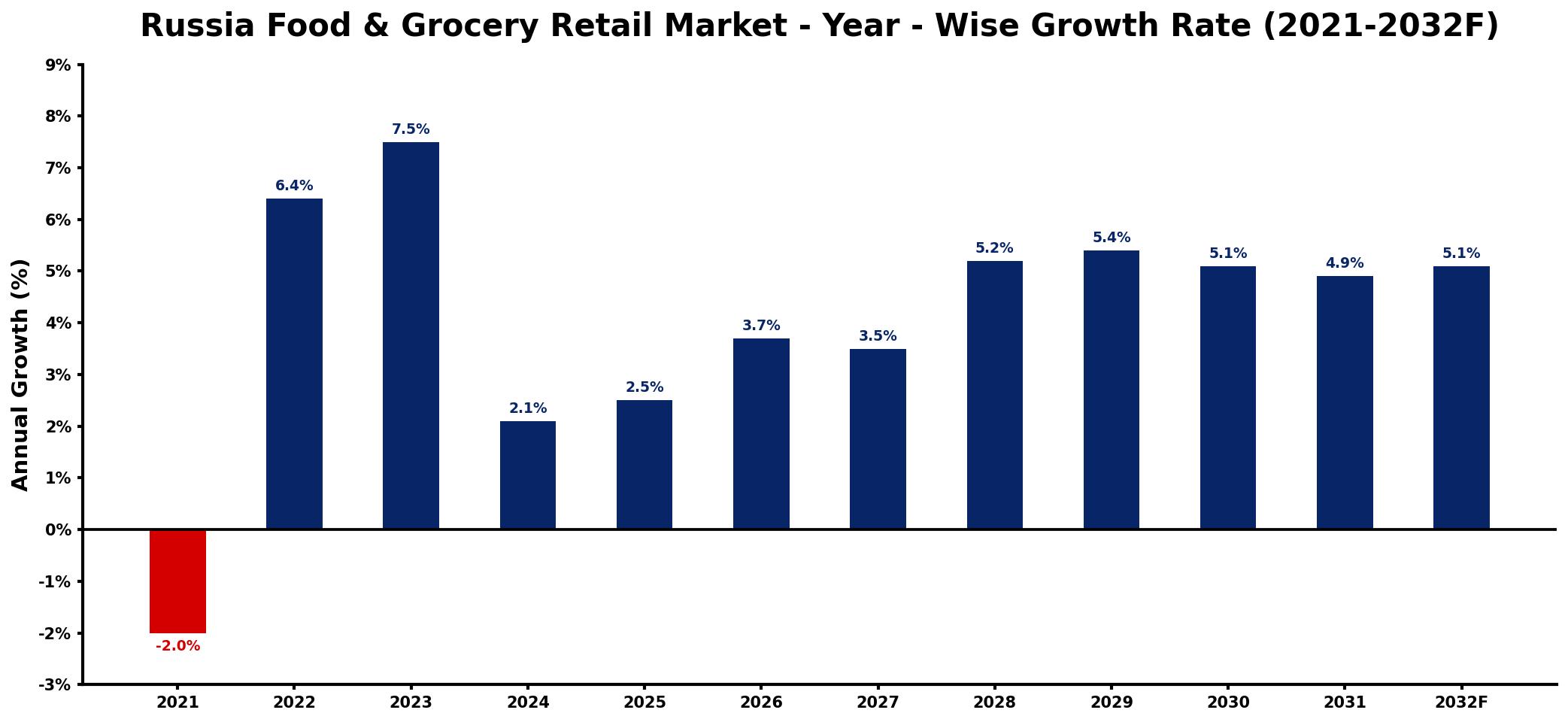
The table below presents the year‑wise growth rates along with the key drivers influencing the market
| Year | Growth Rate | Major Drivers |
| 2021 | -2.0% | decreased consumer spending patterns |
| 2022 | 6.4% | rising disposable income levels |
| 2023 | 7.5% | increased urban population growth |
| 2024 | 2.1% | expansion of online shopping |
| 2025 | 2.5% | growing health consciousness trends |
| 2026 | 3.7% | innovation in delivery services |
| 2027 | 3.5% | enhanced supply chain efficiencies |
| 2028 | 5.2% | increased foreign investment interest |
| 2029 | 5.4% | development of local brands |
| 2030 | 5.1% | rising demand for convenience |
| 2031 | 4.9% | growth in private label options |
| 2032 | 5.1% | emphasis on sustainability practices |
Note: Market size estimations and growth projections presented in this report are based on 6Wresearch's proprietary forecasting methodology, utilizing the latest available industry data, government publications, and primary research inputs.
Russia Food & Grocery Retail Market Synopsis
The strongest force shaping the Russia Food & Grocery Retail Market is the rapid shift toward online grocery shopping, driven by changing consumer lifestyles and technological advancements. Consumers are increasingly seeking convenience, favoring platforms that offer home delivery and a diverse product range.
Moreover, the demand for ready-to-eat meals and healthier food choices is reshaping traditional retail formats. This evolving landscape offers a unique opportunity for retailers to enhance their service offerings and capitalize on emerging consumer trends.
- The transition toward online grocery shopping is accelerating, driven by consumer demand for convenience.
- Health-conscious choices are influencing product offerings, with a growing market for organic and sustainable foods.
- Urbanization continues to fuel the expansion of convenience stores in densely populated areas.
- The market is characterized by intense competition between domestic and international retailers.
- Economic fluctuations and regulatory changes pose ongoing challenges for market players.
Despite the promising growth potential, the Russia Food & Grocery Retail Market faces several restraints. Intense competition creates pricing pressures, limiting profit margins for retailers. Additionally, fluctuating consumer demand, often dictated by economic conditions, presents a challenge in maintaining steady growth. Regulatory hurdles, especially regarding food safety and labeling, complicate operations and compliance. Furthermore, logistical difficulties arising from the countrys vast geography can impede distribution and inventory management, necessitating strategic planning and adaptability from market participants.
Several emerging trends are shaping the future of the Russia Food & Grocery Retail Market. E-commerce growth continues to dominate, with platforms enhancing customer experiences through personalized services and streamlined delivery options. Concurrently, the rise of smaller format stores caters to the urban population's demand for quick and convenient shopping. Furthermore, there is an increasing focus on sustainable practices, compelling retailers to adapt their supply chains and product offerings to align with environmentally conscious consumer behaviors.
Opportunities for investment in the Russia Food & Grocery Retail Market are abundant. The expansion of online grocery platforms presents a substantial growth avenue, particularly as consumer habits shift. Furthermore, investors can capitalize on the rising demand for premium and organic products, which cater to health-conscious consumers. Investment in innovative technologies, such as data analytics for personalized marketing and automated systems for inventory management, can also position companies favorably in an increasingly competitive landscape.
Government policies are actively shaping the Russia Food & Grocery Retail Market, focusing on enhancing domestic production and ensuring food safety. Import substitution measures aim to reduce reliance on foreign goods and promote local agriculture, while strict regulations concerning food quality and labeling help maintain consumer trust. Additionally, various support initiatives, including subsidies for local producers, encourage innovation and competitiveness within the market, fostering a more robust food retail sector.
Looking ahead to 2026-2032, the Russia Food & Grocery Retail Market is set to experience steady growth, propelled by a combination of rising disposable incomes and shifting consumer preferences. The trend toward modern retail formats, including supermarkets and e-commerce platforms, will likely continue to evolve. Additionally, the increasing demand for ready-to-eat meals will cater to the busy lifestyles of urban consumers. However, market players must remain vigilant regarding potential economic fluctuations and regulatory changes that could affect their operations.
Recent developments in the Russia Food & Grocery Retail Market indicate a growing emphasis on enhancing e-commerce capabilities. Retailers are increasingly investing in technology-driven solutions to streamline their operations and improve customer engagement. Moreover, partnerships between local producers and retailers are becoming more common as businesses seek to bolster their supply chains and ensure product quality. Consumer feedback is being leveraged more effectively to adapt offerings to local preferences, illustrating a trend towards more responsive and adaptive retail strategies.
- 10 Years of Market Numbers
- Historical Data Starting from 2022 to 2025
- Base Year: 2025
- Forecast Data until 2032
- Key Performance Indicators Impacting the Market
- Major Upcoming Developments and Projects
Key Highlights of the Report:
- Russia Food & Grocery Retail Market Outlook
- Market Size of Russia Food & Grocery Retail Market, 2025
- Forecast of Russia Food & Grocery Retail Market, 2032
- Historical Data and Forecast of Russia Food & Grocery Retail Revenues & Volume for the Period 2022-2032F
- Russia Food & Grocery Retail Market Trend Evolution
- Russia Food & Grocery Retail Market Drivers and Challenges
- Russia Food & Grocery Retail Price Trends
- Russia Food & Grocery Retail Porter's Five Forces
- Russia Food & Grocery Retail Industry Life Cycle
- Historical Data and Forecast of Russia Food & Grocery Retail Market Revenues & Volume By Product for the Period 2022-2032F
- Historical Data and Forecast of Russia Food & Grocery Retail Market Revenues & Volume By Fresh Food for the Period 2022-2032F
- Historical Data and Forecast of Russia Food & Grocery Retail Market Revenues & Volume By Frozen Food for the Period 2022-2032F
- Historical Data and Forecast of Russia Food & Grocery Retail Market Revenues & Volume By Food Cupboard for the Period 2022-2032F
- Historical Data and Forecast of Russia Food & Grocery Retail Market Revenues & Volume By Beverages for the Period 2022-2032F
- Historical Data and Forecast of Russia Food & Grocery Retail Market Revenues & Volume By Cleaning & Household for the Period 2022-2032F
- Historical Data and Forecast of Russia Food & Grocery Retail Market Revenues & Volume By Others for the Period 2022-2032F
- Historical Data and Forecast of Russia Food & Grocery Retail Market Revenues & Volume By Distribution Channel for the Period 2022-2032F
- Historical Data and Forecast of Russia Food & Grocery Retail Market Revenues & Volume By Supermarkets & Hypermarkets for the Period 2022-2032F
- Historical Data and Forecast of Russia Food & Grocery Retail Market Revenues & Volume By Convenience Stores for the Period 2022-2032F
- Historical Data and Forecast of Russia Food & Grocery Retail Market Revenues & Volume By Departmental Stores & Clubs for the Period 2022-2032F
- Historical Data and Forecast of Russia Food & Grocery Retail Market Revenues & Volume By Online for the Period 2022-2032F
- Russia Food & Grocery Retail Import Export Trade Statistics
- Market Opportunity Assessment By Product
- Market Opportunity Assessment By Distribution Channel
- Russia Food & Grocery Retail Top Companies Market Share
- Russia Food & Grocery Retail Competitive Benchmarking By Technical and Operational Parameters
- Russia Food & Grocery Retail Company Profiles
- Russia Food & Grocery Retail Key Strategic Recommendations






































