Oman Industrial Furnace Market Size, Share & Growth Rate
The Oman Industrial Furnace Market was estimated at USD 110 Million in 2025 and is projected to reach USD 121 Million by 2032, growing at a CAGR of 1.4% from 2026 to 2032. This growth trajectory reflects the escalating industrialization in Oman, driven primarily by sectors such as oil & gas, construction, and manufacturing. A growing emphasis on energy-efficient technologies and eco-friendly solutions is fostering an environment conducive to advancements in industrial furnace systems.
Oman Industrial Furnace Market Year-wise Growth Rate and Key Drivers
This graph highlights how the Oman Industrial Furnace Market has steadily grown over the years, supported by major growth factors.
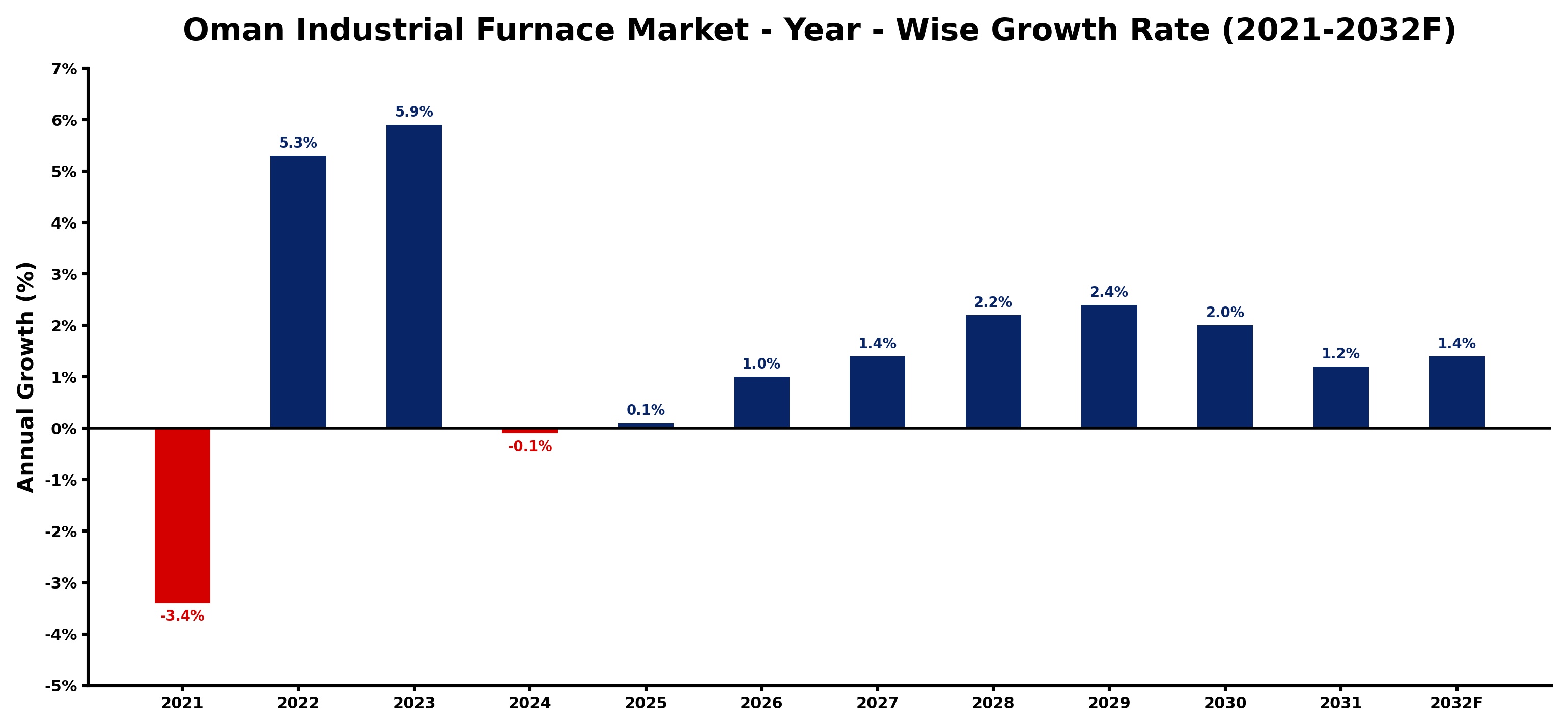
The table below presents the year‑wise growth rates along with the key drivers influencing the market
| Year | Growth Rate | Major Drivers |
| 2021 | -3.4% | Weakening regional demand dampened industrial furnace utilization rates |
| 2022 | 5.3% | Strategic investments in steel processing facilities boost furnace demand |
| 2023 | 5.9% | Export driven industrial modernization boosts demand for energy efficient furnaces |
| 2024 | -0.1% | Export downturns diminished local demand for industrial furnace systems |
| 2025 | 0.1% | Technology upgrades in smelting enhance energy efficiency and output |
| 2026 | 1.0% | New foundry installations boost regional aluminum casting production capacity |
| 2027 | 1.4% | Construction sector rebound drives furnace demand for steel production |
| 2028 | 2.2% | Smart furnace technology adoption enhances energy efficiency in operations |
| 2029 | 2.4% | Manufacturing investments in energy efficiency upgrades boost furnace production capacity |
| 2030 | 2.0% | Increased metalworking capacity utilization boosts furnace procurement demands |
| 2031 | 1.2% | Technological upgrades in manufacturing processes boost furnace efficiency rates |
| 2032 | 1.4% | New steel production facilities boost refractory material demand significantly |
Note - Market size estimations and growth projections presented in this report are based on 6Wresearch's advanced forecasting approach, validated with industry datasets as of June 2026.
Oman Industrial Furnace Market Synopsis
Recently, the Oman Industrial Furnace Market has shown significant momentum, largely supported by the nation's ongoing industrial expansion. However, as the market evolves, it is anticipated to shift towards more energy-efficient and sustainable furnace solutions, aligning with global environmental standards.
The market's future direction will increasingly depend on the adoption of advanced technologies and automation. This transition is set against a backdrop of stringent regulatory requirements and a need for enhanced operational efficiency, ensuring that the market adapts to both local and international pressures.
Oman Industrial Furnace Market Key Takeaways
- The market is driven by the rising demand for energy-efficient and environmentally friendly furnace technologies.
- Adoption of automation and digitalization is enhancing operational efficiency within the industrial furnace sector.
- Investment opportunities are emerging as Oman diversifies its economy and focuses on industrial development.
- Compliance with stringent emission regulations is becoming increasingly critical for market participants.
- The market is experiencing a growing shift towards electric and induction furnaces, reflecting sustainability goals.
Evaluation of Restraints in Oman Industrial Furnace Market
While the Oman Industrial Furnace Market shows promise, it faces several restraints that could impede growth. Increasing competition from international firms is posing challenges to local manufacturers, particularly those unable to adapt to rapid technological advancements. Furthermore, the fluctuating prices of raw materials can create uncertainty in production costs, adversely affecting profitability. Additionally, there exists a notable skills gap in the workforce, which may hinder the effective operation and maintenance of modern industrial furnaces. Addressing these restraints will be vital for sustained market progress.
Oman Industrial Furnace Market Trends
The landscape of the Oman Industrial Furnace Market is currently characterized by several pivotal trends. The increasing demand for electric and induction furnaces highlights a significant shift towards cleaner technologies. Moreover, the integration of automation in furnace operations is allowing for improved control and monitoring, which enhances overall efficiency. As manufacturers focus on developing advanced materials and technologies, the industry's commitment to sustainability is more pronounced, reflecting a broader trend towards reducing energy consumption and emissions.
Oman Industrial Furnace Market Opportunities
The Oman Industrial Furnace Market offers a variety of investment opportunities, primarily due to the country's strategic focus on industrial diversification. Investors can capitalize on the growing demand for advanced and energy-efficient furnaces across key sectors like oil & gas and manufacturing. Additionally, retrofitting existing facilities with modern technology and providing essential maintenance services presents viable business avenues. The government's efforts to attract foreign investments further enhance the appeal of this burgeoning market, offering fertile ground for innovative collaborations.
Government Initiatives in the Oman Industrial Furnace Market
Government policies in Oman are increasingly geared towards promoting sustainable industrial growth while ensuring compliance with environmental regulations. Strict emissions standards are being enforced to mitigate air pollution, which is critical for industrial operators. Furthermore, initiatives are in place to incentivize the adoption of energy-efficient furnace technologies, aimed at enhancing operational efficiencies and supporting the country's sustainability objectives. These policies are fostering a robust industrial furnace sector that aligns with both local and global environmental goals.
Future Insights of the Oman Industrial Furnace Market
Looking ahead to the period from 2026 to 2032, the Oman Industrial Furnace Market is poised for steady growth, driven by ongoing industrialization efforts. The anticipated investments in the oil & gas and manufacturing sectors will continue to propel demand for industrial furnaces. Furthermore, the increasing emphasis on sustainable practices and the integration of automation technologies are expected to shape the market's future trajectory. Despite potential challenges from fluctuating raw material prices and regulatory constraints, the market's overall outlook remains optimistic.
Oman Industrial Furnace Market Latest Developments (May 2025 - June 2026)
In recent months, the Oman Industrial Furnace Market has witnessed a notable shift toward more sustainable technologies. Companies are actively investing in the development of eco-friendly furnace solutions that align with global sustainability trends. Furthermore, there is a growing interest in automating industrial furnace operations to enhance efficiency and reduce energy consumption. Overall, this period has marked significant advancements in technology and operational practices within the sector.
Oman Industrial Furnace Market - Key Attractiveness of the Report
- 10 Years of Market Numbers
- Historical Data Starting from 2022 to 2025
- Base Year: 2025
- Forecast Data until 2032
- Key Performance Indicators Impacting the Market
- Major Upcoming Developments and Projects
Key Highlights of the Report:
- Oman Industrial Furnace Market Outlook
- Market Size of Oman Industrial Furnace Market, 2025
- Forecast of Oman Industrial Furnace Market, 2032
- Historical Data and Forecast of Oman Industrial Furnace Revenues & Volume for the Period 2022-2032F
- Oman Industrial Furnace Market Trend Evolution
- Oman Industrial Furnace Market Drivers and Challenges
- Oman Industrial Furnace Price Trends
- Oman Industrial Furnace Porter's Five Forces
- Oman Industrial Furnace Industry Life Cycle
- Historical Data and Forecast of Oman Industrial Furnace Market Revenues & Volume By Furnace Type for the Period 2022-2032F
- Historical Data and Forecast of Oman Industrial Furnace Market Revenues & Volume By Gas/fuel Operated Industrial Furnace for the Period 2022-2032F
- Historical Data and Forecast of Oman Industrial Furnace Market Revenues & Volume By Electrically Operated Industrial Furnace for the Period 2022-2032F
- Historical Data and Forecast of Oman Industrial Furnace Market Revenues & Volume By Arrangement for the Period 2022-2032F
- Historical Data and Forecast of Oman Industrial Furnace Market Revenues & Volume By Tube or Clamshell Type for the Period 2022-2032F
- Historical Data and Forecast of Oman Industrial Furnace Market Revenues & Volume By Box Type for the Period 2022-2032F
- Historical Data and Forecast of Oman Industrial Furnace Market Revenues & Volume By Bottom Loading & Car Bottom Furnace for the Period 2022-2032F
- Historical Data and Forecast of Oman Industrial Furnace Market Revenues & Volume By Top Loading Furnace for the Period 2022-2032F
- Historical Data and Forecast of Oman Industrial Furnace Market Revenues & Volume By Others for the Period 2022-2032F
- Historical Data and Forecast of Oman Industrial Furnace Market Revenues & Volume By End-User for the Period 2022-2032F
- Historical Data and Forecast of Oman Industrial Furnace Market Revenues & Volume By Metals & Mining for the Period 2022-2032F
- Historical Data and Forecast of Oman Industrial Furnace Market Revenues & Volume By Transportation for the Period 2022-2032F
- Historical Data and Forecast of Oman Industrial Furnace Market Revenues & Volume By Oil & Gas for the Period 2022-2032F
- Historical Data and Forecast of Oman Industrial Furnace Market Revenues & Volume By Chemicals for the Period 2022-2032F
- Historical Data and Forecast of Oman Industrial Furnace Market Revenues & Volume By Others for the Period 2022-2032F
- Oman Industrial Furnace Import Export Trade Statistics
- Market Opportunity Assessment By Furnace Type
- Market Opportunity Assessment By Arrangement
- Market Opportunity Assessment By End-User
- Oman Industrial Furnace Top Companies Market Share
- Oman Industrial Furnace Competitive Benchmarking By Technical and Operational Parameters
- Oman Industrial Furnace Company Profiles
- Oman Industrial Furnace Key Strategic Recommendations






































