Oman LTE IoT Market Size & Growth Rate (2026-2032)
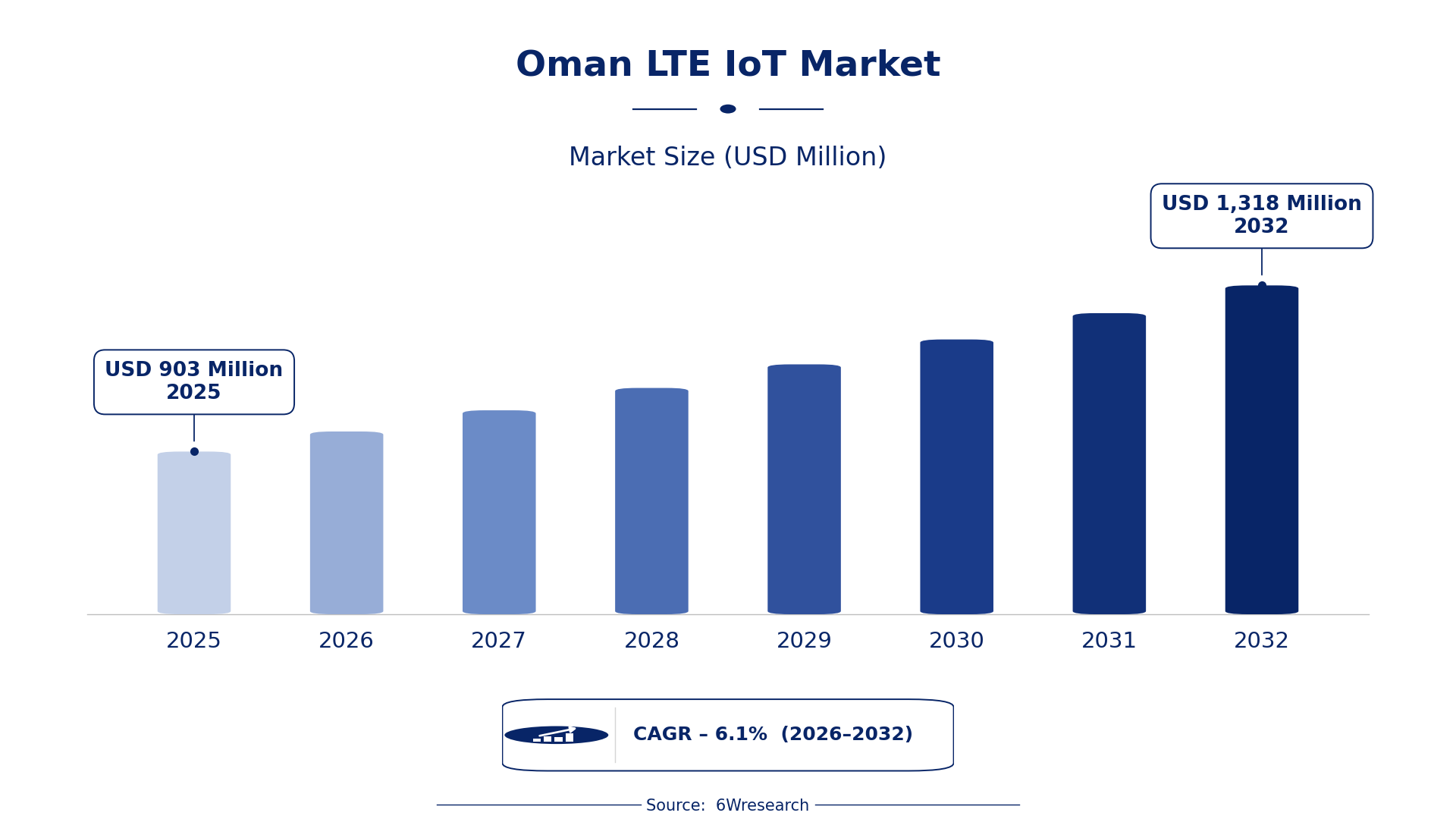
The Oman LTE IoT Market was estimated at USD 903 Million in 2025 and is projected to reach USD 1318 Million by 2032, growing at a CAGR of 6.1% from 2026 to 2032.
Oman LTE IoT Market Synopsis
In Oman, the LTE IoT market is gaining momentum, fueled by the surging demand for connected devices across multiple sectors. The rapid integration of IoT technologies in agriculture, manufacturing, and healthcare is creating a fertile environment for LTE deployment, which provides the high-speed connectivity essential for effective data communication.
Investment in LTE infrastructure is becoming increasingly vital, as stakeholders recognize the critical role it plays in supporting smart initiatives. Government backing for digital transformation, combined with private sector innovation, is setting the stage for a more interconnected future in Oman, enhancing operational efficiencies across industries.
Oman LTE IoT Market Year-wise Growth Rate and Key Drivers
This graph illustrates the annual growth rates of the Oman LTE IoT Market from 2021 to 2032, highlighting a steady upward trajectory and projected expansion over the forecast period.
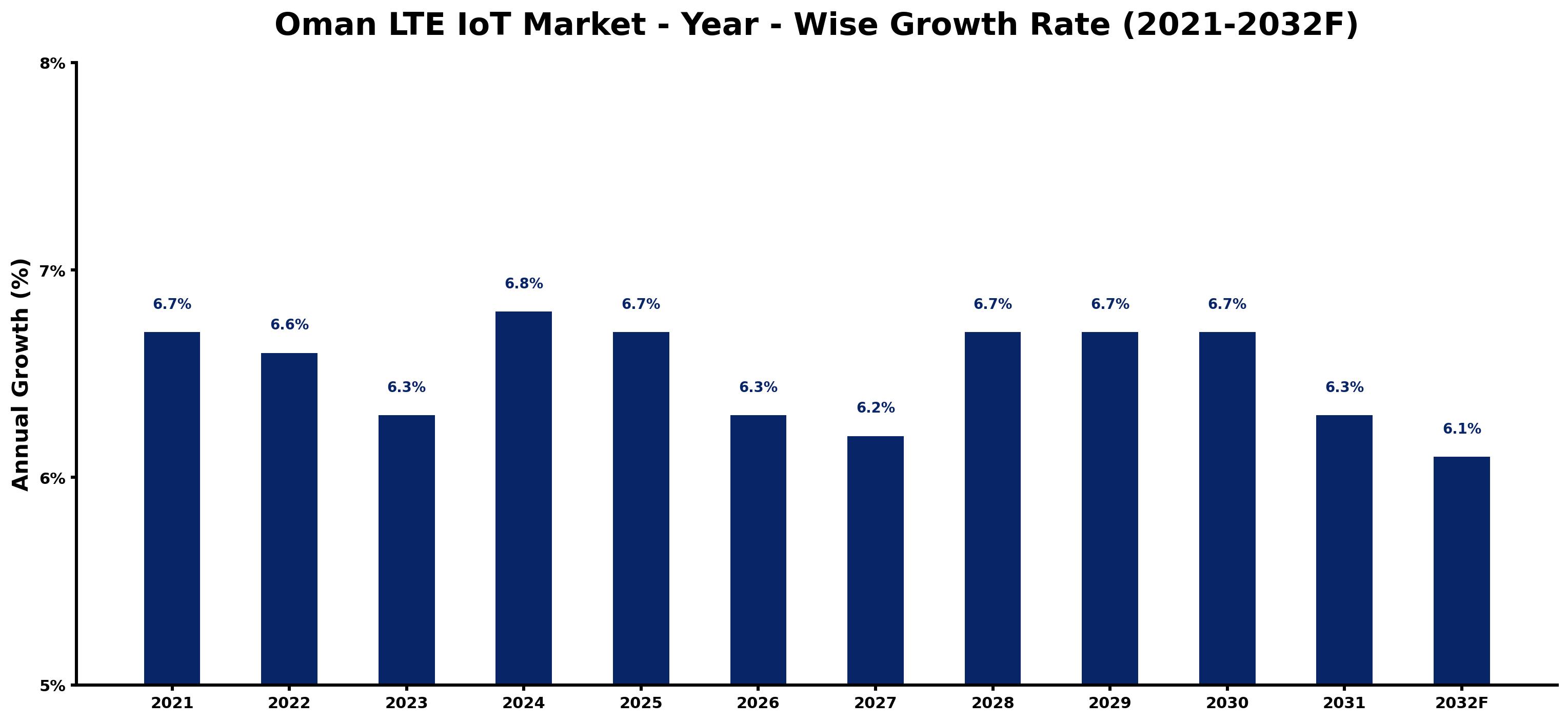
The table below presents the year‑wise growth rates along with the key drivers influencing the market
| Year | Growth Rate | Major Drivers |
| 2021 | 6.7% | Oman Vision 2040 prioritizing communication technology advancements |
| 2022 | 6.6% | Increased adoption of smart metering in utilities sector |
| 2023 | 6.3% | Government incentives for IoT integration in logistics |
| 2024 | 6.8% | Growth in smart city projects in Muscat region |
| 2025 | 6.7% | Local startups pushing IoT innovation and implementation |
| 2026 | 6.3% | Regulatory support for data privacy enhancing IoT trust |
| 2027 | 6.2% | Rising interest in smart healthcare solutions post-pandemic |
| 2028 | 6.7% | Boost in agricultural technology through IoT applications |
| 2029 | 6.7% | Enhancements in wireless spectrum allocation for IoT |
| 2030 | 6.7% | Investments in smart transportation solutions in Oman |
| 2031 | 6.3% | Increased regional partnerships in IoT development initiatives |
| 2032 | 6.1% | Growing interest in environmental monitoring solutions |
Note: Market size estimations and growth projections presented in this report are based on 6Wresearch's proprietary forecasting methodology, utilizing the latest available industry data, government publications, and primary research inputs.
Oman LTE IoT Market Key Takeaways
Below are some of the specific key takeaways from the market, including:
- Growing demand for LTE infrastructure driven by IoT solution adoption.
- Expansion of IoT applications in critical sectors like healthcare and agriculture.
- Government initiatives aimed at fostering smart city developments.
- Investment opportunities in IoT device manufacturing and application development.
- Emergence of partnerships between telecom operators and technology providers.
Evaluation of Restraints in Oman LTE IoT Market
Despite the promising outlook, the Oman LTE IoT market faces notable obstacles. Limited coverage in remote areas poses a significant barrier to widespread IoT adoption, hampering connectivity where it's needed most. High initial costs associated with deploying IoT solutions also deter many organizations from making the leap. The regulatory environment, still in its infancy, lacks standardization, leading to uncertainty and caution among potential adopters. Furthermore, the sector grapples with a skills shortage, as the need for trained professionals to implement and manage IoT systems grows. These challenges must be collectively addressed to unlock the market's full potential.
Oman LTE IoT Market Trends
Several trends are shaping the Oman LTE IoT market. The rise of connected devices and advanced sensors is a key driver, pushing industries to innovate and optimize. Telecommunication companies are actively deploying advanced LTE networks tailored to support IoT applications, which are becoming increasingly sophisticated.
Another significant trend is the emphasis on developing localized IoT solutions that meet the specific needs of various sectors. The government’s push for digital transformation also spurs innovation, resulting in a greater acceptance of IoT technologies. Partnerships among businesses and IoT providers are facilitating access to cutting-edge solutions, paving the way for new applications and increased adoption.
Oman LTE IoT Market Opportunities
Investment opportunities in the Oman LTE IoT market are extensive, particularly in burgeoning areas like smart cities, healthcare, and agriculture. The increasing demand for high-speed connectivity to support IoT applications is driving infrastructure investments. Companies can explore avenues in IoT device manufacturing and sensor production, as well as in developing tailored applications for local enterprises. Collaborating with government bodies and local businesses can enhance market entry strategies, reducing regulatory hurdles and fostering a stronger market presence.
Government Initiatives in the Oman LTE IoT Market
The Omani government is actively shaping the LTE IoT market through strategic initiatives designed to promote technological advancement. By prioritizing digital transformation, the government aims to foster a conducive environment for IoT growth. This proactive stance is evident in various policies that enhance regulatory frameworks, support infrastructure development, and encourage private sector engagement.
- A National IoT Strategy launched in 2023 aims to drive the integration of IoT technologies across key sectors.
- The Telecommunications Regulatory Authority (TRA) is currently reviewing spectrum allocation to facilitate the expansion of LTE networks.
- A public-private partnership initiative to enhance digital infrastructure is currently underway, focusing on smart city projects.
- Regulatory frameworks to standardize IoT device regulations are planned for implementation in 2025.
- Oman Vision 2040 outlines ambitious goals for improving technological innovation and connectivity.
Future Insights of the Oman LTE IoT Market
Looking ahead to 2026-2032, the future of the Oman LTE IoT market appears promising, supported by ongoing investments in digital infrastructure. As industries increasingly integrate IoT solutions to drive efficiency and enhance customer experiences, demand for reliable LTE connectivity will grow. The government's unwavering commitment to fostering technological innovation, paired with a surge in industry-specific IoT applications, suggests significant expansion is on the horizon.
Oman LTE IoT Market Latest Developments
In the past year, activity within the Oman LTE IoT market has been dynamic, characterized by various initiatives aimed at enhancing connectivity and facilitating IoT deployments. Key players are ramping up efforts to build out LTE infrastructure, while new collaborations are emerging, positioning the market for future growth.
- A major telecom operator completed the rollout of a new LTE network in urban areas by Q1 2025, enhancing connectivity for IoT applications.
- In mid-2025, a leading technology vendor launched a suite of IoT solutions tailored for the healthcare sector, significantly expanding service offerings.
- An ongoing initiative launched in early 2025 aims to improve IoT device security standards across various sectors.
- Preparations are underway for a planned 2026 investment project focusing on smart agriculture technologies leveraging LTE connectivity.
- By late 2025, a collaborative project involving local businesses to create an IoT innovation hub is expected to be initiated.
Oman LTE IoT Market - Key Attractiveness of the Report
- 10 Years of Market Numbers
- Historical Data Starting from 2022 to 2025
- Base Year: 2025
- Forecast Data until 2032
- Key Performance Indicators Impacting the Market
- Major Upcoming Developments and Projects
Key Highlights of the Report:
- Oman LTE IoT Market Outlook
- Market Size of Oman LTE IoT Market, 2025
- Forecast of Oman LTE IoT Market, 2032
- Historical Data and Forecast of Oman LTE IoT Revenues & Volume for the Period 2022-2032F
- Oman LTE IoT Market Trend Evolution
- Oman LTE IoT Market Drivers and Challenges
- Oman LTE IoT Price Trends
- Oman LTE IoT Porter's Five Forces
- Oman LTE IoT Industry Life Cycle
- Historical Data and Forecast of Oman LTE IoT Market Revenues & Volume By Technology for the Period 2022-2032F
- Historical Data and Forecast of Oman LTE IoT Market Revenues & Volume By NB-IoT for the Period 2022-2032F
- Historical Data and Forecast of Oman LTE IoT Market Revenues & Volume By LTE-M for the Period 2022-2032F
- Historical Data and Forecast of Oman LTE IoT Market Revenues & Volume By Service for the Period 2022-2032F
- Historical Data and Forecast of Oman LTE IoT Market Revenues & Volume By Professional Services for the Period 2022-2032F
- Historical Data and Forecast of Oman LTE IoT Market Revenues & Volume By Managed Services for the Period 2022-2032F
- Historical Data and Forecast of Oman LTE IoT Market Revenues & Volume By Industry for the Period 2022-2032F
- Historical Data and Forecast of Oman LTE IoT Market Revenues & Volume By Manufacturing for the Period 2022-2032F
- Historical Data and Forecast of Oman LTE IoT Market Revenues & Volume By Energy and utilities for the Period 2022-2032F
- Historical Data and Forecast of Oman LTE IoT Market Revenues & Volume By Transportation and logistics for the Period 2022-2032F
- Historical Data and Forecast of Oman LTE IoT Market Revenues & Volume By Healthcare for the Period 2022-2032F
- Historical Data and Forecast of Oman LTE IoT Market Revenues & Volume By Agriculture for the Period 2022-2032F
- Oman LTE IoT Import Export Trade Statistics
- Market Opportunity Assessment By Technology
- Market Opportunity Assessment By Service
- Market Opportunity Assessment By Industry
- Oman LTE IoT Top Companies Market Share
- Oman LTE IoT Competitive Benchmarking By Technical and Operational Parameters
- Oman LTE IoT Company Profiles
- Oman LTE IoT Key Strategic Recommendations






































