Oman Mineral Oil Market Size, Share & Growth Rate
The Oman Mineral Oil Market was estimated at USD 337 Million in 2025 and is projected to reach USD 445 Million by 2032, growing at a CAGR of 4.1% from 2026 to 2032. This upward trajectory is primarily fueled by increasing industrial activities and a strong demand for high-performance lubricants across various sectors, including automotive and manufacturing. As the economy diversifies, the applications of mineral oil continue to expand, contributing to sustained market growth.
Oman Mineral Oil Market Year-wise Growth Rate and Key Drivers
This graph highlights how the Oman Mineral Oil Market has steadily grown over the years, supported by major growth factors.
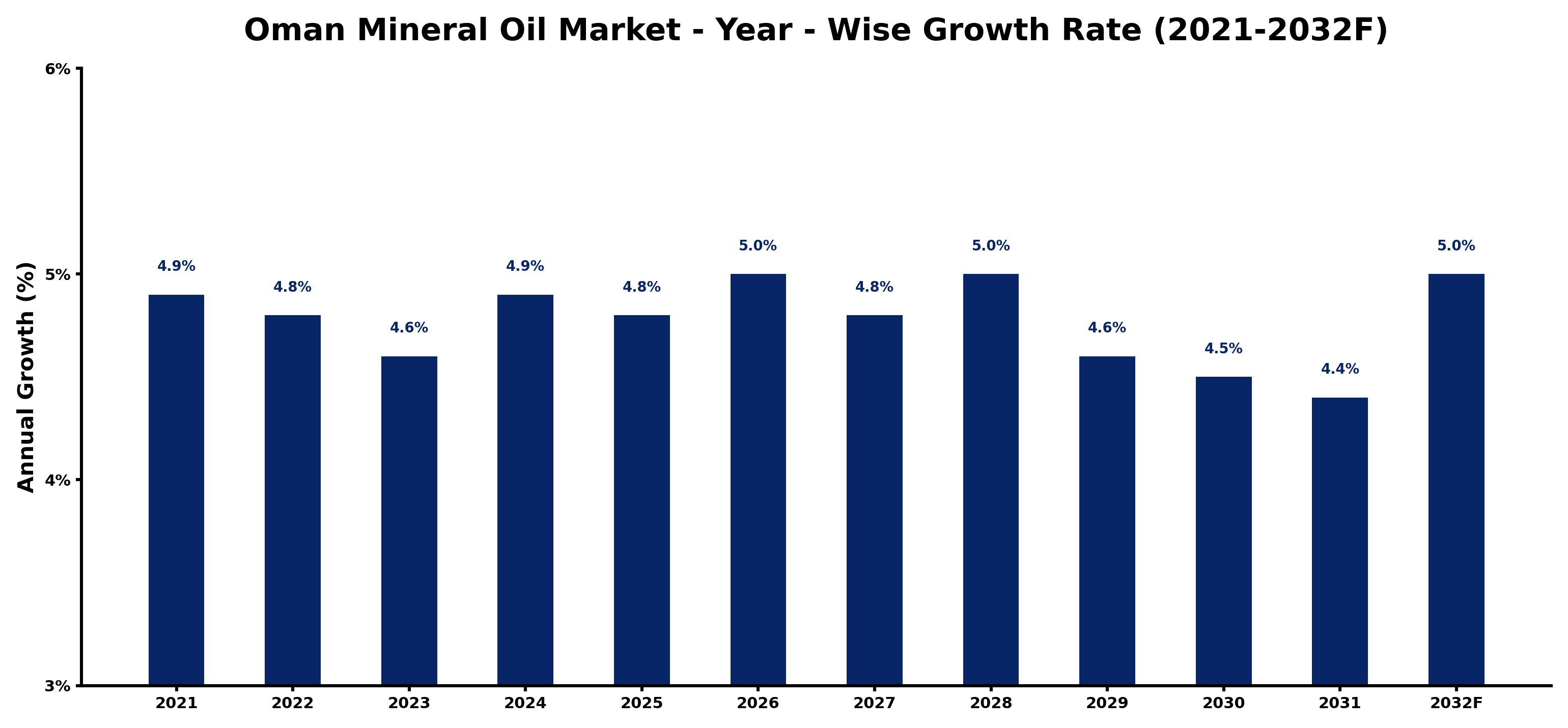
The table below presents the year‑wise growth rates along with the key drivers influencing the market
| Year | Growth Rate | Major Drivers |
| 2021 | 4.9% | Expansion of manufacturing activities |
| 2022 | 4.8% | Rapid growth in telecom and data center sectors |
| 2023 | 4.6% | Rising electricity demand across industries |
| 2024 | 4.9% | Increasing adoption of advanced technologies |
| 2025 | 4.8% | Growing renewable energy integration projects |
| 2026 | 5.0% | Growing urbanization and commercial development |
| 2027 | 4.8% | Increasing smart city development projects |
| 2028 | 5.0% | Expansion of transportation and logistics networks |
| 2029 | 4.6% | Rising electricity demand across industries |
| 2030 | 4.5% | Expansion of transportation and logistics networks |
| 2031 | 4.4% | Increasing industrial automation investments |
| 2032 | 5.0% | Rising electricity demand across industries |
Note - Market size estimations and growth projections presented in this report are based on 6Wresearch's advanced forecasting approach, validated with industry datasets as of June 2026.
Oman Mineral Oil Market Synopsis
The Oman mineral oil market is currently undergoing significant transformation, driven by rising industrialization and advancements in manufacturing technologies. With mineral oils being integral to numerous sectors, their role in lubricating machinery and facilitating efficient operations cannot be overstated.
In the automotive industry, the shift towards high-performance lubricants is increasingly evident, reflecting a growing consumer preference for enhanced efficiency and durability. Furthermore, the cosmetics sector is leveraging mineral oils for their emollient properties, expanding their utilization even further.
Oman Mineral Oil Market Key Takeaways
- The market is experiencing robust growth driven by demand in automotive and industrial sectors.
- High-performance lubricants are increasingly favored, pushing manufacturers to innovate.
- Environmental regulations are influencing extraction and production practices in the market.
- Oman's regulatory framework aims to balance economic benefits and environmental stewardship.
- Opportunities for bio-based alternatives could reshape market dynamics in the coming years.
Evaluation of Restraints in Oman Mineral Oil Market
The Oman mineral oil market faces several restraints that could impede its growth trajectory. One significant factor is the volatility in crude oil prices, which has a direct correlation with production costs and profitability margins for mineral oil manufacturers. Additionally, strict environmental regulations surrounding extraction and processing operations pose operational challenges, often requiring companies to invest heavily in compliance measures. Compounding these issues is the growing trend towards renewable energy sources and bio-based lubricants, which not only shift market preferences but also introduce competitive pressures for traditional mineral oil products.
Oman Mineral Oil Market Trends
Emerging trends within the Oman mineral oil market highlight a shift towards sustainability and innovation. The increasing emphasis on eco-friendly products is driving the development of bio-based lubricants, catering to both consumer preferences and regulatory demands. Furthermore, advancements in refining technologies are enhancing the quality and performance characteristics of mineral oils, providing manufacturers with new avenues for growth.
Digital transformation is also playing a pivotal role, as companies leverage data analytics to optimize production processes and enhance supply chain efficiency. This integration of technology promises not only to boost operational effectiveness but also to address environmental concerns more effectively.
Oman Mineral Oil Market Opportunities
Significant growth and investment opportunities exist within the Oman mineral oil market, particularly in the development of high-performance and specialty lubricants. As industries increasingly seek tailored solutions for specific applications, manufacturers are encouraged to innovate and expand their product offerings. Additionally, the emergence of renewable energy sources opens the door for collaborations in developing bio-lubricants, appealing to environmentally-conscious consumers and businesses alike.
Government Initiatives in the Oman Mineral Oil Market
The Omani government plays a crucial role in regulating the mineral oil market, promoting sustainable extraction practices while ensuring environmental compliance. The Ministry of Oil and Gas is responsible for overseeing the licensing and operational frameworks for mineral oil companies. Various initiatives focus on maximizing economic benefits from oil reserves while minimizing environmental impacts, fostering a balanced approach to natural resource management.
Future Insights of the Oman Mineral Oil Market
Looking ahead to 2026-2032, the Oman mineral oil market is poised for steady growth, bolstered by ongoing industrial expansion and innovations in lubricant technologies. As companies adapt to shifting consumer preferences, particularly towards sustainability, there may be a notable increase in the adoption of alternative lubricants alongside traditional mineral oils. Strategic investments in R&D and the establishment of strong regulatory frameworks will be pivotal for ensuring the market's resilience and long-term viability.
Oman Mineral Oil Market Latest Developments (May 2025 - June 2026)
Recent developments in the Oman mineral oil market indicate a trend towards increased collaboration between the public and private sectors to foster innovation in lubricant production. Regulatory frameworks are continuously being updated to encourage sustainable practices, with an emphasis on minimizing environmental impact. Additionally, industry stakeholders are exploring advanced technologies to enhance production efficiency and product quality, responding proactively to evolving market demands.
Oman Mineral Oil Market - Key Attractiveness of the Report
- 10 Years of Market Numbers
- Historical Data Starting from 2022 to 2025
- Base Year: 2025
- Forecast Data until 2032
- Key Performance Indicators Impacting the Market
- Major Upcoming Developments and Projects
Key Highlights of the Report:
- Oman Mineral Oil Market Outlook
- Market Size of Oman Mineral Oil Market, 2025
- Forecast of Oman Mineral Oil Market, 2032
- Historical Data and Forecast of Oman Mineral Oil Revenues & Volume for the Period 2022-2032F
- Oman Mineral Oil Market Trend Evolution
- Oman Mineral Oil Market Drivers and Challenges
- Oman Mineral Oil Price Trends
- Oman Mineral Oil Porter's Five Forces
- Oman Mineral Oil Industry Life Cycle
- Historical Data and Forecast of Oman Mineral Oil Market Revenues & Volume By Grade for the Period 2022-2032F
- Historical Data and Forecast of Oman Mineral Oil Market Revenues & Volume By Technical Oil for the Period 2022-2032F
- Historical Data and Forecast of Oman Mineral Oil Market Revenues & Volume By White Oil for the Period 2022-2032F
- Historical Data and Forecast of Oman Mineral Oil Market Revenues & Volume By Application for the Period 2022-2032F
- Historical Data and Forecast of Oman Mineral Oil Market Revenues & Volume By Baby Oil for the Period 2022-2032F
- Historical Data and Forecast of Oman Mineral Oil Market Revenues & Volume By Cosmetics for the Period 2022-2032F
- Historical Data and Forecast of Oman Mineral Oil Market Revenues & Volume By Skin Care Products for the Period 2022-2032F
- Historical Data and Forecast of Oman Mineral Oil Market Revenues & Volume By Hair Care Products for the Period 2022-2032F
- Historical Data and Forecast of Oman Mineral Oil Market Revenues & Volume By Consumer Goods for the Period 2022-2032F
- Historical Data and Forecast of Oman Mineral Oil Market Revenues & Volume By Others for the Period 2022-2032F
- Oman Mineral Oil Import Export Trade Statistics
- Market Opportunity Assessment By Grade
- Market Opportunity Assessment By Application
- Oman Mineral Oil Top Companies Market Share
- Oman Mineral Oil Competitive Benchmarking By Technical and Operational Parameters
- Oman Mineral Oil Company Profiles
- Oman Mineral Oil Key Strategic Recommendations






































