Oman Phenol Market Size Growth Rate
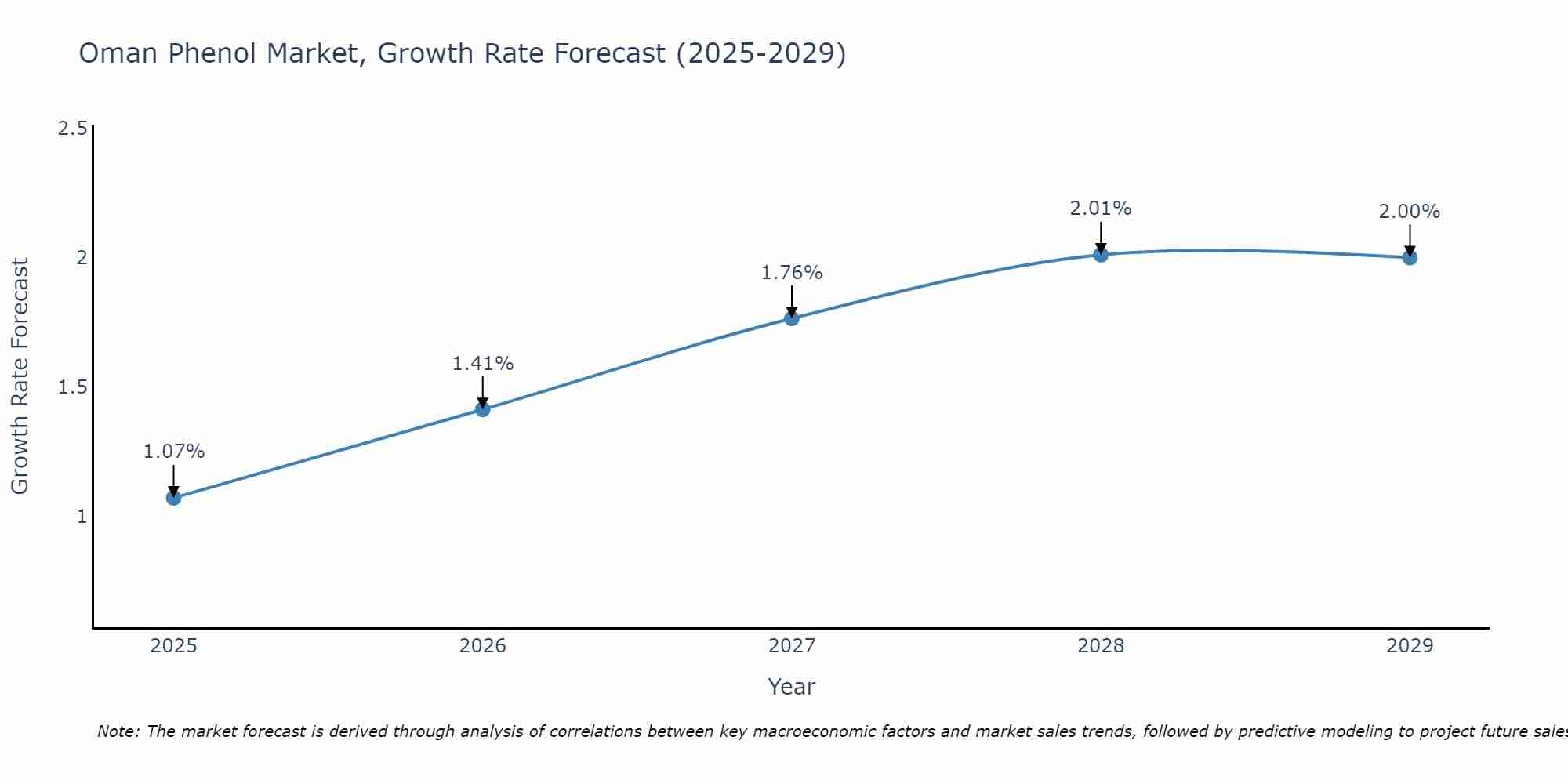
The Oman Phenol Market is projected to witness mixed growth rate patterns during 2025 to 2029. Starting at 1.07% in 2025, the market peaks at 2.01% in 2028, and settles at 2.00% by 2029.
Oman Phenol Market Overview
The Oman Phenol Market is experiencing steady growth driven by the increasing demand from various end-use industries such as automotive, construction, electronics, and healthcare. Phenol, a key chemical intermediate, is primarily used in the production of bisphenol-A (BPA) and phenolic resins. The country`s strategic location and well-established petrochemical industry contribute to its position as a key player in the global phenol market. However, factors such as volatility in crude oil prices and environmental regulations pose challenges to market growth. Key market players in Oman include Oman Oil and Orpic Group, who are investing in capacity expansion and technological advancements to meet the growing demand for phenol domestically and internationally. Overall, the Oman Phenol Market is poised for further development, driven by industrial growth and innovation in the sector.
Oman Phenol Market Trends
The Oman Phenol market is experiencing steady growth due to increasing demand from various end-use industries such as automotive, construction, electronics, and packaging. The growing construction sector in Oman is driving the demand for phenol-based products like adhesives, insulation materials, and laminates. Additionally, the electronics industry`s expansion is fueling the need for phenol in the production of circuit boards and other electronic components. Manufacturers in Oman are focusing on expanding their production capacities to meet the rising demand for phenol in the region. Moreover, the increasing focus on sustainable and eco-friendly products is leading to the development of bio-based phenol, which is expected to further drive market growth in the coming years.
Oman Phenol Market Challenges
The Oman Phenol Market faces several challenges including fluctuating raw material prices, competition from imported phenol products, and limited domestic production capacity. The volatility in crude oil prices directly impacts the prices of raw materials such as benzene, which is a key component in phenol production. This can lead to unstable production costs and pricing strategies for local manufacturers. Additionally, the market faces stiff competition from imported phenol products, which may have cost advantages due to economies of scale or lower production costs in other countries. Furthermore, the limited domestic production capacity in Oman poses a challenge in meeting the growing demand for phenol within the country, potentially leading to reliance on imports to fulfill market needs. Addressing these challenges will be crucial for the sustainable growth and competitiveness of the Oman Phenol Market.
Oman Phenol Market Investment Opportunities
The Oman Phenol Market presents promising investment opportunities driven by increasing industrial activities and demand for phenol derivatives in the country. With Oman being a key player in the petrochemical industry, there is a strong foundation for growth in the phenol market. Investors can consider opportunities in establishing phenol production facilities, partnering with existing manufacturers, or investing in research and development for innovative phenol-based products. Additionally, as phenol is a versatile chemical with applications in various industries such as plastics, pharmaceuticals, and personal care, diversification of product offerings can enhance market competitiveness and profitability. Given Oman`s strategic location and favorable business environment, investing in the Oman Phenol Market holds potential for long-term growth and returns.
Oman Phenol Market Government Policy
The government of Oman has taken initiatives to boost the phenol market in the country by implementing policies that support the growth of the industry. These policies include investment incentives, tax breaks, and infrastructure development to attract more companies to establish phenol production facilities in Oman. Additionally, the government has also focused on promoting research and development in the phenol sector to enhance innovation and competitiveness. Overall, the government`s policies aim to position Oman as a key player in the global phenol market by creating a conducive environment for industry growth and development.
Oman Phenol Market Future Outlook
The future outlook for the Oman Phenol Market appears promising, driven by increasing demand from various end-use industries such as automotive, construction, and electronics. The market is expected to witness steady growth due to the rising investments in infrastructure development projects and the expanding manufacturing sector in the region. Additionally, the growing awareness regarding the benefits of phenol-based products, particularly in the chemical and healthcare industries, is likely to further propel market growth. However, challenges such as fluctuating raw material prices and environmental concerns may impact market dynamics. Overall, with the anticipated economic recovery post-pandemic and ongoing industrial advancements, the Oman Phenol Market is projected to show positive growth trends in the coming years.
Key Highlights of the Report:
- Oman Phenol Market Outlook
- Market Size of Oman Phenol Market, 2021
- Forecast of Oman Phenol Market, 2031
- Historical Data and Forecast of Oman Phenol Revenues & Volume for the Period 2021 - 2031
- Oman Phenol Market Trend Evolution
- Oman Phenol Market Drivers and Challenges
- Oman Phenol Price Trends
- Oman Phenol Porter's Five Forces
- Oman Phenol Industry Life Cycle
- Historical Data and Forecast of Oman Phenol Market Revenues & Volume By End-users for the Period 2021 - 2031
- Historical Data and Forecast of Oman Phenol Market Revenues & Volume By Bisphenol A for the Period 2021 - 2031
- Historical Data and Forecast of Oman Phenol Market Revenues & Volume By Phenolic Resins for the Period 2021 - 2031
- Historical Data and Forecast of Oman Phenol Market Revenues & Volume By Caprolactam for the Period 2021 - 2031
- Historical Data and Forecast of Oman Phenol Market Revenues & Volume By Alkyl Phenyls for the Period 2021 - 2031
- Historical Data and Forecast of Oman Phenol Market Revenues & Volume By Others for the Period 2021 - 2031
- Oman Phenol Import Export Trade Statistics
- Market Opportunity Assessment By End-users
- Oman Phenol Top Companies Market Share
- Oman Phenol Competitive Benchmarking By Technical and Operational Parameters
- Oman Phenol Company Profiles
- Oman Phenol Key Strategic Recommendations






































