Iraq Phenol Market Size, Share & Growth Rate
The Iraq Phenol Market was estimated at USD 316 Million in 2025 and is projected to reach USD 414 Million by 2032, growing at a CAGR of 3.9% from 2026 to 2032. This growth trajectory is largely driven by the expanding industrial sector, particularly in construction and automotive, as well as the rising demand for phenol derivatives in electronics and healthcare. Furthermore, government initiatives aimed at fostering local production and reducing import reliance play a pivotal role in shaping the market's future.
Iraq Phenol Market Year-wise Growth Rate and Key Drivers
This graph highlights how the Iraq Phenol Market has steadily grown over the years, supported by major growth factors.
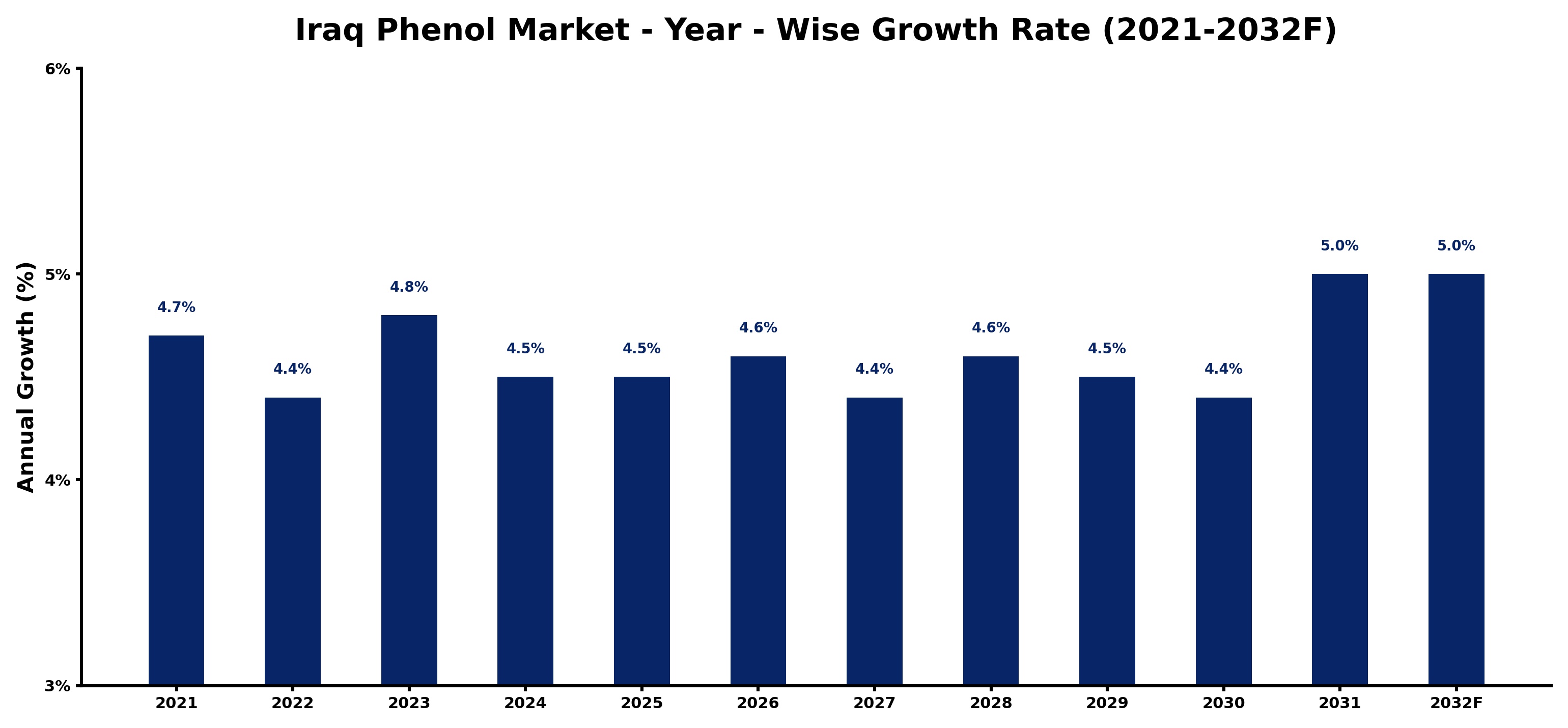
The table below presents the year‑wise growth rates along with the key drivers influencing the market
| Year | Growth Rate | Major Drivers |
| 2021 | 4.7% | Expansion of transportation and logistics networks |
| 2022 | 4.4% | Increasing industrial automation investments |
| 2023 | 4.8% | Increasing smart city development projects |
| 2024 | 4.5% | Rapid growth in telecom and data center sectors |
| 2025 | 4.5% | Government infrastructure modernization initiatives |
| 2026 | 4.6% | Expansion of manufacturing activities |
| 2027 | 4.4% | Growing renewable energy integration projects |
| 2028 | 4.6% | Increasing industrial automation investments |
| 2029 | 4.5% | Growing urbanization and commercial development |
| 2030 | 4.4% | Increasing industrial infrastructure investments |
| 2031 | 5.0% | Rising electricity demand across industries |
| 2032 | 5.0% | Expansion of transportation and logistics networks |
Note - Market size estimations and growth projections presented in this report are based on 6Wresearch's advanced forecasting approach, validated with industry datasets as of June 2026.
Iraq Phenol Market Synopsis
The most significant force influencing the Iraq Phenol Market is the burgeoning demand from the construction and automotive sectors, where phenol-based materials are becoming indispensable. This increasing consumption is supported by a growing awareness of the properties and benefits of phenol in manufacturing, driving both local production and imports.
Additionally, the shift towards sustainable and eco-friendly production methods is redefining how phenol is sourced and utilized in various applications. As industries adapt to these practices, the market is likely to evolve in response to changing consumer preferences and regulatory expectations.
Iraq Phenol Market Key Takeaways
- The market is projected to grow significantly, reaching USD 414 Million by 2032.
- Strong demand from key sectors, particularly automotive and construction, is driving growth.
- Government initiatives aim to bolster local production and enhance competitiveness.
- Challenges like fluctuating raw material prices and political instability may affect growth rates.
- Opportunities exist for investments in production facilities and partnerships with local entities.
Evaluation of Restraints in Iraq Phenol Market
Despite the promising growth trajectory of the Iraq Phenol Market, several restraints pose significant challenges. Political instability continues to be a major concern, creating uncertainties that affect business operations and investor confidence. Additionally, the reliance on oil revenues makes the phenol market particularly vulnerable to global oil price fluctuations, which can impact production costs. Furthermore, inadequate infrastructure, including transportation and power supply, hampers the efficient distribution and manufacturing processes essential for market growth. As such, stakeholders need to remain vigilant and adaptive to these constraints to navigate the market effectively.
Iraq Phenol Market Trends
The Iraq Phenol Market is seeing several emerging trends that are shaping demand and technology. The increasing preference for phenol-based products is attributed to their superior characteristics, such as heat resistance and chemical stability, which make them essential in various manufacturing processes. Moreover, there is a notable push towards sustainability, prompting manufacturers to explore eco-friendly production methods and materials. As awareness regarding environmental issues rises, the market is expected to further align with green initiatives, creating a landscape ripe for innovation and enhanced product offerings.
Iraq Phenol Market Opportunities
The Iraq Phenol Market is rife with investment opportunities, primarily due to the burgeoning chemical industry and increased demand for phenol derivatives. With the country's strategic geographical location and rich raw material resources, establishing phenol production facilities or entering into partnerships with local manufacturers can yield substantial returns. The government's active encouragement of foreign investment, coupled with a focus on modernizing infrastructure, presents a favorable environment for market entrants to capitalize on these opportunities.
Government Initiatives in the Iraq Phenol Market
Government policies concerning the Iraq Phenol Market are centered on promoting local production to diminish reliance on imports and enhance export potential. Incentives and subsidies are provided to local producers to support their growth while adhering to international quality standards. Furthermore, efforts to attract foreign investment and facilitate technology transfer are being prioritized to foster a competitive local industry. Environmental regulations are also being fortified to ensure that phenol production aligns with sustainability goals, reflecting a commitment to public health and ecological preservation.
Future Insights of the Iraq Phenol Market
Looking ahead to 2026-2032, the Iraq Phenol Market is set for moderate growth, driven by an expanding array of applications across sectors such as healthcare, automotive, and construction. The increasing consumption of phenol derivatives—particularly in plastics and resins—will further enhance market prospects. However, it is crucial to remain vigilant regarding regulatory shifts, geopolitical dynamics, and commodity price fluctuations that could influence market stability. With ongoing industrialization efforts and rising disposable incomes, the sector is expected to evolve in alignment with these trends, offering new avenues for growth.
Iraq Phenol Market Latest Developments (May 2025 - June 2026)
Recent developments in the Iraq Phenol Market reflect a dynamic response to both domestic demands and international pressures. Companies are actively exploring sustainable production techniques and enhancing their product offerings to meet evolving consumer expectations. Furthermore, infrastructure projects initiated by the government aim to improve logistics and supply chains, facilitating smoother operations for phenol manufacturers. These movements indicate a robust commitment to advancing the sector, despite existing challenges.
Iraq Phenol Market - Key Attractiveness of the Report
- 10 Years of Market Numbers
- Historical Data Starting from 2022 to 2025
- Base Year: 2025
- Forecast Data until 2032
- Key Performance Indicators Impacting the Market
- Major Upcoming Developments and Projects
Key Highlights of the Report:
- Iraq Phenol Market Outlook
- Market Size of Iraq Phenol Market, 2025
- Forecast of Iraq Phenol Market, 2032
- Historical Data and Forecast of Iraq Phenol Revenues & Volume for the Period 2022-2032F
- Iraq Phenol Market Trend Evolution
- Iraq Phenol Market Drivers and Challenges
- Iraq Phenol Price Trends
- Iraq Phenol Porter's Five Forces
- Iraq Phenol Industry Life Cycle
- Historical Data and Forecast of Iraq Phenol Market Revenues & Volume By End-users for the Period 2022-2032F
- Historical Data and Forecast of Iraq Phenol Market Revenues & Volume By Bisphenol A for the Period 2022-2032F
- Historical Data and Forecast of Iraq Phenol Market Revenues & Volume By Phenolic Resins for the Period 2022-2032F
- Historical Data and Forecast of Iraq Phenol Market Revenues & Volume By Caprolactam for the Period 2022-2032F
- Historical Data and Forecast of Iraq Phenol Market Revenues & Volume By Alkyl Phenyls for the Period 2022-2032F
- Historical Data and Forecast of Iraq Phenol Market Revenues & Volume By Others for the Period 2022-2032F
- Iraq Phenol Import Export Trade Statistics
- Market Opportunity Assessment By End-users
- Iraq Phenol Top Companies Market Share
- Iraq Phenol Competitive Benchmarking By Technical and Operational Parameters
- Iraq Phenol Company Profiles
- Iraq Phenol Key Strategic Recommendations






































