Oman Retail Market Size, Share & Growth Rate
The Oman Retail Market was estimated at USD 1236 Million in 2025 and is projected to reach USD 2154 Million by 2032, growing at a CAGR of 8.3% from 2026 to 2032. This growth trajectory is fueled by a young, dynamic population that is increasingly embracing modern shopping conveniences, coupled with rising disposable incomes that enhance consumer purchasing power. The ongoing investment in infrastructure and technology by retailers further bolsters the sector, setting the stage for a robust and competitive marketplace.
Oman Retail Market Year-wise Growth Rate and Key Drivers
This graph highlights how the Oman Retail Market has steadily grown over the years, supported by major growth factors.
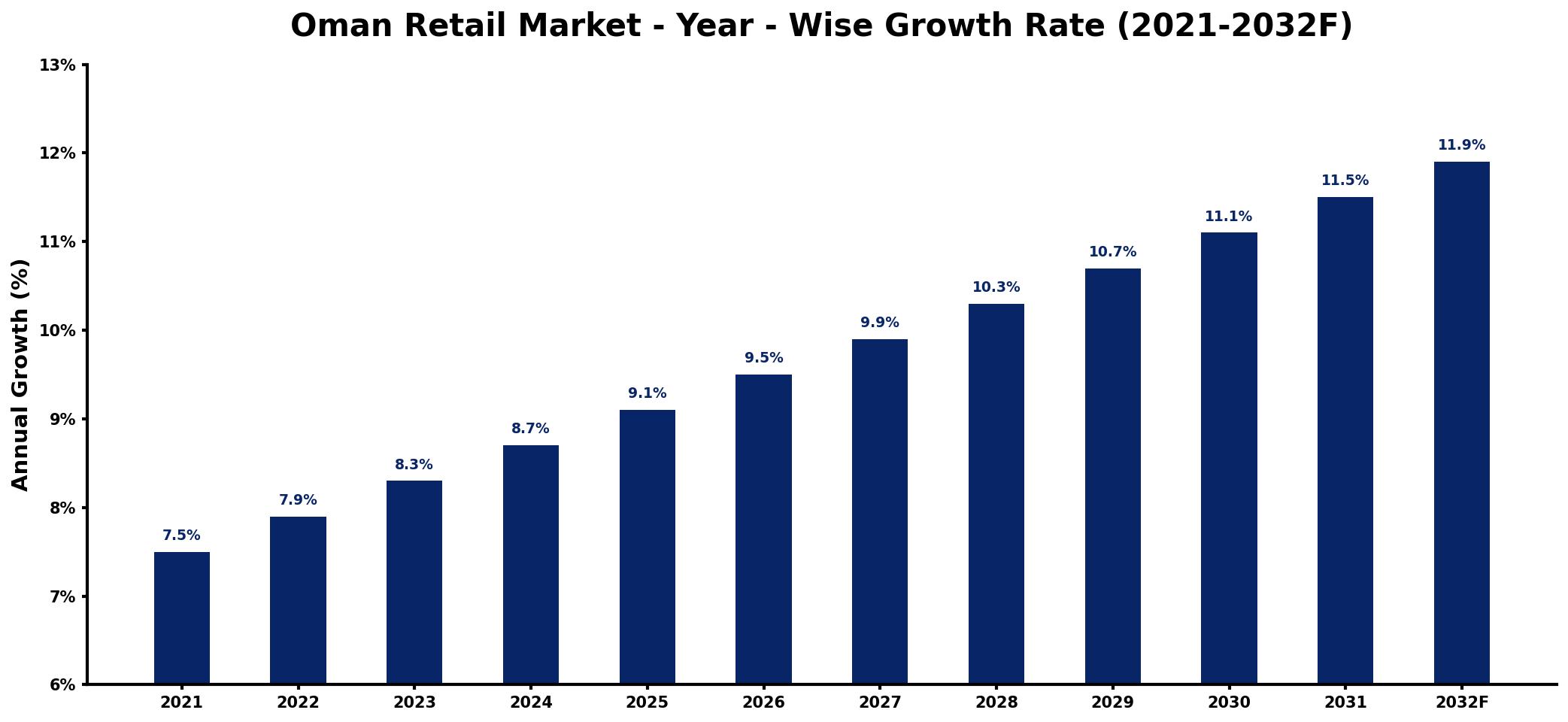
The table below presents the year‑wise growth rates along with the key drivers influencing the market
| Year | Growth Rate | Major Drivers |
| 2021 | 7.5% | E-commerce adoption among consumers |
| 2022 | 7.9% | Increased disposable income levels |
| 2023 | 8.3% | Growing expatriate population trends |
| 2024 | 8.7% | Expansion of shopping centers |
| 2025 | 9.1% | Rising demand for luxury goods |
| 2026 | 9.5% | Technological advancements in logistics |
| 2027 | 9.9% | Shift towards sustainable products |
| 2028 | 10.3% | Growth in online payment solutions |
| 2029 | 10.7% | Increased focus on customer experience |
| 2030 | 11.1% | growing regional consumption patterns |
| 2031 | 11.5% | Investment in digital marketing strategies |
| 2032 | 11.9% | Diversification of product offerings |
Note: Market size estimations and growth projections presented in this report are based on 6Wresearch's proprietary forecasting methodology, utilizing the latest available industry data, government publications, and primary research inputs.
Oman Retail Market Synopsis
The retail landscape in Oman is a vibrant tapestry of traditional and contemporary shopping experiences. From bustling souks to expansive malls and emerging e-commerce platforms, the market reflects the evolving preferences of consumers who increasingly seek quality and convenience.
In recent years, Oman's retail environment has been characterized by significant shifts, notably in consumer behavior and purchasing habits. With a growing inclination towards eco-friendly products and experiential shopping, retailers are rethinking their strategies to resonate with a more conscious and engaged consumer base.
Oman Retail Market Key Takeaways
- The Oman retail sector is diversifying rapidly, integrating traditional and modern retail formats.
- E-commerce is gaining traction, particularly post-COVID-19, as consumers favor online shopping for its convenience.
- Consumers are increasingly demanding sustainable and eco-friendly products, influencing retailer offerings.
- Investment in innovative technologies is essential for retailers to enhance customer experiences and remain competitive.
- Government policies are designed to support local businesses and promote economic growth in the retail sector.
Evaluation of Restraints in Oman Retail Market
Despite its promising growth, the Oman retail market faces several constraints that could inhibit its full potential. Intense competition among both local and international retailers creates pricing pressures, compelling businesses to innovate continually to differentiate themselves. Furthermore, the volatility of economic factors, particularly oil price fluctuations, can dramatically influence consumer spending patterns. Retailers must also navigate logistical challenges inherent in a geographically diverse country like Oman, which can complicate supply chain management and increase operational expenses. This complex landscape necessitates a strategic, customer-centric approach to ensure sustained growth and relevance.
Oman Retail Market Trends
Key trends currently reshaping the Oman retail market include the rising prominence of e-commerce, as consumers increasingly prefer online shopping for its convenience and safety. This is accompanied by a growing emphasis on sustainability, with consumers actively seeking environmentally friendly products. Additionally, the trend towards experiential retail is gaining momentum; retailers are focusing on creating unique shopping experiences that go beyond mere transactions. The adoption of omni-channel retailing is also on the rise, as customers expect seamless interactions across online and offline platforms, prompting retailers to refine their strategies accordingly.
Oman Retail Market Opportunities
Investors in the Oman retail market will find a plethora of opportunities arising from its burgeoning economy and increasing urbanization. Expanding retail outlets and shopping malls can effectively meet growing consumer demand. E-commerce presents an exciting avenue for growth as digital penetration continues to rise, allowing retailers to reach a broader audience. Furthermore, leveraging cutting-edge technologies like contactless payments and personalized marketing can significantly enhance consumer engagement. The demand for international brands and luxury goods also signals promising avenues for strategic partnerships and new market entries.
Government Initiatives in the Oman Retail Market
The Oman government, through the Ministry of Commerce, Industry, and Investment Promotion (MOCIIP), has instituted various policies to stimulate the retail sector. These include mandates encouraging local sourcing of products, which supports domestic businesses. Additionally, the government offers incentives for small and medium-sized enterprises (SMEs), fostering local entrepreneurship and economic growth. These initiatives not only bolster the retail environment but also aim to create a competitive landscape that prioritizes the development of local talent and capabilities.
Future Insights of the Oman Retail Market
Looking ahead to the period between 2026 and 2032, the Oman retail market is expected to thrive, driven by steady increases in disposable incomes and an expanding urban population. As organized retail becomes more prominent, e-commerce and digital innovations will likely transform traditional shopping paradigms. While the competitive landscape will remain fierce, the governments commitment to economic diversification and infrastructure enhancement will provide a conducive environment for growth. Retailers who adapt to evolving consumer preferences and harness technological advancements are well-positioned to succeed in this dynamic market.
Oman Retail Market Latest Developments (2025 - 2026)
The Oman retail sector has witnessed significant shifts in direction over the past year, particularly with an increased focus on integrating technology into shopping experiences. Retailers are exploring innovative in-store solutions and enhancing their online presence to cater to evolving consumer demands. Additionally, sustainability initiatives have gained momentum, with many businesses prioritizing eco-friendly practices and products. This evolving landscape indicates a concerted effort among retailers to not only meet current market needs but also anticipate future trends.
Oman Retail Market - Key Attractiveness of the Report
- 10 Years of Market Numbers
- Historical Data Starting from 2022 to 2025
- Base Year: 2025
- Forecast Data until 2032
- Key Performance Indicators Impacting the Market
- Major Upcoming Developments and Projects
Key Highlights of the Report:
- Oman Retail Market Outlook
- Market Size of Oman Retail Market, 2025
- Forecast of Oman Retail Market, 2032
- Historical Data and Forecast of Oman Retail Revenues & Volume for the Period 2022-2032F
- Oman Retail Market Trend Evolution
- Oman Retail Market Drivers and Challenges
- Oman Retail Price Trends
- Oman Retail Porter's Five Forces
- Oman Retail Industry Life Cycle
- Historical Data and Forecast of Oman Retail Market Revenues & Volume By Product for the Period 2022-2032F
- Historical Data and Forecast of Oman Retail Market Revenues & Volume By Food and Beverages for the Period 2022-2032F
- Historical Data and Forecast of Oman Retail Market Revenues & Volume By Personal and Household Care for the Period 2022-2032F
- Historical Data and Forecast of Oman Retail Market Revenues & Volume By Apparel for the Period 2022-2032F
- Historical Data and Forecast of Oman Retail Market Revenues & Volume By Footwear and Accessories for the Period 2022-2032F
- Historical Data and Forecast of Oman Retail Market Revenues & Volume By Furniture for the Period 2022-2032F
- Historical Data and Forecast of Oman Retail Market Revenues & Volume By Toys for the Period 2022-2032F
- Historical Data and Forecast of Oman Retail Market Revenues & Volume By Electronic and Household Appliances for the Period 2022-2032F
- Historical Data and Forecast of Oman Food and Beverages Retail Market Revenues & Volume By Other Products for the Period 2022-2032F
- Historical Data and Forecast of Oman Retail Market Revenues & Volume By Distribution Channel for the Period 2022-2032F
- Historical Data and Forecast of Oman Retail Market Revenues & Volume By Supermarkets/Hypermarkets for the Period 2022-2032F
- Historical Data and Forecast of Oman Retail Market Revenues & Volume By Convenience Stores for the Period 2022-2032F
- Historical Data and Forecast of Oman Retail Market Revenues & Volume By Department Stores for the Period 2022-2032F
- Historical Data and Forecast of Oman Retail Market Revenues & Volume By Specialty Stores for the Period 2022-2032F
- Historical Data and Forecast of Oman Retail Market Revenues & Volume By Online for the Period 2022-2032F
- Historical Data and Forecast of Oman Retail Market Revenues & Volume By Other Distribution Channels for the Period 2022-2032F
- Oman Retail Import Export Trade Statistics
- Market Opportunity Assessment By Product
- Market Opportunity Assessment By Distribution Channel
- Oman Retail Top Companies Market Share
- Oman Retail Competitive Benchmarking By Technical and Operational Parameters
- Oman Retail Company Profiles
- Oman Retail Key Strategic Recommendations






































