Oman Whipping Cream Market Size, Share & Growth Rate
The Oman Whipping Cream Market was estimated at USD 172 Million in 2025 and is projected to reach USD 229 Million by 2032, growing at a CAGR of 4.2% from 2026 to 2032. This growth trajectory is primarily driven by an escalating demand for premium dairy products, as consumers increasingly opt for high-quality whipping cream for both home cooking and baking. Additionally, the expanding hospitality sector is further propelling the consumption of whipping cream across restaurants and cafes, highlighting a significant shift toward indulgent desserts and culinary creativity.
Oman Whipping Cream Market Growth Rate Analysis (2021-2032)
The Oman whipping cream market has demonstrated robust yet fluctuating growth, with rates oscillating between 4.7% and 5.3% from 2021 through 2022. Factors such as rising consumer demand for premium food products and a growing café culture have significantly contributed to this trend. In 2023, growth slightly dipped to 4.7%, likely due to inflationary pressures impacting disposable income. However, a rebound is expected, with projections pointing to a steady 5.0% in 2024 and 5.2% in 2025 as investments in food processing technology enhance production efficiency. As the market stabilizes towards 2030, continued digitalization and infrastructure improvements will further support the expansion, keeping it aligned with evolving consumer preferences.
Oman Whipping Cream Market Year-wise Growth Rate and Key Drivers
This graph highlights how the Oman Whipping Cream Market has steadily grown over the past five years, supported by major growth factors.
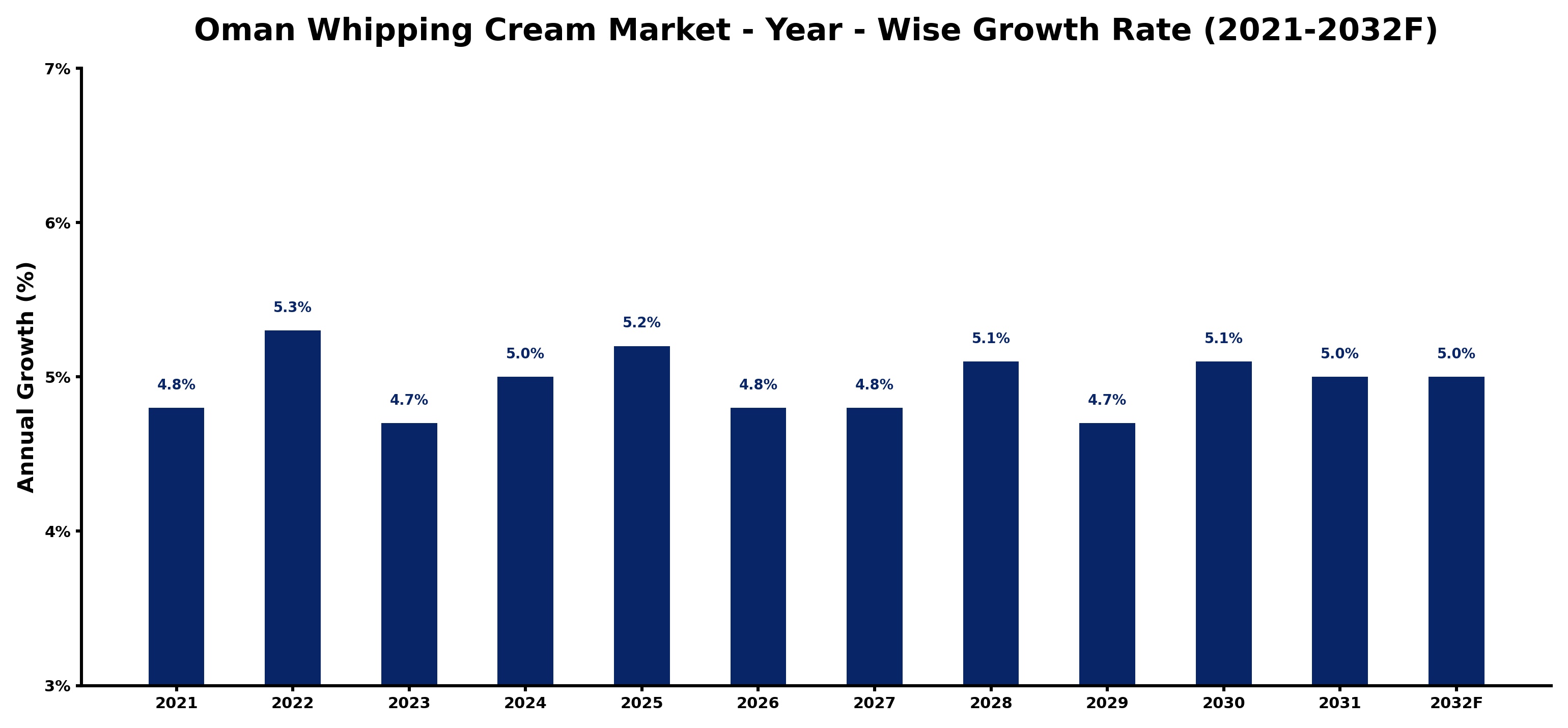
The table below presents the year‑wise growth rates along with the key drivers influencing the market
| Year | Growth Rate | Major Drivers |
| 2021 | 4.8% | Rising demand for desserts |
| 2022 | 5.3% | Increased bakery product offerings |
| 2023 | 4.7% | Growing popularity of coffee shops |
| 2024 | 5.0% | Expansion of culinary tourism |
| 2025 | 5.2% | Health-conscious consumer trends rise |
| 2026 | 4.8% | Diverse flavor innovations launched |
| 2027 | 4.8% | Home baking trends increased sales |
| 2028 | 5.1% | Sustainable sourcing practices adopted |
| 2029 | 4.7% | Plant-based alternatives gaining traction |
| 2030 | 5.1% | Catering services expanded offerings |
| 2031 | 5.0% | Gourmet cooking interest heightened |
| 2032 | 5.0% | Social media influence on recipes |
Note - Market size estimations and growth projections presented in this report are based on 6Wresearch’s advanced forecasting approach, validated with industry datasets as of June 2026.
Oman Whipping Cream Market Synopsis
In Oman, the whipping cream market is characterized by a notable rise in consumer interest, particularly for premium and innovative dairy products. This trend reflects a broader culinary culture that embraces both traditional and modern dessert recipes, stimulating growth in various sectors of food service and retail.
Moreover, as more households engage in home baking and cooking activities, the need for versatile whipping cream options is more pronounced. This evolving consumer behavior underscores the importance of product differentiation and quality in an increasingly competitive market landscape.
Oman Whipping Cream Market Key Takeaways
- The market is witnessing robust growth due to rising demand for premium dairy products.
- Innovation in product offerings, including lactose-free and organic options, is on the rise.
- Home baking trends are contributing significantly to the increased consumption of whipping cream.
- Investment opportunities are abundant, particularly within the hospitality sector.
- Government regulations emphasize food safety and quality standards in the whipping cream market.
Evaluation of Restraints in Oman Whipping Cream Market
Despite the promising growth potential, the Oman whipping cream market faces several restraints. Fluctuating raw material prices can impact profitability and pricing strategies. Additionally, there is a challenge in shifting consumer preferences towards premium dairy products, as traditional products often dominate local cuisine. Furthermore, the hot climate poses logistical issues in terms of distribution and storage, complicating the supply chain for manufacturers. Navigating these challenges requires strategic focus on product differentiation and effective supply chain management.
Oman Whipping Cream Market Trends
Several trends are shaping the Oman whipping cream market today. A key observation is the rising consumer preference for premium quality products, leading to an increase in willingness to pay for superior taste and texture. Alongside this, there is a noteworthy interest in plant-based whipping creams, catering to health-conscious and ethically-minded consumers looking for dairy alternatives. Packaging innovations focused on convenience and sustainability are also gaining traction, reflecting modern consumer priorities.
Oman Whipping Cream Market Opportunities
Opportunities in the Oman whipping cream market are substantial, particularly due to the growing demand for high-quality dairy products in the hospitality sector. Investors may find value in setting up production facilities that align with the emerging trends of premiumization and organic offerings. Additionally, enhancing marketing and distribution channels to bolster brand visibility presents a viable pathway for capturing a larger market share.
Government Initiatives in the Oman Whipping Cream Market
The Oman government has implemented stringent food safety regulations and labeling requirements for dairy products, including whipping cream. These measures are designed to ensure consumer health and maintain high standards within the market. Additionally, trade regulations play a crucial role, influencing the import and export dynamics of whipping cream products while promoting fair trade practices.
Future Insights of the Oman Whipping Cream Market
Looking ahead to 2026-2032, the Oman whipping cream market is anticipated to experience steady growth, underpinned by a growing population and evolving dietary preferences. The increasing disposable income levels will likely further catalyze the trend towards premium dairy products, especially as Western-style desserts gain popularity. Market players will need to invest in product innovation and marketing strategies to harness these opportunities and sustain competitiveness in the dynamic landscape.
Oman Whipping Cream Market Latest Developments (May 2025 - June 2026)
Recent developments in the Oman whipping cream market indicate a push towards sustainability, with companies beginning to adopt eco-friendly practices in production and packaging. There's also a notable rise in partnerships aimed at expanding distribution channels, particularly within the growing food service sector. These initiatives are reflecting the industry's commitment to meeting evolving consumer demands and enhancing market presence.
Oman Whipping Cream Market - Key Attractiveness of the Report
- 10 Years of Market Numbers
- Historical Data Starting from 2022 to 2025
- Base Year: 2025
- Forecast Data until 2032
- Key Performance Indicators Impacting the Market
- Major Upcoming Developments and Projects
Key Highlights of the Report:
- Oman Whipping Cream Market Outlook
- Market Size of Oman Whipping Cream Market, 2025
- Forecast of Oman Whipping Cream Market, 2032
- Historical Data and Forecast of Oman Whipping Cream Revenues & Volume for the Period 2022-2032F
- Oman Whipping Cream Market Trend Evolution
- Oman Whipping Cream Market Drivers and Challenges
- Oman Whipping Cream Price Trends
- Oman Whipping Cream Porter's Five Forces
- Oman Whipping Cream Industry Life Cycle
- Historical Data and Forecast of Oman Whipping Cream Market Revenues & Volume By Product for the Period 2022-2032F
- Historical Data and Forecast of Oman Whipping Cream Market Revenues & Volume By Dairy for the Period 2022-2032F
- Historical Data and Forecast of Oman Whipping Cream Market Revenues & Volume By Non-Dairy for the Period 2022-2032F
- Historical Data and Forecast of Oman Whipping Cream Market Revenues & Volume By Application for the Period 2022-2032F
- Historical Data and Forecast of Oman Whipping Cream Market Revenues & Volume By B2B for the Period 2022-2032F
- Historical Data and Forecast of Oman Whipping Cream Market Revenues & Volume By B2C for the Period 2022-2032F
- Historical Data and Forecast of Oman Whipping Cream Market Revenues & Volume By Distribution Channel for the Period 2022-2032F
- Historical Data and Forecast of Oman Whipping Cream Market Revenues & Volume By Warehouse Clubs for the Period 2022-2032F
- Historical Data and Forecast of Oman Whipping Cream Market Revenues & Volume By Variety Stores for the Period 2022-2032F
- Historical Data and Forecast of Oman Whipping Cream Market Revenues & Volume By Department Stores for the Period 2022-2032F
- Historical Data and Forecast of Oman Whipping Cream Market Revenues & Volume By Online Retail for the Period 2022-2032F
- Historical Data and Forecast of Oman Whipping Cream Market Revenues & Volume By Convenience Stores for the Period 2022-2032F
- Historical Data and Forecast of Oman Whipping Cream Market Revenues & Volume By Supermarkets and Hypermarket for the Period 2022-2032F
- Historical Data and Forecast of Oman Whipping Cream Market Revenues & Volume By Specialist Retailers for the Period 2022-2032F
- Historical Data and Forecast of Oman Whipping Cream Market Revenues & Volume By Others for the Period 2022-2032F
- Oman Whipping Cream Import Export Trade Statistics
- Market Opportunity Assessment By Product
- Market Opportunity Assessment By Application
- Market Opportunity Assessment By Distribution Channel
- Oman Whipping Cream Top Companies Market Share
- Oman Whipping Cream Competitive Benchmarking By Technical and Operational Parameters
- Oman Whipping Cream Company Profiles
- Oman Whipping Cream Key Strategic Recommendations






































