Pakistan Hair Relaxer Market (2026-2032) Outlook | Share, Revenue, Analysis, Value, Size, Industry, Growth, Trends, Companies & Forecast
Market Forecast By Distribution Channel (Supermarkets/Hypermarkets, Convenience Stores, Online Retail Stores, Other Distribution Channels) And Competitive Landscape
| Product Code: ETC327217 | Publication Date: Aug 2022 | Updated Date: Mar 2026 | Product Type: Market Research Report | |
| Publisher: 6Wresearch | Author: Vasudha | No. of Pages: 75 | No. of Figures: 35 | No. of Tables: 20 |
Pakistan Hair Relaxer Market: Import Trend Analysis
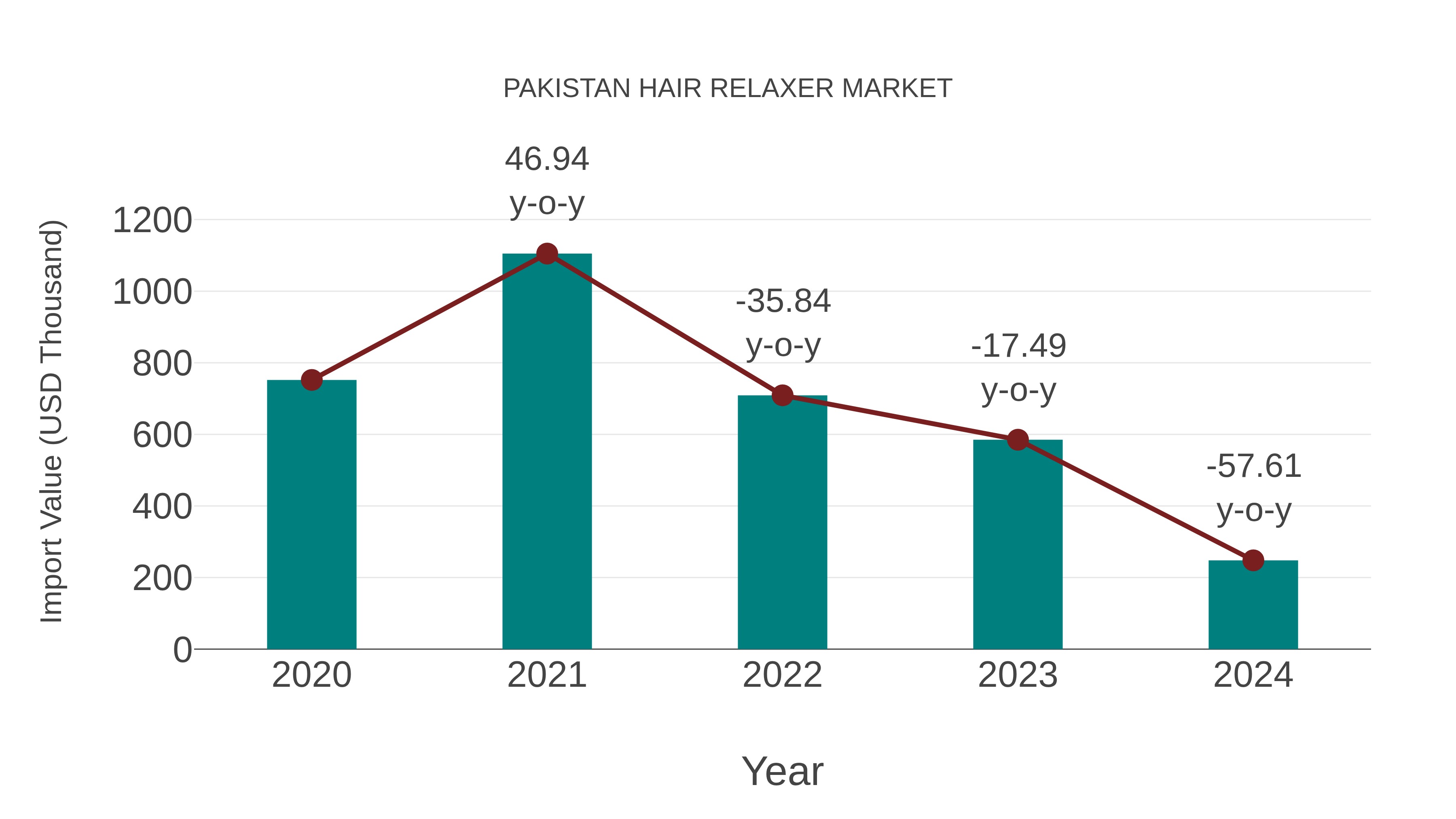
In the Pakistan hair relaxer market, the import trend experienced a significant decline from 2023 to 2024, with a growth rate of -57.61%. The compound annual growth rate (CAGR) from 2020 to 2024 stood at -24.22%. This decline could be attributed to shifts in consumer preferences or changes in trade policies affecting imports.
Pakistan Hair Relaxer Market Synopsis
The Pakistan Hair Relaxer Market is witnessing steady growth driven by factors such as increasing urbanization, rising disposable incomes, and growing awareness about personal grooming. The market is dominated by both international brands like LâOréal and local players offering a wide range of hair relaxer products catering to diverse consumer needs. With a focus on product innovation and marketing strategies, companies are investing in promoting the benefits of hair relaxers for straightening and managing frizzy hair. The market is also seeing a shift towards natural and organic hair relaxer products as consumers become more conscious about the ingredients used in beauty products. Overall, the Pakistan Hair Relaxer Market presents opportunities for further expansion and development in the coming years.
Pakistan Hair Relaxer Market Trends
In the Pakistan hair relaxer market, there is a noticeable shift towards natural and organic hair relaxer products, driven by increasing consumer awareness about the potential harmful effects of chemicals in traditional relaxers. Consumers are seeking gentler alternatives that offer similar results without damaging their hair. Additionally, there is a growing demand for products that cater to specific hair types and textures, as well as those that provide added benefits such as hydration and nourishment. Major players in the market are responding to these trends by introducing new formulations that incorporate natural ingredients and offer customizable solutions for diverse hair needs. Overall, the Pakistan hair relaxer market is witnessing a transition towards more sustainable and health-conscious product offerings to meet the evolving preferences of consumers.
Pakistan Hair Relaxer Market Challenges
In the Pakistan Hair Relaxer Market, one of the main challenges faced is the presence of counterfeit and substandard products. This poses a significant threat to both consumer health and the reputation of established brands. Additionally, cultural preferences and traditional hair care methods can hinder the widespread adoption of hair relaxers in Pakistan. Limited awareness and misconceptions about the usage and benefits of hair relaxers also contribute to a slow market growth. Furthermore, economic factors such as fluctuating exchange rates and import regulations impact the availability and affordability of quality hair relaxer products in the market. Overcoming these challenges will require a concerted effort from manufacturers to ensure product authenticity, educate consumers about the benefits of hair relaxers, and adapt marketing strategies to align with local preferences and cultural norms.
Pakistan Hair Relaxer Market Investment Opportunities
The Pakistan Hair Relaxer Market presents promising investment opportunities due to the growing demand for hair care products in the country. With a large population of consumers looking for solutions to manage their hair, hair relaxers are becoming increasingly popular. Investors can explore opportunities to introduce new and innovative hair relaxer products tailored to the specific needs of Pakistani consumers. Additionally, investing in marketing and distribution channels to reach a wider audience can help capture a larger market share. Collaborating with local salons and beauty influencers can also enhance brand visibility and credibility. Overall, the Pakistan Hair Relaxer Market offers potential for growth and profitability for investors willing to tap into the evolving beauty and personal care industry in the country.
Jordan Agar Market Government Policies
Government policies related to the Pakistan Hair Relaxer Market primarily focus on ensuring product safety, quality, and compliance with regulations. The Pakistan Standards and Quality Control Authority (PSQCA) sets standards for hair relaxer products to protect consumer health and safety. Import regulations are also in place to control the quality of imported products and prevent the entry of substandard or harmful goods into the market. Additionally, the government may impose tariffs or taxes on imported hair relaxer products to promote local manufacturing and protect domestic industries. Overall, the government`s policies aim to safeguard consumer interests, promote fair competition, and maintain the integrity of the Pakistan Hair Relaxer Market.
Pakistan Hair Relaxer Market Future Outlook
The future outlook for the Pakistan Hair Relaxer Market appears positive, with steady growth expected in the coming years. Factors such as increasing urbanization, rising disposable incomes, and changing beauty trends are driving the demand for hair care products, including hair relaxers. The market is likely to benefit from a growing awareness of personal grooming among both men and women, leading to a higher adoption of hair relaxer products. Additionally, the availability of a wide range of hair relaxer options catering to different hair types and preferences is expected to further fuel market growth. Manufacturers are likely to focus on product innovation, marketing strategies, and distribution channels to capitalize on the expanding market opportunities in Pakistan`s hair relaxer segment.
Key Highlights of the Report:
- Pakistan Hair Relaxer Market Outlook
- Market Size of Pakistan Hair Relaxer Market, 2025
- Forecast of Pakistan Hair Relaxer Market, 2032
- Historical Data and Forecast of Pakistan Hair Relaxer Revenues & Volume for the Period 2022 - 2032F
- Pakistan Hair Relaxer Market Trend Evolution
- Pakistan Hair Relaxer Market Drivers and Challenges
- Pakistan Hair Relaxer Price Trends
- Pakistan Hair Relaxer Porter's Five Forces
- Pakistan Hair Relaxer Industry Life Cycle
- Historical Data and Forecast of Pakistan Hair Relaxer Market Revenues & Volume By Distribution Channel for the Period 2022 - 2032F
- Historical Data and Forecast of Pakistan Hair Relaxer Market Revenues & Volume By Supermarkets/Hypermarkets for the Period 2022 - 2032F
- Historical Data and Forecast of Pakistan Hair Relaxer Market Revenues & Volume By Convenience Stores for the Period 2022 - 2032F
- Historical Data and Forecast of Pakistan Hair Relaxer Market Revenues & Volume By Online Retail Stores for the Period 2022 - 2032F
- Historical Data and Forecast of Pakistan Hair Relaxer Market Revenues & Volume By Other Distribution Channels for the Period 2022 - 2032F
- Pakistan Hair Relaxer Import Export Trade Statistics
- Market Opportunity Assessment By Distribution Channel
- Pakistan Hair Relaxer Top Companies Market Share
- Pakistan Hair Relaxer Competitive Benchmarking By Technical and Operational Parameters
- Pakistan Hair Relaxer Company Profiles
- Pakistan Hair Relaxer Key Strategic Recommendations
Pakistan Hair Relaxer Market (2026-2032): FAQs
6Wresearch actively monitors the Pakistan Hair Relaxer Market and publishes its comprehensive annual report, highlighting emerging trends, growth drivers, revenue analysis, and forecast outlook. Our insights help businesses to make data-backed strategic decisions with ongoing market dynamics. Our analysts track relevent industries related to the Pakistan Hair Relaxer Market, allowing our clients with actionable intelligence and reliable forecasts tailored to emerging regional needs.
Yes, we provide customisation as per your requirements. To learn more, feel free to contact us on sales@6wresearch.com
1 Executive Summary |
2 Introduction |
2.1 Key Highlights of the Report |
2.2 Report Description |
2.3 Market Scope & Segmentation |
2.4 Research Methodology |
2.5 Assumptions |
3 Pakistan Hair Relaxer Market Overview |
3.1 Pakistan Country Macro Economic Indicators |
3.2 Pakistan Hair Relaxer Market Revenues & Volume, 2022 & 2032F |
3.3 Pakistan Hair Relaxer Market - Industry Life Cycle |
3.4 Pakistan Hair Relaxer Market - Porter's Five Forces |
3.5 Pakistan Hair Relaxer Market Revenues & Volume Share, By Distribution Channel, 2022 & 2032F |
4 Pakistan Hair Relaxer Market Dynamics |
4.1 Impact Analysis |
4.2 Market Drivers |
4.2.1 Increasing disposable income of consumers in Pakistan |
4.2.2 Growing awareness about personal grooming and beauty trends |
4.2.3 Influence of western beauty standards leading to higher demand for hair relaxers |
4.3 Market Restraints |
4.3.1 Potential health concerns associated with prolonged use of chemical hair relaxers |
4.3.2 Cultural preferences for natural hair textures among certain consumer segments |
5 Pakistan Hair Relaxer Market Trends |
6 Pakistan Hair Relaxer Market, By Types |
6.1 Pakistan Hair Relaxer Market, By Distribution Channel |
6.1.1 Overview and Analysis |
6.1.2 Pakistan Hair Relaxer Market Revenues & Volume, By Distribution Channel, 2022-2032F |
6.1.3 Pakistan Hair Relaxer Market Revenues & Volume, By Supermarkets/Hypermarkets, 2022-2032F |
6.1.4 Pakistan Hair Relaxer Market Revenues & Volume, By Convenience Stores, 2022-2032F |
6.1.5 Pakistan Hair Relaxer Market Revenues & Volume, By Online Retail Stores, 2022-2032F |
6.1.6 Pakistan Hair Relaxer Market Revenues & Volume, By Other Distribution Channels, 2022-2032F |
7 Pakistan Hair Relaxer Market Import-Export Trade Statistics |
7.1 Pakistan Hair Relaxer Market Export to Major Countries |
7.2 Pakistan Hair Relaxer Market Imports from Major Countries |
8 Pakistan Hair Relaxer Market Key Performance Indicators |
8.1 Number of salons offering hair relaxer services |
8.2 Frequency of new product launches in the hair relaxer market |
8.3 Percentage of consumers using hair relaxers as part of their regular hair care routine |
9 Pakistan Hair Relaxer Market - Opportunity Assessment |
9.1 Pakistan Hair Relaxer Market Opportunity Assessment, By Distribution Channel, 2022 & 2032F |
10 Pakistan Hair Relaxer Market - Competitive Landscape |
10.1 Pakistan Hair Relaxer Market Revenue Share, By Companies, 2025 |
10.2 Pakistan Hair Relaxer Market Competitive Benchmarking, By Operating and Technical Parameters |
11 Company Profiles |
12 Recommendations |
13 Disclaimer |
Global Go To Market Strategy - 2030
Export potential enables firms to identify high-growth global markets with greater confidence by combining advanced trade intelligence with a structured quantitative methodology. The framework analyzes emerging demand trends and country-level import patterns while integrating macroeconomic and trade datasets such as GDP and population forecasts, bilateral import–export flows, tariff structures, elasticity differentials between developed and developing economies, geographic distance, and import demand projections. Using weighted trade values from 2020–2024 as the base period to project country-to-country export potential for 2030, these inputs are operationalized through calculated drivers such as gravity model parameters, tariff impact factors, and projected GDP per-capita growth. Through an analysis of hidden potentials, demand hotspots, and market conditions that are most favorable to success, this method enables firms to focus on target countries, maximize returns, and global expansion with data, backed by accuracy.
By factoring in the projected importer demand gap that is currently unmet and could be potential opportunity, it identifies the potential for the Exporter (Country) among 190 countries, against the general trade analysis, which identifies the biggest importer or exporter.
To discover high-growth global markets and optimize your business strategy:
Click Here
Pricing
- Single User License$ 1,995
- Department License$ 2,400
- Site License$ 3,120
- Global License$ 3,795

Leadership Perspectives from Industry Events
Search
Thought Leadership and Analyst Meet





Our Clients








6WResearch In News
- India Air Conditioner Market Set for Strong Rebound in 2026 After Weather-Led Correction and GST-Driven Recovery: 6Wresearch
- ADAS in India: How Automatic Emergency Braking, Blind Spot Detection & Driver Monitoring are Transforming Road Safety
- Doha a strategic location for EV manufacturing hub: IPA Qatar
- Demand for luxury TVs surging in the GCC, says Samsung
- Empowering Growth: The Thriving Journey of Bangladesh’s Cable Industry
- Demand for luxury TVs surging in the GCC, says Samsung
Latest Reports
- Nicaragua RPG Gaming Market (2026-2032)
- New Zealand RPG Gaming Market (2026-2032)
- Netherlands RPG Gaming Market (2026-2032)
- Nauru RPG Gaming Market (2026-2032)
- Namibia RPG Gaming Market (2026-2032)
- Mozambique RPG Gaming Market (2026-2032)
- Montenegro RPG Gaming Market (2026-2032)
- Mongolia RPG Gaming Market (2026-2032)
- Monaco RPG Gaming Market (2026-2032)
- Micronesia RPG Gaming Market (2026-2032)
Industry Events and Analyst Meet

EV India Expo 2026

HIMTEX 2026

India Refining Summit 2026

India EV Show 2026

EV tech India Expo 2026
Whitepaper
- Middle East & Africa Commercial Security Market Click here to view more.
- Middle East & Africa Fire Safety Systems & Equipment Market Click here to view more.
- GCC Drone Market Click here to view more.
- Middle East Lighting Fixture Market Click here to view more.
- GCC Physical & Perimeter Security Market Click here to view more.


