Pakistan Metal Recycling Market Size, Share & Growth Rate
The Pakistan Metal Recycling Market was estimated at USD 172 Million in 2025 and is projected to reach USD 235 Million by 2032, growing at a CAGR of 4.6% from 2026 to 2032. This growth trajectory is propelled by heightened awareness surrounding environmental sustainability and the necessity for resource conservation. Additionally, initiatives from the government aimed at promoting recycling practices and the increasing demand for recycled metals across key sectors such as construction and manufacturing are significant contributors to this upward momentum.
Pakistan Metal Recycling Market Year-wise Growth Rate and Key Drivers
This graph highlights how the Pakistan Metal Recycling Market has steadily grown over the years, supported by major growth factors.
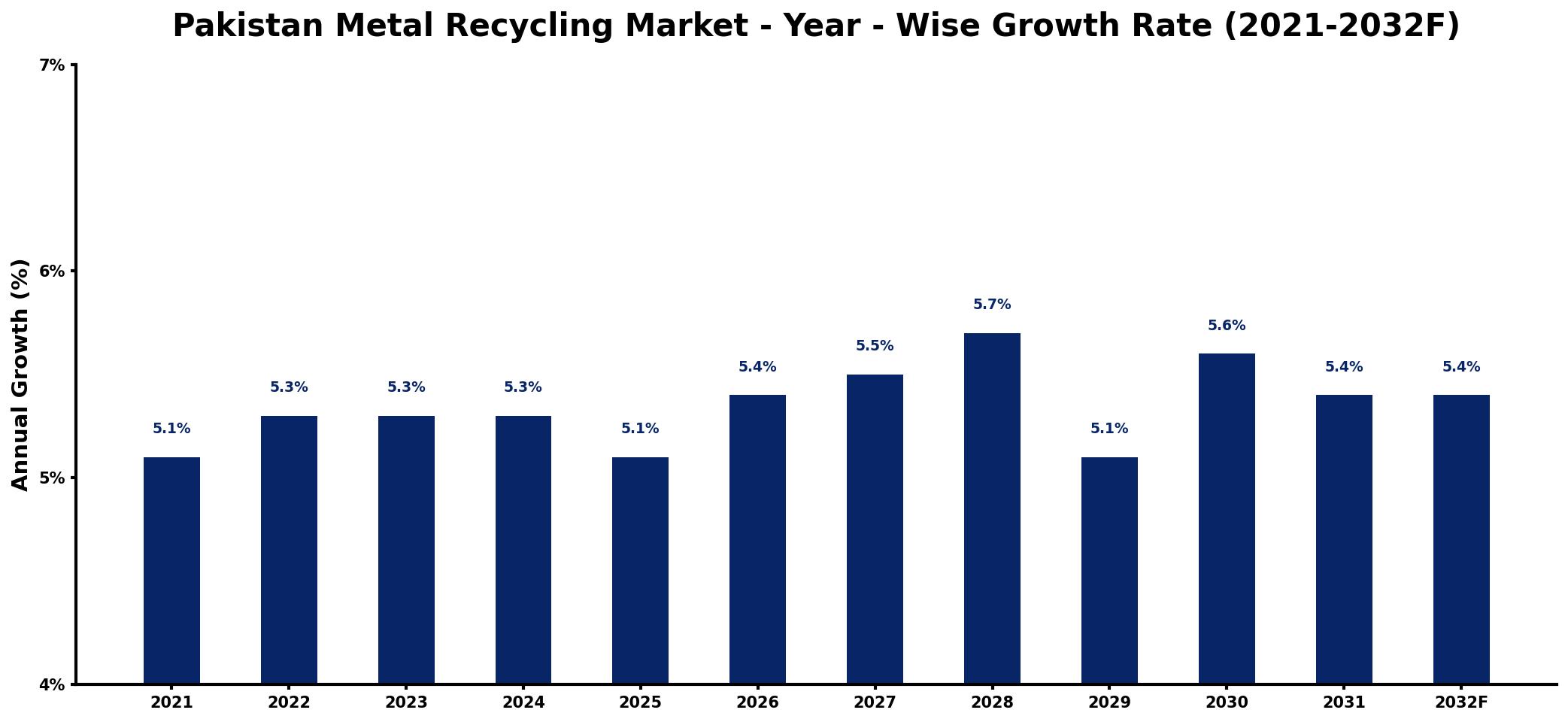
The table below presents the year‑wise growth rates along with the key drivers influencing the market
| Year | Growth Rate | Major Drivers |
| 2021 | 5.1% | Rising construction sector investments |
| 2022 | 5.3% | Increased demand from automotive industry |
| 2023 | 5.3% | Growing focus on sustainability initiatives |
| 2024 | 5.3% | Expansion of electronic waste processing |
| 2025 | 5.1% | growing commercial sector adoption |
| 2026 | 5.4% | Boost in infrastructure development projects |
| 2027 | 5.5% | growing emerging market penetration |
| 2028 | 5.7% | strengthening international trade flows |
| 2029 | 5.1% | Rising industrial output and production |
| 2030 | 5.6% | Increased government regulations promoting sustainability |
| 2031 | 5.4% | Emergence of new technological innovations |
| 2032 | 5.4% | Expanding international trade partnerships |
Note: Market size estimations and growth projections presented in this report are based on 6Wresearch's proprietary forecasting methodology, utilizing the latest available industry data, government publications, and primary research inputs.
Pakistan Metal Recycling Market Synopsis
The Pakistan Metal Recycling Market has emerged as a critical component of the countrys industrial landscape, evolving due to greater environmental awareness and the pressing need for effective resource management. As urbanization accelerates, the necessity for efficient waste management strategies becomes increasingly urgent, positioning metal recycling as a viable solution.
Moreover, the sector is marked by a unique blend of formal and informal recycling operations. This characteristic not only fosters innovation and adaptability but also presents regulatory challenges that must be navigated to ensure sustainable growth. Understanding these dynamics is crucial for stakeholders looking to capitalize on the burgeoning opportunities within this market.
Pakistan Metal Recycling Market Key Takeaways
- The market is experiencing a notable shift towards advanced recycling technologies to enhance efficiency and sustainability.
- Government policies promoting recycling practices provide a supportive framework for market expansion.
- Increased urbanization and industrialization are driving the demand for recycled metals, particularly steel and aluminum.
- Investment opportunities abound in establishing modern recycling facilities and enhancing existing infrastructure.
- The informal sector plays a significant role in metal recovery, presenting both opportunities and challenges for regulation.
Evaluation of Restraints in Pakistan Metal Recycling Market
Despite its potential, the Pakistan Metal Recycling Market faces several constraints that hinder its growth. A significant challenge lies in the lack of adequate infrastructure and modern technology, which results in low recycling rates and inefficiencies in operations. Additionally, the dominance of informal recycling practices not only causes environmental pollution but also raises health concerns for workers involved in these processes. Regulatory inconsistencies further exacerbate the situation, making it difficult for formal operators to thrive. Addressing these constraints will require concerted efforts to invest in infrastructure and enforce stricter regulations that promote sustainable practices.
Pakistan Metal Recycling Market Trends
The Pakistan Metal Recycling Market is currently witnessing a trend towards the adoption of advanced technologies that optimize recycling processes. Automation, particularly in sorting and processing, is gaining traction, improving both efficiency and output quality. Furthermore, there is an increasing emphasis on developing a circular economy, with industries actively seeking sustainable sources of materials. This shift is also reflected in the growing collaborations between businesses and local communities to enhance recycling rates and raise awareness of the benefits associated with resource conservation.
Pakistan Metal Recycling Market Opportunities
The landscape of the Pakistan Metal Recycling Market is ripe with investment opportunities. The burgeoning demand for recycled metals, fueled by ongoing infrastructure projects and industrial expansion, offers a lucrative avenue for new and existing investors. Establishing metal recycling facilities, such as modern scrap yards and processing plants, can yield attractive returns. Additionally, as technology continues to evolve, there is a notable potential for innovative solutions that enhance operational efficiency. Collaborations with governmental initiatives aimed at promoting sustainability further enhance the market's attractiveness for investment.
Government Initiatives in the Pakistan Metal Recycling Market
The Pakistani government has taken significant steps to promote the metal recycling industry through various policies and incentives. For instance, the Pakistan Environmental Protection Act establishes a regulatory framework to ensure safe and eco-friendly recycling practices. Tax incentives are offered to businesses engaged in recycling, thereby encouraging greater participation in the market. Furthermore, the Pakistan Scrap Act regulates the import and export of scrap materials to foster transparency and accountability within the industry. These initiatives are crucial for promoting sustainable practices and facilitating the growth of the metal recycling sector.
Future Insights of the Pakistan Metal Recycling Market
Looking ahead to the period from 2026 to 2032, the Pakistan Metal Recycling Market is anticipated to witness steady growth driven by a combination of environmental sustainability and technological advancements. The government's ongoing initiatives to bolster recycling efforts, alongside the rising demand for recycled metals across various industries, will play a pivotal role in shaping the market's trajectory. However, the extent of this growth will depend on overcoming existing infrastructural challenges and establishing a coherent regulatory framework that supports a more organized recycling industry.
Pakistan Metal Recycling Market Latest Developments (2025 - 2026)
In recent months, the metal recycling industry in Pakistan has seen a surge in discussions around the implementation of more stringent environmental regulations. Stakeholders are actively engaging in initiatives aimed at enhancing recycling efficiencies and minimizing the ecological footprint associated with metal recovery processes. Concurrently, there is a growing recognition of the informal sector's contributions, leading to exploratory partnerships designed to integrate these operations into a more formalized framework. Such developments are indicative of a shifting mindset towards a more sustainable recycling approach in Pakistan.
Pakistan Metal Recycling Market - Key Attractiveness of the Report
- 10 Years of Market Numbers
- Historical Data Starting from 2022 to 2025
- Base Year: 2025
- Forecast Data until 2032
- Key Performance Indicators Impacting the Market
- Major Upcoming Developments and Projects
Key Highlights of the Report:
- Pakistan Metal Recycling Market Outlook
- Market Size of Pakistan Metal Recycling Market, 2025
- Forecast of Pakistan Metal Recycling Market, 2032
- Historical Data and Forecast of Pakistan Metal Recycling Revenues & Volume for the Period 2022-2032F
- Pakistan Metal Recycling Market Trend Evolution
- Pakistan Metal Recycling Market Drivers and Challenges
- Pakistan Metal Recycling Price Trends
- Pakistan Metal Recycling Porter's Five Forces
- Pakistan Metal Recycling Industry Life Cycle
- Historical Data and Forecast of Pakistan Metal Recycling Market Revenues & Volume By Scrap Type for the Period 2022-2032F
- Historical Data and Forecast of Pakistan Metal Recycling Market Revenues & Volume By Old Scrap for the Period 2022-2032F
- Historical Data and Forecast of Pakistan Metal Recycling Market Revenues & Volume By New Scrap for the Period 2022-2032F
- Historical Data and Forecast of Pakistan Metal Recycling Market Revenues & Volume By Type for the Period 2022-2032F
- Historical Data and Forecast of Pakistan Metal Recycling Market Revenues & Volume By Ferrous for the Period 2022-2032F
- Historical Data and Forecast of Pakistan Metal Recycling Market Revenues & Volume By Non-Ferrous for the Period 2022-2032F
- Historical Data and Forecast of Pakistan Metal Recycling Market Revenues & Volume By Equipment for the Period 2022-2032F
- Historical Data and Forecast of Pakistan Metal Recycling Market Revenues & Volume By Shredders for the Period 2022-2032F
- Historical Data and Forecast of Pakistan Metal Recycling Market Revenues & Volume By Shears for the Period 2022-2032F
- Historical Data and Forecast of Pakistan Metal Recycling Market Revenues & Volume By Granulating Machines for the Period 2022-2032F
- Historical Data and Forecast of Pakistan Metal Recycling Market Revenues & Volume By Briquetting Machines for the Period 2022-2032F
- Historical Data and Forecast of Pakistan Metal Recycling Market Revenues & Volume By End-use Sector for the Period 2022-2032F
- Historical Data and Forecast of Pakistan Metal Recycling Market Revenues & Volume By Building & Construction for the Period 2022-2032F
- Historical Data and Forecast of Pakistan Metal Recycling Market Revenues & Volume By Automotive for the Period 2022-2032F
- Historical Data and Forecast of Pakistan Metal Recycling Market Revenues & Volume By Equipment Manufacturing for the Period 2022-2032F
- Historical Data and Forecast of Pakistan Metal Recycling Market Revenues & Volume By Shipbuilding for the Period 2022-2032F
- Historical Data and Forecast of Pakistan Metal Recycling Market Revenues & Volume By Packaging for the Period 2022-2032F
- Historical Data and Forecast of Pakistan Metal Recycling Market Revenues & Volume By Consumer Appliances for the Period 2022-2032F
- Historical Data and Forecast of Pakistan Metal Recycling Market Revenues & Volume By Others for the Period 2022-2032F
- Pakistan Metal Recycling Import Export Trade Statistics
- Market Opportunity Assessment By Scrap Type
- Market Opportunity Assessment By Type
- Market Opportunity Assessment By Equipment
- Market Opportunity Assessment By End-use Sector
- Pakistan Metal Recycling Top Companies Market Share
- Pakistan Metal Recycling Competitive Benchmarking By Technical and Operational Parameters
- Pakistan Metal Recycling Company Profiles
- Pakistan Metal Recycling Key Strategic Recommendations






































