Pakistan Oilfield Air Drilling Market Size, Share & Growth Rate
The Pakistan Oilfield Air Drilling Market was estimated at USD 307 Million in 2025 and is projected to reach USD 523 Million by 2032, growing at a CAGR of 7.9% from 2026 to 2032. This robust growth trajectory is primarily driven by the rising need for cost-efficient and effective drilling solutions, as companies aim to optimize their operations in the face of increasing energy demands. Additionally, air drilling technology is becoming increasingly favored in Pakistan due to its advantages in challenging geological conditions, further enhancing its adoption.
Pakistan Oilfield Air Drilling Market Year-wise Growth Rate and Key Drivers
This graph highlights how the Pakistan Oilfield Air Drilling Market has steadily grown over the years, supported by major growth factors.
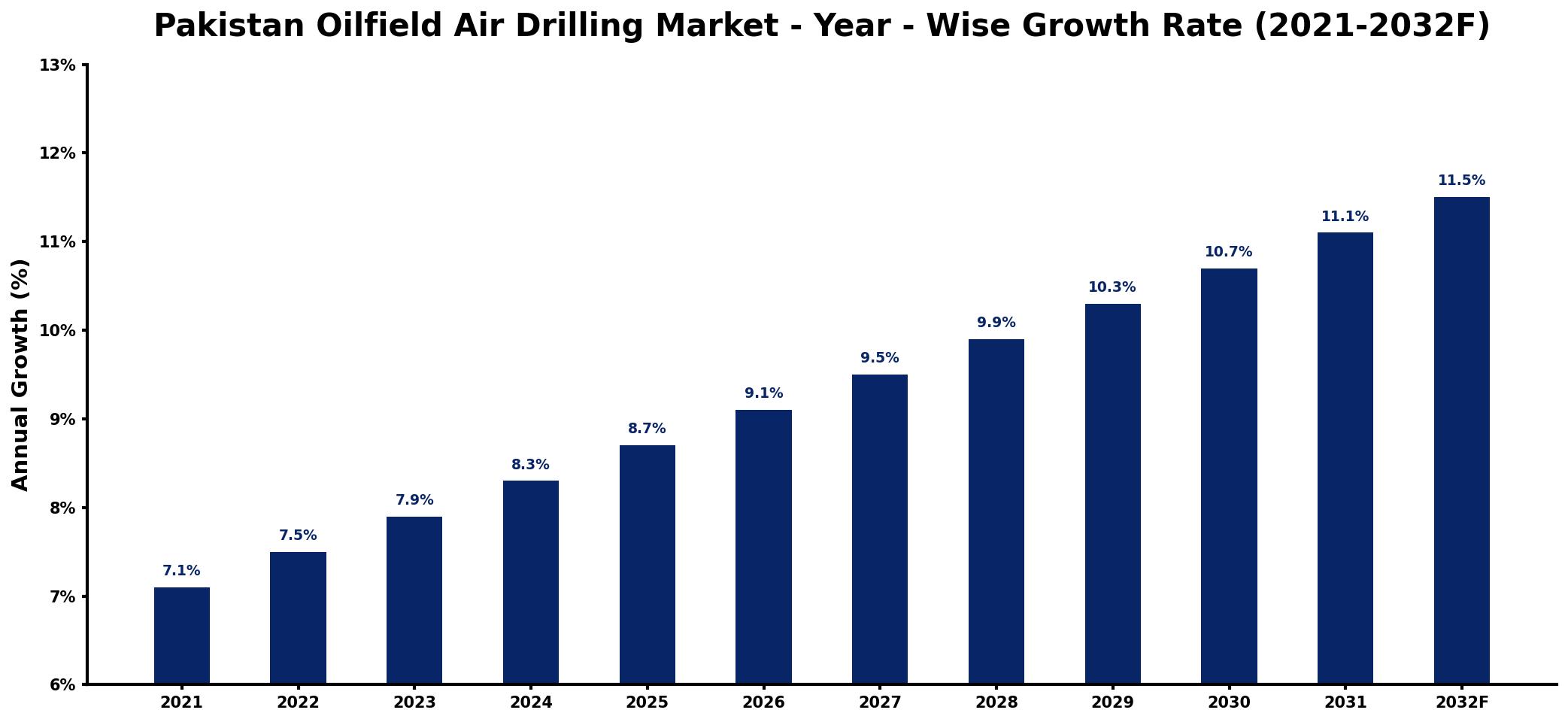
The table below presents the year‑wise growth rates along with the key drivers influencing the market
| Year | Growth Rate | Major Drivers |
| 2021 | 7.1% | Rising energy sector investments |
| 2022 | 7.5% | Increased demand for exploration |
| 2023 | 7.9% | Technological advancements in extraction |
| 2024 | 8.3% | Expansion of renewable energy projects |
| 2025 | 8.7% | Growing global energy consumption |
| 2026 | 9.1% | Enhanced regulatory support frameworks |
| 2027 | 9.5% | Surge in foreign investments |
| 2028 | 9.9% | Emergence of new market players |
| 2029 | 10.3% | Higher consumer energy needs |
| 2030 | 10.7% | growing commercial sector adoption |
| 2031 | 11.1% | Boost in domestic production capacity |
| 2032 | 11.5% | Increasing focus on sustainability initiatives |
Note: Market size estimations and growth projections presented in this report are based on 6Wresearch's proprietary forecasting methodology, utilizing the latest available industry data, government publications, and primary research inputs.
Pakistan Oilfield Air Drilling Market Synopsis
In Pakistan's oilfields, the shift towards air drilling technology is being accelerated by a need for faster and less damaging drilling methods. The prevalent hard rock formations in the region make air drilling particularly advantageous, as it significantly reduces formation damage while maintaining wellbore stability.
With major investments in research and development from industry stakeholders, air drilling techniques are continuously evolving to meet the unique challenges posed by Pakistan's geological landscape. The government's supportive policies aimed at boosting local oil and gas exploration also play a pivotal role in this market's dynamic growth.
Pakistan Oilfield Air Drilling Market Key Takeaways
- The market is experiencing significant growth due to the rising demand for efficient drilling solutions.
- Air drilling technology provides advantages such as faster drilling rates and reduced formation damage.
- Government initiatives are fostering the adoption of advanced drilling methods in the oil and gas sector.
- Investment in R&D is crucial for enhancing air drilling techniques and environmental sustainability.
- Technological advancements are propelling the market toward greater operational efficiency.
Evaluation of Restraints in Pakistan Oilfield Air Drilling Market
Despite its promising growth, the Pakistan Oilfield Air Drilling Market faces several critical restraints. A complex regulatory framework presents challenges for companies aiming to navigate the landscape for long-term investments. Infrastructure inadequacies, such as unreliable transportation networks and power shortages, may impede operational efficiency and increase costs. Furthermore, technological constraints, particularly in remote areas, can limit the feasibility of implementing advanced air drilling solutions. Lastly, environmental concerns about air drilling practices necessitate careful management to ensure sustainable operations, presenting an ongoing challenge for stakeholders in the sector.
Pakistan Oilfield Air Drilling Market Trends
The trend in the Pakistan Oilfield Air Drilling Market is leaning towards the adoption of innovative technologies aimed at improving drilling efficiency. Enhanced wellbore stability and control are becoming increasingly critical, pushing operators to integrate underbalanced drilling methods. Additionally, the rise of directional drilling capabilities, complemented by real-time data analytics, is shifting the landscape towards more sophisticated air drilling solutions. These advancements not only enhance operational efficiency but also address environmental sustainability concerns, driving greater interest in air drilling methodologies across the sector.
Pakistan Oilfield Air Drilling Market Opportunities
Investment opportunities in the Pakistan Oilfield Air Drilling Market are abundant, especially as the demand for efficient drilling techniques continues to escalate. Companies could explore partnerships with air drilling technology providers and equipment manufacturers to maximize returns. Furthermore, investing in R&D initiatives focused on enhancing the environmental sustainability of drilling practices presents a lucrative avenue for growth. With Pakistan's strategic position and significant untapped oil reserves, the potential for profitable ventures in air drilling is substantial, particularly as the local energy sector expands.
Government Initiatives in the Pakistan Oilfield Air Drilling Market
The Pakistan Oilfield Air Drilling Market is significantly influenced by government policies designed to attract investment and promote domestic exploration. The Oil and Gas Regulatory Authority (OGRA) oversees the regulatory environment, implementing incentives like tax breaks and subsidies to stimulate interest from both local and foreign players. In tandem with these financial incentives, the government is committed to enforcing regulations that prioritize environmental sustainability and safety in drilling operations. This dual approach aims to create a conducive business environment that supports the growth of the air drilling sector.
Future Insights of the Pakistan Oilfield Air Drilling Market
Looking ahead to the period from 2026 to 2032, the Pakistan Oilfield Air Drilling Market is positioned for sustained growth. The increasing demand for efficient, cost-effective drilling techniques aligns with the broader industry trend towards sustainability. As regulations on carbon emissions tighten, the advantages of air drilling technology will become even more prominent. The continuous evolution of drilling practices, fueled by technological innovations, will likely lead to improved reservoir recovery rates, setting the stage for a thriving market environment in Pakistan's oilfields.
Pakistan Oilfield Air Drilling Market Latest Developments (2025 - 2026)
Recent developments in the Pakistan Oilfield Air Drilling Market reflect a growing commitment to technological advancement and sustainable practices. Companies are increasingly focusing on enhancing their air drilling capabilities to adapt to the unique challenges presented by Pakistan's geological formations. Furthermore, there has been a noticeable shift towards the implementation of real-time data analytics to optimize drilling operations, thereby improving overall productivity. This push towards innovation is indicative of a market on the cusp of significant transformation and efficiency improvements.
Pakistan Oilfield Air Drilling Market - Key Attractiveness of the Report
- 10 Years of Market Numbers
- Historical Data Starting from 2022 to 2025
- Base Year: 2025
- Forecast Data until 2032
- Key Performance Indicators Impacting the Market
- Major Upcoming Developments and Projects
Key Highlights of the Report:
- Pakistan Oilfield Air Drilling Market Outlook
- Market Size of Pakistan Oilfield Air Drilling Market, 2025
- Forecast of Pakistan Oilfield Air Drilling Market, 2032
- Historical Data and Forecast of Pakistan Oilfield Air Drilling Revenues & Volume for the Period 2022-2032F
- Pakistan Oilfield Air Drilling Market Trend Evolution
- Pakistan Oilfield Air Drilling Market Drivers and Challenges
- Pakistan Oilfield Air Drilling Price Trends
- Pakistan Oilfield Air Drilling Porter's Five Forces
- Pakistan Oilfield Air Drilling Industry Life Cycle
- Historical Data and Forecast of Pakistan Oilfield Air Drilling Market Revenues & Volume By Type for the Period 2022-2032F
- Historical Data and Forecast of Pakistan Oilfield Air Drilling Market Revenues & Volume By Dust for the Period 2022-2032F
- Historical Data and Forecast of Pakistan Oilfield Air Drilling Market Revenues & Volume By Aerated fluid for the Period 2022-2032F
- Historical Data and Forecast of Pakistan Oilfield Air Drilling Market Revenues & Volume By Foam for the Period 2022-2032F
- Historical Data and Forecast of Pakistan Oilfield Air Drilling Market Revenues & Volume By Mist for the Period 2022-2032F
- Historical Data and Forecast of Pakistan Oilfield Air Drilling Market Revenues & Volume By Nitrogen membrane for the Period 2022-2032F
- Pakistan Oilfield Air Drilling Import Export Trade Statistics
- Market Opportunity Assessment By Type
- Pakistan Oilfield Air Drilling Top Companies Market Share
- Pakistan Oilfield Air Drilling Competitive Benchmarking By Technical and Operational Parameters
- Pakistan Oilfield Air Drilling Company Profiles
- Pakistan Oilfield Air Drilling Key Strategic Recommendations






































