Pakistan Web Application Firewall Market Size & Growth Rate (2026-2032)
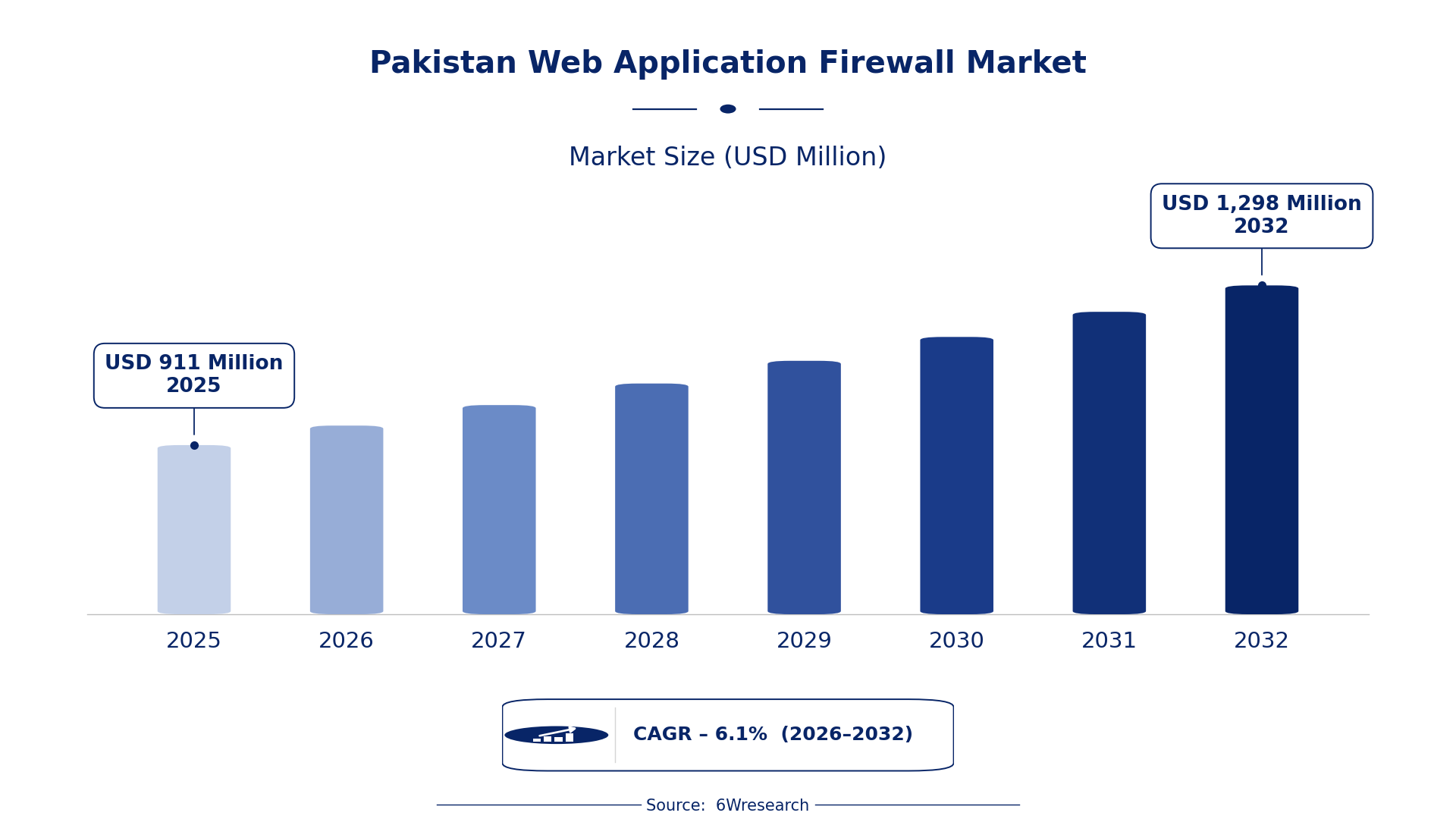
The Pakistan Web Application Firewall Market was estimated at USD 911 Million in 2025 and is projected to reach USD 1298 Million by 2032, growing at a CAGR of 6.1% from 2026 to 2032.
Pakistan Web Application Firewall Market Synopsis
The web application firewall (WAF) market in Pakistan is witnessing a pronounced acceleration as businesses wake up to the escalating threat of cyberattacks. This urgency is reflected in the increased investments in cybersecurity technologies, positioning WAFs as vital components in protecting sensitive digital assets.
While the market has gained momentum, the path ahead reveals a burgeoning demand fueled by rising online transactions and regulatory pressures for compliance. As organizations increasingly migrate to cloud services, WAFs are becoming essential tools in their cybersecurity arsenal.
Pakistan Web Application Firewall Market Year-wise Growth Rate and Key Drivers
This graph illustrates the annual growth rates of the Pakistan Web Application Firewall Market from 2021 to 2032, highlighting a steady upward trajectory and projected expansion over the forecast period.
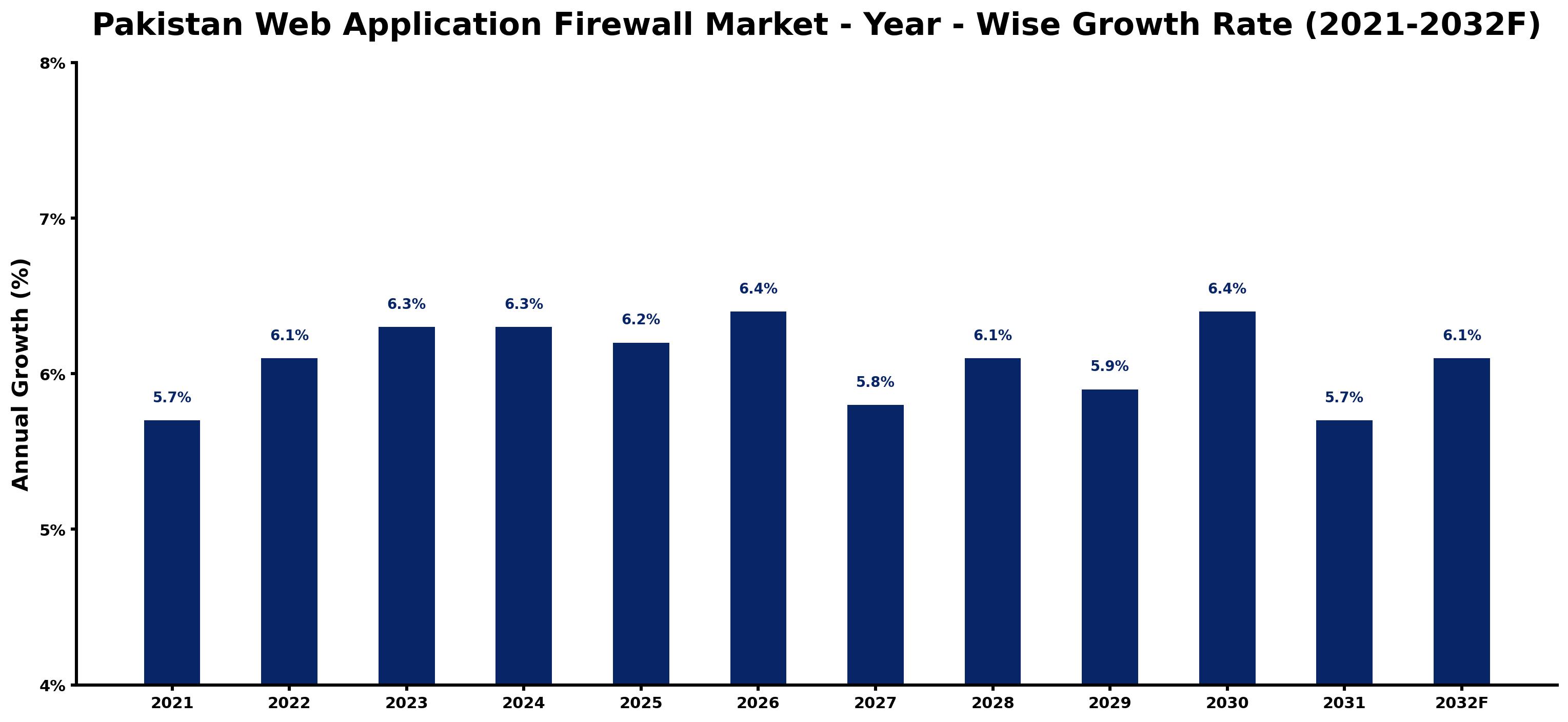
The table below presents the year‑wise growth rates along with the key drivers influencing the market
| Year | Growth Rate | Major Drivers |
| 2021 | 5.7% | Cybersecurity policy enhancements by Pakistan's Ministry of IT |
| 2022 | 6.1% | Increased cyber threats prompting demand for robust security solutions |
| 2023 | 6.3% | Rising e-commerce transactions boosting web security investments |
| 2024 | 6.3% | Growth in fintech firms necessitating advanced application firewalls |
| 2025 | 6.2% | Telecom sector expansion driving online application protection needs |
| 2026 | 6.4% | Regulatory compliance mandates for data protection and privacy |
| 2027 | 5.8% | Surge in remote working increasing vulnerability to cyberattacks |
| 2028 | 6.1% | Local tech startups prioritizing cybersecurity in product development |
| 2029 | 5.9% | Educational institutions adopting online platforms heightening security awareness |
| 2030 | 6.4% | Government regulations enforcing stricter online security measures |
| 2031 | 5.7% | Retail sector digitization fueling demand for web security tools |
| 2032 | 6.1% | Investment in cloud services requiring enhanced application security |
Note: Market size estimations and growth projections presented in this report are based on 6Wresearch's proprietary forecasting methodology, utilizing the latest available industry data, government publications, and primary research inputs.
Pakistan Web Application Firewall Market Key Takeaways
Below are some of the specific key takeaways from the market, including:
- The market is rapidly expanding, driven by the need for robust cybersecurity measures.
- Cloud adoption is a significant factor, pushing organizations towards WAF solutions.
- Cost factors and a shortage of local expertise pose challenges for market penetration.
- Government initiatives are focusing on strengthening national cybersecurity frameworks.
- Emerging technologies are expected to enhance the efficacy of WAF solutions.
Evaluation of Restraints in Pakistan Web Application Firewall Market
High costs and a lack of local expertise are substantial barriers for businesses considering web application firewalls in Pakistan. Many organizations are hesitant to invest due to the financial burden associated with imported solutions and ongoing maintenance. Furthermore, limited public awareness about the critical advantages of WAFs in combating cyber threats restricts wider adoption. This environment creates a challenge for cybersecurity providers to effectively communicate the value of their services.
Pakistan Web Application Firewall Market Trends
As the cybersecurity landscape shifts, several notable trends are emerging. A marked increase in online transactions is driving companies to adopt more sophisticated security measures. Advances in machine learning and AI are being integrated into WAF solutions, providing enhanced threat detection and response capabilities. Furthermore, businesses are increasingly recognizing the importance of compliance with data protection regulations, which further fuels the demand for WAFs.
Pakistan Web Application Firewall Market Opportunities
The market presents numerous growth opportunities, particularly as organizations look to bolster their cybersecurity postures. As regulatory frameworks evolve, companies will be compelled to invest in WAF technologies to ensure compliance and protect consumer data. Additionally, partnerships between cybersecurity vendors and local businesses could facilitate the development of customized solutions tailored to the unique challenges of the Pakistani market.
Government Initiatives in the Pakistan Web Application Firewall Market
Government policies are shaping the cybersecurity environment significantly, with a focus on enhancing the country’s digital defense mechanisms. Efforts to fortify critical infrastructure and mitigate cyber threats underscore the administration's commitment to securing digital assets. Recent regulatory frameworks have established clear guidelines for the deployment of web application firewalls, pushing industries to adopt better cybersecurity practices.
- A national digital security strategy was launched in early 2025, aimed at improving cybersecurity across all sectors.
- Ongoing initiatives include the development of cybersecurity training programs to increase local expertise.
- A regulatory framework mandating the use of WAFs in specific industries was implemented in 2024.
- Future plans include a public-private partnership aimed at funding cybersecurity infrastructure improvements by 2026.
Future Insights of the Pakistan Web Application Firewall Market
Looking ahead to 2026-2032, the Pakistan Web Application Firewall Market is expected to witness steady growth. The ongoing rise in cyber threats will compel more businesses to prioritize cybersecurity investments. As cloud adoption accelerates, WAF solutions will become increasingly integral to safeguarding web applications. The continuous evolution of cyber threats will necessitate advanced solutions that not only protect but also adapt to new vulnerabilities.
Pakistan Web Application Firewall Market Latest Developments
In the past year, industry activity in the Pakistan Web Application Firewall Market has intensified, with a strong focus on integrating advanced technologies and expanding service offerings. Companies are responding to the growing demand for cybersecurity by enhancing their solutions and partnerships.
- A new cybersecurity training program launched in Q1 2025 aims to upskill professionals in WAF deployment.
- An initiative to integrate AI-driven threat detection capabilities into existing WAF solutions is currently underway.
- A leading technology vendor is expected to release a cloud-native WAF solution in mid-2026 to meet emerging market demands.
- Partnerships between regional players and international cybersecurity firms are being established to enhance local capabilities by late 2025.
Pakistan Web Application Firewall Market - Key Attractiveness of the Report
- 10 Years of Market Numbers
- Historical Data Starting from 2022 to 2025
- Base Year: 2025
- Forecast Data until 2032
- Key Performance Indicators Impacting the Market
- Major Upcoming Developments and Projects
Key Highlights of the Report:
- Pakistan Web Application Firewall Market Outlook
- Market Size of Pakistan Web Application Firewall Market, 2025
- Forecast of Pakistan Web Application Firewall Market, 2032
- Historical Data and Forecast of Pakistan Web Application Firewall Revenues & Volume for the Period 2022-2032F
- Pakistan Web Application Firewall Market Trend Evolution
- Pakistan Web Application Firewall Market Drivers and Challenges
- Pakistan Web Application Firewall Price Trends
- Pakistan Web Application Firewall Porter's Five Forces
- Pakistan Web Application Firewall Industry Life Cycle
- Historical Data and Forecast of Pakistan Web Application Firewall Market Revenues & Volume By Component for the Period 2022-2032F
- Historical Data and Forecast of Pakistan Web Application Firewall Market Revenues & Volume By Solutions (Hardware Appliances, Virtual Appliances, Cloud-Based) for the Period 2022-2032F
- Historical Data and Forecast of Pakistan Web Application Firewall Market Revenues & Volume By Services (Professional and Managed) for the Period 2022-2032F
- Historical Data and Forecast of Pakistan Web Application Firewall Market Revenues & Volume By Organization Size for the Period 2022-2032F
- Historical Data and Forecast of Pakistan Web Application Firewall Market Revenues & Volume By SMEs for the Period 2022-2032F
- Historical Data and Forecast of Pakistan Web Application Firewall Market Revenues & Volume By Large Enterprises for the Period 2022-2032F
- Historical Data and Forecast of Pakistan Web Application Firewall Market Revenues & Volume By Vertical for the Period 2022-2032F
- Historical Data and Forecast of Pakistan Web Application Firewall Market Revenues & Volume By Banking, Financial Services & Insurance for the Period 2022-2032F
- Historical Data and Forecast of Pakistan Web Application Firewall Market Revenues & Volume By Retail for the Period 2022-2032F
- Historical Data and Forecast of Pakistan Web Application Firewall Market Revenues & Volume By IT & Telecommunications for the Period 2022-2032F
- Historical Data and Forecast of Pakistan Web Application Firewall Market Revenues & Volume By Government & Defense for the Period 2022-2032F
- Historical Data and Forecast of Pakistan Web Application Firewall Market Revenues & Volume By Healthcare for the Period 2022-2032F
- Historical Data and Forecast of Pakistan Web Application Firewall Market Revenues & Volume By Energy & Utilities for the Period 2022-2032F
- Historical Data and Forecast of Pakistan Web Application Firewall Market Revenues & Volume By Education for the Period 2022-2032F
- Historical Data and Forecast of Pakistan Web Application Firewall Market Revenues & Volume By Other Verticals for the Period 2022-2032F
- Pakistan Web Application Firewall Import Export Trade Statistics
- Market Opportunity Assessment By Component
- Market Opportunity Assessment By Organization Size
- Market Opportunity Assessment By Vertical
- Pakistan Web Application Firewall Top Companies Market Share
- Pakistan Web Application Firewall Competitive Benchmarking By Technical and Operational Parameters
- Pakistan Web Application Firewall Company Profiles
- Pakistan Web Application Firewall Key Strategic Recommendations






































