Peru Infrared Imaging Market Size, Share & Growth Rate
The Peru Infrared Imaging Market was estimated at USD 292 Million in 2025 and is projected to reach USD 409 Million by 2032, growing at a CAGR of 4.9% from 2026 to 2032. This growth trajectory is being driven by increased investments in advanced infrared systems across the defense sector, which prioritizes enhanced situational awareness and security. Simultaneously, the industrial sector's growing reliance on infrared technology for predictive maintenance and quality control is further bolstering the market's expansion.
Peru Infrared Imaging Market Year-wise Growth Rate and Key Drivers
This graph highlights how the Peru Infrared Imaging Market has steadily grown over the years, supported by major growth factors.
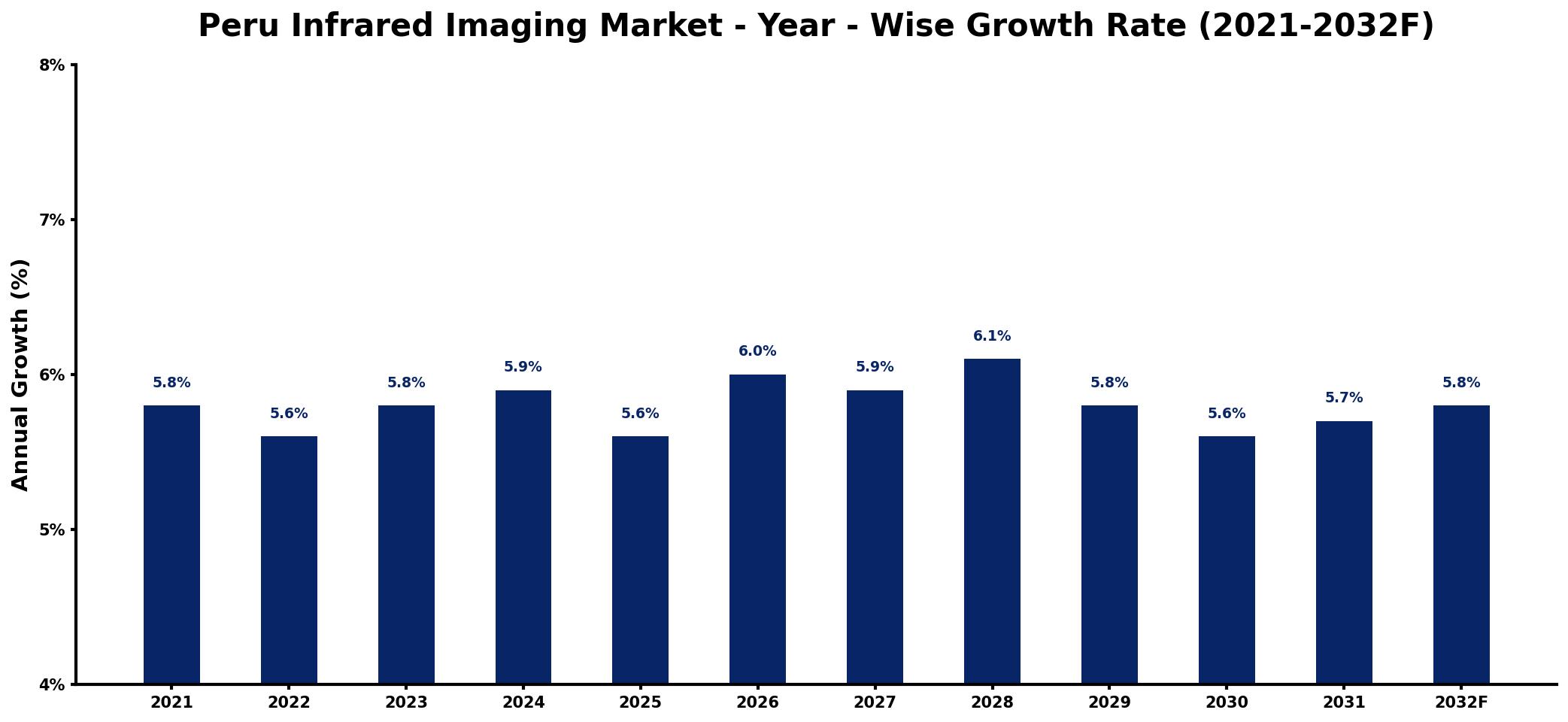
The table below presents the year‑wise growth rates along with the key drivers influencing the market
| Year | Growth Rate | Major Drivers |
| 2021 | 5.8% | Rising healthcare sector investments |
| 2022 | 5.6% | Increased demand for diagnostics |
| 2023 | 5.8% | Growth in industrial applications |
| 2024 | 5.9% | Expansion of research initiatives |
| 2025 | 5.6% | Surge in energy efficiency projects |
| 2026 | 6.0% | Advancements in technology adoption |
| 2027 | 5.9% | Increased focus on safety regulations |
| 2028 | 6.1% | strengthening international trade flows |
| 2029 | 5.8% | Rising demand for maintenance solutions |
| 2030 | 5.6% | Expansion in agricultural applications |
| 2031 | 5.7% | Increased government funding programs |
| 2032 | 5.8% | improved processing technologies adoption |
Note: Market size estimations and growth projections presented in this report are based on 6Wresearch's proprietary forecasting methodology, utilizing the latest available industry data, government publications, and primary research inputs.
Peru Infrared Imaging Market Synopsis
The Peru Infrared Imaging Market has recently gained momentum, primarily fueled by the demand for surveillance and monitoring technology across various sectors. As organizations seek more effective ways to ensure safety and operational efficiency, the adoption of infrared imaging is becoming increasingly prevalent.
Looking ahead, the market is poised for robust growth as technological advancements enhance the capabilities of infrared imaging systems. With broader applications emerging in healthcare, agriculture, and environmental monitoring, the future of the Peru Infrared Imaging Market appears promising and diverse.
Peru Infrared Imaging Market Key Takeaways
- The Peru Infrared Imaging Market is experiencing steady growth, driven by increasing demand from multiple sectors.
- Technological innovations are enhancing infrared imaging capabilities, leading to broader applications.
- Government initiatives are fostering advancements and supporting the development of local expertise in infrared technology.
- The automotive and healthcare sectors are increasingly integrating infrared imaging for enhanced functionality.
- Investment opportunities exist in companies that focus on tailored solutions for diverse industry needs.
Evaluation of Restraints in Peru Infrared Imaging Market
While the Peru Infrared Imaging Market is on an upward trajectory, several restraints may hinder its full potential. High initial investment costs associated with infrared camera systems can deter adoption among smaller enterprises. Furthermore, limited awareness and understanding of the technology among potential end-users can slow market penetration. There is also a notable shortage of skilled professionals required to operate and maintain these sophisticated imaging systems, which presents a significant challenge. These factors necessitate targeted educational initiatives and strategic collaborations to foster growth in the sector.
Peru Infrared Imaging Market Trends
The Peru Infrared Imaging Market is currently shaped by several key trends. A marked increase in the adoption of portable and lightweight infrared cameras allows professionals across various industries to conduct inspections more efficiently. Furthermore, ongoing advancements in infrared sensor technology are resulting in higher resolutions and improved thermal sensitivity, paving the way for expanded applications. Another significant trend is the heightened focus on energy efficiency and predictive maintenance, driving demand for infrared imaging solutions.
Peru Infrared Imaging Market Opportunities
Investment opportunities abound in the Peru Infrared Imaging Market, particularly within the defense and security sectors. The rising need for sophisticated surveillance, reconnaissance, and border control technologies presents a compelling case for investors. Additionally, the industrial sectors growing utilization of infrared imaging for maintenance and quality assurance indicates strong potential. In healthcare, the technology's applications in diagnostics and thermography further enhance its investment attractiveness. Overall, positioning in companies that deliver innovative infrared imaging solutions tailored to specific industry needs can yield significant returns.
Government Initiatives in the Peru Infrared Imaging Market
The Peruvian government is actively promoting the growth of the Infrared Imaging Market through various initiatives. These include tax incentives and grants for research and development aimed at fostering innovation within local companies. Additionally, there is a concerted effort to establish partnerships between industry and academia to cultivate expertise and promote technological advancements. By emphasizing environmental sustainability and safety in the use of infrared technologies, the government is also establishing standards and regulations that ensure responsible practices across sectors.
Future Insights of the Peru Infrared Imaging Market
The future outlook for the Peru Infrared Imaging Market is bright, with steady growth anticipated through 2026-2032. Demand will be driven by continuous technological advancements and a deeper understanding of the benefits of infrared imaging across sectors. As infrastructure modernizes and surveillance capabilities expand, the market is likely to see increased integration of infrared solutions in agriculture and environmental monitoring as well. Overall, as the technology becomes more accessible and diverse in its applications, the Peru Infrared Imaging Market is set to flourish.
Peru Infrared Imaging Market Latest Developments (2025 - 2026)
Recent developments within the Peru Infrared Imaging Market indicate a strong focus on technological innovations, as companies are prioritizing enhancements in imaging resolution and portability. Additionally, there has been a noticeable uptick in collaborations between local firms and international technology providers, aimed at developing customized solutions for the Peruvian landscape. Overall, the market is witnessing a shift towards more versatile applications, reflecting changing user needs and expectations.
Peru Infrared Imaging Market - Key Attractiveness of the Report
- 10 Years of Market Numbers
- Historical Data Starting from 2022 to 2025
- Base Year: 2025
- Forecast Data until 2032
- Key Performance Indicators Impacting the Market
- Major Upcoming Developments and Projects
Key Highlights of the Report:
- Peru Infrared Imaging Market Outlook
- Market Size of Peru Infrared Imaging Market, 2025
- Forecast of Peru Infrared Imaging Market, 2032
- Historical Data and Forecast of Peru Infrared Imaging Revenues & Volume for the Period 2022-2032F
- Peru Infrared Imaging Market Trend Evolution
- Peru Infrared Imaging Market Drivers and Challenges
- Peru Infrared Imaging Price Trends
- Peru Infrared Imaging Porter's Five Forces
- Peru Infrared Imaging Industry Life Cycle
- Historical Data and Forecast of Peru Infrared Imaging Market Revenues & Volume By Technology for the Period 2022-2032F
- Historical Data and Forecast of Peru Infrared Imaging Market Revenues & Volume By Cooled Infrared Imaging for the Period 2022-2032F
- Historical Data and Forecast of Peru Infrared Imaging Market Revenues & Volume By Uncooled Infrared Imaging for the Period 2022-2032F
- Historical Data and Forecast of Peru Infrared Imaging Market Revenues & Volume By Wavelength for the Period 2022-2032F
- Historical Data and Forecast of Peru Infrared Imaging Market Revenues & Volume By Near Infrared for the Period 2022-2032F
- Historical Data and Forecast of Peru Infrared Imaging Market Revenues & Volume By Shortwave Infrared for the Period 2022-2032F
- Historical Data and Forecast of Peru Infrared Imaging Market Revenues & Volume By Mid-wave Infrared for the Period 2022-2032F
- Historical Data and Forecast of Peru Infrared Imaging Market Revenues & Volume By Long-wave Infrared for the Period 2022-2032F
- Historical Data and Forecast of Peru Infrared Imaging Market Revenues & Volume By Application for the Period 2022-2032F
- Historical Data and Forecast of Peru Infrared Imaging Market Revenues & Volume By Security & Surveillance for the Period 2022-2032F
- Historical Data and Forecast of Peru Infrared Imaging Market Revenues & Volume By Monitoring & Inspection for the Period 2022-2032F
- Historical Data and Forecast of Peru Infrared Imaging Market Revenues & Volume By Detection for the Period 2022-2032F
- Historical Data and Forecast of Peru Infrared Imaging Market Revenues & Volume By Vertical for the Period 2022-2032F
- Historical Data and Forecast of Peru Infrared Imaging Market Revenues & Volume By Industrial for the Period 2022-2032F
- Historical Data and Forecast of Peru Infrared Imaging Market Revenues & Volume By Nonindustrial for the Period 2022-2032F
- Peru Infrared Imaging Import Export Trade Statistics
- Market Opportunity Assessment By Technology
- Market Opportunity Assessment By Wavelength
- Market Opportunity Assessment By Application
- Market Opportunity Assessment By Vertical
- Peru Infrared Imaging Top Companies Market Share
- Peru Infrared Imaging Competitive Benchmarking By Technical and Operational Parameters
- Peru Infrared Imaging Company Profiles
- Peru Infrared Imaging Key Strategic Recommendations






































