Peru Mineral Processing Equipment Market Size, Share & Growth Rate
The Peru Mineral Processing Equipment Market was estimated at USD 219 Million in 2025 and is projected to reach USD 306 Million by 2032, growing at a CAGR of 4.9% from 2026 to 2032. This upward trajectory is primarily driven by the nation's rich mineral resources, coupled with a growing demand for metals such as copper, gold, and silver. The ongoing advancements in technology and rising investments in the mining sector further amplify the need for sophisticated processing equipment, ensuring an exciting growth phase for this market.
Peru Mineral Processing Equipment Market Year-wise Growth Rate and Key Drivers
This graph highlights how the Peru Mineral Processing Equipment Market has steadily grown over the years, supported by major growth factors.
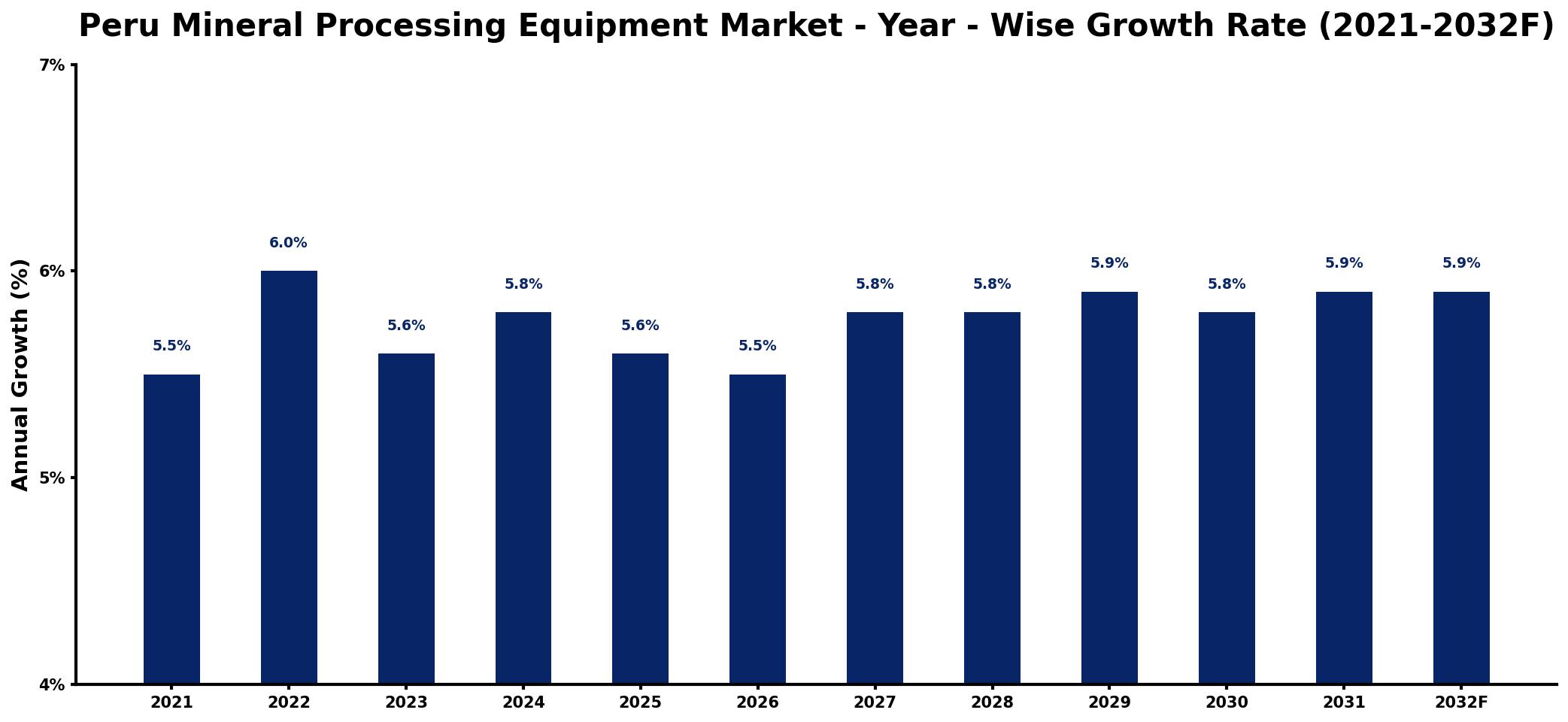
The table below presents the year‑wise growth rates along with the key drivers influencing the market
| Year | Growth Rate | Major Drivers |
| 2021 | 5.5% | Rising demand from mining sector |
| 2022 | 6.0% | Increased investments in infrastructure |
| 2023 | 5.6% | Expansion of renewable energy projects |
| 2024 | 5.8% | Growth in construction activities |
| 2025 | 5.6% | Surge in foreign investments |
| 2026 | 5.5% | Technological advancements in operations |
| 2027 | 5.8% | Strengthening local manufacturing capabilities |
| 2028 | 5.8% | Growing focus on sustainability initiatives |
| 2029 | 5.9% | Increased exports to neighboring countries |
| 2030 | 5.8% | increased capital investment inflows |
| 2031 | 5.9% | Rising global commodity prices |
| 2032 | 5.9% | Growing interest in automation solutions |
Note: Market size estimations and growth projections presented in this report are based on 6Wresearch's proprietary forecasting methodology, utilizing the latest available industry data, government publications, and primary research inputs.
Peru Mineral Processing Equipment Market Synopsis
While recent years have showcased robust activity in the Peru Mineral Processing Equipment Market, the future holds even greater promise. With increasing mining operations and government support, the market is poised for expansion as it adapts to more complex mineral extraction processes and stringent environmental regulations.
The contrast between current momentum and future prospects is significant. Investment in advanced technologies is becoming essential as mining companies seek innovative solutions to enhance productivity. By aligning operational goals with environmental standards, the market is evolving toward a sustainable future.
Peru Mineral Processing Equipment Market Key Takeaways
- The market is fueled by strong demand for copper, gold, and silver, driving investment in processing equipment.
- Technological innovations are reshaping the landscape, with automation and digitalization at the forefront.
- Government initiatives are promoting sustainable mining practices and encouraging the adoption of eco-friendly equipment.
- Investment in research and development is pivotal for companies aiming to stay competitive in a dynamic environment.
- Infrastructure challenges and regulatory uncertainties remain as significant factors influencing market growth.
Evaluation of Restraints in Peru Mineral Processing Equipment Market
Despite its growth potential, the Peru Mineral Processing Equipment Market faces notable constraints. Regulatory uncertainty and shifts in mining policies can significantly influence investment decisions and project timelines. The industry also grapples with a shortage of skilled labor and the technical expertise needed to operate advanced processing equipment. Additionally, inadequate infrastructure can hamper operational efficiency, while fluctuations in global commodity prices add a layer of unpredictability to profitability and growth prospects. Addressing these challenges is essential for companies to thrive in this evolving landscape.
Peru Mineral Processing Equipment Market Trends
Emerging trends in the Peru Mineral Processing Equipment Market highlight a decisive shift toward sustainability and technological innovation. Companies are increasingly focusing on energy-efficient solutions to meet stringent environmental regulations. Automation and digitalization are becoming integral to processing operations, enhancing efficiency, reducing downtime, and improving product quality. Furthermore, the demand for advanced equipment capable of handling complex ore bodies is rising, pushing manufacturers to innovate continually.
Peru Mineral Processing Equipment Market Opportunities
The Peru Mineral Processing Equipment Market presents several promising investment opportunities, particularly in sectors supplying cutting-edge machinery for mineral extraction. The escalating demand for efficient processing equipment indicates a ripe environment for investments in technologies such as crushing, grinding, and sorting machinery. Moreover, the growing need for maintenance, repair, and spare parts services offers additional avenues for revenue generation. Collaborations with local mining entities can also enhance prospects, leveraging Perus favorable mining policies and rich resource base.
Government Initiatives in the Peru Mineral Processing Equipment Market
Government policies in Peru are strategically designed to support the mineral processing equipment sector while promoting sustainable mining practices. Initiatives are in place that encourage technological innovation and environmental stewardship, ensuring that mining operations meet strict regulatory standards. Moreover, incentives such as tax breaks and subsidies are offered to companies that invest in modern processing technologies, enhancing the competitiveness of Peru's mining industry on a global scale.
Future Insights of the Peru Mineral Processing Equipment Market
Looking ahead to 2026-2032, the Peru Mineral Processing Equipment Market is set for consistent growth. The need for efficient processing systems will drive demand as mining companies focus on maximizing output while minimizing costs. Coupled with technological advancements in automation and digital capabilities, the market is aligning itself to meet the evolving requirements of the mining sector. As Peru maintains its status as a key player in global mining, the mineral processing equipment market is well-positioned to experience significant expansion.
Peru Mineral Processing Equipment Market Latest Developments (2025 - 2026)
Recent developments in the Peru Mineral Processing Equipment Market indicate a continued focus on innovation and sustainability. Companies are increasingly adopting advanced technologies aimed at enhancing processing efficiency and reducing environmental impact. Collaborative efforts between industry stakeholders and research institutions are gaining traction, fostering a culture of innovation and knowledge transfer. Furthermore, strategic investments are being made to bolster infrastructure, aiming to improve operational efficiency within the mineral processing sector.
Peru Mineral Processing Equipment Market - Key Attractiveness of the Report
- 10 Years of Market Numbers
- Historical Data Starting from 2022 to 2025
- Base Year: 2025
- Forecast Data until 2032
- Key Performance Indicators Impacting the Market
- Major Upcoming Developments and Projects
Key Highlights of the Report:
- Peru Mineral Processing Equipment Market Outlook
- Market Size of Peru Mineral Processing Equipment Market, 2025
- Forecast of Peru Mineral Processing Equipment Market, 2032
- Historical Data and Forecast of Peru Mineral Processing Equipment Revenues & Volume for the Period 2022-2032F
- Peru Mineral Processing Equipment Market Trend Evolution
- Peru Mineral Processing Equipment Market Drivers and Challenges
- Peru Mineral Processing Equipment Price Trends
- Peru Mineral Processing Equipment Porter's Five Forces
- Peru Mineral Processing Equipment Industry Life Cycle
- Historical Data and Forecast of Peru Mineral Processing Equipment Market Revenues & Volume By Mineral Mining Sector for the Period 2022-2032F
- Historical Data and Forecast of Peru Mineral Processing Equipment Market Revenues & Volume By Bauxite for the Period 2022-2032F
- Historical Data and Forecast of Peru Mineral Processing Equipment Market Revenues & Volume By Iron for the Period 2022-2032F
- Historical Data and Forecast of Peru Mineral Processing Equipment Market Revenues & Volume By Lithium for the Period 2022-2032F
- Historical Data and Forecast of Peru Mineral Processing Equipment Market Revenues & Volume By Others for the Period 2022-2032F
- Historical Data and Forecast of Peru Mineral Processing Equipment Market Revenues & Volume By Equipment for the Period 2022-2032F
- Historical Data and Forecast of Peru Mineral Processing Equipment Market Revenues & Volume By Crushers for the Period 2022-2032F
- Historical Data and Forecast of Peru Mineral Processing Equipment Market Revenues & Volume By Feeders for the Period 2022-2032F
- Historical Data and Forecast of Peru Mineral Processing Equipment Market Revenues & Volume By Conveyors for the Period 2022-2032F
- Historical Data and Forecast of Peru Mineral Processing Equipment Market Revenues & Volume By Drills & Breakers for the Period 2022-2032F
- Historical Data and Forecast of Peru Mineral Processing Equipment Market Revenues & Volume By Others for the Period 2022-2032F
- Historical Data and Forecast of Peru Mineral Processing Equipment Market Revenues & Volume By Application for the Period 2022-2032F
- Historical Data and Forecast of Peru Mineral Processing Equipment Market Revenues & Volume By Construction for the Period 2022-2032F
- Historical Data and Forecast of Peru Mineral Processing Equipment Market Revenues & Volume By Mining for the Period 2022-2032F
- Historical Data and Forecast of Peru Mineral Processing Equipment Market Revenues & Volume By Others for the Period 2022-2032F
- Peru Mineral Processing Equipment Import Export Trade Statistics
- Market Opportunity Assessment By Mineral Mining Sector
- Market Opportunity Assessment By Equipment
- Market Opportunity Assessment By Application
- Peru Mineral Processing Equipment Top Companies Market Share
- Peru Mineral Processing Equipment Competitive Benchmarking By Technical and Operational Parameters
- Peru Mineral Processing Equipment Company Profiles
- Peru Mineral Processing Equipment Key Strategic Recommendations






































