Peru Phenol Market Top 5 Importing Countries and Market Competition (HHI) Analysis
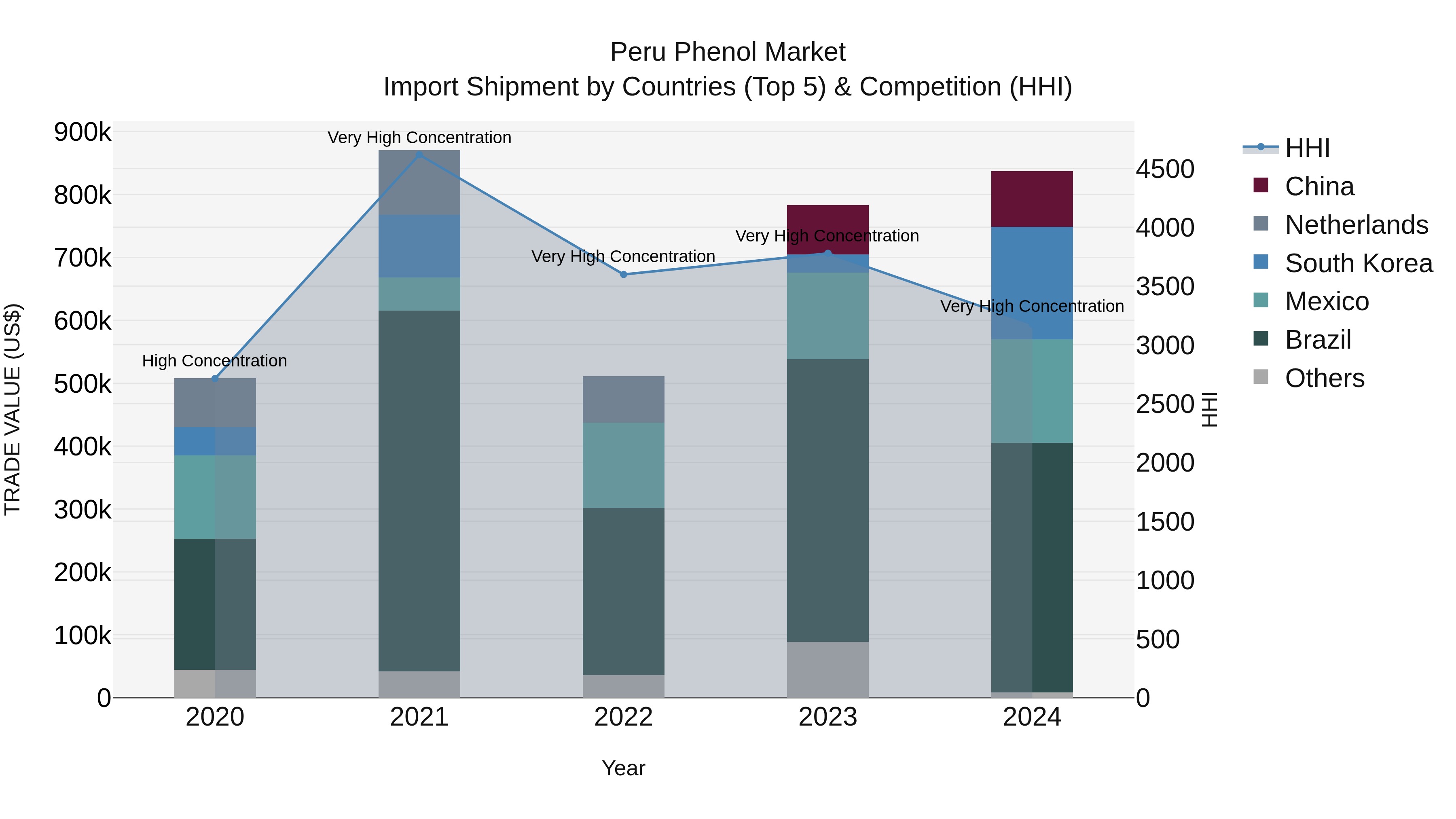
Peru`s phenol import market in 2024 continued to be dominated by key exporting countries such as Brazil, South Korea, Mexico, China, and Spain. The high Herfindahl-Hirschman Index (HHI) indicates a concentrated market structure. With a notable compound annual growth rate (CAGR) of 13.3% from 2020 to 2024, the sector experienced a solid expansion. The growth rate of 6.92% from 2023 to 2024 demonstrates sustained momentum in trade activities. This data suggests a robust market environment for phenol import shipments in Peru.
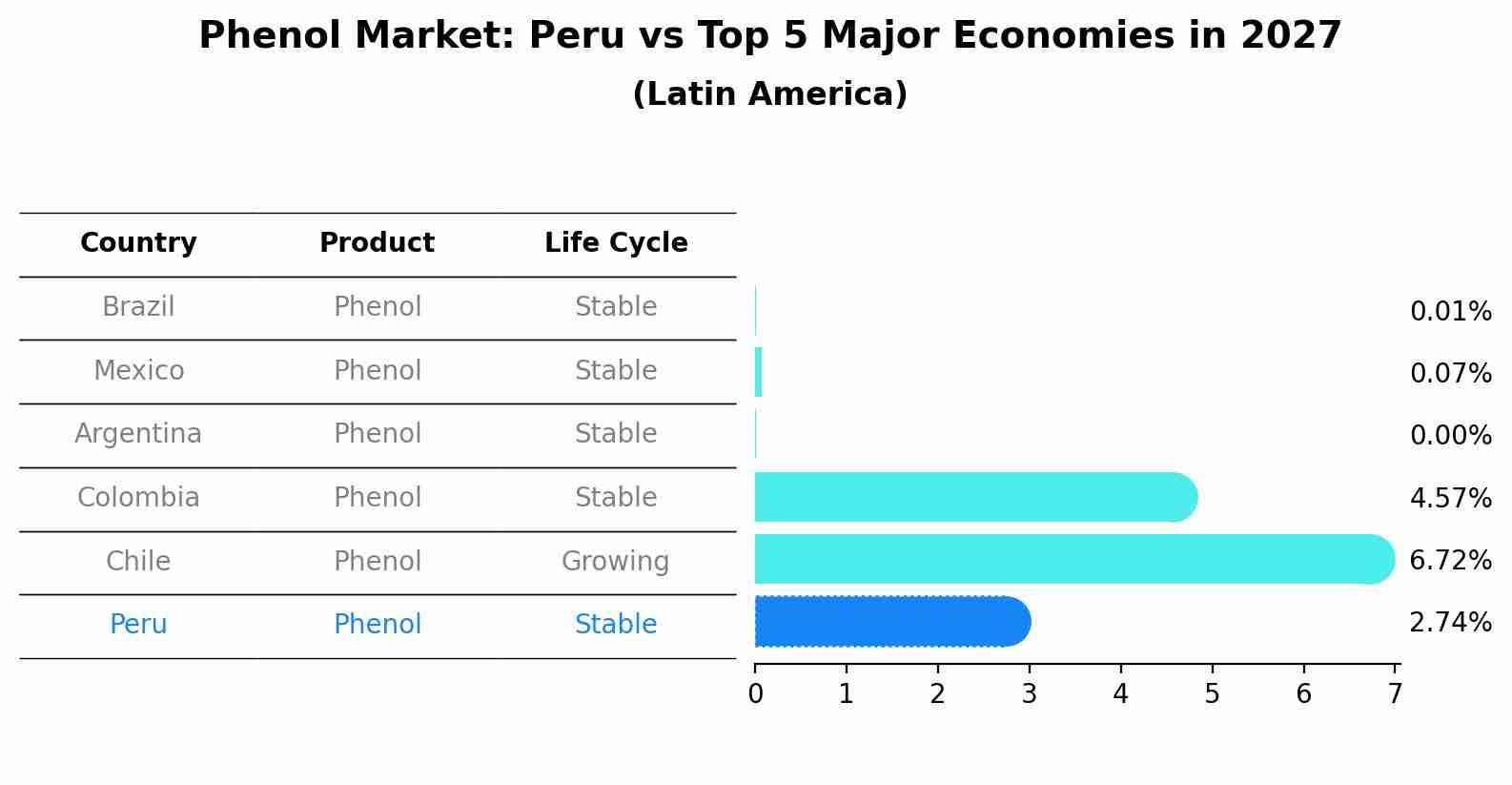
Phenol Market: Peru vs Top 5 Major Economies in 2027 (Latin America)
By 2027, Peru's Phenol market is forecasted to achieve a stable growth rate of 2.74%, with Brazil leading the Latin America region, followed by Mexico, Argentina, Colombia and Chile.
Peru Phenol Market Overview
The Peru Phenol Market is witnessing steady growth driven by its extensive use in the production of resins, plastics, and other chemical compounds. The demand for phenol is primarily fueled by the construction, automotive, and electronics industries in the country. Increasing infrastructure development projects, coupled with the rising automotive production, are expected to further boost the demand for phenol in Peru. Key players in the market are focusing on product innovation and technological advancements to cater to the growing demand and gain a competitive edge. However, fluctuating raw material prices and environmental regulations pose challenges to market growth. Overall, the Peru Phenol Market is poised for expansion, supported by the country`s industrial growth and increasing applications across various sectors.
Peru Phenol Market Trends
In the Peru Phenol Market, current trends include a growing demand for phenolic resins in the construction and automotive industries due to their superior strength and heat resistance properties. Additionally, there is a rising interest in bio-based phenol derived from renewable sources as companies focus on sustainability and environmental impact. The market is also witnessing increased investment in research and development to improve production processes and reduce costs. Overall, the Peru Phenol Market is experiencing a shift towards more sustainable and innovative solutions to meet the evolving needs of various industries while also aligning with global trends towards environmental responsibility.
Peru Phenol Market Challenges
In the Peru Phenol Market, some key challenges include fluctuating raw material prices, regulatory complexities, and increasing competition from imported phenol products. Fluctuations in the prices of raw materials such as benzene, which is a crucial component in phenol production, can impact the overall production costs and profit margins of companies operating in the market. Additionally, navigating the regulatory landscape in Peru, including compliance with environmental regulations and obtaining necessary permits, can be challenging and time-consuming for market players. Furthermore, the growing presence of imported phenol products from other countries poses a competitive threat to domestic producers in Peru, leading to pricing pressures and the need for differentiation strategies to maintain market share and profitability.
Peru Phenol Market Investment Opportunities
The Peru Phenol Market presents lucrative investment opportunities driven by the country`s growing chemical industry and expanding manufacturing sector. The increasing demand for phenol, a key chemical compound used in the production of various consumer goods such as plastics, resins, and pharmaceuticals, is fueling market growth. Investing in phenol production facilities or partnering with local manufacturers can be advantageous in tapping into this growing market. Furthermore, the government`s support for industrial development and favorable economic conditions in Peru make it an attractive destination for investors seeking to capitalize on the opportunities in the phenol market. Conducting thorough market research and assessing the competitive landscape will be crucial for making informed investment decisions in this promising sector.
Peru Phenol Market Government Policy
The Peruvian government has implemented policies to regulate the phenol market, aiming to ensure environmental sustainability and public health. These policies include guidelines for the safe production, handling, and disposal of phenol, as well as monitoring and enforcement measures to prevent pollution and protect workers and communities. Additionally, there are regulations in place to control the import and export of phenol-based products, promoting domestic production and supporting local industries. The government also encourages research and development in sustainable phenol production methods to reduce environmental impact and enhance competitiveness in the global market. Overall, these policies reflect Peru`s commitment to responsible and sustainable management of the phenol sector.
Peru Phenol Market Future Outlook
The Peru Phenol Market is expected to show steady growth in the coming years, driven by increasing demand from various end-use industries such as automotive, electronics, and construction. The market is likely to benefit from the country`s growing industrial sector and the rising trend towards the use of phenol in the production of resins, adhesives, and pharmaceuticals. Additionally, the focus on sustainable practices and the shift towards eco-friendly products are anticipated to further boost the market growth. However, challenges such as fluctuating raw material prices and regulatory constraints may impact market dynamics. Overall, the Peru Phenol Market is poised for a positive outlook, with opportunities for growth and innovation in the forecast period.
Key Highlights of the Report:
- Peru Phenol Market Outlook
- Market Size of Peru Phenol Market, 2021
- Forecast of Peru Phenol Market, 2031
- Historical Data and Forecast of Peru Phenol Revenues & Volume for the Period 2021 - 2031
- Peru Phenol Market Trend Evolution
- Peru Phenol Market Drivers and Challenges
- Peru Phenol Price Trends
- Peru Phenol Porter's Five Forces
- Peru Phenol Industry Life Cycle
- Historical Data and Forecast of Peru Phenol Market Revenues & Volume By End-users for the Period 2021 - 2031
- Historical Data and Forecast of Peru Phenol Market Revenues & Volume By Bisphenol A for the Period 2021 - 2031
- Historical Data and Forecast of Peru Phenol Market Revenues & Volume By Phenolic Resins for the Period 2021 - 2031
- Historical Data and Forecast of Peru Phenol Market Revenues & Volume By Caprolactam for the Period 2021 - 2031
- Historical Data and Forecast of Peru Phenol Market Revenues & Volume By Alkyl Phenyls for the Period 2021 - 2031
- Historical Data and Forecast of Peru Phenol Market Revenues & Volume By Others for the Period 2021 - 2031
- Peru Phenol Import Export Trade Statistics
- Market Opportunity Assessment By End-users
- Peru Phenol Top Companies Market Share
- Peru Phenol Competitive Benchmarking By Technical and Operational Parameters
- Peru Phenol Company Profiles
- Peru Phenol Key Strategic Recommendations






































