Peru Physical Security Market Size & Growth Rate (2026-2032)
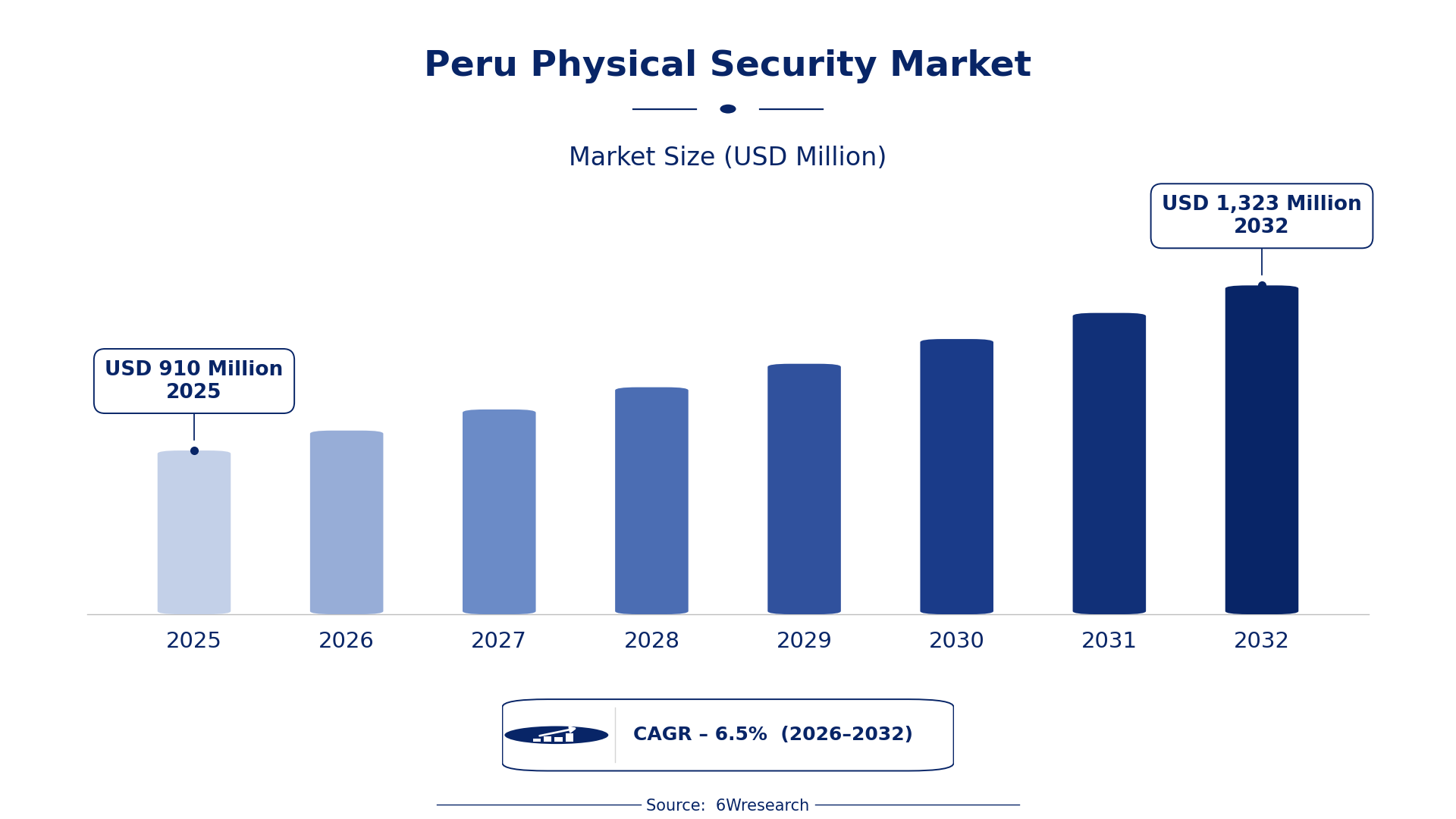
The Peru Physical Security Market was estimated at USD 910 Million in 2025 and is projected to reach USD 1323 Million by 2032, growing at a CAGR of 6.5% from 2026 to 2032.
Peru Physical Security Market Synopsis
Peru is witnessing a notable uptick in the adoption of physical security measures as both private and public sectors acknowledge rising threats, including crime and terrorism. This urgency has led to an increased demand for sophisticated security solutions, notably video surveillance and access control systems.
As urbanization progresses, the need for comprehensive security measures is evident across various sectors. Enhanced government initiatives aimed at public safety further support this shift, fueling the momentum for advanced security technologies in the Peruvian market.
Peru Physical Security Market Year-wise Growth Rate and Key Drivers
This graph illustrates the annual growth rates of the Peru Physical Security Market from 2021 to 2032, highlighting a steady upward trajectory and projected expansion over the forecast period.
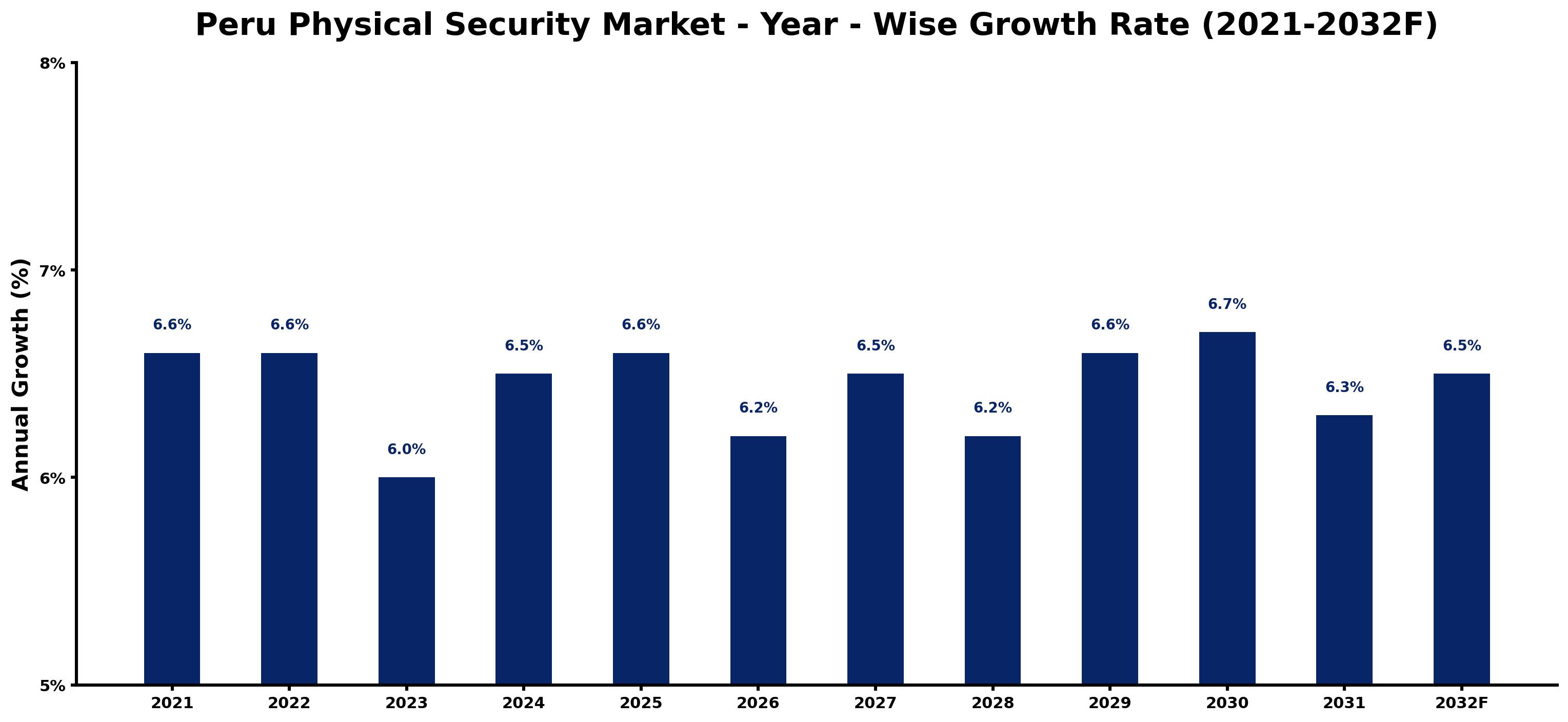
The table below presents the year‑wise growth rates along with the key drivers influencing the market
| Year | Growth Rate | Major Drivers |
| 2021 | 6.6% | New security regulations by Ministerio del Interior implemented. |
| 2022 | 6.6% | Increase in organized crime rates driving security investments. |
| 2023 | 6.0% | Development of gold mining sector boosting physical security needs. |
| 2024 | 6.5% | Rising tourism encouraging private security service requirements. |
| 2025 | 6.6% | Adoption of smart surveillance technology in urban areas. |
| 2026 | 6.2% | Local government initiatives promoting neighborhood safety programs. |
| 2027 | 6.5% | Growing awareness of cyber-physical security integration importance. |
| 2028 | 6.2% | Increase in public events requiring heightened security measures. |
| 2029 | 6.6% | Investment in logistics and transport security due to e-commerce growth. |
| 2030 | 6.7% | Local businesses prioritizing employee safety amid crime uptick. |
| 2031 | 6.3% | Enhanced government funding for public area security infrastructure. |
| 2032 | 6.5% | Emergence of security tech startups focusing on integrated solutions. |
Note: Market size estimations and growth projections presented in this report are based on 6Wresearch's proprietary forecasting methodology, utilizing the latest available industry data, government publications, and primary research inputs.
Peru Physical Security Market Key Takeaways
Below are some of the specific key takeaways from the market, including:
- The market is driven by increasing urbanization and the need for safeguarding critical assets.
- There is a noticeable shift towards integrated security systems, emphasizing real-time monitoring and remote access.
- Adoption of advanced technologies, including AI and cloud-based solutions, is gaining traction.
- Government regulations are evolving to enhance the efficacy of physical security systems across the country.
- Investment opportunities abound as organizations seek innovative solutions to counter rising security threats.
Evaluation of Restraints in Peru Physical Security Market
Despite the growth potential, the Peru Physical Security Market faces real challenges. Limited budget allocations for security systems remain a significant constraint, often hindering organizations from adopting necessary technologies. A prevalent lack of awareness regarding the importance of physical security measures also impedes market growth. on top of that, the diverse geographical landscape complicates the implementation of effective solutions across regions, as varying infrastructure development levels create logistical hurdles that need to be navigated strategically.
Peru Physical Security Market Trends
The trend towards advanced technologies in physical security is unmistakable. Organizations are increasingly integrating video surveillance and biometric solutions into their security frameworks to address evolving threats. Real-time monitoring is becoming a necessity, with many businesses moving toward cloud-based systems that offer flexibility and scalability. As data breaches become more prevalent, the fusion of cybersecurity with physical security measures is gaining importance, pushing companies to adopt comprehensive strategies that cover both domains.
Peru Physical Security Market Opportunities
Investment opportunities are emerging rapidly within the Peru Physical Security Market. As the economy grows, heightened awareness of security needs opens doors for innovative security technology companies. The government's ongoing infrastructure projects necessitate robust security solutions, especially in urban and public areas. Organizations specializing in integrated security systems and advanced monitoring technologies stand to benefit significantly, provided they can tailor their offerings to meet the specific demands of the region.
Government Initiatives in the Peru Physical Security Market
The Peruvian government is actively shaping the Physical Security Market through various policies and initiatives aimed at enhancing public safety. By promoting the installation of modern security systems and collaborating with private sector firms, the government seeks to address emerging threats effectively and ensure the protection of citizens and critical infrastructure.
- A recently completed initiative focused on upgrading public surveillance systems in urban areas to improve crime detection and response times.
- Currently underway is a national campaign to raise awareness about the importance of physical security among businesses, emphasizing the need for strategic investments.
- Plans are in place for a comprehensive regulatory framework aimed at standardizing the installation and operation of security systems across the country by 2027.
- The government is collaborating with tech firms to develop smart city solutions that integrate security measures with urban planning.
- Upcoming legislation is expected to incentivize organizations to invest in state-of-the-art security technologies, fostering an environment of innovation.
Future Insights of the Peru Physical Security Market
Looking ahead to 2026-2032, the Peru Physical Security Market is set for consistent growth. The escalating emphasis on safeguarding assets, driven by rising crime rates and technological advancements, is likely to spur demand for sophisticated security solutions. As organizations continue to prioritize security, opportunities for innovation and service enhancement will emerge, positioning the market for sustained expansion in the coming years.
Peru Physical Security Market Latest Developments
In the past 12-14 months, the Peru Physical Security Market has witnessed dynamic activity, driven by technological advancements and heightened security needs. Companies are increasingly focusing on integrating smart solutions to enhance security measures across various sectors.
- A leading regional provider launched a new line of advanced surveillance cameras in early 2025, significantly improving image resolution and analytics capabilities.
- An ongoing collaboration between a major technology vendor and local governments aims to implement an integrated security management system across several urban centers.
- A product upgrade featuring AI-driven threat detection capabilities is expected to roll out by mid-2026, enhancing operational efficiency for security firms.
- A major conference on security innovations was held in late 2025, attracting key stakeholders and fostering discussions about future industry trends.
- Plans for a new training program targeting security personnel are expected to commence in 2026, aimed at improving skills and knowledge in modern security technologies.
Peru Physical Security Market - Key Attractiveness of the Report
- 10 Years of Market Numbers
- Historical Data Starting from 2022 to 2025
- Base Year: 2025
- Forecast Data until 2032
- Key Performance Indicators Impacting the Market
- Major Upcoming Developments and Projects
Key Highlights of the Report:
- Peru Physical Security Market Outlook
- Market Size of Peru Physical Security Market, 2025
- Forecast of Peru Physical Security Market, 2032
- Historical Data and Forecast of Peru Physical Security Revenues & Volume for the Period 2022-2032F
- Peru Physical Security Market Trend Evolution
- Peru Physical Security Market Drivers and Challenges
- Peru Physical Security Price Trends
- Peru Physical Security Porter's Five Forces
- Peru Physical Security Industry Life Cycle
- Historical Data and Forecast of Peru Physical Security Market Revenues & Volume By Component for the Period 2022-2032F
- Historical Data and Forecast of Peru Physical Security Market Revenues & Volume By Systems (PACS, PSIM, PIAM, Video Surveillance, Fire and Life Safety) for the Period 2022-2032F
- Historical Data and Forecast of Peru Physical Security Market Revenues & Volume By Services for the Period 2022-2032F
- Historical Data and Forecast of Peru Physical Security Market Revenues & Volume By Vertical for the Period 2022-2032F
- Historical Data and Forecast of Peru Physical Security Market Revenues & Volume By BFSI for the Period 2022-2032F
- Historical Data and Forecast of Peru Physical Security Market Revenues & Volume By Government for the Period 2022-2032F
- Historical Data and Forecast of Peru Physical Security Market Revenues & Volume By Retail for the Period 2022-2032F
- Historical Data and Forecast of Peru Physical Security Market Revenues & Volume By Transportation for the Period 2022-2032F
- Historical Data and Forecast of Peru Physical Security Market Revenues & Volume By Residential for the Period 2022-2032F
- Historical Data and Forecast of Peru Physical Security Market Revenues & Volume By Telecom and IT for the Period 2022-2032F
- Historical Data and Forecast of Peru Physical Security Market Revenues & Volume By Other Verticals (Healthcare, Manufacturing, Energy and Utilities, and Education). for the Period 2022-2032F
- Historical Data and Forecast of Peru Physical Security Market Revenues & Volume By Organization Size for the Period 2022-2032F
- Historical Data and Forecast of Peru Physical Security Market Revenues & Volume By SMEs for the Period 2022-2032F
- Historical Data and Forecast of Peru Physical Security Market Revenues & Volume By Large Enterprises for the Period 2022-2032F
- Peru Physical Security Import Export Trade Statistics
- Market Opportunity Assessment By Component
- Market Opportunity Assessment By Vertical
- Market Opportunity Assessment By Organization Size
- Peru Physical Security Top Companies Market Share
- Peru Physical Security Competitive Benchmarking By Technical and Operational Parameters
- Peru Physical Security Company Profiles
- Peru Physical Security Key Strategic Recommendations






































