Peru Predictive Maintenance Market Size & Growth Rate (2026-2032)
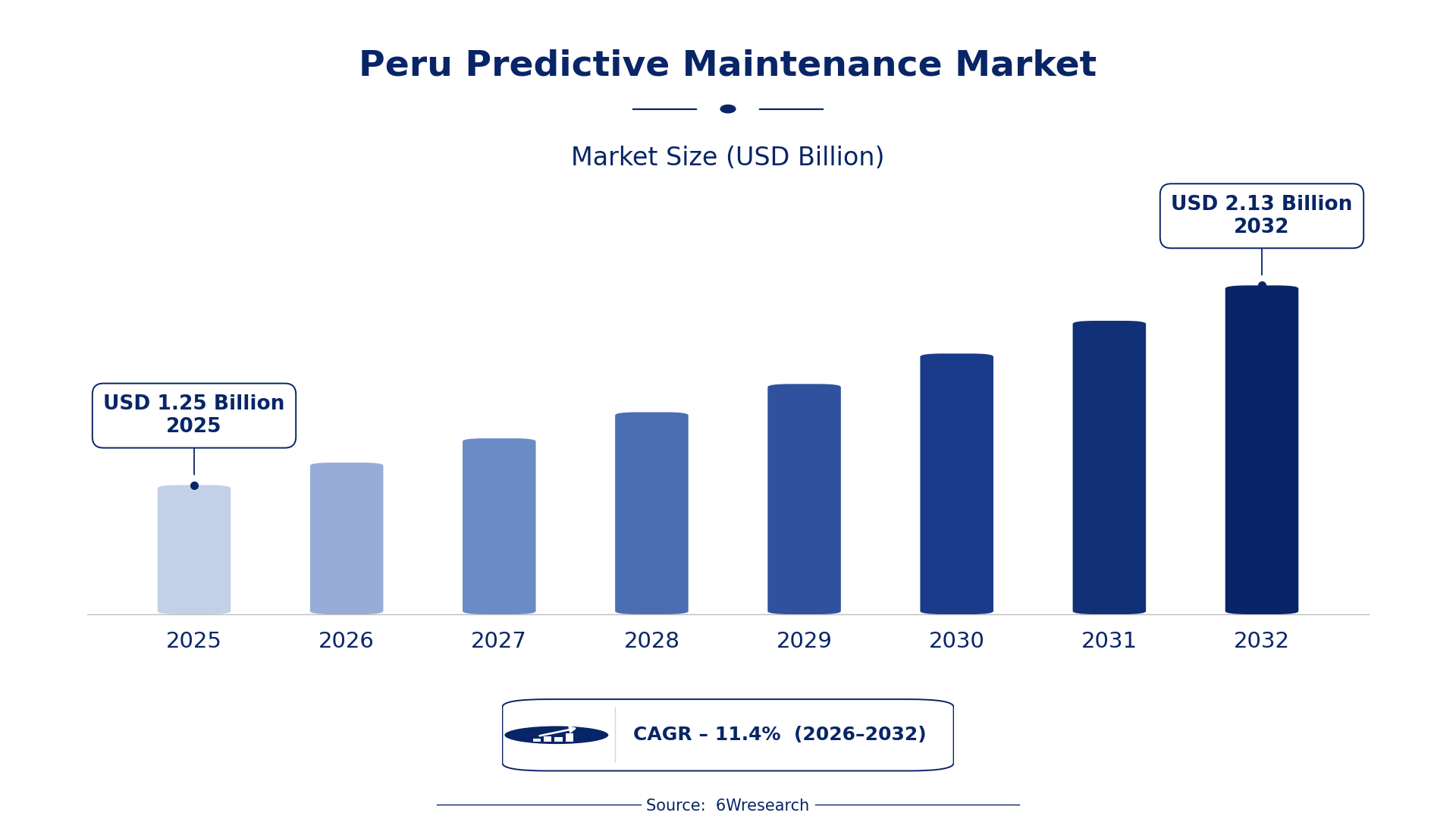
The Peru Predictive Maintenance Market was estimated at USD 1255 Million in 2025 and is projected to reach USD 2128 Million by 2032, growing at a CAGR of 11.4% from 2026 to 2032.
Peru Predictive Maintenance Market Synopsis
As industries in Peru increasingly embrace advanced technologies, predictive maintenance is rapidly gaining traction. The manufacturing, mining, oil & gas, and transportation sectors are leading the charge, leveraging data analytics and IoT to enhance equipment reliability and operational efficiency.
Companies are realizing the economic benefits of predictive maintenance, including reduced downtime and optimized maintenance schedules. As cloud-based platforms become more prevalent, organizations are better positioned to monitor equipment health in real-time, further driving the demand for these solutions.
Peru Predictive Maintenance Market Year-wise Growth Rate and Key Drivers
This graph illustrates the annual growth rates of the Peru Predictive Maintenance Market from 2021 to 2032, highlighting a steady upward trajectory and projected expansion over the forecast period.
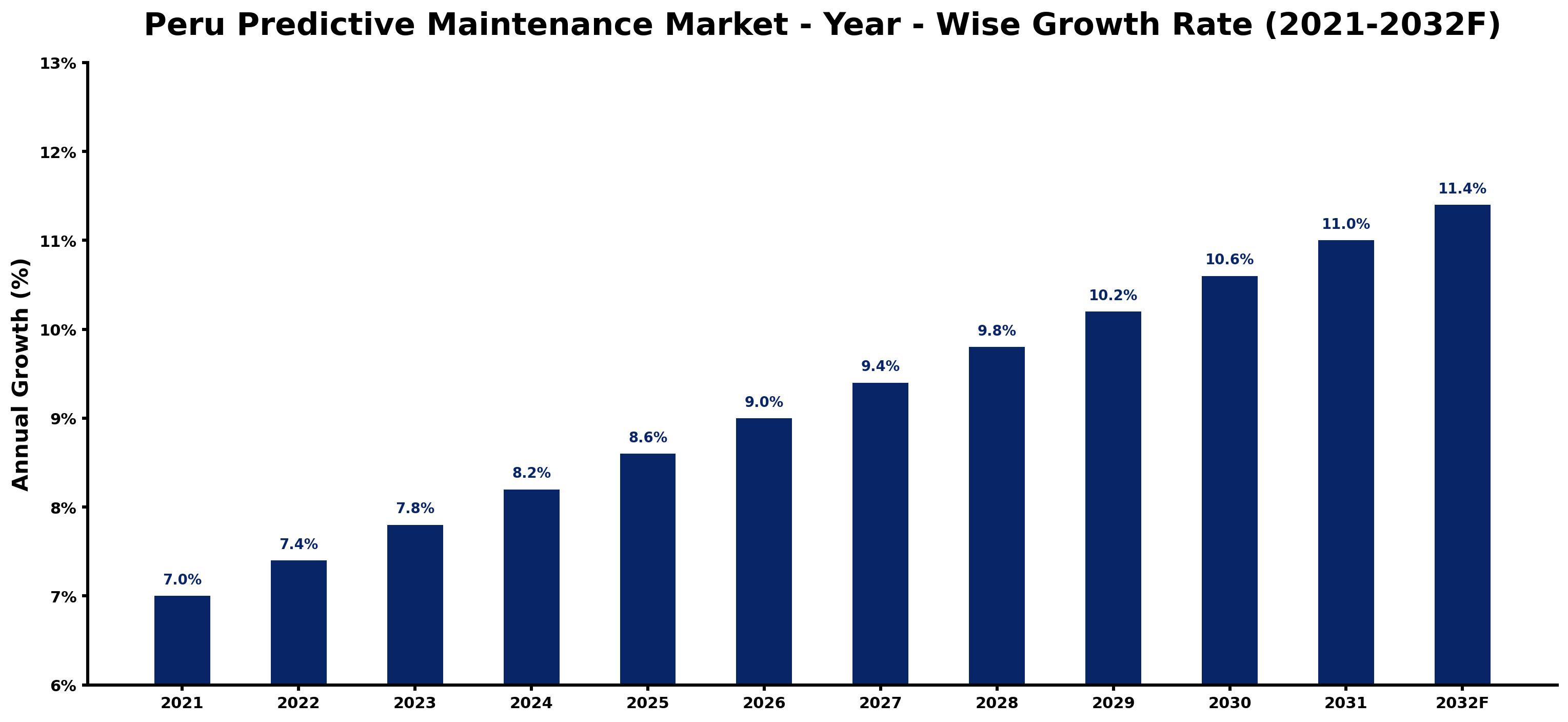
The table below presents the year‑wise growth rates along with the key drivers influencing the market
| Year | Growth Rate | Major Drivers |
| 2021 | 7.0% | Increase in mining sector investments enhancing maintenance strategies. |
| 2022 | 7.4% | Adoption of IoT technologies in equipment monitoring systems. |
| 2023 | 7.8% | Government support for Industry 4.0 initiatives boosting predictive solutions. |
| 2024 | 8.2% | Growth of local talent in data analytics and AI. |
| 2025 | 8.6% | Increased regulatory focus on equipment reliability and safety. |
| 2026 | 9.0% | Surge in exports from mining driving automated maintenance needs. |
| 2027 | 9.4% | Rise of local partnerships in predictive analytics software. |
| 2028 | 9.8% | Increased penetration of cloud computing in infrastructure management. |
| 2029 | 10.2% | Emergence of sustainability initiatives promoting efficiency in operations. |
| 2030 | 10.6% | Investment in smart agriculture driving predictive maintenance applications. |
| 2031 | 11.0% | Deployment of 5G networks enhancing real-time monitoring capabilities. |
| 2032 | 11.4% | Shift towards digital twins in manufacturing processes evolution. |
Note: Market size estimations and growth projections presented in this report are based on 6Wresearch's proprietary forecasting methodology, utilizing the latest available industry data, government publications, and primary research inputs.
Peru Predictive Maintenance Market Key Takeaways
Below are some of the specific key takeaways from the market, including:
- The market is driven by the increasing need for operational efficiency across key industries.
- Integration of IoT and AI technologies is essential for real-time monitoring and data analysis.
- Cloud-based predictive maintenance platforms are becoming a preferred choice for scalability.
- Customized solutions are in demand to cater to specific sector needs, particularly in mining and agriculture.
- Ongoing government initiatives are aimed at promoting technology adoption in predictive maintenance.
Evaluation of Restraints in Peru Predictive Maintenance Market
Despite the promising growth, several barriers hinder the advancement of the predictive maintenance market in Peru. High initial implementation costs deter many companies, especially smaller enterprises, from adopting these technologies. on top of that, the lack of skilled personnel to interpret complex data results in underutilization of available tools. Resistance to change within organizations and the challenge of integrating new systems with legacy equipment further compound the issues. Standardization of data collection methods also remains an obstacle, creating inefficiencies in strategy execution.
Peru Predictive Maintenance Market Trends
A key trend is the growing integration of IoT sensors, enabling real-time monitoring and proactive maintenance. Predictive analytics is being increasingly utilized to enhance fault prediction accuracy. The shift towards cloud-based platforms is notable, as they offer greater flexibility and data accessibility. Additionally, industries are moving towards developing customized maintenance solutions tailored to their specific operational challenges, particularly in sectors like mining and agriculture.
Peru Predictive Maintenance Market Opportunities
Opportunities abound in the Peru Predictive Maintenance Market, particularly through strategic partnerships between technology providers and local industries. Customized solutions for emerging sectors can create significant market potential. The ongoing digital transformation initiatives across industries further highlight the need for effective predictive maintenance strategies. Companies that can innovate and provide cost-effective solutions are likely to gain a competitive edge.
Government Initiatives in the Peru Predictive Maintenance Market
The Peruvian government is actively promoting the adoption of advanced technologies within industries, recognizing their potential to enhance productivity and safety. Regulatory policies are being shaped to encourage innovation and facilitate the implementation of predictive maintenance practices. These initiatives are crucial for ensuring that local industries remain competitive on a global scale.
- A national program launched in 2023 to incentivize companies adopting advanced predictive maintenance technologies, aimed at reducing operational costs.
- Current initiatives include workshops and training programs for local businesses to raise awareness and skills in predictive maintenance practices.
- Planned legislation expected to roll out by late 2025 will mandate the adoption of predictive maintenance standards across critical industries.
- Ongoing collaboration between industry players and research institutions to develop best practices in predictive maintenance.
Future Insights of the Peru Predictive Maintenance Market
Looking ahead to 2026-2032, the Peru Predictive Maintenance Market is set to expand as companies continue to prioritize operational efficiency. As awareness grows about the tangible benefits of predictive maintenance, more industries will adopt these solutions. The ongoing advancements in sensor technology and machine learning will further enhance predictive capabilities, resulting in smarter maintenance strategies. With a focus on Industry 4.0, the market is likely to see innovative offerings tailored to specific industry needs.
Peru Predictive Maintenance Market Latest Developments
Recent months have seen a surge in activity within the Peru Predictive Maintenance Market, reflecting a strong commitment to innovation and efficiency. Companies are launching new initiatives and partnerships to capitalize on emerging technologies that can enhance maintenance processes and reduce downtime.
- A major technology vendor is currently rolling out a cloud-based predictive maintenance solution tailored for the mining sector, which began in Q1 2025 and is expected to be fully operational by Q3 2025.
- An initiative launched in early 2025 focuses on integrating AI-driven analytics to improve fault detection across manufacturing plants, currently underway.
- Plans for a nationwide data analytics platform aimed at streamlining predictive maintenance practices are expected to commence by mid-2026.
- A leading regional operator has recently partnered with a local university to develop training programs on predictive maintenance technologies, which is currently ongoing.
Peru Predictive Maintenance Market - Key Attractiveness of the Report
- 10 Years of Market Numbers
- Historical Data Starting from 2022 to 2025
- Base Year: 2025
- Forecast Data until 2032
- Key Performance Indicators Impacting the Market
- Major Upcoming Developments and Projects
Key sectors include manufacturing, mining, oil & gas, and transportation. These industries are increasingly leveraging predictive maintenance to improve reliability and reduce operational costs.
Key Highlights of the Report:
- Peru Predictive Maintenance Market Outlook
- Market Size of Peru Predictive Maintenance Market, 2025
- Forecast of Peru Predictive Maintenance Market, 2032
- Historical Data and Forecast of Peru Predictive Maintenance Revenues & Volume for the Period 2022-2032F
- Peru Predictive Maintenance Market Trend Evolution
- Peru Predictive Maintenance Market Drivers and Challenges
- Peru Predictive Maintenance Price Trends
- Peru Predictive Maintenance Porter's Five Forces
- Peru Predictive Maintenance Industry Life Cycle
- Historical Data and Forecast of Peru Predictive Maintenance Market Revenues & Volume By Component for the Period 2022-2032F
- Historical Data and Forecast of Peru Predictive Maintenance Market Revenues & Volume By Solutions for the Period 2022-2032F
- Historical Data and Forecast of Peru Predictive Maintenance Market Revenues & Volume By Services for the Period 2022-2032F
- Historical Data and Forecast of Peru Predictive Maintenance Market Revenues & Volume By Organization Size for the Period 2022-2032F
- Historical Data and Forecast of Peru Predictive Maintenance Market Revenues & Volume By Large Enterprises for the Period 2022-2032F
- Historical Data and Forecast of Peru Predictive Maintenance Market Revenues & Volume By SME for the Period 2022-2032F
- Historical Data and Forecast of Peru Predictive Maintenance Market Revenues & Volume By Deployment Mode for the Period 2022-2032F
- Historical Data and Forecast of Peru Predictive Maintenance Market Revenues & Volume By On-premises for the Period 2022-2032F
- Historical Data and Forecast of Peru Predictive Maintenance Market Revenues & Volume By Cloud for the Period 2022-2032F
- Historical Data and Forecast of Peru Predictive Maintenance Market Revenues & Volume By Vertical for the Period 2022-2032F
- Historical Data and Forecast of Peru Predictive Maintenance Market Revenues & Volume By Government and Defense for the Period 2022-2032F
- Historical Data and Forecast of Peru Predictive Maintenance Market Revenues & Volume By Manufacturing for the Period 2022-2032F
- Historical Data and Forecast of Peru Predictive Maintenance Market Revenues & Volume By Energy and Utilities for the Period 2022-2032F
- Historical Data and Forecast of Peru Predictive Maintenance Market Revenues & Volume By Transportation and Logistics for the Period 2022-2032F
- Historical Data and Forecast of Peru Predictive Maintenance Market Revenues & Volume By Healthcare and Life Sciences for the Period 2022-2032F
- Peru Predictive Maintenance Import Export Trade Statistics
- Market Opportunity Assessment By Component
- Market Opportunity Assessment By Organization Size
- Market Opportunity Assessment By Deployment Mode
- Market Opportunity Assessment By Vertical
- Peru Predictive Maintenance Top Companies Market Share
- Peru Predictive Maintenance Competitive Benchmarking By Technical and Operational Parameters
- Peru Predictive Maintenance Company Profiles
- Peru Predictive Maintenance Key Strategic Recommendations






































