Peru Remote Workplace Services Market Size & Growth Rate (2026-2032)
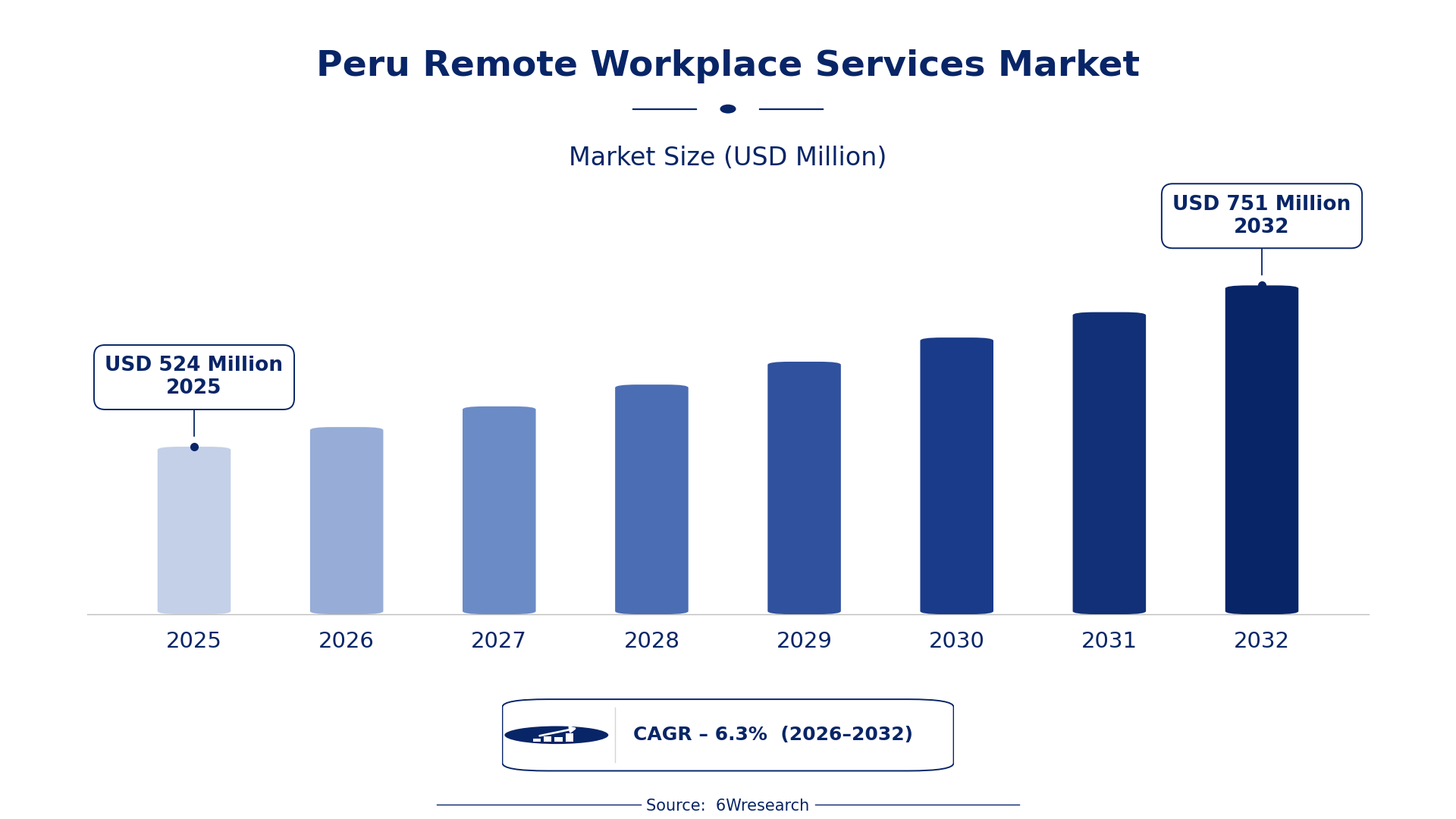
The Peru Remote Workplace Services Market was estimated at USD 524 Million in 2025 and is projected to reach USD 751 Million by 2032, growing at a CAGR of 6.3% from 2026 to 2032.
Peru Remote Workplace Services Market Synopsis
The accelerating shift towards remote work is the most influential factor driving the Peru Remote Workplace Services Market. The COVID-19 pandemic catalyzed this transition, compelling businesses to rethink traditional work environments and invest in remote capabilities.
As organizations adapt, they are increasingly relying on advanced tools such as virtual desktop infrastructure, cloud solutions, and collaboration platforms. This trend not only enhances operational efficiency but also opens avenues for innovative service offerings that cater specifically to the needs of Peruvian businesses.
Peru Remote Workplace Services Market Year-wise Growth Rate and Key Drivers
This graph illustrates the annual growth rates of the Peru Remote Workplace Services Market from 2021 to 2032, highlighting a steady upward trajectory and projected expansion over the forecast period.
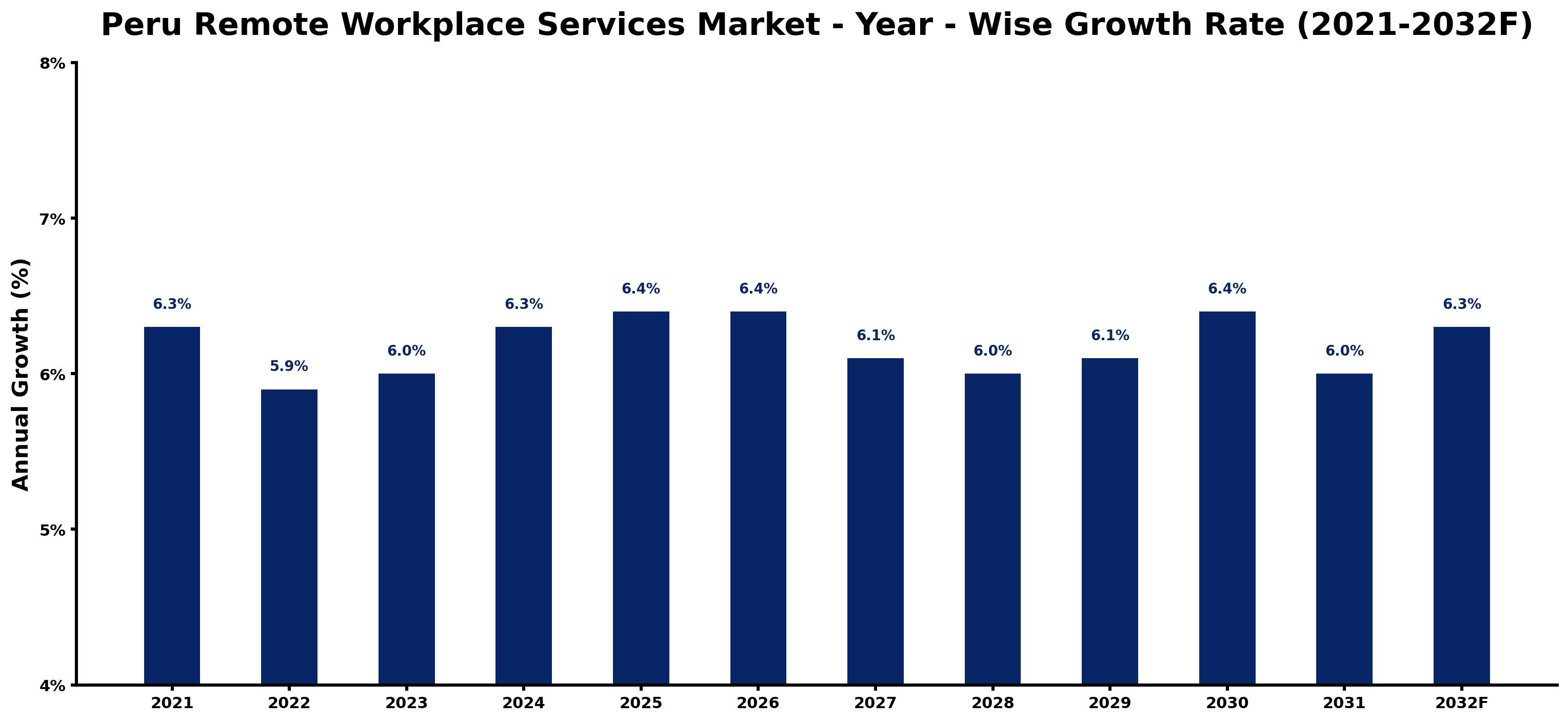
The table below presents the year‑wise growth rates along with the key drivers influencing the market
| Year | Growth Rate | Major Drivers |
| 2021 | 6.3% | Government telework policies supporting remote job creation. |
| 2022 | 5.9% | Growth in digital infrastructure investments by local firms. |
| 2023 | 6.0% | Increased adoption of cloud solutions by Peruvian businesses. |
| 2024 | 6.3% | Rise in home internet penetration among rural populations. |
| 2025 | 6.4% | Surge in demand for virtual collaboration tools nationwide. |
| 2026 | 6.4% | Local startups enhancing remote work technologies and services. |
| 2027 | 6.1% | Corporate shift towards flexible work arrangements post-pandemic. |
| 2028 | 6.0% | Increased training programs for remote work skills development. |
| 2029 | 6.1% | Expanded access to affordable high-speed internet plans. |
| 2030 | 6.4% | Government incentives for remote workplace technology innovations. |
| 2031 | 6.0% | Strengthened remote cybersecurity regulations boosting service demand. |
| 2032 | 6.3% | Ongoing cultural shift favoring work-life balance in Peru. |
Note: Market size estimations and growth projections presented in this report are based on 6Wresearch's proprietary forecasting methodology, utilizing the latest available industry data, government publications, and primary research inputs.
Peru Remote Workplace Services Market Key Takeaways
Below are some of the specific key takeaways from the market, including:
- The market is on an upward trajectory, driven by the increasing integration of remote work practices.
- Technological advancements such as 5G and IoT are enhancing remote work capabilities.
- A growing freelance economy is pushing demand for flexible workplace solutions.
- Investment in cybersecurity is becoming a top priority for organizations supporting remote teams.
- Government initiatives aimed at improving digital infrastructure are further fueling market growth.
Evaluation of Restraints in Peru Remote Workplace Services Market
Despite the promising growth, the Peru Remote Workplace Services Market faces significant hurdles. Limited technological infrastructure in certain regions hampers the effective deployment of remote services. Connectivity issues remain prevalent, especially in rural areas, obstructing access to essential tools and platforms. on top of that, cultural resistance within some organizations towards remote work practices can slow down adoption rates. Coupled with ongoing concerns regarding data security, these factors present challenges that need addressing for sustainable market development.
Peru Remote Workplace Services Market Trends
The market is witnessing a surge in demand for cloud-based collaboration tools and cybersecurity measures as companies prioritize remote workforce support. Flexible working arrangements are becoming standard, with more businesses recognizing the benefits of a distributed workforce. The rise of digital nomadism and the freelancing trend is also reshaping service offerings, pushing providers to innovate and cater to a more dynamic workforce.
Peru Remote Workplace Services Market Opportunities
With the ongoing transformation of work practices, substantial opportunities exist for service providers in the remote workplace sector. The need for tailored solutions that enhance productivity and collaboration is paramount. Companies focusing on developing integrated platforms that combine virtual workspaces, communication tools, and robust cybersecurity measures are likely to find a receptive market. Additionally, the increasing emphasis on employee well-being and work-life balance presents a fertile ground for innovative service offerings.
Government Initiatives in the Peru Remote Workplace Services Market
Government policies in Peru are playing a crucial role in shaping the remote workplace services market. Recent initiatives focus on enhancing digital infrastructure and promoting flexible work arrangements across various sectors. By addressing connectivity challenges and encouraging businesses to invest in remote capabilities, public policy is directly influencing market growth.
- A national digital infrastructure upgrade programme now in its rollout phase aims to enhance internet connectivity in rural areas.
- Current tax incentives for companies adopting flexible work policies are encouraging a shift towards remote arrangements.
- Regulations to ensure data security and privacy for remote workers have been implemented to foster trust in remote work setups.
- Ongoing public-private initiatives are expected to expand telecom infrastructure access by 2028.
Future Insights of the Peru Remote Workplace Services Market
Looking ahead, the Peru Remote Workplace Services Market is set for sustained expansion through 2032. With the continued integration of remote work into corporate culture, businesses will increasingly prioritize investments in technology that supports flexible work environments. As competition for talent intensifies, organizations will focus on enhancing employee experiences through innovative remote solutions. The ongoing digital transformation will further drive growth, ensuring that remote workplace services remain at the forefront of business strategy.
Peru Remote Workplace Services Market Latest Developments
In the last year, the Peru Remote Workplace Services Market has experienced significant activity, with numerous developments aimed at enhancing service offerings and infrastructure. Companies are increasingly adopting new technologies to improve remote working capabilities, reflecting the ongoing demand for effective remote solutions.
- A leading regional operator launched a new cloud-based collaboration tool in early 2025, designed specifically for remote teams.
- An ongoing initiative aims to expand access to high-speed internet in underserved areas, expected to be completed by mid-2026.
- A major technology vendor is currently rolling out an enhanced cybersecurity platform tailored for remote work environments, enhancing data protection.
- Plans are underway for a national training programme focused on equipping the workforce with skills necessary for effective remote work, scheduled to launch in late 2026.
Peru Remote Workplace Services Market - Key Attractiveness of the Report
- 10 Years of Market Numbers
- Historical Data Starting from 2022 to 2025
- Base Year: 2025
- Forecast Data until 2032
- Key Performance Indicators Impacting the Market
- Major Upcoming Developments and Projects
Key Highlights of the Report:
- Peru Remote Workplace Services Market Outlook
- Market Size of Peru Remote Workplace Services Market, 2025
- Forecast of Peru Remote Workplace Services Market, 2032
- Historical Data and Forecast of Peru Remote Workplace Services Revenues & Volume for the Period 2022-2032F
- Peru Remote Workplace Services Market Trend Evolution
- Peru Remote Workplace Services Market Drivers and Challenges
- Peru Remote Workplace Services Price Trends
- Peru Remote Workplace Services Porter's Five Forces
- Peru Remote Workplace Services Industry Life Cycle
- Historical Data and Forecast of Peru Remote Workplace Services Market Revenues & Volume By Component for the Period 2022-2032F
- Historical Data and Forecast of Peru Remote Workplace Services Market Revenues & Volume By Solutions for the Period 2022-2032F
- Historical Data and Forecast of Peru Remote Workplace Services Market Revenues & Volume By Services for the Period 2022-2032F
- Historical Data and Forecast of Peru Remote Workplace Services Market Revenues & Volume By Deployment Mode for the Period 2022-2032F
- Historical Data and Forecast of Peru Remote Workplace Services Market Revenues & Volume By On-Premises for the Period 2022-2032F
- Historical Data and Forecast of Peru Remote Workplace Services Market Revenues & Volume By Cloud for the Period 2022-2032F
- Historical Data and Forecast of Peru Remote Workplace Services Market Revenues & Volume By Organization Size for the Period 2022-2032F
- Historical Data and Forecast of Peru Remote Workplace Services Market Revenues & Volume By Large Enterprises for the Period 2022-2032F
- Historical Data and Forecast of Peru Remote Workplace Services Market Revenues & Volume By SMEs for the Period 2022-2032F
- Historical Data and Forecast of Peru Remote Workplace Services Market Revenues & Volume By Vertical for the Period 2022-2032F
- Historical Data and Forecast of Peru Remote Workplace Services Market Revenues & Volume By Telecommunication for the Period 2022-2032F
- Historical Data and Forecast of Peru Remote Workplace Services Market Revenues & Volume By Banking, Financial Services, & Insurance for the Period 2022-2032F
- Historical Data and Forecast of Peru Remote Workplace Services Market Revenues & Volume By IT & ITeS for the Period 2022-2032F
- Historical Data and Forecast of Peru Remote Workplace Services Market Revenues & Volume By Manufacturing for the Period 2022-2032F
- Historical Data and Forecast of Peru Remote Workplace Services Market Revenues & Volume By Retail & Consumer Goods for the Period 2022-2032F
- Historical Data and Forecast of Peru Remote Workplace Services Market Revenues & Volume By Media & Entertainment for the Period 2022-2032F
- Historical Data and Forecast of Peru Remote Workplace Services Market Revenues & Volume By Healthcare & Life Sciences for the Period 2022-2032F
- Historical Data and Forecast of Peru Remote Workplace Services Market Revenues & Volume By Government & Public Sectors for the Period 2022-2032F
- Peru Remote Workplace Services Import Export Trade Statistics
- Market Opportunity Assessment By Component
- Market Opportunity Assessment By Deployment Mode
- Market Opportunity Assessment By Organization Size
- Market Opportunity Assessment By Vertical
- Peru Remote Workplace Services Top Companies Market Share
- Peru Remote Workplace Services Competitive Benchmarking By Technical and Operational Parameters
- Peru Remote Workplace Services Company Profiles
- Peru Remote Workplace Services Key Strategic Recommendations






































