Peru Used Car Market Summary
The peru used car market was estimated at USD 107 Million in 2025 and is projected to reach USD 118 Million by 2032, growing at a CAGR of 1.3% from 2026 to 2032.
Peru Used Car Market Year-wise Growth Rate and Key Drivers
This graph highlights how the Peru Used Car Market has steadily grown over the past five years, supported by major growth factors.
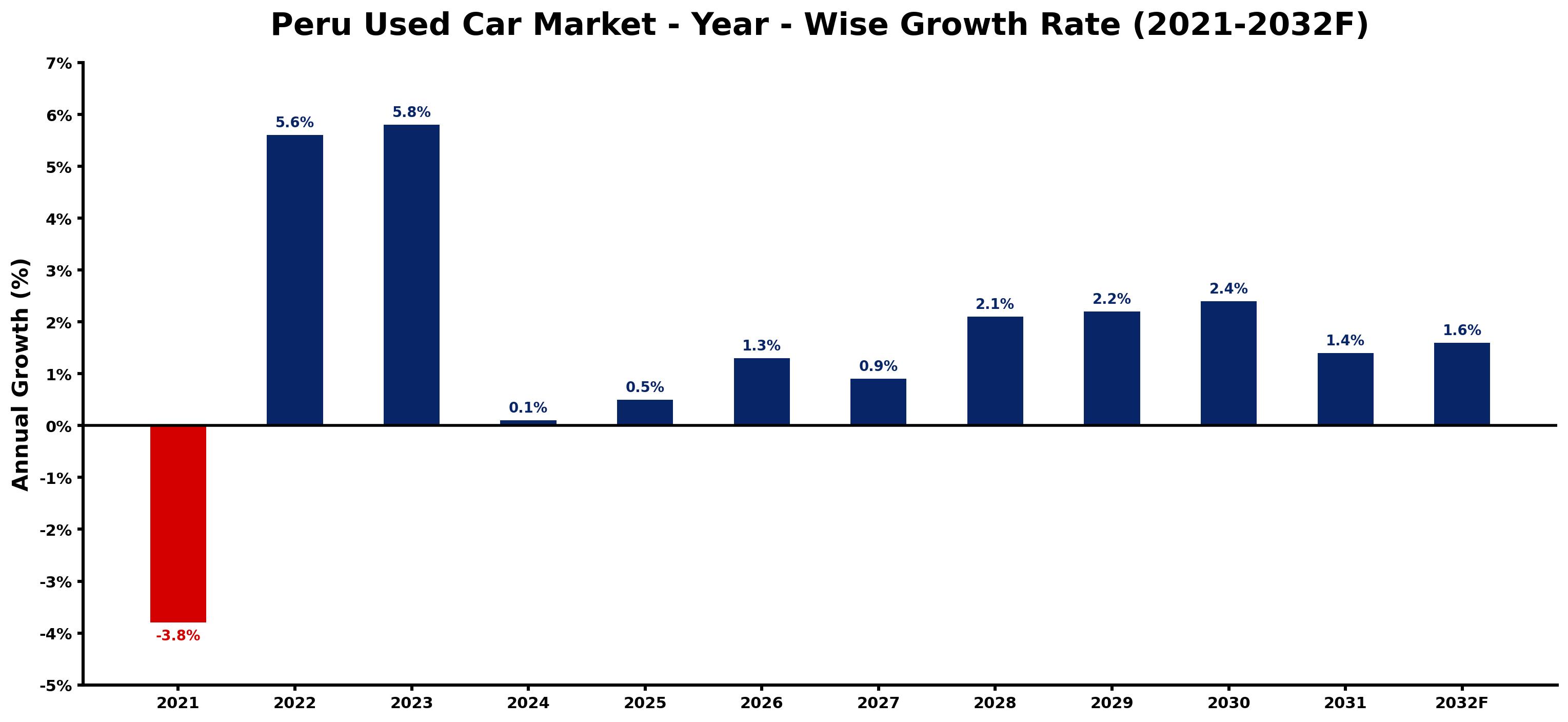
The table below presents the year wise growth rates along with the key drivers influencing the market
| Year | Growth Rate | Major Drivers |
| 2021 | -3.8% | Economic instability led to reduced disposable income, significantly impacting used car sales in Peru. |
| 2022 | 5.6% | A shift towards online platforms makes buying used cars more convenient. |
| 2023 | 5.8% | Increased urbanization drives demand for affordable and compact used vehicles. |
| 2024 | 0.1% | Rising fuel prices encourage buyers to seek more fuel-efficient options. |
| 2025 | 0.5% | Financial institutions begin offering more accessible loans for used car purchases. |
| 2026 | 1.3% | An influx of imported used cars expands the available inventory significantly. |
| 2027 | 0.9% | Technological integration in dealerships enhances customer experience and sales processes. |
| 2028 | 2.1% | Environmental awareness prompts buyers to consider electric and hybrid used models. |
| 2029 | 2.2% | Population growth in major cities accelerates the search for reliable transportation. |
| 2030 | 2.4% | Local automotive regulations promote transparency in used car transaction processes. |
| 2031 | 1.4% | Collaborations between dealerships and digital platforms streamline vehicle listings effectively. |
| 2032 | 1.6% | Increasing confidence in used car quality improves overall market reliability and trust. |
Note - Market size estimations and growth projections presented in this report are based on 6Wresearch's advanced forecasting approach, validated with industry datasets as of June 2026.
Peru Used Car Market Synopsis
The Peru Used Car Market is projected to reach 1.3% and witness significant growth during the forecast period (2026-2032). This market is influenced by several dynamic factors, including economic conditions, shifting consumer preferences, and the availability of a diverse range of vehicles. As urbanization continues to escalate and the middle class expands, the demand for reliable and affordable transportation solutions is expected to rise significantly. Used cars have emerged as a popular choice for many Peruvians, primarily due to their lower price points compared to new vehicles, creating a competitive landscape filled with numerous options for consumers.
Peru Used Car Market Growth Drivers
The growth of the Peru Used Car Market can be attributed to several key drivers:
- The expanding middle class is increasingly seeking budget-friendly transportation, resulting in a heightened demand for used cars.
- Urbanization is accelerating, leading to a greater need for personal vehicles in metropolitan areas.
- Peruvian consumers are favoring pre-owned vehicles due to their affordability and potential for value retention.
- The rise of online platforms is transforming the buying experience, allowing for a broader range of choices and enhanced convenience.
- Consumer preferences are shifting towards reliable, fuel-efficient vehicles, particularly compact and subcompact cars, influenced by economic factors and sustainability concerns.
Peru Used Car Market Trends and Opportunities
Current trends within the Peru Used Car Market indicate a robust shift in consumer behavior and vehicle preferences, which present various opportunities for growth:
- There is a strong inclination towards fuel-efficient and environmentally friendly vehicles, including hybrids and electric models, driven by sustainability awareness.
- Many consumers prioritize vehicles with lower mileage and comprehensive service history, which influences their purchasing decisions.
- The COVID-19 pandemic has led to an increased focus on budget-friendly options, pushing sales towards smaller, more economical vehicles.
- Online marketplaces are gaining traction, reflecting a growing trend towards digital transactions and wider accessibility for consumers.
- This market evolution opens doors for innovative services, such as vehicle refurbishment and aftermarket upgrades, enhancing vehicle appeal and resale value.
Peru Used Car Market Challenges and Restraints
Despite the positive outlook, the Peru Used Car Market faces several challenges that may impede its growth:
- A significant challenge is the lack of transparency regarding vehicle history, raising concerns about hidden damages and fraudulent practices among potential buyers.
- Older vehicles with high mileage dominate the market, affecting overall quality and consumer trust.
- Limited financing options hinder access to used cars, making it challenging for many buyers to make purchases.
- Uncertainties stemming from non-standardized pricing can complicate negotiations, leaving consumers unsure about fair deal values.
- These issues contribute to a perceived risk associated with purchasing used vehicles, potentially stalling market growth and consumer confidence.
Peru Used Car Market Government Investment and Initiatives
The Peruvian government has implemented several measures aimed at regulating the used car market to promote sustainability and protect consumers:
- The Ministry of Transportation and Communications mandates emissions testing for all used vehicles to ensure compliance with environmental standards before sale.
- Regulatory frameworks are in place to prevent the sale of stolen or illegally imported vehicles, requiring sellers to provide documentation verifying ownership history.
- Taxation policies on used car sales serve to generate government revenue while discouraging excessive vehicle consumption.
- Investor incentives in the form of tax breaks for environmentally friendly vehicle sales could stimulate market growth.
- These initiatives aim to enhance transparency, safety, and environmental responsibility within the Peru Used Car Market.
Peru Used Car Market Latest Developments (May 2025 - June 2026)
Between May 2025 and June 2026, the Peru Used Car Market has witnessed notable developments that reflect its evolving landscape:
- Digital platforms have seen increased adoption as more consumers turn to online channels for buying and selling used vehicles, enhancing market efficiency.
- The popularity of fuel-efficient and eco-friendly vehicles has led to product diversification, with more sellers focusing on hybrid and electric options.
- Consumer education initiatives about vehicle history and maintenance have emerged as part of efforts to enhance market transparency.
- There has been a noticeable uptick in demand for compact and subcompact models, owing to their affordability amid economic fluctuations.
- Collaboration between local dealerships and online platforms has strengthened the market, providing consumers with more comprehensive choices.
Peru Used Car Market - Key Attractiveness of the Report
- 10 Years of Market Numbers
- Historical Data Starting from 2022 to 2025
- Base Year: 2025
- Forecast Data until 2032
- Key Performance Indicators Impacting the Market
- Major Upcoming Developments and Projects
Key Highlights of the Report:
- Peru Used Car Market Outlook
- Market Size of Peru Used Car Market, 2025
- Forecast of Peru Used Car Market, 2032F
- Historical Data and Forecast of Peru Used Car Revenues & Volume for the Period 2022-2032F
- Peru Used Car Market Trend Evolution
- Peru Used Car Market Drivers and Challenges
- Peru Used Car Price Trends
- Peru Used Car Porter's Five Forces
- Peru Used Car Industry Life Cycle
- Historical Data and Forecast of Peru Used Car Market Revenues & Volume By Vehicle Type for the Period 2022-2032F
- Historical Data and Forecast of Peru Used Car Market Revenues & Volume By Hatchbacks for the Period 2022-2032F
- Historical Data and Forecast of Peru Used Car Market Revenues & Volume By Sedan for the Period 2022-2032F
- Historical Data and Forecast of Peru Used Car Market Revenues & Volume By Sports Utility Vehicle for the Period 2022-2032F
- Historical Data and Forecast of Peru Used Car Market Revenues & Volume By Others for the Period 2022-2032F
- Historical Data and Forecast of Peru Used Car Market Revenues & Volume By Vendor for the Period 2022-2032F
- Historical Data and Forecast of Peru Used Car Market Revenues & Volume By Organized for the Period 2022-2032F
- Historical Data and Forecast of Peru Used Car Market Revenues & Volume By Unorganized for the Period 2022-2032F
- Historical Data and Forecast of Peru Used Car Market Revenues & Volume By Fuel Type for the Period 2022-2032F
- Historical Data and Forecast of Peru Used Car Market Revenues & Volume By Gasoline for the Period 2022-2032F
- Historical Data and Forecast of Peru Used Car Market Revenues & Volume By Diesel for the Period 2022-2032F
- Historical Data and Forecast of Peru Used Car Market Revenues & Volume By Alternative Fuel Vehicles for the Period 2022-2032F
- Peru Used Car Import Export Trade Statistics
- Market Opportunity Assessment By Vehicle Type
- Market Opportunity Assessment By Vendor
- Market Opportunity Assessment By Fuel Type
- Peru Used Car Top Companies Market Share
- Peru Used Car Competitive Benchmarking By Technical and Operational Parameters
- Peru Used Car Company Profiles
- Peru Used Car Key Strategic Recommendations






































