Peru Vending machines Market Summary
The peru vending machines market was estimated at USD 269 Million in 2025 and is projected to reach USD 362 Million by 2032, growing at a CAGR of 5.2% from 2026 to 2032.
Peru Vending machines Market Year-wise Growth Rate and Key Drivers
This graph highlights how the Peru Vending machines Market has steadily grown over the past five years, supported by major growth factors.
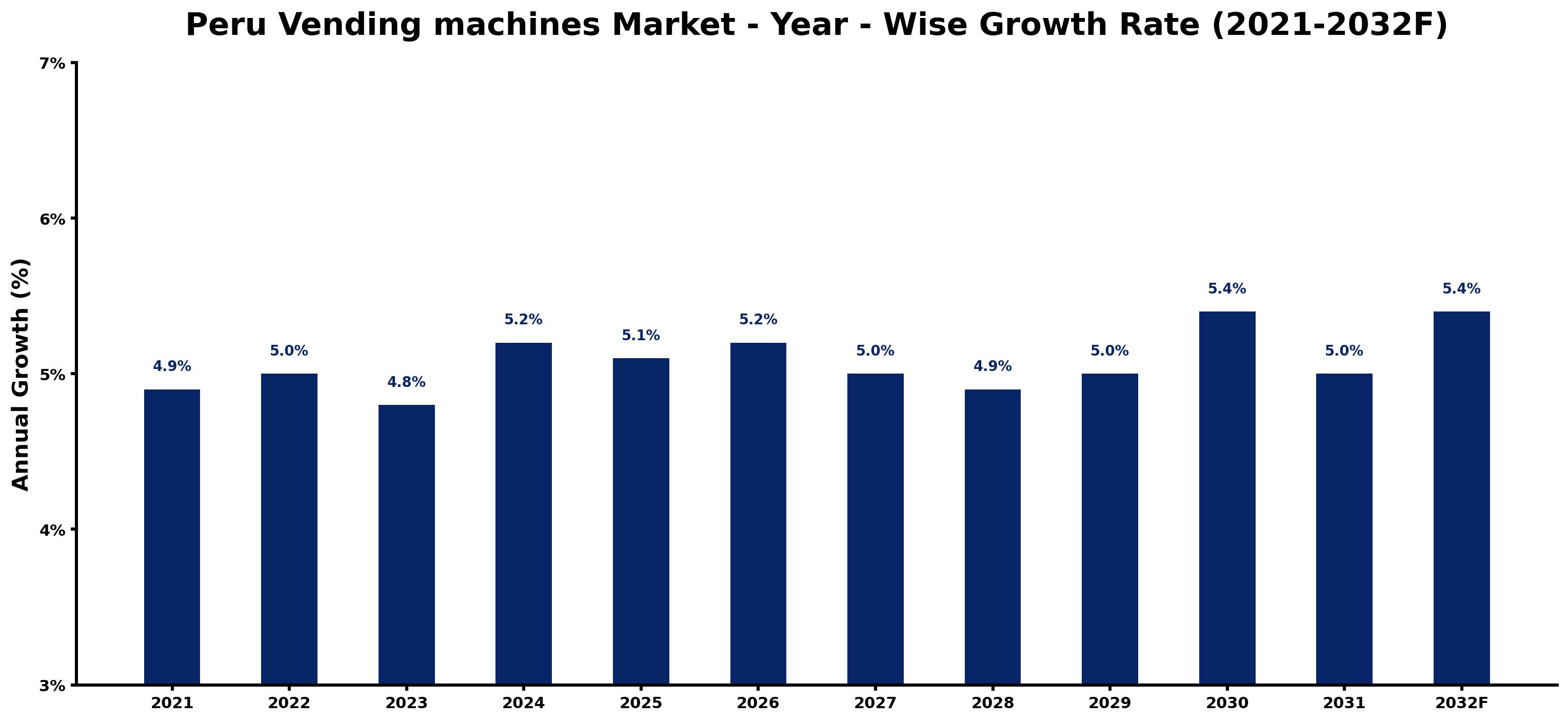
The table below presents the year wise growth rates along with the key drivers influencing the market
| Year | Growth Rate | Major Drivers |
| 2021 | 4.9% | Consumer preferences shift towards convenient purchasing options in urban environments. |
| 2022 | 5.0% | Technological innovations enhance vending machine capabilities, attracting diverse clientele. |
| 2023 | 4.8% | Urbanization trends contribute to increased foot traffic in potential vending locations. |
| 2024 | 5.2% | Emergence of healthier snack options aligns with global wellness trends observed. |
| 2025 | 5.1% | Payment technology advancements simplify transactions, broadening user demographics and adoption. |
| 2026 | 5.2% | Corporate interest in vending services rises, driven by employee satisfaction initiatives. |
| 2027 | 5.0% | Expanding urban populations create demand for accessible retail solutions and services. |
| 2028 | 4.9% | Emerging middle class in Peru enhances spending power, impacting vending choices. |
| 2029 | 5.0% | Sustainability focus motivates companies to introduce eco-friendly vending machine products. |
| 2030 | 5.4% | Integration of IoT technology optimizes inventory management, improving operational efficiencies. |
| 2031 | 5.0% | Collaborations with local brands foster unique offerings, enhancing consumer engagement. |
| 2032 | 5.4% | Market saturation prompts innovation in machine design and product variety strategies. |
Note - Market size estimations and growth projections presented in this report are based on 6Wresearch's advanced forecasting approach, validated with industry datasets as of June 2026.
Peru Vending machines Market Synopsis
The Peru Vending machines Market is projected to reach 5.2% and witness significant growth during the forecast period (2026-2032). This expansion is driven by a rising demand for quick and convenient food and beverage options in various settings such as schools, offices, hospitals, and public spaces. The focus on automatic retail solutions aligns with evolving consumer preferences, further solidifying the significance of vending machines in the Peruvian market.
Peru Vending machines Market Growth Drivers
A variety of factors contribute to the growth of the Peru vending machines market. Firstly, increasing urbanization is creating a higher density of potential users, driving demand for accessible food and beverage options. Secondly, the cultural shift towards convenience is motivating consumers to seek faster access to products.
- The demand for healthier options is reshaping vending machine offerings, encouraging operators to include fresh and organic products.
- Technological advancements such as cashless payments and touchless interfaces are improving the consumer experience, making transactions faster and safer.
- A growing middle class in urban areas is willing to spend more on premium and diverse product offerings, which vending machines can conveniently provide.
- Data analytics and IoT technologies are being integrated into vending machines, enhancing inventory management and operational efficiency.
- Government initiatives aimed at promoting healthy eating provide a favorable backdrop, encouraging the introduction of healthier vending options.
Peru Vending machines Market Trends and Opportunities
Current trends in the Peru vending machines market indicate a shift towards diversity in product offerings and an emphasis on health-conscious choices. Consumers are increasingly gravitating towards vending machines that provide fresh food items and healthy snack options, reflecting broader dietary trends.
- There is a noticeable increase in the demand for organic products, which is encouraging vending machine manufacturers to innovate their selections.
- Contactless payment methods are becoming standard, driven by consumer demand for convenience and enhanced hygiene, a trend catalyzed by the COVID-19 pandemic.
- The integration of real-time data tracking is allowing operators to optimize inventory levels, thereby reducing waste and increasing profitability.
- Connected vending machines, which utilize the Internet of Things (IoT), are gaining traction for their ability to gather consumer data and enhance the overall user experience.
- New strategies to combat operational challenges, such as vandalism and theft, are leading to improved security features in the machines, thus safeguarding investments.
Peru Vending machines Market Challenges and Restraints
Despite the promising growth of the Peru vending machines market, several challenges must be addressed. Limited access to high-footfall locations poses a significant barrier for operators. Securing advantageous placements can be complicated by competitive pressures and regulatory constraints.
- Initial investment costs for vending machine procurement and installation may deter smaller businesses and new entrants, making it essential for these players to devise financial strategies.
- Security concerns related to theft and vandalism may hinder profitability; addressing these issues requires additional resources for maintenance and monitoring systems.
- Regulatory frameworks governing food safety and hygiene may present hurdles for compliance, necessitating ongoing diligence from operators.
- Market saturation in urban areas may lead to intensified competition, potentially impacting profit margins and leading to price wars.
- The need for continuous technological upgrades to meet consumer expectations can also place financial pressure on operators, particularly smaller entities.
Peru Vending machines Market Investment Opportunities
The Peru vending machines market presents substantial investment opportunities, particularly due to increasing urbanization and a focus on convenience among consumers. The rise of the middle class, accompanied by changing preferences towards on-the-go products, highlights a robust potential for growth.
- Investments in vending machines that offer healthier food and beverage options can tap into the growing consumer base prioritizing wellness.
- High-traffic locations, such as educational institutions and healthcare facilities, are prime targets for establishing vending machine operations.
- The demand for technological innovation, particularly in the realm of cashless transactions and data analytics, offers lucrative pathways for investment.
- Partnerships with local businesses and institutions can facilitate strategic placements, enhancing product visibility and sales.
- As the market continues to evolve, focusing on sustainable vending solutions may attract environmentally-conscious consumers and investors alike.
Peru Vending machines Market Government Investment and Initiatives
Government policies play a vital role in shaping the Peru vending machines market. Regulatory measures concerning food safety and hygiene standards ensure that vending machines uphold necessary health protocols, promoting consumer trust and safety.
- Licensing requirements govern the placement of vending machines in public areas to ensure fair competition and consumer protection.
- Government initiatives promoting healthier eating habits are encouraging the introduction of nutritious offerings in vending machines.
- Public spending on urban infrastructure enhances the environment in which vending machines can operate, contributing to increased accessibility.
- Import regulations and tax policies are in place that affect the availability and cost of vending machines and products, requiring operators to navigate these complexities effectively.
- Overall, the government aims to balance industry growth with public health considerations, fostering a conducive environment for vending machine operations.
Peru Vending machines Market Latest Developments (May 2025 - June 2026)
In the period from May 2025 to June 2026, the Peru vending machines market has witnessed significant developments. Operators are increasingly focusing on integrating advanced technologies into their machines to enhance user experience and operational efficiency. There has been a marked shift towards incorporating healthier product options in response to consumer demand for wellness-oriented choices.
- Operators are exploring partnerships with local food suppliers to diversify their product offerings and align with health trends.
- The adoption of contactless payment systems has become more widespread, enhancing the convenience and safety of transactions.
- Investment in security measures has been prioritized to mitigate issues related to theft and vandalism, improving overall profitability.
- Market research indicates an increasing consumer preference for fresh and organic options, prompting operators to adjust their inventory accordingly.
- Additionally, real-time data tracking capabilities are being utilized to optimize inventory management and improve customer satisfaction.
Peru Vending machines Market - Key Attractiveness of the Report
- 10 Years of Market Numbers
- Historical Data Starting from 2022 to 2025
- Base Year: 2025
- Forecast Data until 2032
- Key Performance Indicators Impacting the Market
- Major Upcoming Developments and Projects
Key Highlights of the Report:
- Peru Vending machines Market Outlook
- Market Size of Peru Vending machines Market, 2025
- Forecast of Peru Vending machines Market, 2032F
- Historical Data and Forecast of Peru Vending machines Revenues & Volume for the Period 2022-2032F
- Peru Vending machines Market Trend Evolution
- Peru Vending machines Market Drivers and Challenges
- Peru Vending machines Price Trends
- Peru Vending machines Porter's Five Forces
- Peru Vending machines Industry Life Cycle
- Historical Data and Forecast of Peru Vending machines Market Revenues & Volume By Applications for the Period 2022-2032F
- Historical Data and Forecast of Peru Vending machines Market Revenues & Volume By Commercial Places for the Period 2022-2032F
- Historical Data and Forecast of Peru Vending machines Market Revenues & Volume By Offices for the Period 2022-2032F
- Historical Data and Forecast of Peru Vending machines Market Revenues & Volume By Public Places for the Period 2022-2032F
- Historical Data and Forecast of Peru Vending machines Market Revenues & Volume By Others for the Period 2022-2032F
- Historical Data and Forecast of Peru Vending machines Market Revenues & Volume By Payment Mode for the Period 2022-2032F
- Historical Data and Forecast of Peru Vending machines Market Revenues & Volume By Cash for the Period 2022-2032F
- Historical Data and Forecast of Peru Vending machines Market Revenues & Volume By Cashless for the Period 2022-2032F
- Peru Vending machines Import Export Trade Statistics
- Market Opportunity Assessment By Applications
- Market Opportunity Assessment By Payment Mode
- Peru Vending machines Top Companies Market Share
- Peru Vending machines Competitive Benchmarking By Technical and Operational Parameters
- Peru Vending machines Company Profiles
- Peru Vending machines Key Strategic Recommendations






































