Philippines 2-Aminoethanol Market (2026-2032) | Opportunities, Strategic Insights, Supply, Size, Industry, Drivers, Outlook, Competitive, Value, Challenges, Analysis, Consumer Insights, Pricing Analysis, Restraints, Segments, Investment Trends, Companies, Strategy, Demand, Share, Competition, Forecast, Growth, Segmentation, Revenue, Trends
Market Forecast By Application (Pharmaceuticals, Agrochemicals, Detergents), By End User (Industrial, Chemical Manufacturing), By Production Process (Ethoxylation, Reaction with Ammonia), By Product Purity (Low, Medium, High) And Competitive Landscape
| Product Code: ETC11430625 | Publication Date: Apr 2025 | Updated Date: May 2026 | Product Type: Market Research Report | |
| Publisher: 6Wresearch | Author: Bhawna Singh | No. of Pages: 65 | No. of Figures: 34 | No. of Tables: 19 |
Philippines 2-Aminoethanol Growth Rate
According to 6Wresearch internal database and industry insights, the Philippines 2-Aminoethanol is projected to grow at a compound annual growth rate (CAGR) of 7.1% during the forecast period from 2026 to 2032.
Philippines 2-Aminoethanol Market Year-wise Growth Rate and Key Drivers
This graph highlights how the Philippines 2-Aminoethanol Market has steadily grown over the past five years, supported by major growth factors.
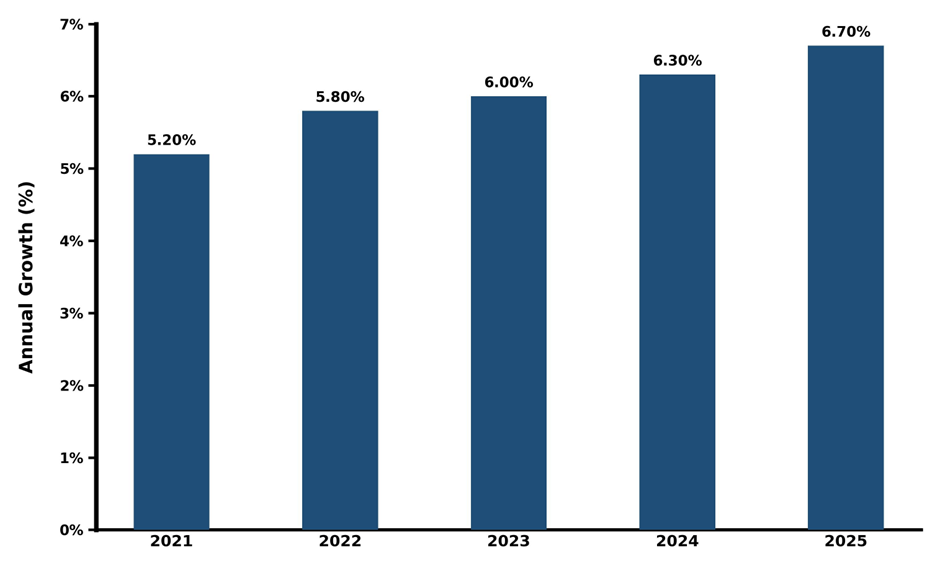
The table below presents the year‑wise growth rates along with the key drivers influencing the market
| Years | Est. Annual Growth in % | Growth Drivers |
| 2021 | 5.2% | Increased demand in the pharmaceutical and agrochemical sectors. |
| 2022 | 5.8% | Rising applications in detergents and cleaning agents. |
| 2023 | 6% | Growing focus on environmental sustainability in chemical manufacturing. |
| 2024 | 6.3% | Expansion in the production of agrochemical formulations. |
| 2025 | 6.7% | Increasing demand for higher purity 2 Aminoethanol for industrial applications. |
Topics Covered in the Philippines 2-Aminoethanol Report
The Philippines 2-Aminoethanol report thoroughly covers the market by application, end user, production process, and product purity, providing an unbiased and detailed analysis of ongoing market trends, opportunities, challenges, and market drivers, helping stakeholders align their strategies with current and future market dynamics.
Philippines 2-Aminoethanol Highlights
| Report Name | Philippines 2-Aminoethanol |
| Forecast period | 2026-2032 |
| CAGR | 7.1% |
| Growing Sector | Chemical Manufacturing |
Philippines 2-Aminoethanol Synopsis
The Philippines 2-Aminoethanol is experiencing continuous expansion as the demand for its products has increased in pharmaceutical, agrochemical and detergent markets. Its role as a primary component in chemical production and cleaning product development is currently experiencing increased demand and the market is expanding as companies increasingly value sustainable practices in their agrochemical and detergent product development. The 2-Aminoethanol is expanding as production process advancements make the chemical essential for multiple industries while increasing its use in important business areas.
Evaluation of Growth Drivers in the Philippines 2-Aminoethanol (2026-2032)
Below mentioned are some prominent drivers and their impact on the market dynamics:
| Drivers | Primary Segments Affected | Why It Matters (Evidence) |
| Increasing Demand in Pharmaceuticals | Pharmaceuticals, Chemical Manufacturing | Growing use of 2 Aminoethanol in drug formulation is driving market growth. |
| Sustainability in Agrochemicals | Agrochemicals, Detergents | The shift towards eco-friendly agrochemical products is fueling demand for 2 Aminoethanol. |
| Technological Advancements in Production | All Segments | Innovations in manufacturing processes are improving efficiency and reducing costs. |
| Rising Demand in Detergents | Detergents, Chemical Manufacturing | The increasing demand for effective cleaning agents boosts the use of 2 Aminoethanol. |
| Expanding Industrial Applications | Industrial, Chemical Manufacturing | Growing use of 2 Aminoethanol in industrial applications drives market expansion. |
The Philippines 2-Aminoethanol Size is projected to grow at a CAGR of 7.1% from 2026 to 2032. The Philippines 2-Aminoethanol is driven by increasing demand in pharmaceuticals, agrochemicals, and detergents. The material functions as an essential component which chemical manufacturers use for their production processes and cleaning products while the market expansion results from sustainable agricultural practices which manufacturers use to create their agrochemical and detergent products. The production process advancements which use technological progress to improve efficiency and decrease expenses result in greater production capacity of high-purity 2 Aminoethanol. These factors collectively contribute to the steady growth and future potential of the 2-Aminoethanol in the Philippines.
Evaluation of Restraints in the Philippines 2-Aminoethanol
Below mentioned are some major restraints and their influence on the market dynamics:
| Restraints | Primary Segments Affected | What This Means (Evidence) |
| High Production Costs | Pharmaceuticals, Agrochemicals | High production costs for high-purity 2 Aminoethanol may limit market growth in price-sensitive sectors. |
| Regulatory Compliance | All Segments | Stringent environmental regulations on chemical production can increase costs and limit market entry. |
| Supply Chain Disruptions | All Segments | Global supply chain challenges can delay production and availability of raw materials. |
| Limited Awareness in Emerging Markets | Agrochemicals, Detergents | Awareness of 2-Aminothanol highlights is a gapin emerging markets and may slow the penetration. |
| Competition from Substitutes | Pharmaceuticals, Agrochemicals | Availability of cheaper substitutes may hinder demand for 2 Aminoethanol in certain applications. |
Philippines 2-Aminoethanol Challenges
The Philippines 2 Aminoethanol Industry faces several challenges such as the high production costs associated with high-purity 2 Aminoethanol, as well as regulatory hurdles that increase manufacturing costs and supply chain disruptions which can delay the production of key raw materials. The market also faces limited awareness in emerging markets, which could slow down adoption and in order to overcome these challenges, companies need to focus on reducing costs, improving production efficiency, and expanding their educational efforts in new markets.
Philippines 2-Aminoethanol Trends
Here are some major trends changing the Philippines 2-Aminoethanol Growth dynamics:
- Shift Towards Sustainable Chemicals - The increasing demand for eco-friendly and biodegradable agrochemicals and detergents is driving growth in 2 Aminoethanol applications.
- Technological Innovations - The production methods for 2 Aminoethanol show ongoing improvement through current production method improvements which enhance product efficiency and product purity.
- Increased Demand for Detergents - The rising demand for household and industrial detergents is driving the use of 2 Aminoethanol, particularly in surfactant formulations.
Investment Opportunities in the Philippines 2-Aminoethanol
The Philippines market presents several investment opportunities:
- Investment in Sustainable Manufacturing - The companies which invest in green and sustainable production methods for 2 Aminoethanol will gain a market advantage in the environmentally conscious industry.
- Expansion in Pharmaceutical Applications - The expansion of Pharmaceutical Applications provides important investment opportunities as the pharmaceutical sector delivers fundamental resources needed for drug development and active pharmaceutical ingredient production.
- R&D in Higher Purity Products - Research and development activities which aim to enhance the purity of 2 Aminoethanol will support the rising need for premium industrial products.
Top 5 Leading Players in the Philippines 2-Aminoethanol
Below is the list of prominent companies leading the Philippines 2-Aminoethanol Share:
Dow Chemical Philippines, Inc.
| Company Name | Dow Chemical Philippines, Inc. |
| Established Year | 1964 (Philippines) |
| Headquarters | Makati City, Philippines (Parent: Midland, Michigan, USA) |
| Official Website | Click Here |
Dow is a global leader in ethanolamine production. In the Philippines, they are a primary supplier of high-purity MEA, supporting the local laundry detergent industry and providing specialized amine solutions for gas treating and metalworking fluids.
BASF Philippines, Inc.
| Company Name | BASF Philippines, Inc. |
| Established Year | 1963 (Philippines) |
| Headquarters | Makati City, Philippines (Parent: Ludwigshafen, Germany) |
| Official Website | Click Here |
BASF is a major producer of chemical intermediates. They provide the Philippine market with a broad range of ethanolamines used in the formulation of wood preservatives, surfactants, and agricultural chemicals, leveraging their global Verbund production integrated network.
Ilyon Industrial Corporation
| Company Name | Ilyon Industrial Corporation |
| Established Year | 1992 |
| Headquarters | Valenzuela City, Philippines |
| Official Website | Click Here |
Ilyon is one of the leading local importers and distributors of industrial chemicals in the Philippines. They act as a critical supply chain partner for many global manufacturers, distributing MEA to domestic SMEs and large factories in the soap, detergent, and textile sectors.
Huntsman Philippines
| Company Name | Huntsman Philippines |
| Established Year | 1970 (Global) / Long-standing local presence |
| Headquarters | Makati City, Philippines (Parent: The Woodlands, Texas, USA) |
| Official Website | Click Here |
Huntsman is a global pioneer in amine chemistry. Their Philippine operations focus on providing high-performance ethanolamines for the local polyurethane and agrochemical industries, as well as specialized formulations used in the domestic oil and gas refining processes.
SBS Philippines Corporation
| Company Name | SBS Philippines Corporation |
| Established Year | 1970 |
| Headquarters | Quezon City, Philippines |
| Official Website | Click Here |
SBS is a major publicly-listed chemical trader and distributor in the Philippines. They maintain extensive warehousing and logistics facilities to supply 2-Aminoethanol to various industrial end-users, focusing on the water treatment, construction, and personal care formulation markets.
Government Regulations Introduced in the Philippines 2-Aminoethanol
According to Filipino government data, to regulate the production of 2 Aminoethanol in accordance with environmental standards, the government of the Philippines has developed a variety of regulations through the Department of Environment and Natural Resources, or DENR. For example, the DENR regulates emissions and waste disposal from chemical manufacturing facilities. These regulatory measures are intended to encourage responsible production practices, improve consumer confidence, and help support the long-term growth of the overall market.
Future Insights of the Philippines 2-Aminoethanol
The Philippines 2-Aminoethanol is expected to expand owing to the high demand for 2 Aminoethanol in pharmaceuticals, agrochemicals, and detergents industry. Technological innovations in production processes will increase production capabilities and allow manufacturers to produce sustainably, which will also help increase demand for 2 Aminoethanol for both industrial and pharmaceutical purposes presents many opportunities for investment potential in these sectors. With continued growth in the pharmaceutical and world-wide chemical markets, both domestic and international manufacturers are expected to benefit from the increasing demand for modern chemical products.
Market Segmentation Analysis
The report offers a comprehensive study of the following market segments and their leading categories:
By Application – Pharmaceuticals to Dominate the Market
According to Ritika Kalra, Senior Research Analyst, 6Wresearch, the market analysis shows that the pharmaceutical segment currently holds the market lead and the market for this sector experiences growth owing to drug manufacturers increasingly utilize 2 Aminoethanol.
By End User - Chemical Manufacturing to Dominate the Market
The Chemical Manufacturing sector dominates the market. 2 Aminoethanol is a crucial intermediate in the production of various chemicals, including surfactants, solvents, and agrochemicals. Its widespread use in chemical manufacturing makes this segment the leading end-user of 2 Aminoethanol in the Philippines market.
By Production Process – Ethoxylation to Dominate the Market
The Ethoxylation process dominates the production of 2 Aminoethanol as the chemical industry needs high-quality 2 Aminoethanol, which Ethoxylation produces as the standard method.
By Product Purity - High Purity to Dominate the Market
High Purity 2 Aminoethanol dominates the market. High-purity 2 Aminoethanol is increasingly preferred in industrial applications where precision and quality are critical, such as in pharmaceuticals and high-performance detergents. This demand for higher purity is driving growth in the segment.
Key Attractiveness of the Report
- 10 Years of Market Numbers
- Historical Data Starting from 2022 to 2025
- Base Year: 2025
- Forecast Data until 2032
- Key Performance Indicators Impacting the Market
- Major Upcoming Developments and Projects
Key Highlights of the Report:
- Philippines 2-Aminoethanol Market Outlook
- Market Size of Philippines 2-Aminoethanol Market, 2025
- Forecast of Philippines 2-Aminoethanol Market, 2032
- Historical Data and Forecast of Philippines 2-Aminoethanol Revenues & Volume for the Period 2022- 2032
- Philippines 2-Aminoethanol Market Trend Evolution
- Philippines 2-Aminoethanol Market Drivers and Challenges
- Philippines 2-Aminoethanol Price Trends
- Philippines 2-Aminoethanol Porter's Five Forces
- Philippines 2-Aminoethanol Industry Life Cycle
- Historical Data and Forecast of Philippines 2-Aminoethanol Market Revenues & Volume By Application for the Period 2022- 2032
- Historical Data and Forecast of Philippines 2-Aminoethanol Market Revenues & Volume By Pharmaceuticals for the Period 2022- 2032
- Historical Data and Forecast of Philippines 2-Aminoethanol Market Revenues & Volume By Agrochemicals for the Period 2022- 2032
- Historical Data and Forecast of Philippines 2-Aminoethanol Market Revenues & Volume By Detergents for the Period 2022- 2032
- Historical Data and Forecast of Philippines 2-Aminoethanol Market Revenues & Volume By End User for the Period 2022- 2032
- Historical Data and Forecast of Philippines 2-Aminoethanol Market Revenues & Volume By Industrial for the Period 2022- 2032
- Historical Data and Forecast of Philippines 2-Aminoethanol Market Revenues & Volume By Chemical Manufacturing for the Period 2022- 2032
- Historical Data and Forecast of Philippines 2-Aminoethanol Market Revenues & Volume By Production Process for the Period 2022- 2032
- Historical Data and Forecast of Philippines 2-Aminoethanol Market Revenues & Volume By Ethoxylation for the Period 2022- 2032
- Historical Data and Forecast of Philippines 2-Aminoethanol Market Revenues & Volume By Reaction with Ammonia for the Period 2022- 2032
- Historical Data and Forecast of Philippines 2-Aminoethanol Market Revenues & Volume By Product Purity for the Period 2022- 2032
- Historical Data and Forecast of Philippines 2-Aminoethanol Market Revenues & Volume By Low for the Period 2022- 2032
- Historical Data and Forecast of Philippines 2-Aminoethanol Market Revenues & Volume By Medium for the Period 2022- 2032
- Historical Data and Forecast of Philippines 2-Aminoethanol Market Revenues & Volume By High for the Period 2022- 2032
- Philippines 2-Aminoethanol Import Export Trade Statistics
- Market Opportunity Assessment By Application
- Market Opportunity Assessment By End User
- Market Opportunity Assessment By Production Process
- Market Opportunity Assessment By Product Purity
- Philippines 2-Aminoethanol Top Companies Market Share
- Philippines 2-Aminoethanol Competitive Benchmarking By Technical and Operational Parameters
- Philippines 2-Aminoethanol Company Profiles
- Philippines 2-Aminoethanol Key Strategic Recommendations
Market Covered
The report offers a comprehensive study of the subsequent market segments:
By Application
- Pharmaceuticals
- Agrochemicals
- Detergents
By End User
- Industrial
- Chemical Manufacturing
By Production Process
- Ethoxylation
- Reaction with Ammonia
By Product Purity
- Low
- Medium
- High
Philippines 2-Aminoethanol Market (2026-2032) : FAQs
The market is projected to grow at a CAGR of 7.1% between 2026-2032.
The pharmaceuticals segment is expected to dominate due to increased demand for 2-Aminoethanol in drug formulations.
The pharmaceutical and chemical manufacturing sectors provide investment prospects through their development of high-purity 2-aminoethanol products.
The DENR enforces regulations to ensure the safe production of 2-Aminoethanol which results in market stability and consumer confidence.
6Wresearch actively monitors the Philippines 2-Aminoethanol Market and publishes its comprehensive annual report, highlighting emerging trends, growth drivers, revenue analysis, and forecast outlook. Our insights help businesses to make data-backed strategic decisions with ongoing market dynamics. Our analysts track relevent industries related to the Philippines 2-Aminoethanol Market, allowing our clients with actionable intelligence and reliable forecasts tailored to emerging regional needs.
Yes, we provide customisation as per your requirements. To learn more, feel free to contact us on sales@6wresearch.com
| 1 Executive Summary |
| 2 Introduction |
| 2.1 Key Highlights of the Report |
| 2.2 Report Description |
| 2.3 Market Scope & Segmentation |
| 2.4 Research Methodology |
| 2.5 Assumptions |
| 3 Philippines 2-Aminoethanol Market Overview |
| 3.1 Philippines Country Macro Economic Indicators |
| 3.2 Philippines 2-Aminoethanol Market Revenues & Volume, 2022 & 2032F |
| 3.3 Philippines 2-Aminoethanol Market - Industry Life Cycle |
| 3.4 Philippines 2-Aminoethanol Market - Porter's Five Forces |
| 3.5 Philippines 2-Aminoethanol Market Revenues & Volume Share, By Application, 2022 & 2032F |
| 3.6 Philippines 2-Aminoethanol Market Revenues & Volume Share, By End User, 2022 & 2032F |
| 3.7 Philippines 2-Aminoethanol Market Revenues & Volume Share, By Production Process, 2022 & 2032F |
| 3.8 Philippines 2-Aminoethanol Market Revenues & Volume Share, By Product Purity, 2022 & 2032F |
| 4 Philippines 2-Aminoethanol Market Dynamics |
| 4.1 Impact Analysis |
| 4.2 Market Drivers |
| 4.2.1 Growing demand for pharmaceuticals and personal care products in the Philippines, where 2-aminoethanol is used as a key ingredient. |
| 4.2.2 Increasing awareness about the benefits of using 2-aminoethanol in industrial applications such as coatings, adhesives, and lubricants. |
| 4.2.3 Favorable government regulations and policies supporting the use of 2-aminoethanol in various industries. |
| 4.3 Market Restraints |
| 4.3.1 Fluctuating prices of raw materials used in the production of 2-aminoethanol, impacting the overall cost of the product. |
| 4.3.2 Intense competition from alternative chemicals or substitutes that may hinder the market growth. |
| 5 Philippines 2-Aminoethanol Market Trends |
| 6 Philippines 2-Aminoethanol Market, By Types |
| 6.1 Philippines 2-Aminoethanol Market, By Application |
| 6.1.1 Overview and Analysis |
| 6.1.2 Philippines 2-Aminoethanol Market Revenues & Volume, By Application, 2022 - 2032F |
| 6.1.3 Philippines 2-Aminoethanol Market Revenues & Volume, By Pharmaceuticals, 2022 - 2032F |
| 6.1.4 Philippines 2-Aminoethanol Market Revenues & Volume, By Agrochemicals, 2022 - 2032F |
| 6.1.5 Philippines 2-Aminoethanol Market Revenues & Volume, By Detergents, 2022 - 2032F |
| 6.2 Philippines 2-Aminoethanol Market, By End User |
| 6.2.1 Overview and Analysis |
| 6.2.2 Philippines 2-Aminoethanol Market Revenues & Volume, By Industrial, 2022 - 2032F |
| 6.2.3 Philippines 2-Aminoethanol Market Revenues & Volume, By Chemical Manufacturing, 2022 - 2032F |
| 6.3 Philippines 2-Aminoethanol Market, By Production Process |
| 6.3.1 Overview and Analysis |
| 6.3.2 Philippines 2-Aminoethanol Market Revenues & Volume, By Ethoxylation, 2022 - 2032F |
| 6.3.3 Philippines 2-Aminoethanol Market Revenues & Volume, By Reaction with Ammonia, 2022 - 2032F |
| 6.4 Philippines 2-Aminoethanol Market, By Product Purity |
| 6.4.1 Overview and Analysis |
| 6.4.2 Philippines 2-Aminoethanol Market Revenues & Volume, By Low, 2022 - 2032F |
| 6.4.3 Philippines 2-Aminoethanol Market Revenues & Volume, By Medium, 2022 - 2032F |
| 6.4.4 Philippines 2-Aminoethanol Market Revenues & Volume, By High, 2022 - 2032F |
| 7 Philippines 2-Aminoethanol Market Import-Export Trade Statistics |
| 7.1 Philippines 2-Aminoethanol Market Export to Major Countries |
| 7.2 Philippines 2-Aminoethanol Market Imports from Major Countries |
| 8 Philippines 2-Aminoethanol Market Key Performance Indicators |
| 8.1 Adoption rate of 2-aminoethanol in key industries such as pharmaceuticals, personal care, and industrial applications. |
| 8.2 Number of research and development activities focused on enhancing the properties and applications of 2-aminoethanol. |
| 8.3 Regulatory compliance levels and certifications obtained for the use of 2-aminoethanol in different industries. |
| 9 Philippines 2-Aminoethanol Market - Opportunity Assessment |
| 9.1 Philippines 2-Aminoethanol Market Opportunity Assessment, By Application, 2022 & 2032F |
| 9.2 Philippines 2-Aminoethanol Market Opportunity Assessment, By End User, 2022 & 2032F |
| 9.3 Philippines 2-Aminoethanol Market Opportunity Assessment, By Production Process, 2022 & 2032F |
| 9.4 Philippines 2-Aminoethanol Market Opportunity Assessment, By Product Purity, 2022 & 2032F |
| 10 Philippines 2-Aminoethanol Market - Competitive Landscape |
| 10.1 Philippines 2-Aminoethanol Market Revenue Share, By Companies, 2025 |
| 10.2 Philippines 2-Aminoethanol Market Competitive Benchmarking, By Operating and Technical Parameters |
| 11 Company Profiles |
| 12 Recommendations |
| 13 Disclaimer |
Export potential assessment - trade Analytics for 2030
Export potential enables firms to identify high-growth global markets with greater confidence by combining advanced trade intelligence with a structured quantitative methodology. The framework analyzes emerging demand trends and country-level import patterns while integrating macroeconomic and trade datasets such as GDP and population forecasts, bilateral import–export flows, tariff structures, elasticity differentials between developed and developing economies, geographic distance, and import demand projections. Using weighted trade values from 2020–2024 as the base period to project country-to-country export potential for 2030, these inputs are operationalized through calculated drivers such as gravity model parameters, tariff impact factors, and projected GDP per-capita growth. Through an analysis of hidden potentials, demand hotspots, and market conditions that are most favorable to success, this method enables firms to focus on target countries, maximize returns, and global expansion with data, backed by accuracy.
By factoring in the projected importer demand gap that is currently unmet and could be potential opportunity, it identifies the potential for the Exporter (Country) among 190 countries, against the general trade analysis, which identifies the biggest importer or exporter.
To discover high-growth global markets and optimize your business strategy:
Click Here
Pricing
- Single User License$ 1,995
- Department License$ 2,400
- Site License$ 3,120
- Global License$ 3,795

Thought Leadership
Search
Thought Leadership and Analyst Meet





Our Clients








Latest Reports
- New Zealand Aseptic Manufacturing Market (2026-2032)
- Netherlands Aseptic Manufacturing Market (2026-2032)
- Nauru Aseptic Manufacturing Market (2026-2032)
- Namibia Aseptic Manufacturing Market (2026-2032)
- Mozambique Aseptic Manufacturing Market (2026-2032)
- Montenegro Aseptic Manufacturing Market (2026-2032)
- Mongolia Aseptic Manufacturing Market (2026-2032)
- Monaco Aseptic Manufacturing Market (2026-2032)
- Micronesia Aseptic Manufacturing Market (2026-2032)
- Mauritius Aseptic Manufacturing Market (2026-2032)
Industry Events and Analyst Meet

HIMTEX 2026

India Refining Summit 2026

India EV Show 2026

EV tech India Expo 2026

Auto Tech Asia 2026
Whitepaper
- Middle East & Africa Commercial Security Market Click here to view more.
- Middle East & Africa Fire Safety Systems & Equipment Market Click here to view more.
- GCC Drone Market Click here to view more.
- Middle East Lighting Fixture Market Click here to view more.
- GCC Physical & Perimeter Security Market Click here to view more.
6WResearch In News
- Doha a strategic location for EV manufacturing hub: IPA Qatar
- Demand for luxury TVs surging in the GCC, says Samsung
- Empowering Growth: The Thriving Journey of Bangladesh’s Cable Industry
- Demand for luxury TVs surging in the GCC, says Samsung
- Video call with a traditional healer? Once unthinkable, it’s now common in South Africa
- Intelligent Buildings To Smooth GCC’s Path To Net Zero


