Philippines Anthracite Market Top 5 Importing Countries and Market Competition (HHI) Analysis
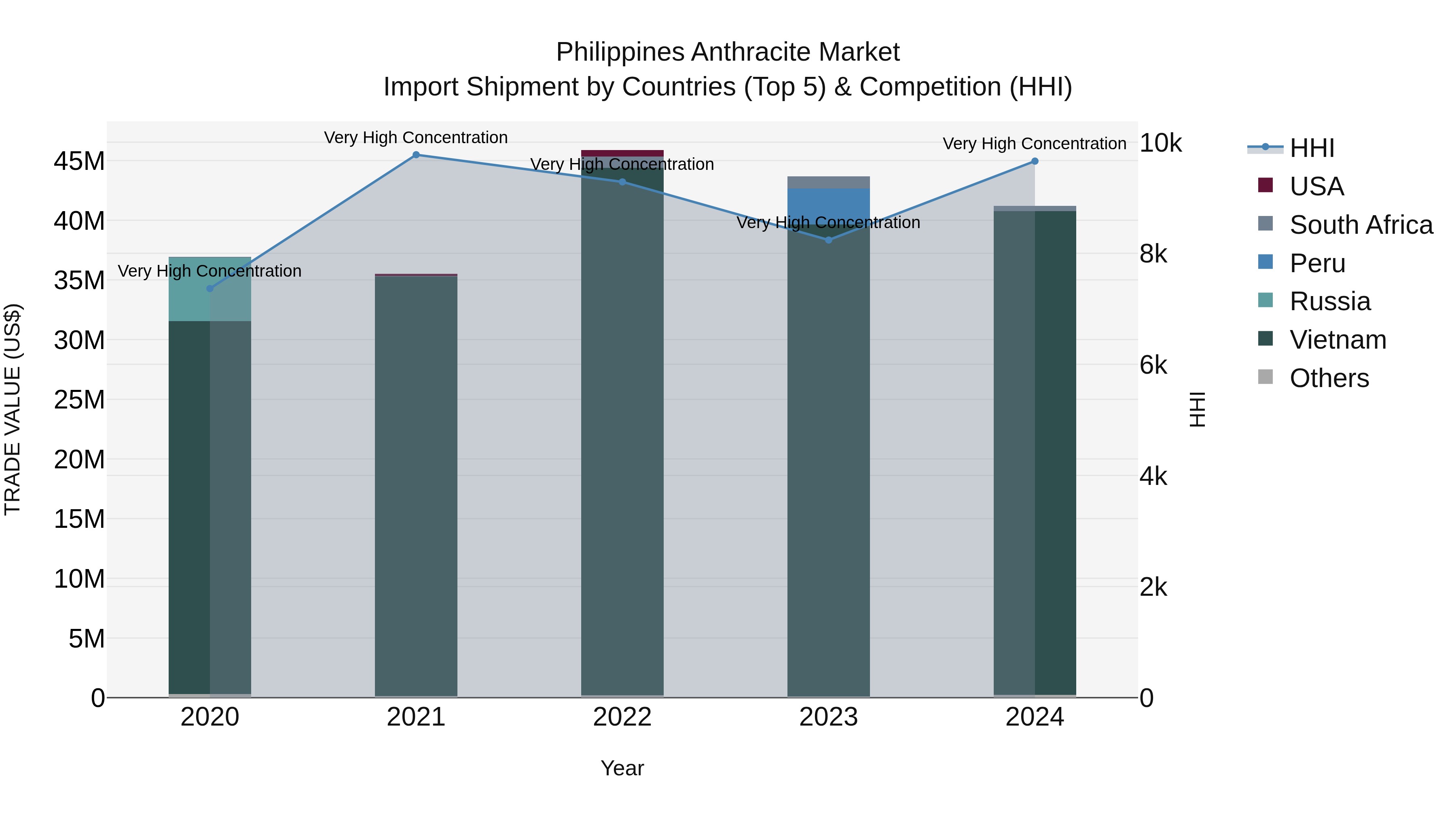
Despite a slight decline in growth rate in 2024, the Philippines continued to heavily rely on anthracite imports, with top exporters being Vietnam, South Africa, Malaysia, South Korea, and China. The high Herfindahl-Hirschman Index (HHI) indicates a concentrated market, potentially leading to pricing power for suppliers. With a modest compound annual growth rate (CAGR) of 2.78% from 2020 to 2024, the market for anthracite imports in the Philippines remains stable, highlighting the importance of these key exporting countries in meeting the country`s demand for this essential commodity.
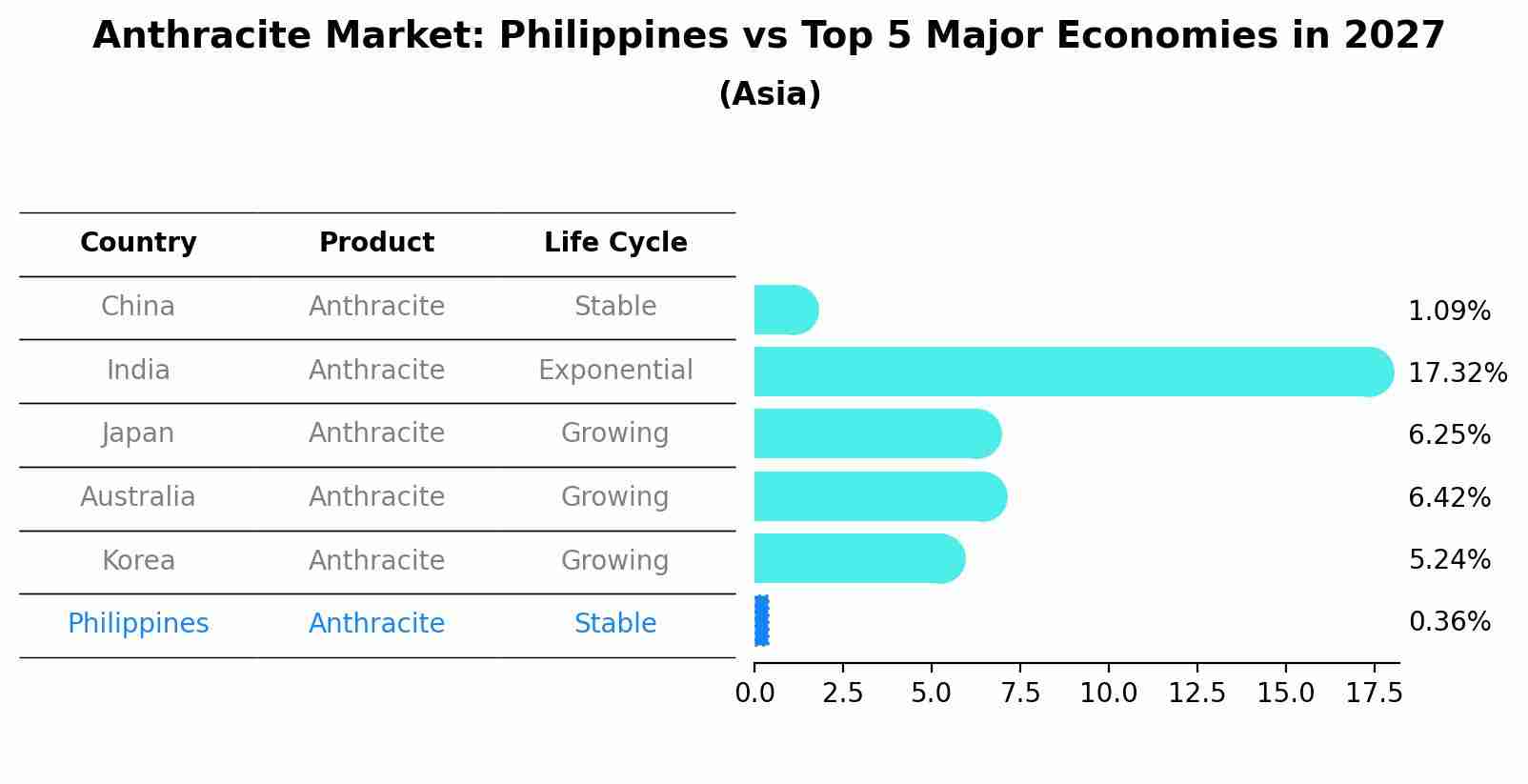
Anthracite Market: Philippines vs Top 5 Major Economies in 2027 (Asia)
Philippines's Anthracite market is anticipated to experience a stable growth rate of 0.36% by 2027, reflecting trends observed in the largest economy China, followed by India, Japan, Australia and South Korea.
philippines bituminous coal market Synopsis
The Philippines bituminous coal market was valued at USD 1 billion and is estimated to grow at a CAGR of 7% due to its improved efficiency compared to other fuels used for thermal power production as well as reduced pollution levels when burned properly. Furthermore, continuous research activities being undertaken for reducing carbon dioxide emissions from burning bituminous coal are anticipated to drive utilization over time across various end-use sectors including residential & commercial buildings and heavy industry manufacturing units such as cement plants & steel mills among others.
Drivers of the Market
The Philippines bituminous coal market`s outlook is shaped by several key drivers. Bituminous coal, valued for its energy content and versatility, is a vital resource for electricity generation, industrial processes, and residential heating. As the Philippines aims to balance energy security and environmental sustainability, bituminous coal remains a significant part of its energy mix. The demand for affordable and reliable energy sources, especially in areas with limited access to alternative fuels, continues to drive the consumption of bituminous coal. Its use in cement and steel production also contributes to its market demand. While the global shift towards cleaner energy sources is ongoing, bituminous coal`s role in the Philippines energy transition is expected to persist for the foreseeable future.
Challenges of the Market
The Philippines bituminous coal market faces several challenges that influence its outlook within the energy and industrial sectors. A significant challenge is the global trend toward cleaner energy sources and reduced carbon emissions. This shift could lead to decreased demand for coal, including bituminous coal, as governments and industries prioritize renewable energy and lower-carbon alternatives. Environmental concerns, such as air and water pollution associated with coal combustion, contribute to regulatory pressures that could impact the market`s growth. Additionally, market volatility and fluctuations in international coal prices can affect the profitability and competitiveness of domestic coal production and export. Technological advancements in extraction and utilization of coal alternatives further challenge the market`s position. To overcome these challenges, the bituminous coal market needs to explore avenues for cleaner coal technologies, diversify its applications, and invest in sustainable mining and environmental practices.
COVID-19 Impact on the Market
The Philippines bituminous coal market has encountered fluctuations due to both global market dynamics and the impact of the COVID-19 pandemic. Bituminous coal, valued for its energy content, is used in power generation and industrial processes. The pandemic led to reduced energy consumption and disrupted supply chains, affecting the market. However, as economic activities pick up, the demand for energy is expected to increase, positively influencing the bituminous coal market. The market`s outlook depends on factors such as energy policies, environmental considerations, and global energy trends.
Key Players in the Market
The Philippines bituminous coal market is anticipated to see modest growth due to its importance in power generation and industrial processes. Despite efforts to transition to cleaner energy sources, bituminous coal remains relevant. Key players like CoalEnergy Corp., BituCoal Mines Ltd., and PowerCoal Industries play a pivotal role in the market. These companies are adapting to stricter environmental regulations and exploring carbon capture and storage technologies.
Key Highlights of the Report:
- Philippines Anthracite Market Outlook
- Market Size of Philippines Anthracite Market, 2024
- Forecast of Philippines Anthracite Market, 2031
- Historical Data and Forecast of Philippines Anthracite Revenues & Volume for the Period 2021-2031
- Philippines Anthracite Market Trend Evolution
- Philippines Anthracite Market Drivers and Challenges
- Philippines Anthracite Price Trends
- Philippines Anthracite Porter's Five Forces
- Philippines Anthracite Industry Life Cycle
- Historical Data and Forecast of Philippines Anthracite Market Revenues & Volume By Application for the Period 2021-2031
- Historical Data and Forecast of Philippines Anthracite Market Revenues & Volume By Fuel for the Period 2021-2031
- Historical Data and Forecast of Philippines Anthracite Market Revenues & Volume By Steel Making for the Period 2021-2031
- Historical Data and Forecast of Philippines Anthracite Market Revenues & Volume By Sinter Plants for the Period 2021-2031
- Historical Data and Forecast of Philippines Anthracite Market Revenues & Volume By Indurating Furnaces for the Period 2021-2031
- Historical Data and Forecast of Philippines Anthracite Market Revenues & Volume By Furnace Coal Replacement for the Period 2021-2031
- Historical Data and Forecast of Philippines Anthracite Market Revenues & Volume By Others for the Period 2021-2031
- Historical Data and Forecast of Philippines Anthracite Market Revenues & Volume By End-user for the Period 2021-2031
- Historical Data and Forecast of Philippines Anthracite Market Revenues & Volume By Steel for the Period 2021-2031
- Historical Data and Forecast of Philippines Anthracite Market Revenues & Volume By Energy & Power for the Period 2021-2031
- Historical Data and Forecast of Philippines Anthracite Market Revenues & Volume By Bricks for the Period 2021-2031
- Historical Data and Forecast of Philippines Anthracite Market Revenues & Volume By Silicon & Glass for the Period 2021-2031
- Historical Data and Forecast of Philippines Anthracite Market Revenues & Volume By Synthetic Fuels for the Period 2021-2031
- Historical Data and Forecast of Philippines Anthracite Market Revenues & Volume By Others for the Period 2021-2031
- Philippines Anthracite Import Export Trade Statistics
- Market Opportunity Assessment By Application
- Market Opportunity Assessment By End-user
- Philippines Anthracite Top Companies Market Share
- Philippines Anthracite Competitive Benchmarking By Technical and Operational Parameters
- Philippines Anthracite Company Profiles
- Philippines Anthracite Key Strategic Recommendations






































