Philippines Bus Market Size, Share & Growth Rate
The Philippines Bus Market was estimated at USD 120 Million in 2025 and is projected to reach USD 131 Million by 2032, growing at a CAGR of 1.3% from 2026 to 2032. This steady growth trajectory is primarily driven by ongoing urbanization and significant investments in public transportation infrastructure, particularly in metropolitan areas. The government's commitment to modernizing the public utility vehicle fleet also plays a crucial role in meeting the rising demand for efficient and environmentally-friendly transport solutions.
Philippines Bus Market Year-wise Growth Rate and Key Drivers
This graph highlights how the Philippines Bus Market has steadily grown over the years, supported by major growth factors.
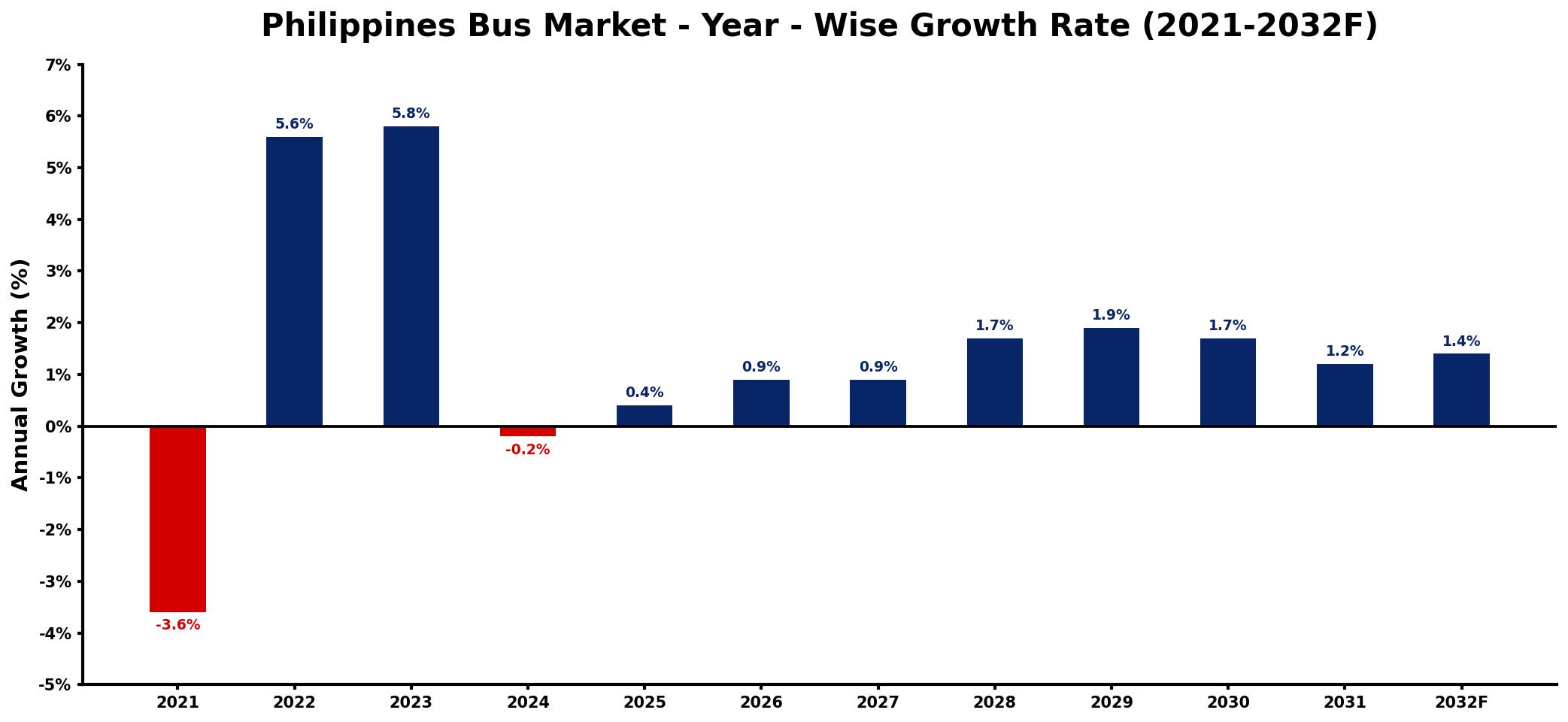
The table below presents the year‑wise growth rates along with the key drivers influencing the market
| Year | Growth Rate | Major Drivers |
| 2021 | -3.6% | decrease in public transportation investments |
| 2022 | 5.6% | rise in commuter demand initiatives |
| 2023 | 5.8% | increased infrastructure development projects |
| 2024 | -0.2% | drop in fuel price stability |
| 2025 | 0.4% | expansion of urban transport networks |
| 2026 | 0.9% | growth in eco-friendly transit options |
| 2027 | 0.9% | enhanced public transport accessibility programs |
| 2028 | 1.7% | development of smart transit solutions |
| 2029 | 1.9% | increase in travel frequency rates |
| 2030 | 1.7% | rising infrastructure development spending |
| 2031 | 1.2% | rising procurement volume requirements |
| 2032 | 1.4% | stronger distribution network expansion |
Note: Market size estimations and growth projections presented in this report are based on 6Wresearch's proprietary forecasting methodology, utilizing the latest available industry data, government publications, and primary research inputs.
Philippines Bus Market Synopsis
In the Philippines, the bus market is witnessing transformative changes shaped by a burgeoning urban population and increased commuter demands. Public transportation systems are under pressure to deliver efficiency, accessibility, and improved service quality, leading to a growing focus on bus modernization.
Local manufacturers and international players are responding to these challenges by innovating and expanding their offerings. Government initiatives, such as the Public Utility Vehicle Modernization Program (PUVMP), are pivotal in facilitating the transition towards modern, fuel-efficient buses that meet contemporary passenger needs and environmental standards.
Philippines Bus Market Key Takeaways
- The market is projected to grow steadily, reflecting ongoing investments in public transportation infrastructure.
- Government initiatives are fostering a shift towards modern fleets, enhancing overall service delivery.
- Urbanization is driving the demand for various types of buses, including city and tourist buses.
- Challenges related to emissions standards and consumer preferences continue to shape market dynamics.
- The need for efficient fuel consumption remains a significant focus for manufacturers and operators alike.
Evaluation of Restraints in Philippines Bus Market
Despite the positive growth outlook, several restraints impact the Philippines bus market. Strict compliance with emission regulations presents ongoing challenges for manufacturers, particularly when balancing performance with environmental standards. Additionally, variations in customer preferences across different market segments complicate the development of universally appealing bus designs. Economic fluctuations can also affect investment in public infrastructure, creating uncertainty in future demand for new bus purchases.
Philippines Bus Market Trends
Emerging trends in the Philippines bus market point towards a heightened emphasis on sustainability and advanced technology. The adoption of electric and hybrid buses is gaining momentum as the government pushes for greener transportation solutions. Furthermore, the integration of smart technology in buses—such as GPS tracking and passenger information systems—enhances operational efficiency and improves the commuter experience. The move towards digitization in transport services indicates a shift in how companies engage with passengers and manage fleet operations.
Philippines Bus Market Opportunities
Significant growth opportunities lie in the modernization of public transportation fleets, particularly under government programs like the PUVMP. The demand for advanced, environmentally-friendly buses opens avenues for investment in electric vehicle technology and infrastructure. Additionally, the rising trend of tourism provides prospects for specialized bus services catering to both domestic and international travelers, further fueling market expansion. The commitment to expanding urban infrastructure will also bolster the need for diverse bus types.
Government Initiatives in the Philippines Bus Market
The Philippine government has initiated several programs aimed at revitalizing the public transportation sector, with the Public Utility Vehicle Modernization Program (PUVMP) at the forefront. This initiative seeks to phase out older, less efficient vehicles in favor of modern, fuel-efficient buses. By encouraging the adoption of cleaner technologies and better safety standards, these government initiatives are crucial for enhancing the overall quality of public transport across the country. Ongoing public spending on infrastructure improvements aligns with the broader goals of sustainable urban development.
Future Insights of the Philippines Bus Market
Looking ahead to 2026-2032, the Philippines bus market is positioned for cautious yet meaningful growth. Continued urbanization, coupled with governmental support for fleet modernization, will likely drive demand for both city and specialized buses. Emphasizing fuel efficiency and sustainability will remain crucial, guiding manufacturers in their innovation efforts. As public infrastructure improves, a more robust transportation network will emerge, making it imperative for stakeholders to adapt to evolving consumer expectations and regulatory requirements.
Philippines Bus Market Latest Developments (2025 - 2026)
In recent months, there has been a noticeable uptick in discussions surrounding the integration of electric buses into existing fleets, with pilot programs launching in major urban centers. Collaborations between public and private sectors are increasingly focused on upgrading transport systems to better align with sustainability goals. Simultaneously, local manufacturers are exploring partnerships with technology firms to enhance operational efficiencies and service delivery, indicating a shift towards modernization in the bus market.
Philippines Bus Market - Key Attractiveness of the Report
- 10 Years of Market Numbers
- Historical Data Starting from 2022 to 2025
- Base Year: 2025
- Forecast Data until 2032
- Key Performance Indicators Impacting the Market
- Major Upcoming Developments and Projects
Key Highlights of the Report:
- Philippines Bus Market Outlook
- Market Size of Philippines Bus Market, 2025
- Forecast of Philippines Bus Market, 2032
- Historical Data and Forecast of Philippines Bus Revenues & Volume for the Period 2022-2032F
- Philippines Bus Market Trend Evolution
- Philippines Bus Market Drivers and Challenges
- Philippines Bus Price Trends
- Philippines Bus Porter's Five Forces
- Philippines Bus Industry Life Cycle
- Historical Data and Forecast of Philippines Bus Market Revenues & Volume By Type for the Period 2022-2032F
- Historical Data and Forecast of Philippines Bus Market Revenues & Volume By Single Deck for the Period 2022-2032F
- Historical Data and Forecast of Philippines Bus Market Revenues & Volume By Double Deck for the Period 2022-2032F
- Historical Data and Forecast of Philippines Bus Market Revenues & Volume By Application for the Period 2022-2032F
- Historical Data and Forecast of Philippines Bus Market Revenues & Volume By Transit for the Period 2022-2032F
- Historical Data and Forecast of Philippines Bus Market Revenues & Volume By Coaches for the Period 2022-2032F
- Historical Data and Forecast of Philippines Bus Market Revenues & Volume By Others for the Period 2022-2032F
- Historical Data and Forecast of Philippines Bus Market Revenues & Volume By Fuel Type for the Period 2022-2032F
- Historical Data and Forecast of Philippines Bus Market Revenues & Volume By Diesel for the Period 2022-2032F
- Historical Data and Forecast of Philippines Bus Market Revenues & Volume By Electric and Hybrid for the Period 2022-2032F
- Historical Data and Forecast of Philippines Bus Market Revenues & Volume By Others for the Period 2022-2032F
- Historical Data and Forecast of Philippines Bus Market Revenues & Volume By Seat Capacity for the Period 2022-2032F
- Historical Data and Forecast of Philippines Bus Market Revenues & Volume By 15-30 Seats for the Period 2022-2032F
- Historical Data and Forecast of Philippines Bus Market Revenues & Volume By 31-50 Seats for the Period 2022-2032F
- Historical Data and Forecast of Philippines Bus Market Revenues & Volume By More than 50 Seats for the Period 2022-2032F
- Philippines Bus Import Export Trade Statistics
- Market Opportunity Assessment By Type
- Market Opportunity Assessment By Application
- Market Opportunity Assessment By Fuel Type
- Market Opportunity Assessment By Seat Capacity
- Philippines Bus Top Companies Market Share
- Philippines Bus Competitive Benchmarking By Technical and Operational Parameters
- Philippines Bus Company Profiles
- Philippines Bus Key Strategic Recommendations






































