Europe Bus Market Size & Growth Rate
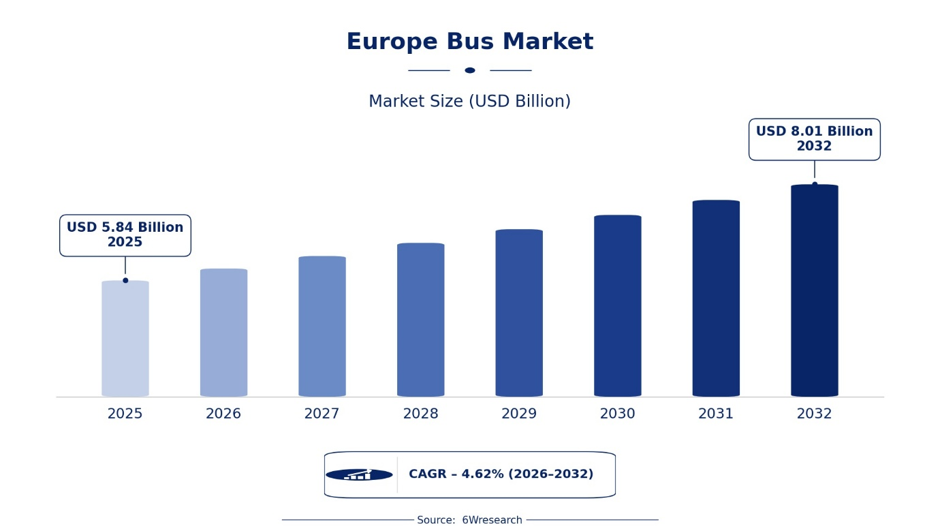
According to 6Wresearch internal database and industry insights, the Europe Bus Market was valued at USD 5.84 billion in 2025 and is projected to reach USD 8.01 billion by 2032, growing at a CAGR of 4.62% during 2026–2032.
Europe Bus Market Highlights
| Report Metric | Details |
| Report Name | Europe Bus Market (2026-2032) |
| Market Size 2025 | USD 5.84 billion |
| Market Size 2032 | USD 8.01 billion |
| Absolute Growth 2025–2032 | USD 2.17 billion |
| CAGR 2026–2032 | 4.62% |
| Peak Annual Growth | 5.9% in 2029 |
| Forecast Period | 2026–2032 |
| Historical Data | 2022–2025 |
| Base Year | 2025 |
| Leading Type, 2025 | Single Deck (84% share) |
| Leading Applications, 2025 | Transit Bus (52% share) |
| Leading Fuel Type, 2025 | Diesel (62% share) |
| Fastest-Growing Fuel Type | Electric & Hybrid (8.6% CAGR) |
| Leading Seat Capacity, 2025 | More than 50 Seats (48% share) |
| Fastest-Growing Seat Capacity | 15-30 Seats (5.2% CAGR) |
| Leading Countries, 2025 | Germany (24% share) |
| Fastest-Growing Countries | Spain (5.8% CAGR) |
| Growing Sector | Zero-emission urban public transport |
| Key End Users | Municipal and regional transport authorities, private transit operators, intercity coach operators, tour and charter companies, and school and airport transport providers |
Europe Bus Market Year-wise Growth Rate and Key Drivers (2022–2032)
This graph illustrates the annual growth rates of the market from 2022 to 2032, highlighting a steady upward trajectory and projected market expansion over the forecast period.
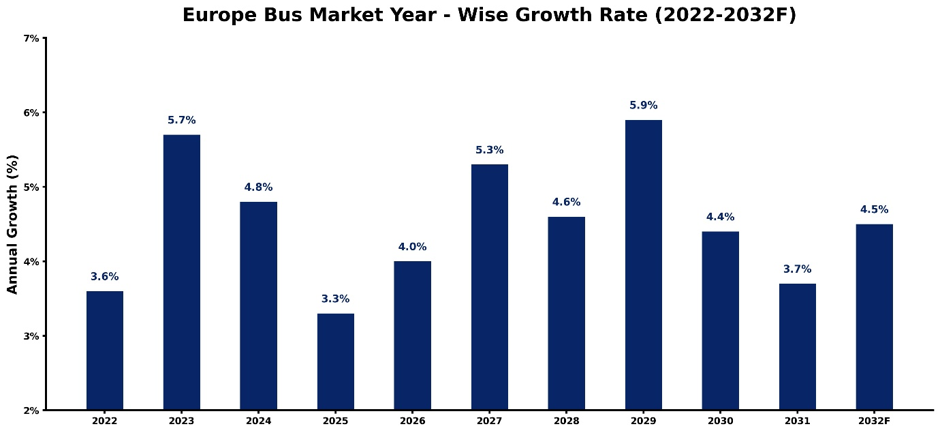
The following table presents the estimated annual growth rate for each year together with the principal factor influencing market performance. The values are intended to highlight year-specific drivers rather than to provide a direct comparison between individual years.
| Year | Estimated Annual Growth (%) | Market Rationale |
| 2022 | 3.6% | Delayed post-pandemic orders and rising chassis costs slowed fleet replacement despite recovering ridership across major European cities. |
| 2023 | 5.7% | Backlog deliveries and strong zero-emission bus orders from city operators lifted registrations and manufacturer revenues. |
| 2024 | 4.8% | European Central Bank deposit rates of 4 percent through mid-2024 raised financing costs and moderated order intake after the catch-up. |
| 2025 | 3.3% | Delayed municipal tenders and softer long-distance coach demand held growth below earlier expectations. |
| 2026 | 4% | Gradual release of postponed municipal tenders is expected to restore moderate order flow across leading markets. |
| 2027 | 5.3% | Falling battery pack prices are expected to narrow the cost gap and lift zero-emission orders. |
| 2028 | 4.6% | Completion of the first replacement wave is expected to moderate order growth in leading urban markets. |
| 2029 | 5.9% | Preparation for 2030 urban bus emission limits is expected to trigger a surge in compliant vehicle orders. |
| 2030 | 4.4% | Post-deadline normalisation of orders is expected to lower growth once mandated purchases are completed. |
| 2031 | 3.7% | Fiscal consolidation in several national budgets is expected to limit subsidies for new vehicle purchases. |
| 2032 | 4.5% | Wider rollout of driver-assistance features and integrated mobility services is expected to renew demand. |
Note: Market size estimations and growth projections presented in this report are based on 6Wresearch's proprietary forecasting methodology, utilizing the latest available industry data, government publications, and primary research inputs.
Europe Bus Market Synopsis
The Europe Bus Market encompasses single deck and double deck buses and coaches serving urban transit, regional routes, intercity travel, tourism, school transport and airport transfers across Germany, Spain, France, Italy, the United Kingdom and the wider region. Demand is sustained by dense urban populations, ageing municipal fleets, expanding low emission zones and established public transport funding. Meanwhile, manufacturers across Germany, Poland, Spain and the United Kingdom are expanding zero emission portfolios, as operators increasingly adopt leasing models and digital fleet management solutions.
Market Dynamics Impact Analysis (2026–2032)
| Factor | Type | Impact | Primary Segment Affected |
| Zero-emission public procurement obligations | Driver | High | Electric & Hybrid |
| Replacement of ageing municipal fleets | Driver | High | Transit Bus |
| Depot charging and energy management services | Opportunity | High | Electric & Hybrid |
| Small electric shuttles for on-demand services | Opportunity | Medium | 15-30 Seats |
| High upfront cost of zero-emission buses | Restraint | High | Electric & Hybrid |
| Cyclical long-distance coach demand | Restraint | Medium | Coaches |
| Driver and technician shortages | Challenge | High | Transit Bus |
| Price competition from Chinese manufacturers | Challenge | Medium | Single Deck |
Evaluation of Drivers in the Europe Bus Market (2026–2032)
Below mentioned are some major drivers and their influence on the market dynamics:
| Drivers | Primary Segment Affected | Why It Matters (Evidence) |
| Zero-emission public procurement obligations | Electric & Hybrid | Binding targets force transport authorities to buy clean vehicles, and the Clean Vehicles Directive sets a 65 percent clean bus share for 2026–2030. |
| Expansion of low-emission zones | Diesel | City access restrictions raise the cost of operating older vehicles and bring forward retirement, with more than 300 low-emission zones active across Europe. |
| Ageing municipal fleets | Transit Bus | Vehicles reaching the end of a service life of roughly 12 to 15 years must be replaced, creating a steady base of tender demand. |
| Growth of intercity coach networks | Coaches | Low-fare networks add routes and frequency, and FlixBus, founded in Munich in 2013, now serves more than 40 countries. |
| Capacity needs in congested city centres | Double Deck | High passenger capacity per road footprint lowers cost per seat, and London operates one of the world's largest double-deck fleets. |
The Europe Bus Market benefits from urbanisation, with approximately 75% of Europeans living in cities, increasing passenger volumes and strengthening demand for high-capacity mobility. At the same time, congestion costs and parking restrictions encourage commuters to use scheduled services. Expanding leasing and fleet financing options from manufacturers and banks are easing upfront capital requirements, while telematics, predictive maintenance and contactless ticketing improve vehicle availability and revenue generation. Moreover, private investment in modern depots and manufacturing facilities across Poland, Spain and Germany is reinforcing the regional supply base.
Evaluation of Restraints in the Europe Bus Market
Below mentioned are some major restraints and their influence on the market dynamics:
| Market Restraint | Primary Segment Affected | Why It Matters (Evidence) |
| High upfront cost of zero-emission buses | Electric & Hybrid | Higher purchase prices strain municipal budgets and delay orders, as a battery-electric city bus typically costs about twice as much as a diesel equivalent. |
| Grid connection and charging infrastructure delays | Electric & Hybrid | Depots need high-capacity power connections before vehicles can enter service, and utility upgrades can take several years in dense cities. |
| Cyclical long-distance coach demand | Coaches | Discretionary travel falls quickly during downturns and competes with rail, and Germany's Deutschlandticket launched in May 2023 at EUR 49 a month. |
| Supply chain constraints in components | Single Deck | Shortages of batteries, chassis parts and semiconductors extend delivery times, with order lead times stretching beyond 12 months in 2022–23. |
| Uncertain refuelling networks for alternative fuels | Others | Operators hesitate to commit to hydrogen and gas fleets without dependable fuel supply, and Europe has only about 250 hydrogen refuelling stations. |
Europe Bus Market Challenges
The Europe Bus Market faces persistent operational and technological constraints, particularly driver shortages in Germany and the United Kingdom, which force service reductions or delay fleet expansion. Additionally, battery replacement after roughly eight years introduces costs beyond conventional diesel ownership and complicates residual value planning for lenders.
In China, BYD and Yutong are winning competitive pricing tenders in 2024, putting pressure on European manufacturers owing to higher labour cost. In addition, charging standard interoperability and depot energy integration requires tailored engineering work that delays commissioning; while achieving 2035 zero emission standards require platform changes due to uncertain future diesel demand.
Trends in the Europe Bus Market
Key trends shaping the Europe bus market are outlined below:
- Shift from Diesel to Battery-Electric City Fleets: Cities are retiring diesel vehicles faster as total cost of ownership narrows. Hamburger Hochbahn has bought only emission-free buses since 2021, setting a pattern followed by other German and Dutch operators.
- Transition from Direct Purchase to Leasing and Battery-as-a-Service: Operators are moving away from owning vehicles outright because battery risk and capital costs are high. Manufacturer finance arms and banks in the United Kingdom and the Netherlands now offer lease structures that separate battery ownership from the vehicle.
- Hydrogen Emerging as an Option for Long and Rural Routes: Operators serving long distances or hilly terrain are testing fuel-cell vehicles where battery range falls short. Wrightbus has supplied hydrogen double-deckers for London services, while Solaris has built fuel-cell models for several Central European cities.
Investment Opportunities in the Europe Bus Market
Emerging investment opportunities in the Europe bus market are outlined below:
- Depot Charging and Energy Management: Operators converting fleets need grid connections, chargers and storage faster than utilities can deliver them. Investors can supply charging hardware, battery storage and software that manages tariffs and charging schedules.
- Battery Refurbishment and Second-Life Storage: Early electric buses are approaching battery replacement, creating a pool of used packs. Investors can build testing, remanufacturing and stationary storage facilities close to bus builders in Poland and Germany.
- Small Electric Shuttles and Minibuses: Local authorities are replacing low-demand routes with on-demand services that need compact, low-floor vehicles. Investors can fund assembly and conversion lines for vehicles with 15 to 30 seats.
Leading Players in the Europe Bus Market
A detailed compilation of leading companies operating in the Europe bus market is presented below:
1. Mercedes-Benz Buses
|
Company Name |
Mercedes-Benz Buses |
|
Established Year |
1995 |
|
Headquarters |
Mannheim, Germany |
|
Official Website |
Mercedes-Benz Buses leads the European sector with a strong lineup of diesel, hybrid and electric buses and coaches, such as the Mercedes-Benz Citaro, under the Mercedes-Benz and Setra brands.
2. Volvo Buses
|
Company Name |
Volvo Buses |
|
Established Year |
1927 (Volvo Group; bus production began in 1934) |
|
Headquarters |
Gothenburg, Sweden |
|
Official Website |
Volvo Buses is a major European manufacturer focused on sustainable mobility, safety, and fully electric or hybrid city buses, such as the Volvo 7900 Electric.
3. MAN Truck & Bus
|
Company Name |
MAN Truck & Bus |
|
Established Year |
1758 (MAN origins) |
|
Headquarters |
Munich, Germany |
|
Official Website |
MAN Truck & Bus offers a comprehensive range of urban and intercity buses with advanced technology and a strong emphasis on zero-emission solutions.
4. Scania AB
|
Company Name |
Scania AB |
|
Established Year |
1891 |
|
Headquarters |
Södertälje, Sweden |
|
Official Website |
Scania is renowned for high-quality buses and coaches with a low total cost of ownership (TCO), such as the Scania Citywide.
4. Solaris Bus & Coach
|
Company Name |
Solaris Bus & Coach |
|
Established Year |
1996 |
|
Headquarters |
Bolechowo-Osiedle, Poland |
|
Official Website |
Solaris is a prominent leader across Central and Western Europe, specializing in electric and hydrogen fuel-cell buses.
Government Initiatives in the Europe Bus Market
The Europe Bus Market is guided by Directive (EU) 2019/1161, the Clean Vehicles Directive, which requires public procurers to meet clean bus targets of 45% for 2021–2025 and 65% for 2026–2030, with half of each target allocated to zero emission buses. Additionally, Regulation (EU) 2024/1610 establishes CO2 reduction targets for new heavy-duty vehicles, including a 90% reduction for urban buses from 2030 and zero emission urban bus sales by 2035.
The market opportunities are further supplemented by national and city-wide programs for decarbonization of the bus market. In the UK, the ZEBRA program allocated 129 million GBP to local governments for zero emission buses, while in Germany, the funding program for alternative drive buses has been helping bus operators since 2021. Likewise, Île de France Mobilités is replacing more than 10,000 buses with electric and biogas technology.
Future Insights of the Europe Bus Market
The Europe Bus Market is poised for transformation through advanced driver assistance systems that enhance safety and lower fleet operating costs. Meanwhile, Mobility as a Service platform is expected to connect buses with rail, cycling and ride sharing through integrated ticketing, encouraging ridership.
Smart depot energy management will optimise charging expenses and renewable power utilisation, while lightweight materials will reduce energy consumption per passenger. Furthermore, Europe's decarbonisation agenda, targeting a 55% emissions reduction by 2030 and climate neutrality by 2050, is expected to sustain investment in cleaner public transport infrastructure.
Market Segmentation Analysis
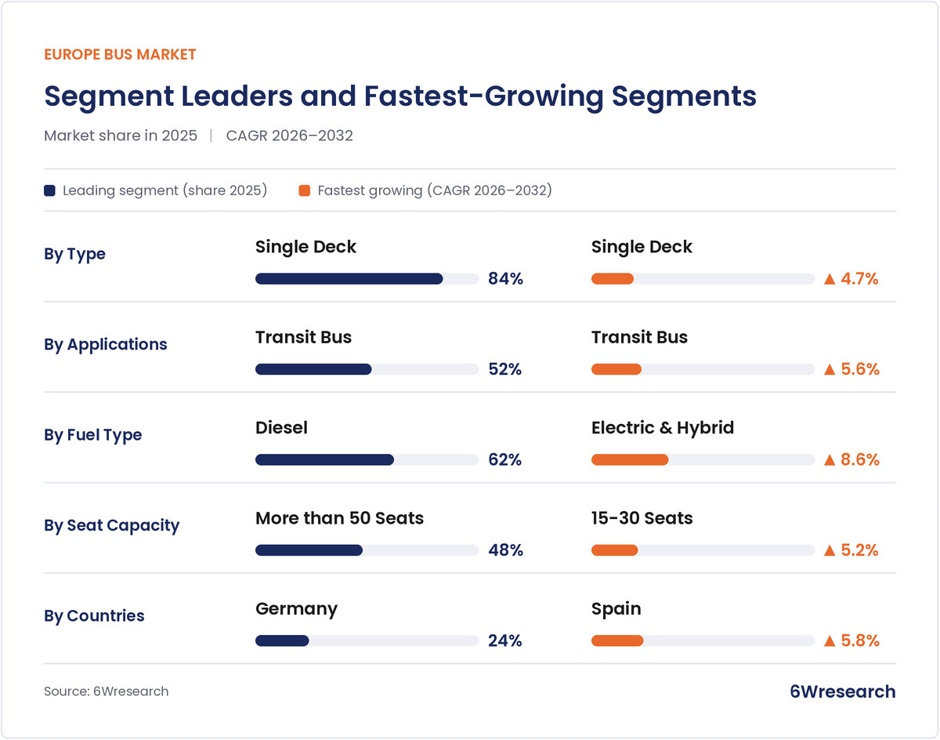
The report offers a comprehensive study of the market across its key segments. The chart below highlights the leading segment by market share in 2025 and the fastest-growing segment by CAGR over 2026–2032, followed by a detailed analysis of each segment.
By Type – Single Deck Leads and Records the Fastest Growth
According to Ravi Bhandari, Research Head at 6Wresearch, single deck buses led the Europe Bus Market with an 84% share in 2025 as they suit the narrow streets and close stop spacing of most European cities and form the backbone of urban and regional fleets from Germany to Poland. Furthermore, they are set to record the fastest CAGR of 4.7% during 2026–2032 as operators replace ageing vehicles with low-floor accessible models.
By Applications – Transit Bus Leads and Records the Fastest Growth
Transit buses held a 52% share in 2025 as municipal and regional authorities in Germany, France and Italy renew large fleets through competitive public tenders and long-term service contracts. Moreover, the segment is projected to grow at the fastest CAGR of 5.6% over 2026–2032, supported by clean vehicle purchasing obligations and expanding low-emission zones in major cities.
By Fuel Type – Diesel Leads, Electric & Hybrid Expected to Grow Fastest
Diesel accounted for 62% of 2025 share as the installed fleet is largely diesel and long-distance, rural and charter operators still rely on its range and refuelling convenience. In contrast, Electric & Hybrid is expected to expand at a CAGR of 8.6% during 2026–2032 as public procurement targets, falling battery costs and city emission rules steer operators towards cleaner vehicles.
By Seat Capacity – More than 50 Seats Leads, 15-30 Seats Expected to Grow Fastest
Buses with more than 50 seats captured a 48% share in 2025, since intercity coaches and articulated city vehicles are preferred on high-demand corridors where capacity per driver matters most. Meanwhile, vehicles with 15-30 seats are projected to record the fastest CAGR of 5.2% over 2026–2032, driven by on-demand services, rural connectors and airport and hotel shuttles that suit smaller formats.
By Countries – Germany Leads, Spain Expected to Grow Fastest
Germany held a 24% share in 2025, supported by the region's largest public transport network, a strong domestic bus manufacturing base and dependable municipal funding. Meanwhile, Spain is expected to record the fastest CAGR of 5.8% during 2026–2032, helped by large urban operators such as Madrid's EMT expanding clean fleets and by a domestic coachbuilding industry serving tourism.
Key Attractiveness of the Report
- 10 Years of Market Numbers
- Historical Data Starting from 2022 to 2025
- Base Year 2025
- Forecast Data until 2032
- Key Performance Indicators Impacting the Market
- Major Upcoming Developments and Projects
Key Highlights of the Report:
- Europe Bus Market Outlook
- Market Size of Europe Bus Market, 2025
- Forecast of Europe Bus Market, 2032
- Historical Data and Forecast of Europe Bus Market Revenues & Volume for the Period 2022–2032
- Europe Bus Market Trend Evolution
- Europe Bus Market Drivers and Challenges
- Europe Bus Price Trends
- Europe Bus Porter's Five Forces
- Europe Bus Industry Life Cycle
- Historical Data and Forecast of Europe Bus Market Revenues & Volume By Type for the Period 2022–2032
- Historical Data and Forecast of Europe Bus Market Revenues & Volume By Single Deck for the Period 2022–2032
- Historical Data and Forecast of Europe Bus Market Revenues & Volume By Double Deck for the Period 2022–2032
- Historical Data and Forecast of Europe Bus Market Revenues & Volume By Application for the Period 2022–2032
- Historical Data and Forecast of Europe Bus Market Revenues & Volume By Transit Bus for the Period 2022–2032
- Historical Data and Forecast of Europe Bus Market Revenues & Volume By Coaches for the Period 2022–2032
- Historical Data and Forecast of Europe Bus Market Revenues & Volume By Others for the Period 2022–2032
- Historical Data and Forecast of Europe Bus Market Revenues & Volume By Fuel Type for the Period 2022–2032
- Historical Data and Forecast of Europe Bus Market Revenues & Volume By Diesel for the Period 2022–2032
- Historical Data and Forecast of Europe Bus Market Revenues & Volume By Electric & Hybrid for the Period 2022–2032
- Historical Data and Forecast of Europe Bus Market Revenues & Volume By Other Fuel Types for the Period 2022–2032
- Historical Data and Forecast of Europe Bus Market Revenues & Volume By Seat Capacity for the Period 2022–2032
- Historical Data and Forecast of Europe Bus Market Revenues & Volume By 15–30 Seats for the Period 2022–2032
- Historical Data and Forecast of Europe Bus Market Revenues & Volume By 31–50 Seats for the Period 2022–2032
- Historical Data and Forecast of Europe Bus Market Revenues & Volume By More Than 50 Seats for the Period 2022–2032
- Historical Data and Forecast of Europe Bus Market Revenues & Volume By Countries for the Period 2022–2032
- Historical Data and Forecast of Europe Bus Market Revenues & Volume By Germany for the Period 2022–2032
- Historical Data and Forecast of Europe Bus Market Revenues & Volume By Spain for the Period 2022–2032
- Historical Data and Forecast of Europe Bus Market Revenues & Volume By France for the Period 2022–2032
- Historical Data and Forecast of Europe Bus Market Revenues & Volume By Italy for the Period 2022–2032
- Historical Data and Forecast of Europe Bus Market Revenues & Volume By United Kingdom for the Period 2022–2032
- Historical Data and Forecast of Europe Bus Market Revenues & Volume By Rest of Europe for the Period 2022–2032
- Europe Bus Import Export Trade Statistics
- Market Opportunity Assessment By Type
- Market Opportunity Assessment By Application
- Market Opportunity Assessment By Fuel Type
- Market Opportunity Assessment By Seat Capacity
- Market Opportunity Assessment By Countries
- Europe Bus Top Companies Market Share
- Europe Bus Competitive Benchmarking By Technical and Operational Parameters
- Europe Bus Company Profiles
- Europe Bus Key Strategic Recommendations
Market Covered
The report offers an extensive study of the following market segments.
By Type
- Single Deck
- Double Deck
By Applications
- Transit Bus
- Coaches
- Others
By Fuel Type
- Diesel
- Electric & Hybrid
- Others
By Seat Capacity
- 15-30 Seats
- 31-50 Seats
- More than 50 Seats
By Countries
- Germany
- Spain
- France
- Italy
- United Kingdom
- Rest of Europe






































