Philippines Cloud Managed Services Market Size & Growth Rate (2026-2032)
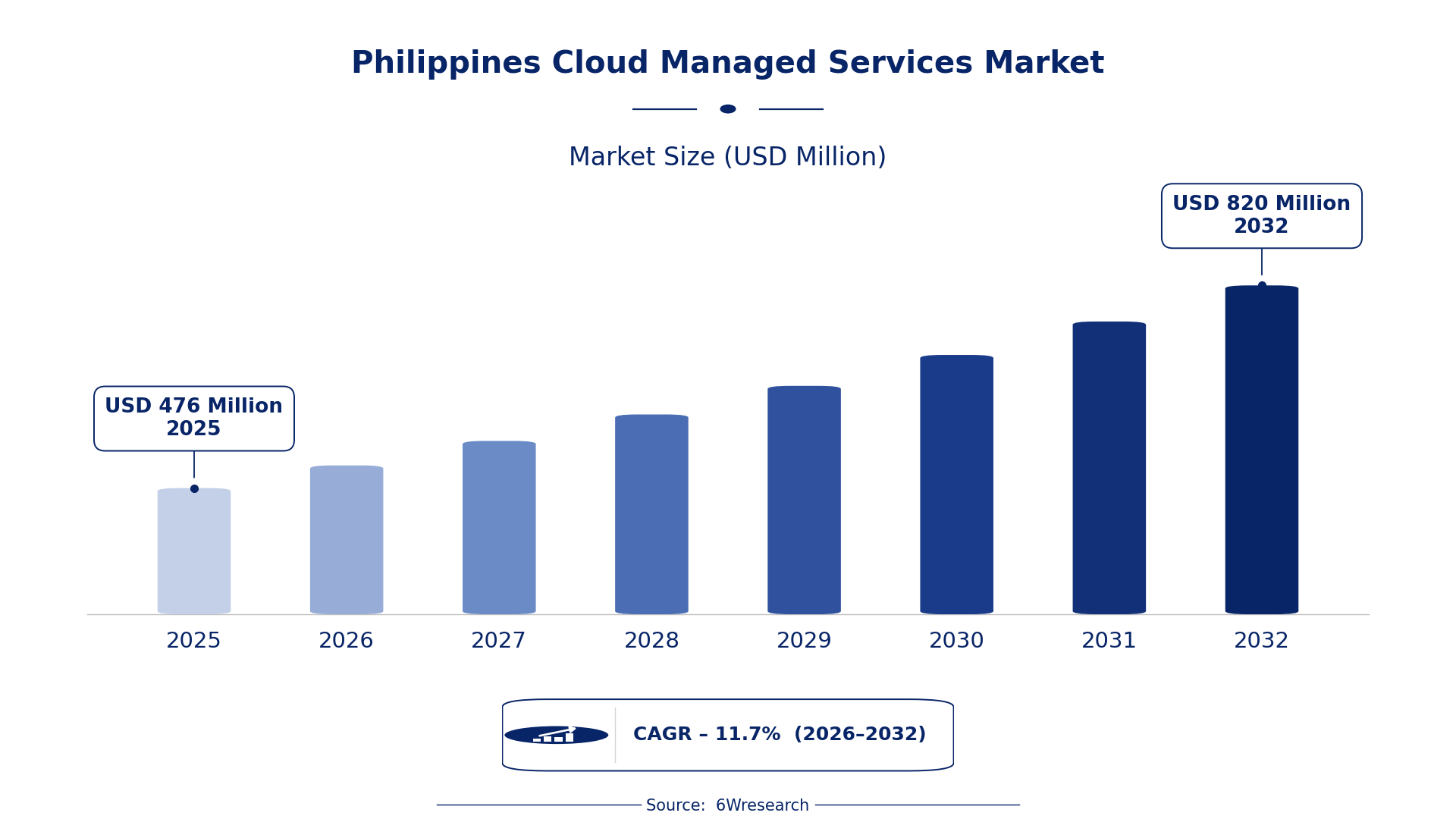
The Philippines Cloud Managed Services Market was estimated at USD 476 Million in 2025 and is projected to reach USD 820 Million by 2032, growing at a CAGR of 11.7% from 2026 to 2032.
Philippines Cloud Managed Services Market Synopsis
The Philippines is experiencing a surge in demand for cloud managed services as organizations aim to streamline their operations and enhance security. Companies are increasingly turning to external expertise to effectively manage their complex cloud environments, which has become essential for optimizing resources and ensuring resilience.
This trend is not merely a response to technological advancement; it reflects a deeper understanding of the strategic advantages cloud solutions can offer. The rapid digital transformation accelerated by the COVID-19 pandemic has further solidified the need for managed services, making it a cornerstone for many businesses in the Philippines.
Philippines Cloud Managed Services Market Year-wise Growth Rate and Key Drivers
This graph illustrates the annual growth rates of the Philippines Cloud Managed Services Market from 2021 to 2032, highlighting a steady upward trajectory and projected expansion over the forecast period.
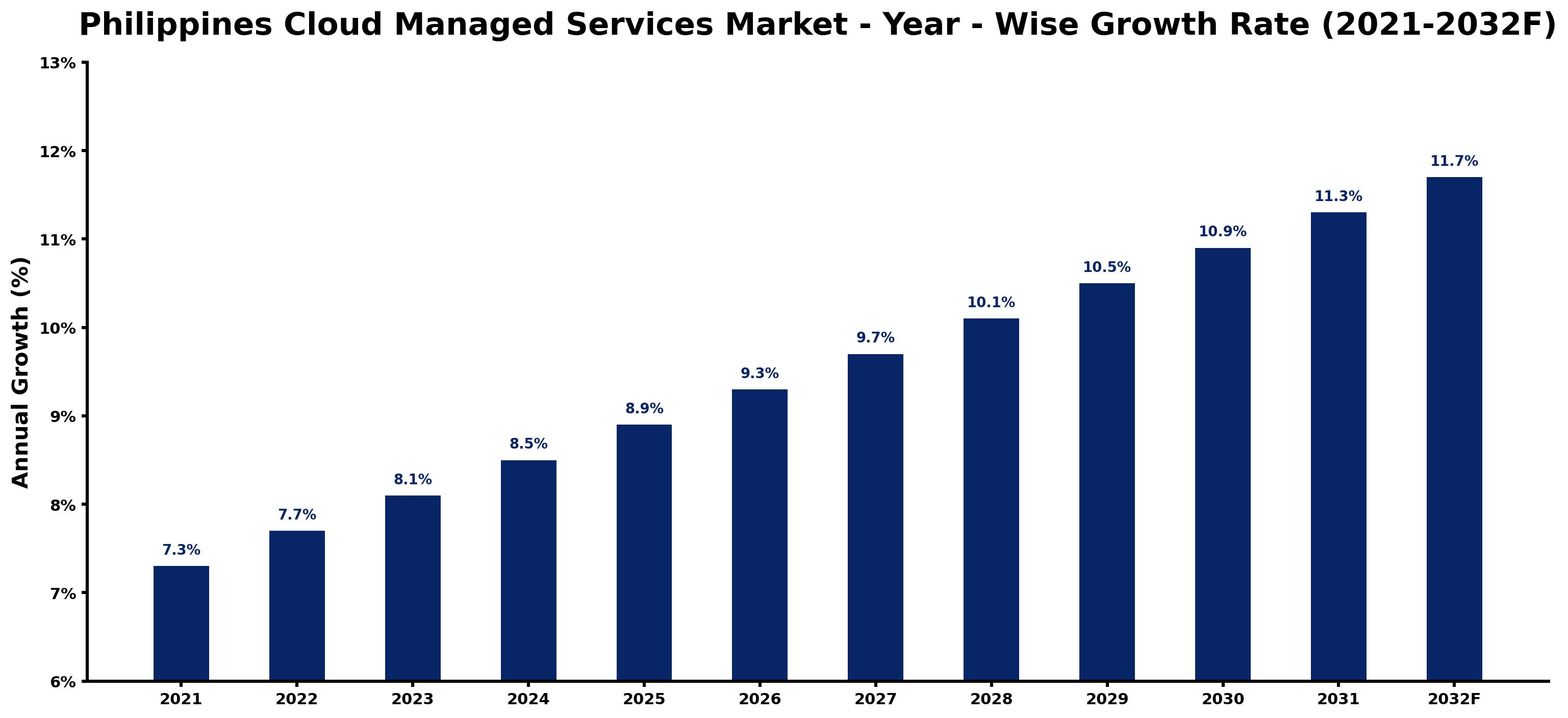
The table below presents the year‑wise growth rates along with the key drivers influencing the market
| Year | Growth Rate | Major Drivers |
| 2021 | 7.3% | Department of Information and Communications Technology initiatives boosting cloud adoption |
| 2022 | 7.7% | Launch of Philippine Digital Workforce Program driving cloud usage |
| 2023 | 8.1% | Local enterprises prioritizing cybersecurity measures spurring cloud services |
| 2024 | 8.5% | Government incentives for SMEs adopting digital technology in cloud |
| 2025 | 8.9% | Increased education sector demand for online learning platforms |
| 2026 | 9.3% | Rising e-commerce growth necessitating reliable cloud solutions |
| 2027 | 9.7% | Strong foreign investments in Philippine tech startups enhancing cloud services |
| 2028 | 10.1% | Emergence of AI applications driving cloud service demands |
| 2029 | 10.5% | Public healthcare sector transitioning to cloud for better access |
| 2030 | 10.9% | Regulatory framework supporting better data protection in cloud |
| 2031 | 11.3% | Popularity of Fintech apps leading to cloud service expansion |
| 2032 | 11.7% | Surge in digital content creation requiring scalable cloud resources |
Note: Market size estimations and growth projections presented in this report are based on 6Wresearch's proprietary forecasting methodology, utilizing the latest available industry data, government publications, and primary research inputs.
Philippines Cloud Managed Services Market Key Takeaways
Below are some of the specific key takeaways from the market, including:
- Growing recognition among organizations of the need for expert management of cloud resources.
- Increased reliance on third-party providers for efficient cloud infrastructure management.
- A notable gap in skilled professionals, presenting a challenge for businesses.
- COVID-19 has acted as a catalyst, accelerating the shift toward cloud solutions.
- Key players are investing heavily in local operations to cater to the market's unique demands.
Evaluation of Restraints in Philippines Cloud Managed Services Market
The Philippines Cloud Managed Services market faces notable constraints, primarily stemming from a shortage of qualified talent in cloud management. This skills gap restricts the ability of businesses to fully utilize cloud technologies, leaving many organizations struggling to effectively manage their cloud environments. The complexity of cloud solutions requires professionals with specialized skills, and the current educational and training frameworks are not sufficiently addressing this need. As a result, organizations may find themselves unable to capitalize on the full potential of cloud services.
Philippines Cloud Managed Services Market Trends
Emerging trends in the Philippines Cloud Managed Services Market include a growing emphasis on automation and artificial intelligence to enhance service delivery. Companies are increasingly adopting these technologies to improve efficiency and reduce operational costs. on top of that, the rise of hybrid cloud solutions is gaining traction as organizations seek flexibility in their cloud strategies. Security concerns also remain at the forefront, prompting businesses to prioritize managed services that offer enhanced security protocols and compliance measures.
Philippines Cloud Managed Services Market Opportunities
Opportunities in the Philippines Cloud Managed Services Market are plentiful, particularly in sectors like healthcare and finance, which are undergoing digital transformations. As regulatory requirements in these industries tighten, organizations are looking for managed services that can ensure compliance and data security. Additionally, the expansion of internet infrastructure in remote areas opens new doors for cloud services, enabling businesses in less urbanized regions to leverage cloud technologies effectively.
Government Initiatives in the Philippines Cloud Managed Services Market
The Philippine government is actively shaping the Cloud Managed Services Market through various initiatives aimed at promoting digital transformation. With a focus on enhancing digital infrastructure and fostering a conducive regulatory environment, these efforts are crucial for attracting investment and driving market growth. The government's commitment to technology adoption is evident in its support for programs that facilitate cloud migration and the development of a skilled workforce.
- A recently completed national digital infrastructure upgrade programme aimed at enhancing connectivity across the archipelago.
- A currently ongoing initiative to develop a regulatory framework for cloud service providers to ensure transparency and security in data handling.
- Planned public-private partnerships expected to expand access to cloud solutions for small and medium enterprises by 2028.
- A program initiated to support training and certification in cloud technologies, addressing the skills gap in the workforce.
- A strategic policy launched in 2025 to incentivize companies adopting cloud solutions, particularly in the public sector.
Future Insights of the Philippines Cloud Managed Services Market
Looking ahead, the Philippines Cloud Managed Services Market is set for dynamic growth driven by continuous digital transformation initiatives. As organizations become increasingly aware of the strategic importance of cloud technologies, demand for managed services will intensify. Innovations in AI and machine learning will likely redefine service offerings, while the government's ongoing infrastructure projects will facilitate broader access to cloud solutions. By 2032, the market is expected to become more competitive, with a diverse range of service providers catering to various industry needs.
Philippines Cloud Managed Services Market Latest Developments
In the past year, the Philippines Cloud Managed Services Market has witnessed a flurry of activity reflecting the increasing importance of cloud technologies. Businesses are rapidly adopting cloud solutions, resulting in heightened competition among service providers. This has led to numerous partnerships and investments aimed at enhancing service capabilities and infrastructure.
- A major technology vendor announced an expansion of its cloud service offerings, which began rollout in Q3 2025, targeting local enterprises.
- An ongoing initiative from a leading regional operator focused on integrating AI-driven analytics into their cloud management services, enhancing customer experience.
- A planned service upgrade expected to launch in early 2026 will introduce advanced security features tailored for SMEs.
- A partnership between two cloud service providers initiated in late 2025 aims to co-develop a platform for hybrid cloud solutions.
- A new product launch showcasing innovative cloud solutions is anticipated for mid-2026, designed to cater to the healthcare sector.
Philippines Cloud Managed Services Market - Key Attractiveness of the Report
- 10 Years of Market Numbers
- Historical Data Starting from 2022 to 2025
- Base Year: 2025
- Forecast Data until 2032
- Key Performance Indicators Impacting the Market
- Major Upcoming Developments and Projects
Key Highlights of the Report:
- Philippines Cloud Managed Services Market Outlook
- Market Size of Philippines Cloud Managed Services Market, 2025
- Forecast of Philippines Cloud Managed Services Market, 2032
- Historical Data and Forecast of Philippines Cloud Managed Services Revenues & Volume for the Period 2022-2032F
- Philippines Cloud Managed Services Market Trend Evolution
- Philippines Cloud Managed Services Market Drivers and Challenges
- Philippines Cloud Managed Services Price Trends
- Philippines Cloud Managed Services Porter's Five Forces
- Philippines Cloud Managed Services Industry Life Cycle
- Historical Data and Forecast of Philippines Cloud Managed Services Market Revenues & Volume By Service Type for the Period 2022-2032F
- Historical Data and Forecast of Philippines Cloud Managed Services Market Revenues & Volume By Managed Security Services for the Period 2022-2032F
- Historical Data and Forecast of Philippines Cloud Managed Services Market Revenues & Volume By Managed Network Services for the Period 2022-2032F
- Historical Data and Forecast of Philippines Cloud Managed Services Market Revenues & Volume By Managed Infrastructure Services for the Period 2022-2032F
- Historical Data and Forecast of Philippines Cloud Managed Services Market Revenues & Volume By Managed Communication & Collaboration Services for the Period 2022-2032F
- Historical Data and Forecast of Philippines Cloud Managed Services Market Revenues & Volume By Managed Mobility Services for the Period 2022-2032F
- Historical Data and Forecast of Philippines Cloud Managed Services Market Revenues & Volume By Managed Business Services for the Period 2022-2032F
- Historical Data and Forecast of Philippines Cloud Managed Services Market Revenues & Volume By Security Services for the Period 2022-2032F
- Historical Data and Forecast of Philippines Cloud Managed Services Market Revenues & Volume By Managed Identity & Access Management for the Period 2022-2032F
- Historical Data and Forecast of Philippines Cloud Managed Services Market Revenues & Volume By Managed Antivirus/Anti-Malware for the Period 2022-2032F
- Historical Data and Forecast of Philippines Cloud Managed Services Market Revenues & Volume By Managed Firewall for the Period 2022-2032F
- Historical Data and Forecast of Philippines Cloud Managed Services Market Revenues & Volume By Managed Risk & Compliance Management for the Period 2022-2032F
- Historical Data and Forecast of Philippines Cloud Managed Services Market Revenues & Volume By Managed Vulnerability Management for the Period 2022-2032F
- Historical Data and Forecast of Philippines Cloud Managed Services Market Revenues & Volume By Managed Security Information & Event Management for the Period 2022-2032F
- Historical Data and Forecast of Philippines Cloud Managed Services Market Revenues & Volume By Managed Intrusion Detection System/Intrusion Prevention System for the Period 2022-2032F
- Historical Data and Forecast of Philippines Cloud Managed Services Market Revenues & Volume By Managed Data Loss Prevention for the Period 2022-2032F
- Historical Data and Forecast of Philippines Cloud Managed Services Market Revenues & Volume By Network Services for the Period 2022-2032F
- Historical Data and Forecast of Philippines Cloud Managed Services Market Revenues & Volume By Managed Network Provisioning for the Period 2022-2032F
- Historical Data and Forecast of Philippines Cloud Managed Services Market Revenues & Volume By Managed Network Monitoring & Management for the Period 2022-2032F
- Historical Data and Forecast of Philippines Cloud Managed Services Market Revenues & Volume By Infrastructure Services for the Period 2022-2032F
- Historical Data and Forecast of Philippines Cloud Managed Services Market Revenues & Volume By Storage Management for the Period 2022-2032F
- Historical Data and Forecast of Philippines Cloud Managed Services Market Revenues & Volume By Server Management for the Period 2022-2032F
- Historical Data and Forecast of Philippines Cloud Managed Services Market Revenues & Volume By Managed Print Services for the Period 2022-2032F
- Historical Data and Forecast of Philippines Cloud Managed Services Market Revenues & Volume By Managed Communication & Collaboration Services for the Period 2022-2032F
- Historical Data and Forecast of Philippines Cloud Managed Services Market Revenues & Volume By Managed Voice Over Internet Protocol for the Period 2022-2032F
- Historical Data and Forecast of Philippines Cloud Managed Services Market Revenues & Volume By Managed Unified Communication as a Service for the Period 2022-2032F
- Historical Data and Forecast of Philippines Cloud Managed Services Market Revenues & Volume By Managed Mobility Services for the Period 2022-2032F
- Historical Data and Forecast of Philippines Cloud Managed Services Market Revenues & Volume By Device Management Services for the Period 2022-2032F
- Historical Data and Forecast of Philippines Cloud Managed Services Market Revenues & Volume By Application Management Services for the Period 2022-2032F
- Historical Data and Forecast of Philippines Cloud Managed Services Market Revenues & Volume By Managed Business Services for the Period 2022-2032F
- Historical Data and Forecast of Philippines Cloud Managed Services Market Revenues & Volume By Business Process Services for the Period 2022-2032F
- Historical Data and Forecast of Philippines Cloud Managed Services Market Revenues & Volume By Continuity & Disaster Recovery Services for the Period 2022-2032F
- Historical Data and Forecast of Philippines Cloud Managed Services Market Revenues & Volume By Other Managed Business Services for the Period 2022-2032F
- Historical Data and Forecast of Philippines Cloud Managed Services Market Revenues & Volume By Organization Size for the Period 2022-2032F
- Historical Data and Forecast of Philippines Cloud Managed Services Market Revenues & Volume By SMEs for the Period 2022-2032F
- Historical Data and Forecast of Philippines Cloud Managed Services Market Revenues & Volume By Large Enterprises for the Period 2022-2032F
- Philippines Cloud Managed Services Import Export Trade Statistics
- Market Opportunity Assessment By Service Type
- Market Opportunity Assessment By Security Services
- Market Opportunity Assessment By Network Services
- Market Opportunity Assessment By Infrastructure Services
- Market Opportunity Assessment By Managed Communication & Collaboration Services
- Market Opportunity Assessment By Managed Mobility Services
- Market Opportunity Assessment By Managed Business Services
- Market Opportunity Assessment By Organization Size
- Philippines Cloud Managed Services Top Companies Market Share
- Philippines Cloud Managed Services Competitive Benchmarking By Technical and Operational Parameters
- Philippines Cloud Managed Services Company Profiles
- Philippines Cloud Managed Services Key Strategic Recommendations






































