Philippines Concrete Chain Saw Market Size Growth Rate
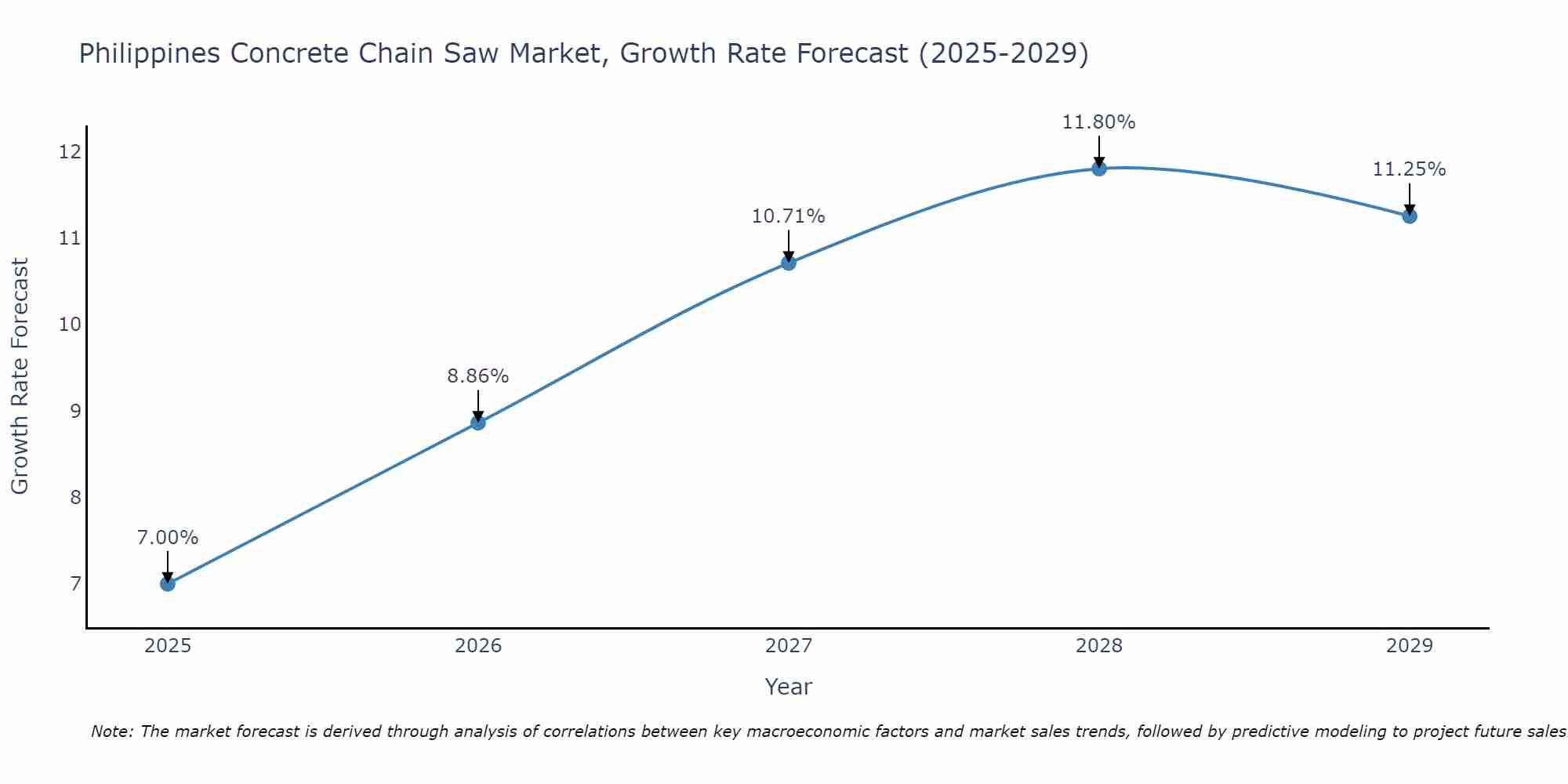
The Philippines Concrete Chain Saw Market is projected to witness mixed growth rate patterns during 2025 to 2029. Growth accelerates to 11.80% in 2028, following an initial rate of 7.00%, before easing to 11.25% at the end of the period.
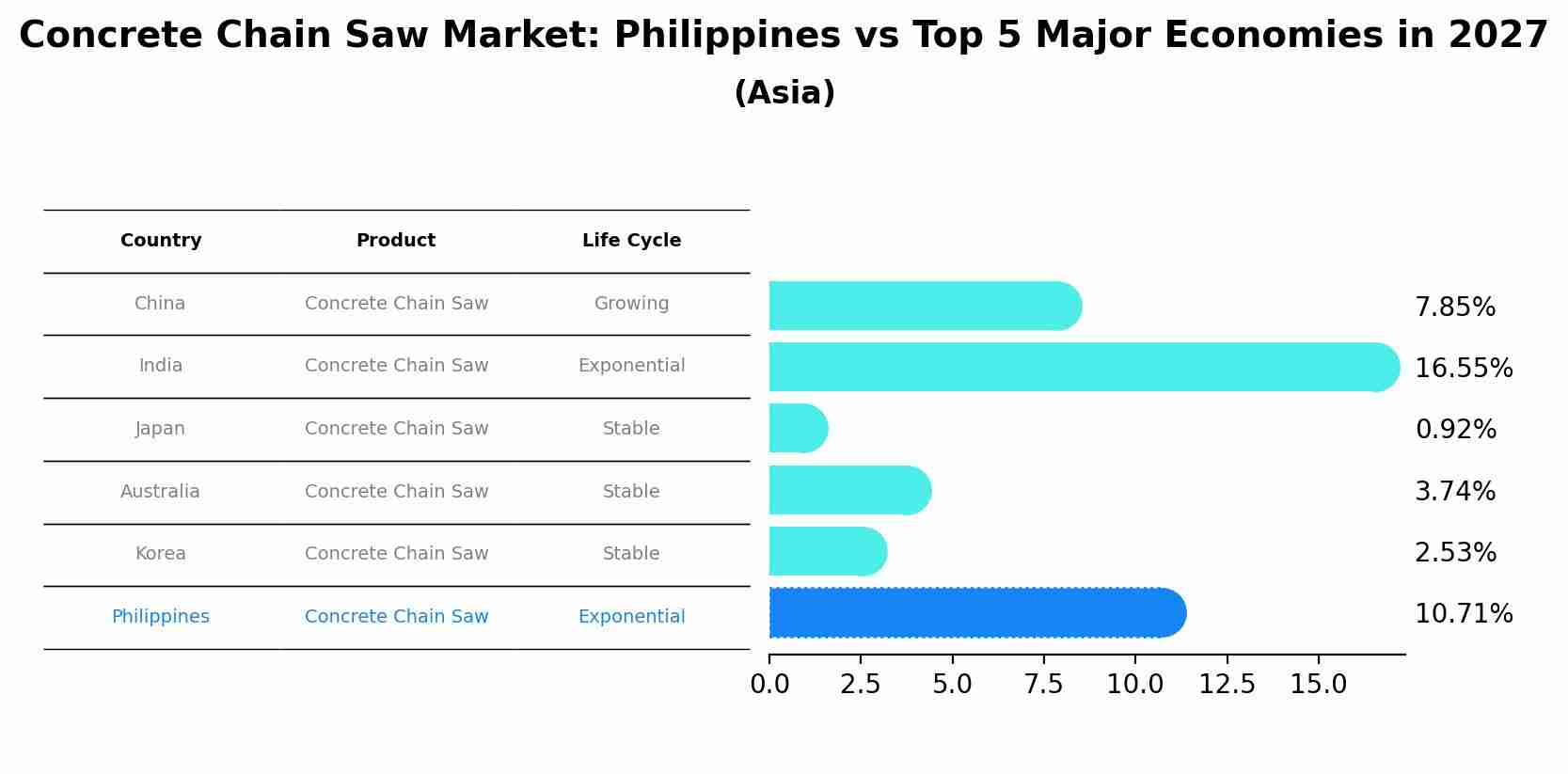
Concrete Chain Saw Market: Philippines vs Top 5 Major Economies in 2027 (Asia)
By 2027, the Concrete Chain Saw market in Philippines is anticipated to reach a growth rate of 10.71%, as part of an increasingly competitive Asia region, where China remains at the forefront, supported by India, Japan, Australia and South Korea, driving innovations and market adoption across sectors.
Philippines Concrete Chain Saw Market Synopsis
The concrete chain saw market in The Philippines has been steadily increasing over recent years due to increased infrastructure projects across residential and commercial sectors that require precise cutting abilities that only chain saws offer safely and efficiently. According To Mordor Intelligence, this trend is expected to continue over the forecast period due to continued investment in urban development projects including transportation expansion initiatives which require specific cuts using diamond chainsaw blades for long lasting durability and precision accuracy resulting in increased revenues estimated at around USD 15 million during 2025-2031 with a compound annual growth rate (CAGR) close to 6%.
Drivers of the Market
The growth of the concrete chain saw market in the Philippines is driven by several key factors. The construction and infrastructure sectors are expanding, leading to higher demand for efficient and precise cutting tools. Concrete chain saws offer the ability to cut through tough materials like concrete, masonry, and stone, making them essential tools for construction and demolition activities. The need for accurate and controlled cutting, especially in confined spaces, has contributed to the increased adoption of concrete chain saws. Additionally, the advancement of cutting technology and safety features has further fueled the market growth.
Challenges of the Market
Concrete chain saws are essential for construction and demolition tasks. Challenges in this market involve maintaining saw performance and longevity in demanding environments. Developing durable chains and efficient cooling systems to handle tough materials like concrete and reinforced concrete presents an ongoing challenge.
COVID-19 Impact on the Market
The Philippines Concrete Chain Saw Market faced challenges as construction projects were delayed or scaled down. However, the market`s recovery was supported by the construction sector`s gradual revival, with a focus on efficiency and precision in cutting applications.
Key Players in the Market
In the construction and concrete cutting industry in the Philippines, the demand for concrete chain saws has increased. Key players like Husqvarna and STIHL have contributed to this market by offering high-performance concrete chain saws. These companies provide machines equipped with features like diamond chain technology and ergonomic designs, ensuring efficient and precise concrete cutting. Their focus on safety, durability, and innovative cutting solutions positions them as leaders in the Philippines` concrete chain saw market.
Key Highlights of the Report:
- Philippines Concrete Chain Saw Market Outlook
- Market Size of Philippines Concrete Chain Saw Market, 2024
- Forecast of Philippines Concrete Chain Saw Market, 2031
- Historical Data and Forecast of Philippines Concrete Chain Saw Revenues & Volume for the Period 2021-2031
- Philippines Concrete Chain Saw Market Trend Evolution
- Philippines Concrete Chain Saw Market Drivers and Challenges
- Philippines Concrete Chain Saw Price Trends
- Philippines Concrete Chain Saw Porter's Five Forces
- Philippines Concrete Chain Saw Industry Life Cycle
- Historical Data and Forecast of Philippines Concrete Chain Saw Market Revenues & Volume By Type for the Period 2021-2031
- Historical Data and Forecast of Philippines Concrete Chain Saw Market Revenues & Volume By Gas Chain Saw for the Period 2021-2031
- Historical Data and Forecast of Philippines Concrete Chain Saw Market Revenues & Volume By Hydraulic Chain Saw for the Period 2021-2031
- Historical Data and Forecast of Philippines Concrete Chain Saw Market Revenues & Volume By Pneumatic Chain Saw for the Period 2021-2031
- Philippines Concrete Chain Saw Import Export Trade Statistics
- Market Opportunity Assessment By Type
- Philippines Concrete Chain Saw Top Companies Market Share
- Philippines Concrete Chain Saw Competitive Benchmarking By Technical and Operational Parameters
- Philippines Concrete Chain Saw Company Profiles
- Philippines Concrete Chain Saw Key Strategic Recommendations






































