Philippines Conveyors System Market Summary
The philippines conveyors system market was estimated at USD 352 Million in 2025 and is projected to reach USD 484 Million by 2032, growing at a CAGR of 5.5% from 2026 to 2032.
Philippines Conveyors System Market Year-wise Growth Rate and Key Drivers
This graph highlights how the Philippines Conveyors System Market has steadily grown over the past five years, supported by major growth factors.
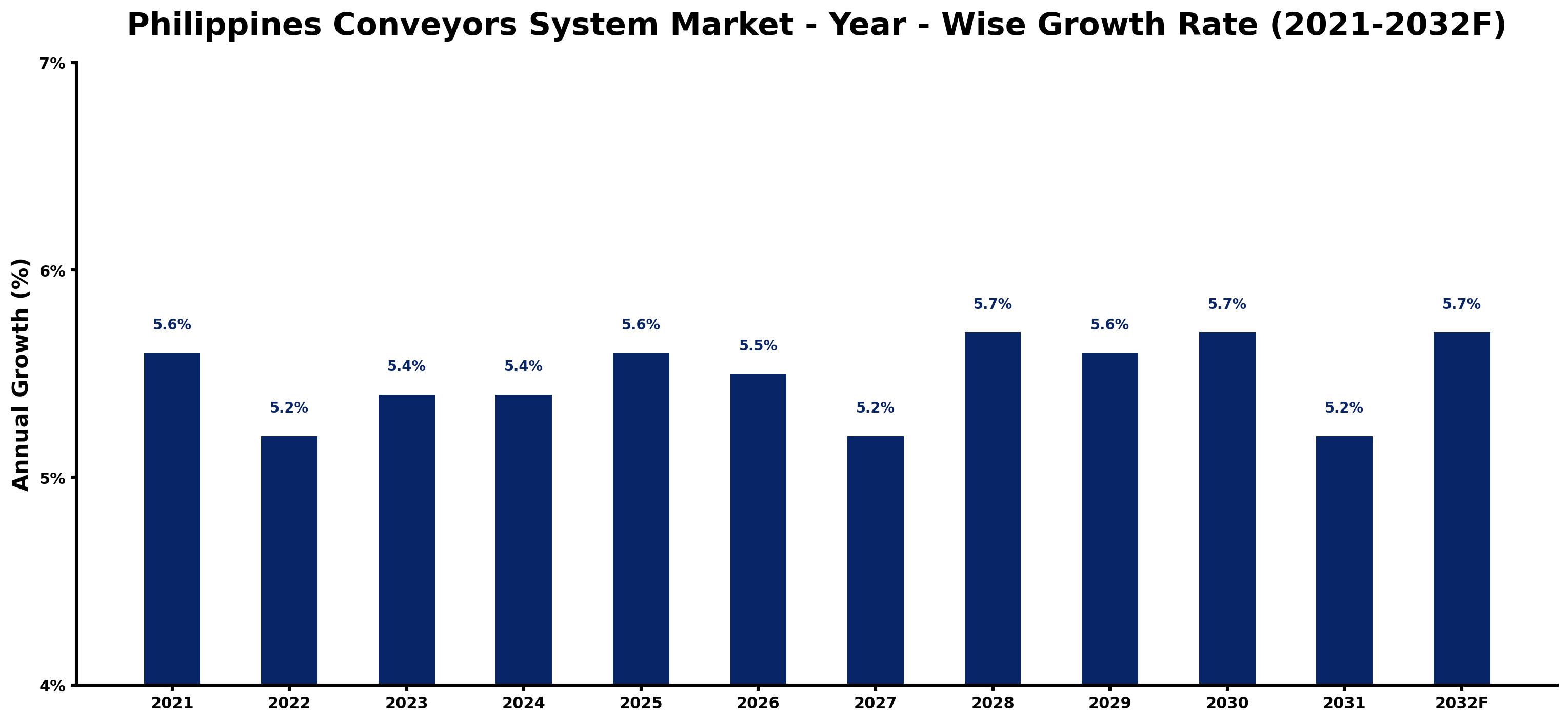
The table below presents the year wise growth rates along with the key drivers influencing the market
| Year | Growth Rate | Major Drivers |
| 2021 | 5.6% | Post-lockdown recovery sparked renewed investments in supply chain efficiency across industries. |
| 2022 | 5.2% | Manufacturing sector expansion highlighted the necessity for advanced material handling systems. |
| 2023 | 5.4% | Rising e-commerce activities increased demand for automated conveyor solutions in logistics. |
| 2024 | 5.4% | Infrastructure development plans boosted the need for reliable conveyor systems in construction. |
| 2025 | 5.6% | Technological integration with IoT enhanced conveyor system capabilities, attracting more users. |
| 2026 | 5.5% | Sustainability objectives prompted firms to adopt energy-efficient conveyor technologies. |
| 2027 | 5.2% | Emerging markets within the region stimulated competition and innovation in conveyor manufacturing. |
| 2028 | 5.7% | Increased urbanization led to higher requirements for automated solutions in urban planning. |
| 2029 | 5.6% | Logistics sector evolution emphasized speed, driving automation and conveyor system investment. |
| 2030 | 5.7% | Growing emphasis on smart factories promoted the integration of conveyors in production lines. |
| 2031 | 5.2% | Corporate focus on operational efficiency advanced the adoption of automated conveyor technologies. |
| 2032 | 5.7% | A robust supply chain strategy highlighted the importance of reliable conveyor systems. |
Note - Market size estimations and growth projections presented in this report are based on 6Wresearch's advanced forecasting approach, validated with industry datasets as of June 2026.
Philippines Conveyors System Market Synopsis
The Philippines Conveyors System Market is projected to reach 5.5% and witness significant growth during the forecast period (2026-2032). The market is anticipated to expand at a compound annual growth rate (CAGR) of 4.9%, driven by various factors including increased investments in infrastructure projects, heightened industrialization, and an escalating demand for automation across multiple sectors. The recent entry of global players into the Philippine market has further enhanced the demand for conveyor systems, contributing positively to market dynamics. Furthermore, technological advancements in materials handling processes are leading to the development of innovative products that allow manufacturers to provide cost-effective solutions to consumers.
Philippines Conveyors System Market Growth Drivers
Several factors are fueling the growth of the Philippines conveyor system market. The foremost among these is the increasing investment by both the government and private sector in various infrastructure development projects. This surge in investment creates a favorable environment for the deployment of conveyor systems as essential components of logistics and material handling.
- The rising levels of industrialization across various sectors are significantly enhancing the demand for efficient material transport solutions, prompting a shift towards more advanced conveyor systems.
- Technological advancements are driving productivity and efficiency in operations, encouraging companies to adopt automated material movement equipment, thus influencing market growth positively.
- Access to raw materials such as rubber and plastic at competitive prices facilitates the production of conveyor systems, contributing to overall market affordability and availability.
- The expansion of the e-commerce sector has resulted in a need for sophisticated packaging lines, further amplifying the requirement for conveyor systems to streamline operations.
- Rapid urbanization is leading to an increased demand for efficient warehousing operations, compelling businesses to invest in conveyor systems that enhance logistical capabilities.
Philippines Conveyors System Market Challenges and Restraints
Despite the favorable growth prospects, the Philippines conveyor system market faces several challenges that could hinder its development. One of the primary issues is the fluctuating prices of raw materials, which can significantly impact the overall operational cost structure for manufacturers.
- A shortage of skilled labor poses a challenge to the implementation of conveyor system projects, as the lack of expertise can lead to delays in project completion and increased costs.
- Limited financial facilities can constrain companies' capacity utilization, resulting in inefficiencies and reduced output in the conveyor system market.
- Market players may face challenges in adapting to rapidly changing technologies, which can necessitate continuous investment in research and development to remain competitive.
- Regulatory hurdles and compliance requirements may also impact operational efficiencies, creating barriers to entry for new market participants.
- The impact of global market trends, including shifts in consumer behavior and economic fluctuations, can introduce unpredictability in demand for conveyor systems.
Philippines Conveyors System Market Government Investment and Initiatives
The Philippine government has implemented various policies and initiatives aimed at fostering growth in the conveyor system market. Investment in infrastructure is a key focus area, with public spending directed towards developing transportation networks, industrial zones, and logistics hubs. The government's initiatives aim to create favorable conditions for both local and foreign investments in core sectors that demand conveyor systems.
In response to the growing need for efficient supply chains, the government is also promoting automation in various industries. Supportive measures, including tax incentives for companies investing in modern material handling technologies, are being introduced to encourage the adoption of conveyor systems. Additionally, government-led infrastructure development projects are expected to provide substantial opportunities for the conveyor system industry, further driving demand in the coming years.
Philippines Conveyors System Market Latest Developments (May 2025 - June 2026)
Recent developments in the Philippines conveyor system market have been notably shaped by advancements in technology and the increasing demand for automation. Companies are focusing on enhancing their product offerings with innovative features that improve efficiency and reduce operational costs.
The influence of the COVID-19 pandemic is still felt, as various sectors, including food processing and pharmaceuticals, continue to adapt to new operational realities. As lockdown restrictions ease, a rebound in the conveyor system market is anticipated, supporting a swift recovery in manufacturing and logistics activities.
The sector is witnessing a growing emphasis on sustainability, with companies increasingly integrating environmentally friendly materials and practices into their conveyor system solutions. Additionally, an uptick in collaborative ventures and partnerships among domestic and international firms is being observed, aimed at leveraging technologies and resources for enhanced competitive advantages.
Philippines Conveyors System Market - Key Attractiveness of the Report
- 10 Years of Market Numbers
- Historical Data Starting from 2022 to 2025
- Base Year: 2025
- Forecast Data until 2032
- Key Performance Indicators Impacting the Market
- Major Upcoming Developments and Projects
Key Highlights of the Report:
- Philippines Conveyors System Market Outlook
- Market Size of Philippines Conveyors System Market, 2025
- Forecast of Philippines Conveyors System Market, 2032
- Historical Data and Forecast of Philippines Conveyors System Revenues & Volume for the Period 2022-2032F
- Philippines Conveyors System Market Trend Evolution
- Philippines Conveyors System Market Drivers and Challenges
- Philippines Conveyors System Price Trends
- Philippines Conveyors System Porter's Five Forces
- Philippines Conveyors System Industry Life Cycle
- Historical Data and Forecast of Philippines Conveyors System Market Revenues & Volume By Type for the Period 2022-2032F
- Historical Data and Forecast of Philippines Conveyors System Market Revenues & Volume By Belt for the Period 2022-2032F
- Historical Data and Forecast of Philippines Conveyors System Market Revenues & Volume By Roller for the Period 2022-2032F
- Historical Data and Forecast of Philippines Conveyors System Market Revenues & Volume By Pallet for the Period 2022-2032F
- Historical Data and Forecast of Philippines Conveyors System Market Revenues & Volume By Overhead for the Period 2022-2032F
- Historical Data and Forecast of Philippines Conveyors System Market Revenues & Volume By Floor for the Period 2022-2032F
- Historical Data and Forecast of Philippines Conveyors System Market Revenues & Volume By Crescent for the Period 2022-2032F
- Historical Data and Forecast of Philippines Conveyors System Market Revenues & Volume By Tri-planar for the Period 2022-2032F
- Historical Data and Forecast of Philippines Belt Conveyors System Market Revenues & Volume By Others for the Period 2022-2032F
- Historical Data and Forecast of Philippines Conveyors System Market Revenues & Volume By End-Use Industry for the Period 2022-2032F
- Historical Data and Forecast of Philippines Conveyors System Market Revenues & Volume By Warehouse & Distribution for the Period 2022-2032F
- Historical Data and Forecast of Philippines Conveyors System Market Revenues & Volume By Food & Beverage for the Period 2022-2032F
- Historical Data and Forecast of Philippines Conveyors System Market Revenues & Volume By Automotive for the Period 2022-2032F
- Historical Data and Forecast of Philippines Conveyors System Market Revenues & Volume By Electronics for the Period 2022-2032F
- Historical Data and Forecast of Philippines Conveyors System Market Revenues & Volume By Mining for the Period 2022-2032F
- Historical Data and Forecast of Philippines Conveyors System Market Revenues & Volume By Airport for the Period 2022-2032F
- Philippines Conveyors System Import Export Trade Statistics
- Market Opportunity Assessment By Type
- Market Opportunity Assessment By End-Use Industry
- Philippines Conveyors System Top Companies Market Share
- Philippines Conveyors System Competitive Benchmarking By Technical and Operational Parameters
- Philippines Conveyors System Company Profiles
- Philippines Conveyors System Key Strategic Recommendations






































