Philippines Corporate Learning Management System (LMS) Market Size & Growth Rate (2026-2032)
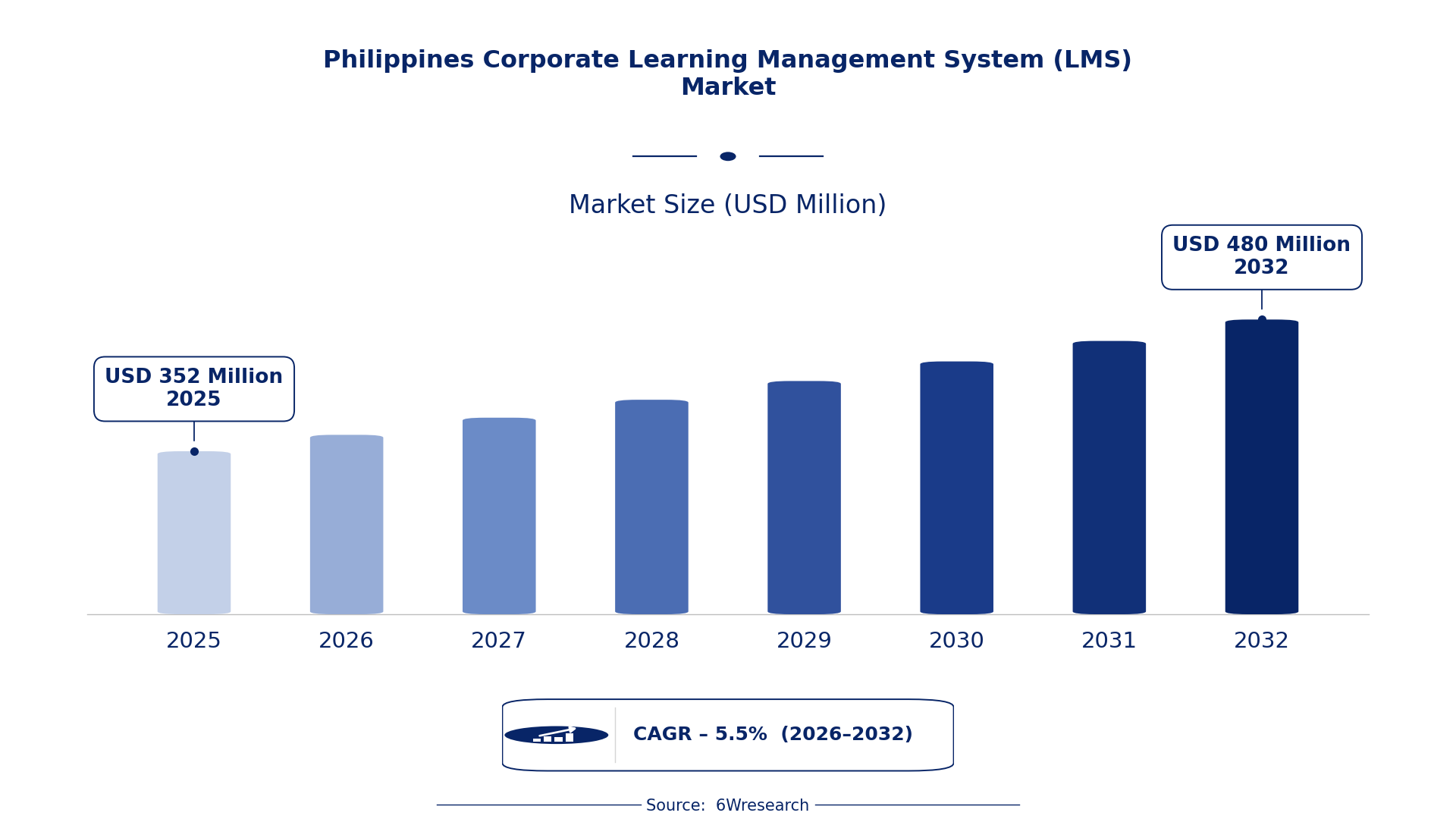
The Philippines Corporate Learning Management System (LMS) Market was estimated at USD 352 Million in 2025 and is projected to reach USD 480 Million by 2032, growing at a CAGR of 5.5% from 2026 to 2032.
Philippines Corporate Learning Management System (LMS) Market Synopsis
The demand for Corporate Learning Management Systems (LMS) in the Philippines is surging as businesses strive to enhance employee capabilities through structured training programs. Organizations increasingly recognize that investing in workforce development is critical to maintaining competitiveness in a rapidly changing economy.
LMS platforms are becoming vital for both large corporations and small-to-medium enterprises (SMEs) in the Philippines. With the rise of digital learning, companies are seeking efficient ways to deliver training content, track progress, and ensure compliance—all while adapting to the remote work environment shaped by the COVID-19 pandemic.
Philippines Corporate Learning Management System (LMS) Market Year-wise Growth Rate and Key Drivers
This graph illustrates the annual growth rates of the Philippines Corporate Learning Management System (LMS) Market from 2021 to 2032, highlighting a steady upward trajectory and projected expansion over the forecast period.
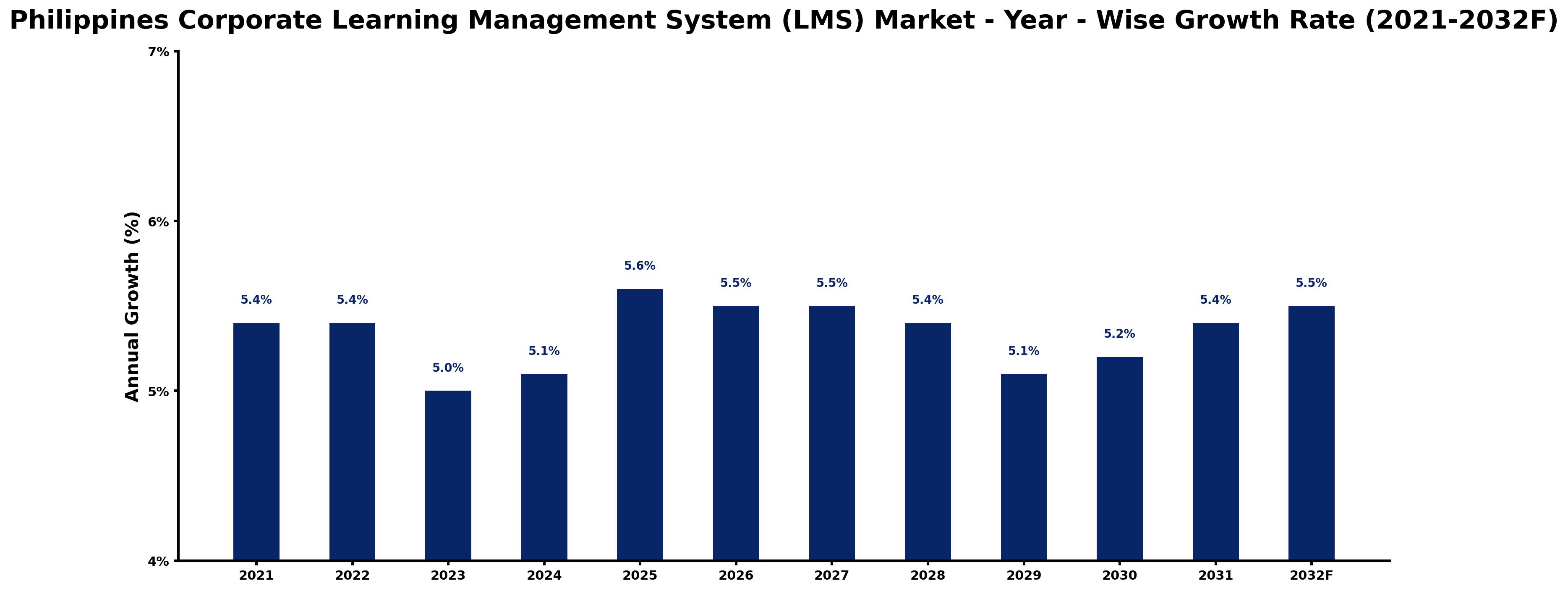
The table below presents the year‑wise growth rates along with the key drivers influencing the market
| Year | Growth Rate | Major Drivers |
| 2021 | 5.4% | Increased remote work spurred demand for digital training. |
| 2022 | 5.4% | Government mandates on employee reskilling programs. |
| 2023 | 5.0% | Growing emphasis on digital transformation in businesses. |
| 2024 | 5.1% | Rise in online course offerings from local universities. |
| 2025 | 5.6% | Corporate investments in talent development programs rise. |
| 2026 | 5.5% | Enhancements in mobile learning technologies boost engagement. |
| 2027 | 5.5% | Focus on compliance training post-pandemic regulations. |
| 2028 | 5.4% | Local startups driving innovation in corporate training solutions. |
| 2029 | 5.1% | Increased workforce diversity enhancing learning platform adoption. |
| 2030 | 5.2% | Partnerships between companies and LMS providers expand. |
| 2031 | 5.4% | Higher education institutions integrating LMS into curricula. |
| 2032 | 5.5% | Corporate wellness programs including training for employee growth. |
Note: Market size estimations and growth projections presented in this report are based on 6Wresearch's proprietary forecasting methodology, utilizing the latest available industry data, government publications, and primary research inputs.
Philippines Corporate Learning Management System (LMS) Market Key Takeaways
Below are some of the specific key takeaways from the market, including:
- Rapid growth in LMS adoption driven by a heightened focus on employee training and development.
- The shift toward remote learning has accelerated the need for effective LMS solutions.
- Businesses are prioritizing platforms that offer analytics to measure training effectiveness.
- Challenges such as digital literacy gaps may hinder widespread LMS implementation.
- Government initiatives are playing a supportive role in fostering a culture of continuous learning.
Evaluation of Restraints in Philippines Corporate Learning Management System (LMS) Market
Despite the optimistic growth trajectory, several challenges are impeding the Philippines Corporate LMS Market. A significant barrier is the lack of digital literacy among employees, which complicates the adoption of technology-driven training solutions. Additionally, many organizations grapple with the need to shift their corporate culture toward a mindset that values continuous learning. This cultural resistance, combined with difficulties in sourcing relevant and engaging training content, creates hurdles for effective LMS deployment.
Philippines Corporate Learning Management System (LMS) Market Trends
The trend toward personalized learning experiences is gaining traction as organizations recognize that one-size-fits-all training is ineffective. Companies are increasingly adopting adaptive learning technologies within their LMS, allowing for customized training paths based on individual employee needs and performance metrics. on top of that, the integration of gamification elements is becoming more common, making learning more engaging and interactive.
Another notable trend is the increasing focus on compliance and regulatory training. Businesses are realizing the importance of ensuring that employees are up to date with industry regulations, which is prompting investment in LMS platforms that can provide automated compliance tracking and reporting capabilities.
Philippines Corporate Learning Management System (LMS) Market Opportunities
As the demand for corporate LMS solutions grows, several key opportunities are emerging. Companies that offer tailored training content, particularly in emerging sectors like technology and healthcare, stand to gain significant market share. Additionally, partnering with educational institutions to develop industry-specific training modules presents a pathway for innovation and expansion.
on top of that, with the government emphasizing digital transformation, there are avenues for LMS providers to engage in public-private partnerships that enhance digital literacy initiatives. These collaborations could lead to expanded market reach and increased user adoption across various sectors.
Government Initiatives in the Philippines Corporate Learning Management System (LMS) Market
The Philippine government is actively involved in promoting workforce development through various initiatives that support the Corporate Learning Management System (LMS) Market. Policies focused on enhancing digital education and vocational training are critical for addressing workforce skills gaps and preparing employees for future challenges. This regulatory environment is increasingly favorable for LMS adoption as it aligns with national economic goals.
- A recently completed initiative focused on enhancing digital literacy in schools, expected to serve as a model for corporate training programs.
- Ongoing support for a national digital skills training program aimed at upskilling the workforce in line with industry demands.
- A planned public-private partnership expected to launch in 2026, aimed at integrating LMS solutions in government training programs.
- Current discussions surrounding new regulations that will mandate corporate training programs to include digital skills components.
Future Insights of the Philippines Corporate Learning Management System (LMS) Market
Looking ahead to 2026-2032, the Philippines Corporate Learning Management System (LMS) Market is set for substantial growth. As businesses continue to evolve, the demand for versatile and user-friendly LMS platforms will increase. Enhanced analytics capabilities will become a crucial differentiator, enabling organizations to make informed training decisions. The integration of artificial intelligence in LMS will further drive personalization, making training more effective and relevant to individual employees.
Philippines Corporate Learning Management System (LMS) Market Latest Developments
In the past year, the Philippines Corporate Learning Management System (LMS) Market has seen a flurry of activity as organizations adapt to new training demands. The emphasis on remote learning has led to a wave of innovations aimed at improving user experience and content delivery. Companies are investing in modernizing their LMS platforms to meet these evolving needs.
- A major technology vendor launched an updated LMS platform in early 2025, featuring advanced analytics and mobile accessibility.
- Ongoing collaborations between educational institutions and private firms are developing industry-specific training programs, enhancing the relevance of learning.
- A leading regional operator is currently upgrading its LMS offerings to include gamified learning experiences, expected to roll out by mid-2026.
- New partnerships announced in Q1 2025 are aimed at integrating AI capabilities into existing LMS platforms to enhance personalization.
Philippines Corporate Learning Management System (LMS) Market - Key Attractiveness of the Report
- 10 Years of Market Numbers
- Historical Data Starting from 2022 to 2025
- Base Year: 2025
- Forecast Data until 2032
- Key Performance Indicators Impacting the Market
- Major Upcoming Developments and Projects
Key Highlights of the Report:
- Philippines Corporate Learning Management System (LMS) Market Outlook
- Market Size of Philippines Corporate Learning Management System (LMS) Market, 2025
- Forecast of Philippines Corporate Learning Management System (LMS) Market, 2032
- Historical Data and Forecast of Philippines Corporate Learning Management System (LMS) Revenues & Volume for the Period 2022-2032F
- Philippines Corporate Learning Management System (LMS) Market Trend Evolution
- Philippines Corporate Learning Management System (LMS) Market Drivers and Challenges
- Philippines Corporate Learning Management System (LMS) Price Trends
- Philippines Corporate Learning Management System (LMS) Porter's Five Forces
- Philippines Corporate Learning Management System (LMS) Industry Life Cycle
- Historical Data and Forecast of Philippines Corporate Learning Management System (LMS) Market Revenues & Volume By Vertical for the Period 2022-2032F
- Historical Data and Forecast of Philippines Corporate Learning Management System (LMS) Market Revenues & Volume By Software for the Period 2022-2032F
- Historical Data and Forecast of Philippines Corporate Learning Management System (LMS) Market Revenues & Volume By Technology for the Period 2022-2032F
- Historical Data and Forecast of Philippines Corporate Learning Management System (LMS) Market Revenues & Volume By Healthcare for the Period 2022-2032F
- Historical Data and Forecast of Philippines Corporate Learning Management System (LMS) Market Revenues & Volume By Retail for the Period 2022-2032F
- Historical Data and Forecast of Philippines Corporate Learning Management System (LMS) Market Revenues & Volume By BFSI for the Period 2022-2032F
- Historical Data and Forecast of Philippines Corporate Learning Management System (LMS) Market Revenues & Volume By Telecommunications for the Period 2022-2032F
- Historical Data and Forecast of Philippines Corporate Learning Management System (LMS) Market Revenues & Volume By Offering for the Period 2022-2032F
- Historical Data and Forecast of Philippines Corporate Learning Management System (LMS) Market Revenues & Volume By Solutions for the Period 2022-2032F
- Historical Data and Forecast of Philippines Corporate Learning Management System (LMS) Market Revenues & Volume By Services for the Period 2022-2032F
- Historical Data and Forecast of Philippines Corporate Learning Management System (LMS) Market Revenues & Volume By Deployment Mode for the Period 2022-2032F
- Historical Data and Forecast of Philippines Corporate Learning Management System (LMS) Market Revenues & Volume By Cloud for the Period 2022-2032F
- Historical Data and Forecast of Philippines Corporate Learning Management System (LMS) Market Revenues & Volume By On-premises for the Period 2022-2032F
- Historical Data and Forecast of Philippines Corporate Learning Management System (LMS) Market Revenues & Volume By Organization Size for the Period 2022-2032F
- Historical Data and Forecast of Philippines Corporate Learning Management System (LMS) Market Revenues & Volume By SMEs for the Period 2022-2032F
- Historical Data and Forecast of Philippines Corporate Learning Management System (LMS) Market Revenues & Volume By Large Enterprises for the Period 2022-2032F
- Philippines Corporate Learning Management System (LMS) Import Export Trade Statistics
- Market Opportunity Assessment By Vertical
- Market Opportunity Assessment By Offering
- Market Opportunity Assessment By Deployment Mode
- Market Opportunity Assessment By Organization Size
- Philippines Corporate Learning Management System (LMS) Top Companies Market Share
- Philippines Corporate Learning Management System (LMS) Competitive Benchmarking By Technical and Operational Parameters
- Philippines Corporate Learning Management System (LMS) Company Profiles
- Philippines Corporate Learning Management System (LMS) Key Strategic Recommendations






































