Philippines Disposable Intravenous Products Market Top 5 Importing Countries and Market Competition (HHI) Analysis
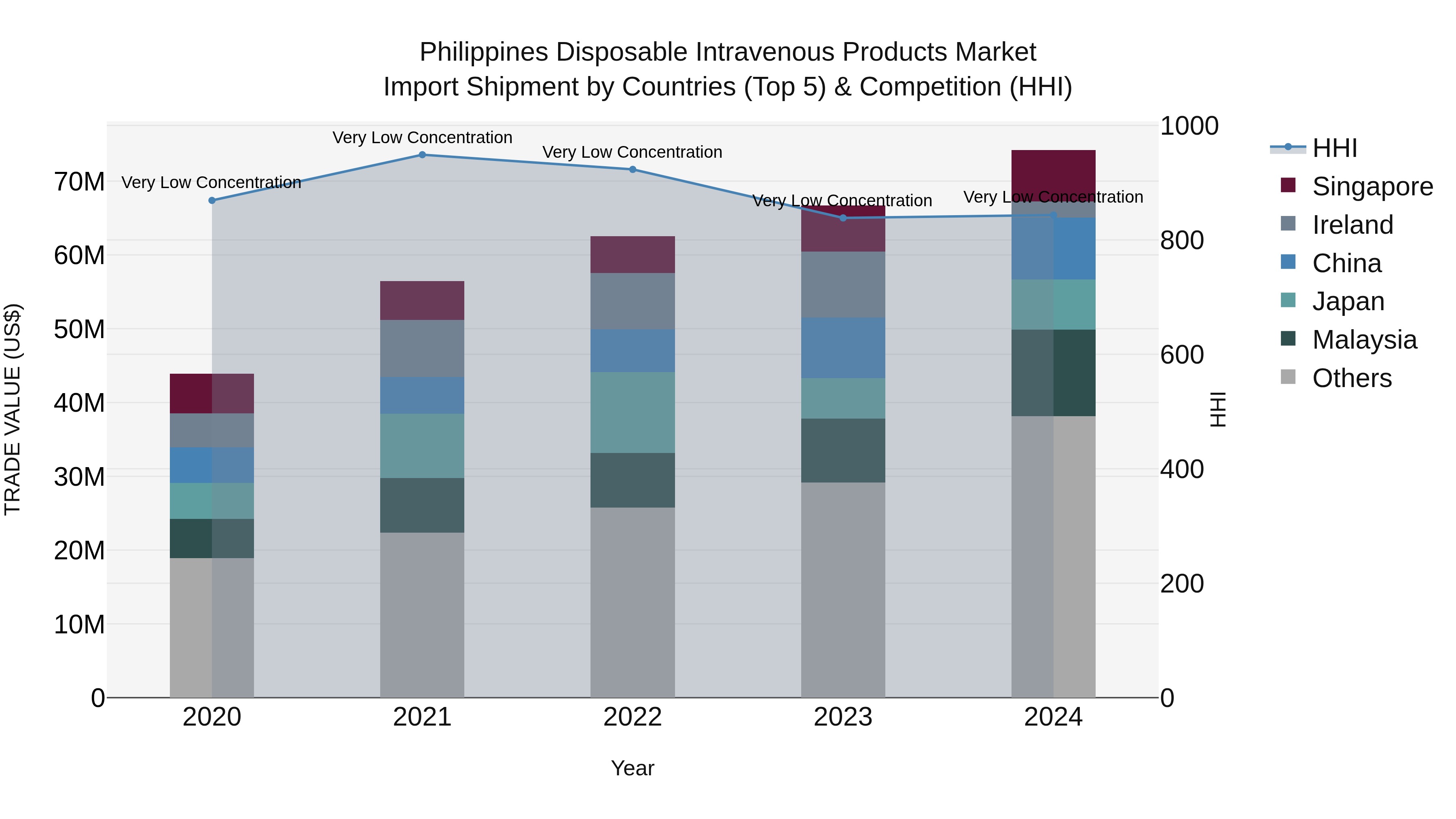
The Philippines saw a significant increase in disposable intravenous products import shipments in 2024, with top exporting countries including Malaysia, China, Singapore, Japan, and Costa Rica. The market remained competitive with a low concentration level indicated by the Herfindahl-Hirschman Index (HHI). The compound annual growth rate (CAGR) from 2020 to 2024 was strong at 14.02%, reflecting a growing demand for these products. Additionally, the growth rate from 2023 to 2024 stood at 11.28%, indicating a continued upward trajectory in the market.
Philippines Disposable Intravenous Products Market Synopsis
The market for disposable intravenous (IV) products in the Philippines is expanding with the rising number of hospital admissions, surgical procedures, and chronic disease management requirements. These products ensure infection control and streamline IV therapy, driving their adoption across healthcare settings. Government efforts to enhance public health services and the growing private healthcare sector support this market, though concerns around plastic waste and disposal practices are increasing.
Trends of the market
The market for disposable intravenous (IV) products is expanding with increasing hospital infrastructure and focus on infection control. The COVID-19 pandemic accelerated demand for sterile disposable medical supplies. Regulatory standards and quality assurance are critical factors influencing market growth.
Challenges of the market
The disposable IV products market is challenged by the need to meet rigorous safety and sterility standards, which raises production costs. Fluctuations in healthcare spending and procurement delays in public hospitals affect consistent demand. Furthermore, competition from reusable systems in cost-sensitive environments reduces disposable product adoption. The market also grapples with waste management concerns and increasing pressure to shift toward eco-friendly alternatives.
Investment opportunities in the Market
The disposable intravenous (IV) products market is expanding in response to increasing hospitalizations, outpatient procedures, and a focus on infection control in healthcare facilities. Investments in high-quality, sterilized IV sets, catheters, and related disposables support patient safety and compliance with medical standards. Local manufacturing or assembly facilities reduce import dependence and improve supply reliability. Partnering with healthcare institutions to provide training and support services strengthens market presence.
Government Policy of the market
The disposable intravenous products market is strictly regulated to ensure sterility, safety, and quality in clinical use. The FDA enforces stringent certification and monitoring processes. Government policies also promote the use of single-use devices to prevent healthcare-associated infections, aligning with broader public health objectives.
Key Highlights of the Report:
- Philippines Disposable Intravenous Products Market Outlook
- Market Size of Philippines Disposable Intravenous Products Market, 2024
- Forecast of Philippines Disposable Intravenous Products Market, 2031
- Historical Data and Forecast of Philippines Disposable Intravenous Products Revenues & Volume for the Period 2021- 2031
- Philippines Disposable Intravenous Products Market Trend Evolution
- Philippines Disposable Intravenous Products Market Drivers and Challenges
- Philippines Disposable Intravenous Products Price Trends
- Philippines Disposable Intravenous Products Porter's Five Forces
- Philippines Disposable Intravenous Products Industry Life Cycle
- Historical Data and Forecast of Philippines Disposable Intravenous Products Market Revenues & Volume By Product for the Period 2021- 2031
- Historical Data and Forecast of Philippines Disposable Intravenous Products Market Revenues & Volume By IV Catheters for the Period 2021- 2031
- Historical Data and Forecast of Philippines Disposable Intravenous Products Market Revenues & Volume By Administration set for the Period 2021- 2031
- Historical Data and Forecast of Philippines Disposable Intravenous Products Market Revenues & Volume By Infusion Set for the Period 2021- 2031
- Historical Data and Forecast of Philippines Disposable Intravenous Products Market Revenues & Volume By Securement Devices for the Period 2021- 2031
- Historical Data and Forecast of Philippines Disposable Intravenous Products Market Revenues & Volume By Stopcocks and Check Valves for the Period 2021- 2031
- Historical Data and Forecast of Philippines Disposable Intravenous Products Market Revenues & Volume By Drip Chambers for the Period 2021- 2031
- Historical Data and Forecast of Philippines Disposable Intravenous Products Market Revenues & Volume By Needleless Connectors for the Period 2021- 2031
- Historical Data and Forecast of Philippines IV Catheters Disposable Intravenous Products Market Revenues & Volume By Others for the Period 2021- 2031
- Historical Data and Forecast of Philippines Disposable Intravenous Products Market Revenues & Volume By End User for the Period 2021- 2031
- Historical Data and Forecast of Philippines Disposable Intravenous Products Market Revenues & Volume By Hospitals and Clinics for the Period 2021- 2031
- Historical Data and Forecast of Philippines Disposable Intravenous Products Market Revenues & Volume By Home Care for the Period 2021- 2031
- Philippines Disposable Intravenous Products Import Export Trade Statistics
- Market Opportunity Assessment By Product
- Market Opportunity Assessment By End User
- Philippines Disposable Intravenous Products Top Companies Market Share
- Philippines Disposable Intravenous Products Competitive Benchmarking By Technical and Operational Parameters
- Philippines Disposable Intravenous Products Company Profiles
- Philippines Disposable Intravenous Products Key Strategic Recommendations






































