Philippines Edible Beans Market Top 5 Importing Countries and Market Competition (HHI) Analysis
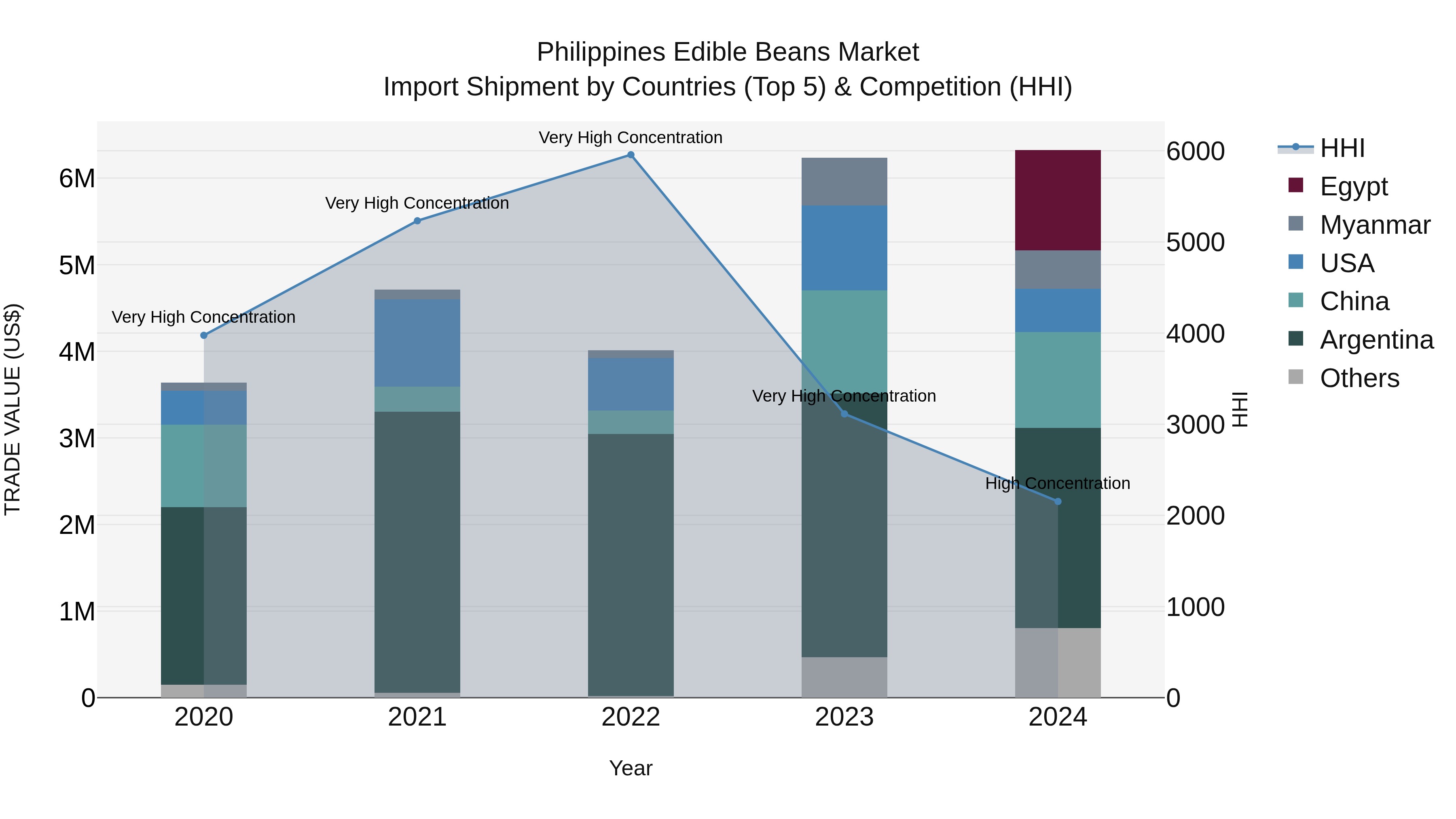
The Philippines` edible beans import market saw a notable increase in concentration in 2024, with Argentina, Egypt, China, USA, and India emerging as key exporting countries. The high Herfindahl-Hirschman Index (HHI) indicates a concentrated market, which continued to grow in 2024. With a strong compound annual growth rate (CAGR) of 14.82% from 2020 to 2024, the market experienced steady growth. Although the growth rate slightly slowed to 1.42% in 2024, the overall trend suggests a resilient market for edible beans imports in the Philippines.
Philippines Edible Beans Market Synopsis
The Philippines edible beans market has grown steadily, with a CAGR of approximately 3.7% during the forecast period. This growth is due to the rising consumer awareness about the nutritional benefits of beans and legumes.
Drivers of the Market
The Philippines Edible Beans market is on the rise due to shifting consumer preferences towards healthier and plant-based diets. Edible beans, rich in protein and nutrients, are gaining popularity as a versatile ingredient in various dishes. Increased awareness about their health benefits, along with a growing vegetarian and vegan population, is driving the demand for edible beans. This trend is expected to continue driving market growth in the coming years.
Challenges of the Market
The Philippines edible beans market has the potential for growth due to increasing consumer interest in plant-based protein sources. Nevertheless, challenges related to supply chain and production methods must be addressed. Limited arable land and environmental factors can impact the cultivation of beans domestically. This often leads to a reliance on imports, which can affect the market`s stability. To overcome this challenge, stakeholders in the market, including farmers and distributors, should explore sustainable farming practices and invest in technologies that enhance yield. Additionally, raising awareness about the nutritional benefits of edible beans among the population can stimulate demand and drive market growth.
COVID-19 Impact on the Market
The edible beans market in the Philippines faced challenges due to disruptions in supply chains, labor shortages, and reduced consumer spending during the pandemic. Despite increased interest in plant-based protein sources, the market was affected by logistical issues, impacting both production and distribution.
Key Players in the Market
The Philippines edible beans market involves the cultivation, processing, and distribution of various types of edible beans. Key players in this market might include local agricultural cooperatives and companies like AgriNurture Inc.
Key Highlights of the Report:
- Philippines Edible Beans Market Outlook
- Market Size of Philippines Edible Beans Market, 2024
- Forecast of Philippines Edible Beans Market, 2031
- Historical Data and Forecast of Philippines Edible Beans Revenues & Volume for the Period 2021-2031
- Philippines Edible Beans Market Trend Evolution
- Philippines Edible Beans Market Drivers and Challenges
- Philippines Edible Beans Price Trends
- Philippines Edible Beans Porter's Five Forces
- Philippines Edible Beans Industry Life Cycle
- Historical Data and Forecast of Philippines Edible Beans Market Revenues & Volume By Product Type for the Period 2021-2031
- Historical Data and Forecast of Philippines Edible Beans Market Revenues & Volume By Pinto Beans for the Period 2021-2031
- Historical Data and Forecast of Philippines Edible Beans Market Revenues & Volume By Navy Beans for the Period 2021-2031
- Historical Data and Forecast of Philippines Edible Beans Market Revenues & Volume By Great Northern Beans for the Period 2021-2031
- Historical Data and Forecast of Philippines Edible Beans Market Revenues & Volume By Red Kidney Beans for the Period 2021-2031
- Historical Data and Forecast of Philippines Edible Beans Market Revenues & Volume By Black Beans for the Period 2021-2031
- Historical Data and Forecast of Philippines Edible Beans Market Revenues & Volume By Yellow Beans for the Period 2021-2031
- Historical Data and Forecast of Philippines Edible Beans Market Revenues & Volume By Others for the Period 2021-2031
- Historical Data and Forecast of Philippines Edible Beans Market Revenues & Volume By Distribution Channel for the Period 2021-2031
- Historical Data and Forecast of Philippines Edible Beans Market Revenues & Volume By Supermarket/Hypermarket for the Period 2021-2031
- Historical Data and Forecast of Philippines Edible Beans Market Revenues & Volume By Online Stores for the Period 2021-2031
- Historical Data and Forecast of Philippines Edible Beans Market Revenues & Volume By Specialty Stores for the Period 2021-2031
- Historical Data and Forecast of Philippines Edible Beans Market Revenues & Volume By Other for the Period 2021-2031
- Historical Data and Forecast of Philippines Edible Beans Market Revenues & Volume By Application for the Period 2021-2031
- Historical Data and Forecast of Philippines Edible Beans Market Revenues & Volume By Household for the Period 2021-2031
- Historical Data and Forecast of Philippines Edible Beans Market Revenues & Volume By Restaurants for the Period 2021-2031
- Historical Data and Forecast of Philippines Edible Beans Market Revenues & Volume By Others for the Period 2021-2031
- Philippines Edible Beans Import Export Trade Statistics
- Market Opportunity Assessment By Product Type
- Market Opportunity Assessment By Distribution Channel
- Market Opportunity Assessment By Application
- Philippines Edible Beans Top Companies Market Share
- Philippines Edible Beans Competitive Benchmarking By Technical and Operational Parameters
- Philippines Edible Beans Company Profiles
- Philippines Edible Beans Key Strategic Recommendations






































