Philippines Fennel Seeds Market Size, Share & Growth Rate
The Philippines Fennel Seeds Market was estimated at USD 429 Million in 2025 and is projected to reach USD 614 Million by 2032, growing at a CAGR of 5.3% from 2026 to 2032. This growth trajectory is largely attributed to the rising consumer awareness surrounding health benefits, which bolsters demand across culinary, pharmaceutical, and cosmetic applications. Furthermore, the ongoing trend towards organic and sustainably sourced products drives investment in quality cultivation practices, further stimulating market expansion.
Philippines Fennel Seeds Market Growth Rate Analysis (2021-2032)
The Philippines fennel seeds market has exhibited a stable growth pattern, with notable yearly growth rates such as 6.4% in both 2021 and 2024, and a modest dip to 5.8% in 2031. This growth stems from increasing consumer demand for natural remedies and spices, alongside a rise in culinary experimentation. Investments in agricultural technology have further enhanced crop yields and quality, fostering a competitive landscape. The fluctuations observed in recent years, particularly the slight decline in 2026 and 2031, can be attributed to fluctuating weather conditions affecting production. Nevertheless, with ongoing digitalization in distribution and supportive agricultural policies, the market is well-positioned for sustained interest and development through 2032 and beyond.
Philippines Fennel Seeds Market Year-wise Growth Rate and Key Drivers
This graph highlights how the Philippines Fennel Seeds Market has steadily grown over the past five years, supported by major growth factors.
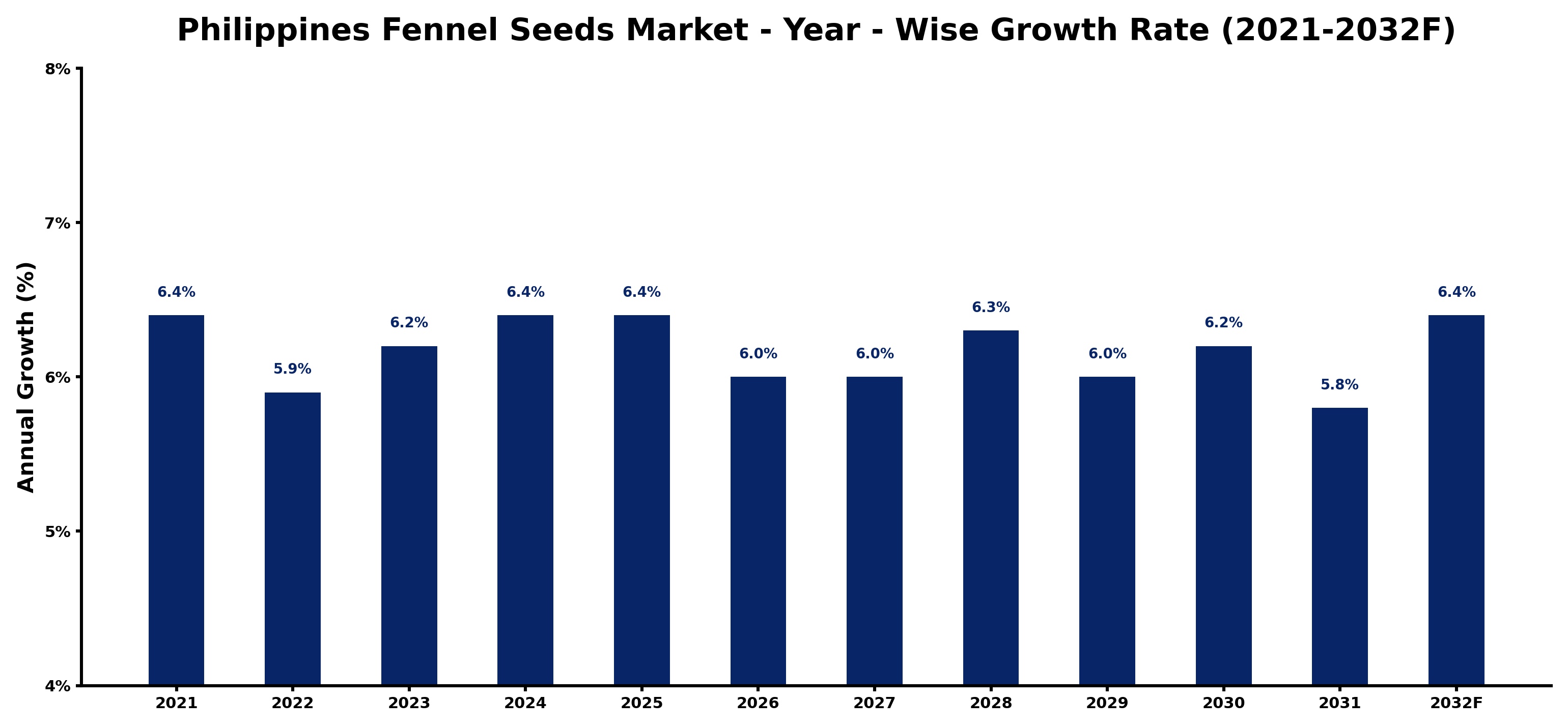
The table below presents the year‑wise growth rates along with the key drivers influencing the market
| Year | Growth Rate | Major Drivers |
| 2021 | 6.4% | Health benefits gained consumer attention |
| 2022 | 5.9% | Culinary trends embraced fennel seeds |
| 2023 | 6.2% | E-commerce platforms expanded reach |
| 2024 | 6.4% | Local farming initiatives increased supply |
| 2025 | 6.4% | Organic product demand surged significantly |
| 2026 | 6.0% | Cultural cuisine popularity enhanced usage |
| 2027 | 6.0% | Food innovation introduced new applications |
| 2028 | 6.3% | Wellness trends promoted natural ingredients |
| 2029 | 6.0% | Export opportunities opened new markets |
| 2030 | 6.2% | Consumer awareness campaigns drove interest |
| 2031 | 5.8% | Sustainable sourcing practices gained traction |
| 2032 | 6.4% | Culinary education highlighted fennel versatility |
Note - Market size estimations and growth projections presented in this report are based on 6Wresearch's advanced forecasting approach, validated with industry datasets as of June 2026.
Philippines Fennel Seeds Market Synopsis
The Philippines fennel seeds market is gaining traction as consumers increasingly recognize the seeds' diverse applications—from culinary enhancements to natural remedies. With an estimated market worth of PHP 19 million in 2020, the sector is showing promising growth, driven primarily by health-conscious consumers seeking natural ingredients.
In 2019, the Philippines imported around 98 metric tons of fennel seeds from countries like India, Pakistan, and Turkey, indicating a strong reliance on international supply chains. As domestic production expands, companies are positioning themselves to meet both local and export demand, aligning with the global trend towards organic and high-quality spices.
Philippines Fennel Seeds Market Key Takeaways
- Rising health consciousness is propelling the demand for fennel seeds across various sectors.
- Notable growth in the culinary and herbal markets showcases the versatility of fennel seeds.
- Supply chain disruptions due to COVID-19 prompted a shift towards retail and online distribution channels.
- Challenges such as climatic fluctuations and pest management strategies remain pivotal in market dynamics.
- Investment in organic farming practices is becoming essential to meet evolving consumer preferences.
Evaluation of Restraints in Philippines Fennel Seeds Market
The Philippines fennel seeds market faces several critical restraints that could potentially hinder its growth. Variability in weather patterns poses a significant risk to fennel cultivation, affecting both crop yield and quality. This climatic instability, compounded by pest outbreaks, necessitates robust pest management practices to ensure consistent production. Additionally, maintaining quality to meet international export standards requires significant investment in processing and quality control, which may strain smaller market players. The competitive nature of the global spice market further amplifies the need for differentiation and cost-effectiveness.
Philippines Fennel Seeds Market Trends
Current trends in the Philippines fennel seeds market indicate a growing inclination towards organic and eco-friendly products. Consumers are becoming more selective, favoring brands that prioritize sustainability and health benefits. The increasing popularity of fennel seeds in culinary practices, particularly in home cooking, is also a significant trend driving demand. Furthermore, the digital transformation is reshaping retail strategies, with companies enhancing their online presence to directly reach consumers.
Philippines Fennel Seeds Market Opportunities
Opportunities in the Philippines fennel seeds market are ripe for exploration, particularly in the realms of product diversification and export potential. With rising health awareness, developing specialized fennel products for health supplements could capture an untapped consumer segment. Additionally, leveraging digital platforms for e-commerce can allow local producers to reach a broader audience, enhancing market visibility. With global demand for organic spices on the rise, positioning local fennel as a premium product can bolster export capabilities.
Government Initiatives in the Philippines Fennel Seeds Market
The Philippine government has recognized the potential of the agricultural sector, including the spice market, and is implementing initiatives to promote sustainable farming practices. Programs aimed at providing financial support and technical assistance for farmers are pivotal in enhancing crop quality and yield. Furthermore, policies that incentivize organic farming contribute to the overall sustainability of the fennel seeds market. The government is also focusing on improving export logistics to facilitate better market access for local farmers.
Future Insights of the Philippines Fennel Seeds Market
Looking ahead to 2026-2032, the Philippines fennel seeds market is poised for notable expansion, driven by an increasing focus on health and wellness. As consumer preferences continue to shift towards natural and organic products, the demand for fennel seeds is expected to rise steadily. Additionally, advancements in agricultural technology and practices will likely improve cultivation efficiency, enabling producers to meet both local and international demand while adhering to quality standards. This landscape promises to create a vibrant environment for growth and investment.
Philippines Fennel Seeds Market Latest Developments (May 2025 - June 2026)
Recent developments in the Philippines fennel seeds market indicate a growing commitment to quality and sustainability among producers. There has been a marked increase in initiatives aimed at enhancing organic farming practices, with several local farmers collaborating with agricultural organizations to improve crop resilience. Additionally, the surge in online purchasing has prompted many businesses to adapt their distribution strategies, ensuring availability directly to consumers. This period has seen a notable shift in how fennel seeds are marketed and perceived within the culinary community.
Philippines Fennel Seeds Market - Key Attractiveness of the Report
- 10 Years of Market Numbers
- Historical Data Starting from 2022 to 2025
- Base Year: 2025
- Forecast Data until 2032
- Key Performance Indicators Impacting the Market
- Major Upcoming Developments and Projects
Key Highlights of the Report:
- Philippines Fennel Seeds Market Outlook
- Market Size of Philippines Fennel Seeds Market, 2025
- Forecast of Philippines Fennel Seeds Market, 2032F
- Historical Data and Forecast of Philippines Fennel Seeds Revenues & Volume for the Period 2022-2032F
- Philippines Fennel Seeds Market Trend Evolution
- Philippines Fennel Seeds Market Drivers and Challenges
- Philippines Fennel Seeds Price Trends
- Philippines Fennel Seeds Porter's Five Forces
- Philippines Fennel Seeds Industry Life Cycle
- Historical Data and Forecast of Philippines Fennel Seeds Market Revenues & Volume By Types for the Period 2022-2032F
- Historical Data and Forecast of Philippines Fennel Seeds Market Revenues & Volume By Organic for the Period 2022-2032F
- Historical Data and Forecast of Philippines Fennel Seeds Market Revenues & Volume By Conventional for the Period 2022-2032F
- Historical Data and Forecast of Philippines Fennel Seeds Market Revenues & Volume By Application for the Period 2022-2032F
- Historical Data and Forecast of Philippines Fennel Seeds Market Revenues & Volume By Essential for the Period 2022-2032F
- Historical Data and Forecast of Philippines Fennel Seeds Market Revenues & Volume By Flavors for the Period 2022-2032F
- Historical Data and Forecast of Philippines Fennel Seeds Market Revenues & Volume By Seasoning Ingredient for the Period 2022-2032F
- Historical Data and Forecast of Philippines Fennel Seeds Market Revenues & Volume By Beverages for the Period 2022-2032F
- Historical Data and Forecast of Philippines Fennel Seeds Market Revenues & Volume By End-user for the Period 2022-2032F
- Historical Data and Forecast of Philippines Fennel Seeds Market Revenues & Volume By Households for the Period 2022-2032F
- Historical Data and Forecast of Philippines Fennel Seeds Market Revenues & Volume By Food Industry for the Period 2022-2032F
- Historical Data and Forecast of Philippines Fennel Seeds Market Revenues & Volume By Personal Care Industry for the Period 2022-2032F
- Philippines Fennel Seeds Import Export Trade Statistics
- Market Opportunity Assessment By Types
- Market Opportunity Assessment By Application
- Market Opportunity Assessment By End-user
- Philippines Fennel Seeds Top Companies Market Share
- Philippines Fennel Seeds Competitive Benchmarking By Technical and Operational Parameters
- Philippines Fennel Seeds Company Profiles
- Philippines Fennel Seeds Key Strategic Recommendations






































